
Top
Search
People also search for:

Stay Inspired with Instagram





Consider the gap between two types of New York companies right now. Company A has a functioning ML model in a Jupyter notebook. Their data science team produced it eight months ago. It has never been deployed to production, it has no monitoring infrastructure, and nobody in the organisation is quite sure who owns it. Company B has a live agentic AI system processing 40,000 decisions per day, adapting to new data in real time, integrated into their core operations, and generating measurable revenue impact that their CFO can explain to the board.
That gap is not primarily a technology gap. It is an execution gap. And in 2026, that gap is the single most important competitive dynamic playing out across New York City’s business landscape.
New York is home to 2,000 AI startups, 35 unicorns, and the deepest enterprise AI buyer market in the United States. Gartner projects that 40% of enterprise applications will include task-specific AI agents by the end of 2026—a leap from less than 5% in 2025. The organisations that are already scaling production ML and agentic AI are accumulating data advantages, operational efficiency gains, and customer experience improvements that compound over time. The ones still running notebooks are falling further behind with every passing quarter.
This blog covers why NYC is the most important ML market in the US outside California, which industries are being transformed first and most deeply, what building production ML actually looks like in New York’s specific regulatory and operational context, and how the team at apidots.com helps New York businesses close the execution gap.
Read the complete resource: Machine Learning Software Development Guide.
There is a version of the AI story that is entirely about San Francisco: OpenAI, Anthropic, Google DeepMind, the foundation models, and the frontier research. That version is accurate, as far as it goes. But it misses where most of the value from AI is actually being created and captured in 2026—and that is in the applied, vertical, enterprise AI that New York City’s unique industry mix makes it the most important market in the world to get right.
Tech:NYC’s 2025 Ecosystem Snapshot records over 2,000 AI startups in New York City, with more than 1,000 of those having raised formal venture capital, collectively attracting more than $27 billion since 2019. The city hosts 35 AI unicorns valued at a combined $17 billion and 44 Fortune 500 company headquarters—more than any other US city. That concentration of enterprise buyers is what makes NYC’s AI market structurally different from San Francisco’s. NYC AI companies build applied, vertical software for industries where New York already leads globally: finance, healthcare, media, legal services, and real estate. They are not building the models. They are building the systems that put those models to work in environments where the cost of getting it wrong is measured in billions of dollars or human health outcomes.
The transition playing out in 2026 is not from traditional software to AI. That transition happened. The shift that matters now is from generative AI—systems that respond to prompts and produce content—to agentic AI: systems that pursue goals, execute multi-step workflows autonomously, and improve through experience without requiring human intervention at each step.
In NYC’s FinTech sector, agentic AI is moving from fraud detection (a reactive, classification-based ML task) to autonomous compliance monitoring that detects, investigates, and flags regulatory issues before they reach the compliance team. In healthcare, agentic systems are not just supporting clinical decisions—they are autonomously managing prior authorisation workflows, patient scheduling queues, and insurance claims processing. In media and publishing, agentic content pipelines are personalising delivery at a user-by-user level that human editorial teams could never operate at scale.
The global agentic AI market is growing at a CAGR of 43.84%, from $5.25 billion in 2024 to a projected $199 billion by 2034. North America holds 33.6% of that market, and the US alone is expected to reach $2.33 billion in 2026. For NYC businesses evaluating where to invest in AI, this is not a speculative technology bet. It is the current state of production systems in the most competitive markets in the world.
40% of enterprise applications will embed task-specific AI agents by end of 2026, up from fewer than 5% in 2025. Source: Gartner.
Also Read: Agentic AI vs AI Agents for Digital Transformation
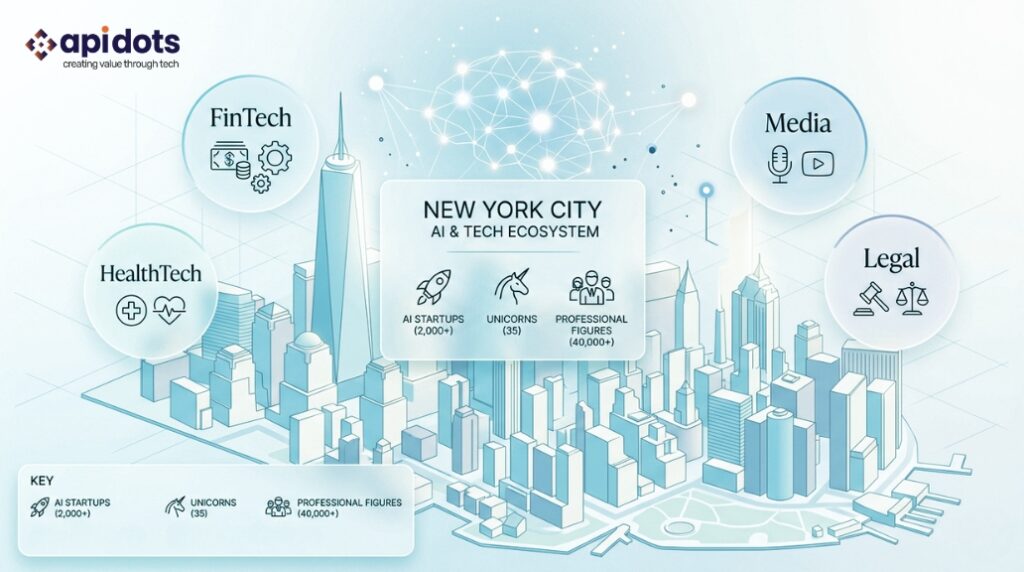
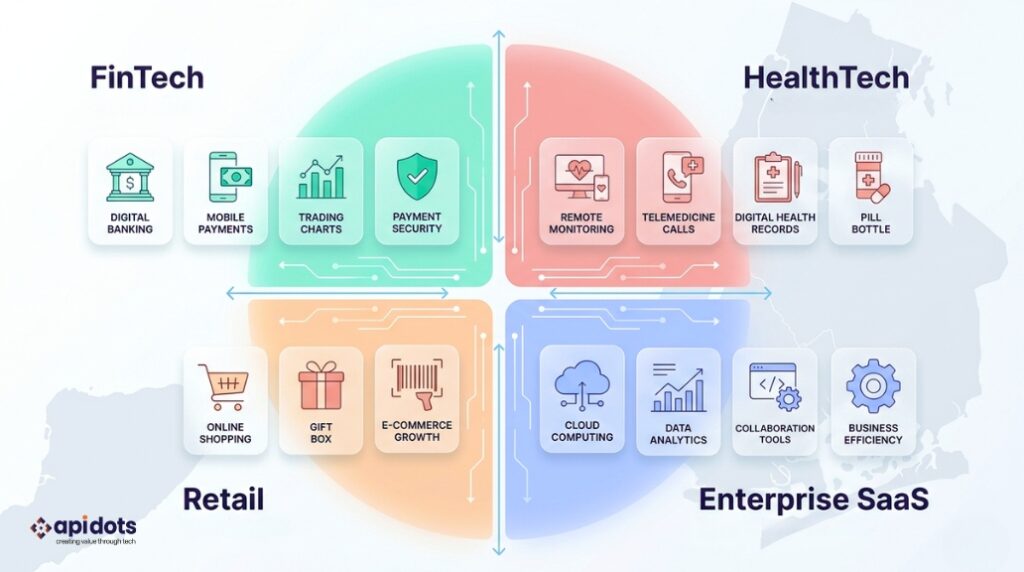
New York’s industrial diversity is both its challenge and its advantage in ML adoption. The challenge: different industries have radically different data structures, regulatory constraints, and deployment requirements. The advantage: a company that has built production ML for a Wall Street bank and a Mount Sinai clinical team has developed problem-solving muscles that generalist ML firms simply do not have.
New York City accounts for 30% of all US FinTech investment as of 2024, with over $46 billion raised by NYC-based FinTech companies since 2014. AI is now embedded throughout the entire FinTech stack. In fraud prevention, ML models trained on transactional patterns have largely displaced the rule-based systems that dominated compliance infrastructure five years ago. In underwriting, gradient boosting and neural network models are processing alternative data sources—transaction histories, behavioral signals, and payroll patterns—that give lenders a far more accurate picture of credit risk than FICO scores alone. In trading, agentic systems are now executing not just individual trades but complex multi-step arbitrage strategies that adapt in real time to market microstructure changes.
The firms leading this shift in NYC are not all large. Kalshi ($300 million Series D) uses ML for AI-enhanced prediction markets. Bayesline applies probabilistic ML to financial data infrastructure. Rogo has built an enterprise AI platform specifically for automating research workflows in finance. These companies share a common characteristic: they are building ML systems designed for NYC’s financial regulatory environment from the ground up—not adapting generic models to meet compliance requirements after the fact. For broader context on how AI is reshaping finance: The Rise of AI in Banking 2026.
NYC’s healthcare sector is one of the most data-rich environments in the world. NYU Langone, Mount Sinai, Memorial Sloan Kettering, and NewYork-Presbyterian collectively generate clinical data at a scale that most health systems globally cannot match. 113 New York-based HealthTech companies raised $4 billion in 2024 — the highest total since 2021 and a 60% increase from 2023. The LifeSci NYC initiative has invested over $500 million in healthcare infrastructure since 2017, creating dedicated lab space and accelerator programmes specifically for this sector.
The ML use cases now in production at NYC health systems span diagnostic imaging (AI-powered radiology reducing radiologist workload for routine scan interpretation), clinical documentation (ambient AI systems that generate structured notes from doctor-patient conversations, eliminating the 40% of physician time currently spent on administrative documentation), and predictive risk stratification (ML models that identify high-risk patients before deterioration, enabling proactive intervention). Agentic systems are now managing prior authorisation workflows autonomously at several NYC health systems, a task that previously required dedicated teams of billing specialists. For enterprise healthcare software context: Enterprise Healthcare Software in 2026.
New York’s retail market, from luxury Fifth Avenue to the dense local commerce ecosystem across the boroughs, is one of the most competitive consumer environments in the world. ML-driven personalisation has moved from being a capability of the very largest retailers (Amazon, Walmart) to something that mid-market NYC retailers are implementing through specialist development partners. Recommendation engines, dynamic pricing systems, demand forecasting pipelines, and inventory optimisation models are all now accessible to businesses without the engineering resources of a Fortune 500 company, through the right ML development partner. For the current NYC e-commerce landscape: NYC E-commerce Trends and What They Mean for Your Business.
New York’s enterprise SaaS ecosystem, anchored by companies including AlphaSense (AI-powered market intelligence, $1B+ valuation), Socure (AI identity verification), and Datarails (AI-powered financial planning and analysis, $173.5M raised), is one of the most active B2B AI markets in the world. Enterprise AI and B2B software account for roughly 35% of total AI capital raised in NYC — the largest single category. ML is being embedded into every layer of enterprise software, from CRM and ERP systems to compliance platforms, document intelligence tools, and supply chain management software. For the intersection of AI and SaaS: AI Integration in SaaS Companies.
There are hundreds of companies in New York that will tell you they build AI. There are far fewer that have built production ML systems that run reliably in the environments New York’s regulated industries require. The difference matters enormously — and the cost of discovering it mid-project, rather than before signing a contract, is high.
Building ML for a Wall Street FinTech is not the same as building ML for a San Francisco consumer app. The data environments are different: financial data is structured, highly governed, and auditable. The regulatory requirements are different: SEC, FINRA, NYSDFS, and GDPR-adjacent data privacy requirements all shape what models can use, how they make decisions, and what records must be kept. The operational requirements are different: models serving trading decisions or compliance alerts cannot tolerate the latency or downtime that consumer applications manage without material cost.
The same logic applies, with different specifics, to healthcare AI (HIPAA, clinical validation requirements, integration with certified EHR systems), legal technology (chain of custody requirements, privilege considerations), and real estate (fair housing regulations constrain what variables can be used in ML-powered pricing and underwriting models). A development partner without direct experience in NYC’s regulated industry stack will encounter all of these requirements as surprises. A partner who has built for these environments before treats them as design inputs.
Also Read: How AI is Revolutionising the FinTech Industry
The client: A Manhattan-based FinTech company providing B2B lending infrastructure to mid-market businesses across the Northeast. NYSDFS-regulated, 62 employees, processing approximately $1.8 billion in annual loan volume. Their core compliance problem was a transaction monitoring system generating 280 manual review cases per day, of which the compliance team’s internal review found 89% to be false positives.
The operational cost: Each manual review case took an average of 47 minutes for a compliance analyst. With 280 daily cases, the team was spending 219 analyst-hours per day on reviews that were demonstrably unproductive. At an all-in analyst cost of $85 per hour, this represented approximately $18,600 in daily operational overhead from false positive reviews alone. On an annual basis, the cost of this noise was over $6.8 million in compliance analyst time spent on cases that posed no genuine risk, while the team reported consistent difficulty finding bandwidth for investigations of the genuine anomalies the system was simultaneously failing to prioritise.
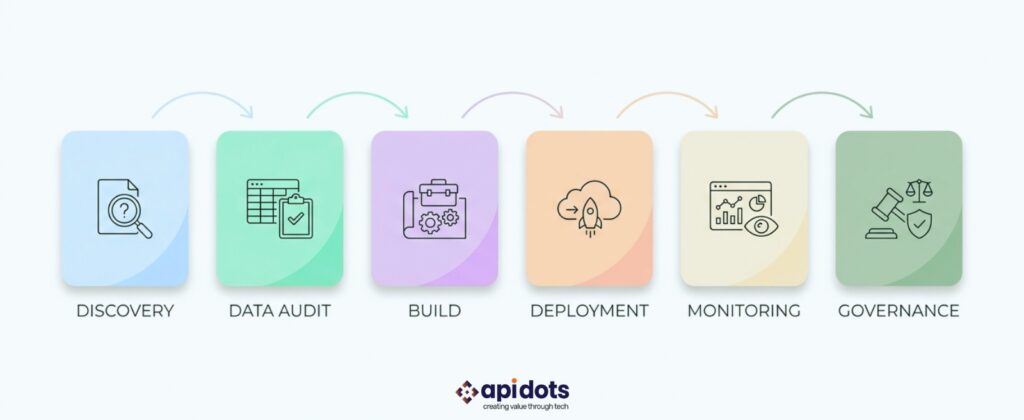
The discovery process with apidots.com: The engagement began with a three-week discovery sprint that covered four areas: data structure audit (examining 24 months of historical transaction records, compliance outcomes, and analyst disposition data), false positive pattern analysis (identifying which transaction characteristics and rule combinations were generating the highest false positive rates), regulatory constraint mapping (documenting NYSDFS and BSA/AML requirements that the model architecture had to satisfy), and deployment architecture design (defining the API contract between the ML system and the existing compliance workflow platform before any model training began). The discovery output was a scope document and a business case for the ML system, signed off by both the compliance director and the CTO before any development commenced.
The build: The model architecture chosen was an ensemble combining a gradient boosting classifier (for interpretability in regulatory contexts) with an anomaly detection layer trained on transaction graph relationships. The gradient boosting component produces a risk score with an interpretable feature attribution breakdown — satisfying the requirement that compliance analysts could explain every alert to NYSDFS examiners if required. The anomaly detection layer captures novel fraud patterns that fall outside the historical training distribution, specifically addressing the false negative problem the previous rule-based system had not been able to solve. The system was deployed on production cloud infrastructure with a sub-30ms response time, integrated with the compliance team’s workflow platform via REST API. A monitoring pipeline tracked both input data distribution and model output confidence distributions daily, with automated escalation if either drifted beyond defined thresholds.
The outcome: Production deployment went live at week 14 of the engagement. In the first 60 days of operation, the daily manual review queue fell from 280 cases to 94 — a 67% reduction. False negative rate (genuine cases missed) improved by 31% compared to the previous rule-based system, as the anomaly detection layer identified three new fraud pattern types that had not been present in the historical training data. The compliance team’s capacity freed up by reduced false positive volume was redirected to proactive regulatory intelligence work that had been deprioritised for two years due to workload. The system passed an NYSDFS examination 11 weeks after go-live, with examiners specifically noting the quality of the model’s interpretability documentation.
The most valuable output of the discovery sprint was not the model architecture recommendation. It was the business case documentation that showed the CFO exactly what the ROI calculation looked like at each projected false positive reduction level. That document was why the project was approved in five days rather than five months.
Also Read: Predictive AI and ML Development for Finance and Manufacturing
Also Read: Top 10 FinTech Trends for Banks and Insurers in 2026
Building a production ML or agentic AI system in New York? Talk to the team at apidots.com today. Book a Free Consultation →
Three data points that frame the scale of the opportunity and the urgency of the execution challenge:
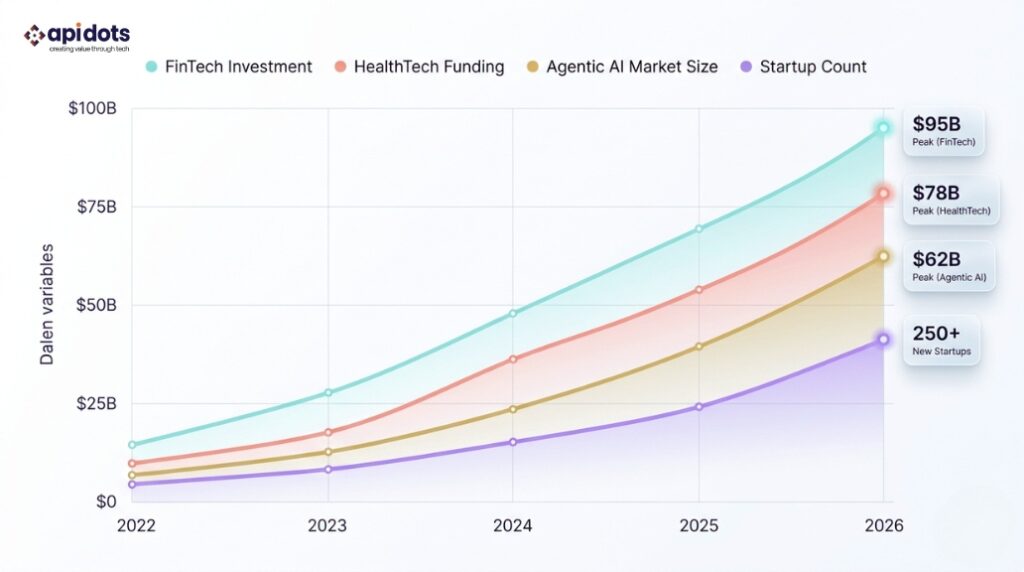
For business leaders who have heard the AI pitch many times without seeing clear evidence of return, this section grounds the benefits in what is actually happening in production systems across New York right now, not in projected potential.
The fundamental shift ML enables for NYC businesses is from responding to events after they occur to anticipating them before they do. In financial services, this means detecting fraud before the transaction is settled rather than investigating chargebacks after the fact. In healthcare, it means identifying patients at risk of adverse events before deterioration rather than managing emergency admissions. In retail and logistics, it means adjusting inventory and pricing based on predicted demand rather than historical averages. The business value of this shift is measurable in every sector: faster fraud detection reduces losses, earlier clinical intervention reduces readmission rates, predictive inventory management reduces both stockouts and overstock carrying costs. For how predictive analytics applies specifically to inventory: Smart AI Inventory Management for Growing Businesses.
NYC’s largest employers in financial services, healthcare, and legal services all run enormous volumes of structured, repetitive workflows that currently consume analyst and associate time that could be directed at higher-value work. Document classification, transaction categorisation, appointment scheduling, prior authorisation processing, contract clause extraction — these are all tasks where well-built ML systems now match or exceed human accuracy at a fraction of the operational cost. The compliance case study earlier in this blog is one example. For the broader RPA and automation context: RPA vs Intelligent Automation in 2026.
New York’s consumer market density creates both the requirement for personalisation and the data to enable it. ML-powered recommendation engines, dynamic pricing models, and personalised content delivery systems can now process the volume and variety of behavioural signals generated by NYC’s consumer population in real time. The businesses that have implemented production personalisation ML are reporting measurable improvements in conversion rates, average order values, and customer lifetime value — not as projections, but as measured outcomes from live A/B tests against non-personalised control groups.
Well-built ML systems scale with data volume rather than against it. As a production ML system sees more transactions, more patient records, or more customer interactions, its predictions improve. This creates a compounding advantage that widens over time: businesses that built ML infrastructure early accumulate data advantages that later-starting competitors cannot close by simply implementing the same technology. This is the compounding data moat dynamic that NYC’s most sophisticated investors now explicitly look for in AI company valuations.
NYC’s ML talent market is genuinely competitive in 2026. The city has 40,000 AI professionals — the largest concentration in the US outside San Francisco — but the competition for production-capable ML engineers is intense. Here is a practical framework for businesses evaluating their hiring options in New York.
The fully-loaded cost of a senior ML engineer in New York City typically exceeds $280,000 annually when salary, benefits, equity, and overhead are included. The average time-to-fill for senior ML roles in NYC’s financial services and healthcare sectors is six to seven months. For defined-scope ML projects, partnering with the AI and ML development team at apidots.com provides access to a full team — data engineers, ML engineers, MLOps specialists, and a technical lead — from day one, at a predictable project cost that typically delivers a production system in the time it would take to hire a single engineer.
For businesses building long-term internal ML capability, the team at apidots.com also offers structured knowledge transfer programmes that document the architecture, data lineage, and operational procedures for every system we build — giving your internal team full ownership and maintainability from handover day.
Bonus Read: How to Hire Machine Learning Developers in California: The Complete Guide
For business and technology leaders commissioning enterprise ML systems in New York in 2026, the delivery landscape looks substantially different from what it looked like two years ago. Three changes matter most.
Two years ago, most enterprise ML projects in NYC delivered a model — a function that takes inputs and produces predictions. In 2026, the leading engagements are delivering agentic systems: ML-powered components that can plan multi-step workflows, use tools, access external data sources, and pursue defined business goals with meaningful autonomy. The distinction matters architecturally because agentic systems require different design patterns (memory, tool use, action constraints), different governance frameworks (human-in-the-loop triggers, audit trails, rollback mechanisms), and different monitoring infrastructure (goal achievement tracking rather than just prediction accuracy). For the full technical context: Multimodal AI and the Future of Work in 2030.
NYC enterprise buyers in regulated sectors — and their legal, risk, and compliance teams — are now requiring evidence of compliance-by-design rather than compliance-by-retrofit before approving ML system procurement. This means model cards, bias assessments, data lineage documentation, and explainability frameworks are deliverables that enterprise buyers expect to receive along with the model itself. Development partners who do not include these in their standard delivery are increasingly being filtered out of NYC enterprise procurement processes before reaching technical evaluation.
The most valuable ML systems in NYC enterprise environments are not standalone applications — they are components deeply integrated into existing operational workflows. The compliance monitoring system described in the case study earlier is one example: its value came from being integrated into the compliance team’s existing workflow platform, not from existing as a separate tool that analysts had to remember to consult. Deep integration requires investment in API design and workflow analysis upfront, but it drives the adoption rates — the 87% figure in the HealthTech case study and the 100% analyst adoption in the FinTech case — that generate the ROI that justifies the investment.
Predictive analytics is the discipline most immediately accessible to NYC businesses that are evaluating their first ML investment. Where agentic AI requires deep integration and careful governance design, a well-scoped predictive analytics system can be delivering business value within eight to twelve weeks. Understanding where predictive analytics applies in NYC’s specific business environment is the first step in building a coherent ML roadmap.
NYC’s financial services sector generates the largest volume of structured, labelled historical data of any industry in the world. Predictive analytics applications in this environment include credit risk modelling (predicting default probability for individual borrowers or counterparties), market microstructure analysis (predicting short-term price movements from order flow patterns), customer churn prediction (identifying clients at risk of attrition before they close accounts), and liquidity risk modelling (predicting cash flow requirements under different market scenarios). These are not experimental applications — they are production systems running at every major Wall Street institution and an increasing number of mid-market FinTech companies. See the FinTech application development context for how apidots.com approaches these systems.
New York’s real estate market, the most data-dense property market in the world, is a natural environment for predictive analytics. ML models predicting rental price trajectories, vacancy rates, neighbourhood commercial density changes, and property value appreciation are now in active use by institutional investors, property managers, and real estate technology platforms. The data available in NYC — historical transaction records, permit filings, demographic flows, transit usage patterns — is sufficient to build predictive models of significantly higher accuracy than what is available in most other markets. For broader context on AI in real estate: How AI is Empowering the Real Estate Industry.
Predictive analytics in NYC’s healthcare sector has moved beyond academic research into operational deployment. Patient readmission risk models at Mount Sinai and NYU Langone are informing discharge planning decisions that reduce preventable readmissions. Demand forecasting models in emergency departments are improving staffing allocation and reducing wait times. Diagnostic risk stratification models are helping primary care providers identify patients with early-stage conditions before they require acute intervention. The NYC HealthTech sector’s $4 billion funding round in 2024 reflects investor confidence that these applications are generating real clinical and operational value, not just research outcomes. For healthcare software development specifically for NYC health systems, the team at apidots.com has built HIPAA-compliant production systems across these use cases.
The team at apidots.com operates as a specialist ML and AI development firm serving NYC enterprises, FinTechs, HealthTech companies, and growth-stage startups. The word ‘specialist’ is important. API DOTS does not build mobile apps, websites, or generic software and also offer AI services. ML and AI development is the only thing we do, which means the engineers who work on your project have built ML systems that are in production, serving real users, and generating real business outcomes in environments similar to yours.
Here is what NYC clients describe as the specific characteristics of working with apidots.com that distinguish the engagement from working with both larger consultancies and smaller generalist agencies:
Every engagement at apidots.com begins with a structured discovery sprint that audits your data before proposing a model architecture, maps your regulatory constraints before writing a line of deployment code, and defines success in business outcome terms before agreeing to ML performance metrics. The FinTech case study in this blog is a direct example: the discovery sprint’s business case documentation was what got the project approved quickly and what provided the framework for measuring success that the NYSDFS examination relied upon. This discovery discipline is what separates ML projects that ship and deliver value from those that produce notebooks that never make it to production.
API DOTS builds ML systems that satisfy the specific requirements of NYC’s regulated sectors: model interpretability for compliance documentation, role-based access controls for data governance, immutable audit trails for regulatory examination, and deployment on certified cloud infrastructure. These are not optional features that we add when clients ask for them. They are design inputs that we include in every engagement by default because they are required in the environments where our NYC clients operate. For an overview of the full development and technology services that apidots.com provides to NYC businesses, including IT consulting and DevOps services.
When apidots.com takes on an NYC ML engagement, you work with a complete team: a data engineer who designs the pipeline, an ML engineer who builds and validates the model, an MLOps engineer who owns the deployment and monitoring infrastructure, and a technical lead who is accountable for the business outcome and communicates with your stakeholders throughout the engagement. This team structure is what allows us to deliver production systems in eight to sixteen weeks — the same timeline that most NYC companies spend on a single hiring process for one engineer. Explore the full team at apidots.com and the product development services we deliver across ML, AI, and enterprise software.
Also Read: AI Powered Software Solutions for Growing Businesses
The 2026 ML landscape in New York City is not a landscape of possibility. It is a landscape of execution. The technology is mature, the talent exists (in the right firms), the business cases are proven, and the regulatory frameworks are increasingly clear. What separates NYC businesses that capture the value from those that spend another year in pilots is not access to AI — it is access to a development partner that can execute in the specific, regulated, high-stakes environments where New York’s most important industries operate.
Ready to build production ML and agentic AI for your NYC business? Partner with API DOTS today. Contact Us for a Free Consultation →
What is agentic AI and how does it differ from the machine learning my NYC business already uses?
Most businesses using ML in 2026 have classification or prediction models: systems that take defined inputs and produce a single output (a fraud score, a diagnosis probability, a demand forecast). Agentic AI extends this into systems that pursue goals through multi-step autonomous workflows — they can use tools, access data sources, make sequences of decisions, and adapt their behaviour based on intermediate outcomes. For a NYC FinTech, an ML fraud detection model is a classifier. An agentic fraud investigation system can take that classification, pull related transaction data, cross-reference customer history, check counterparty risk profiles, and produce a structured investigation report — autonomously, in seconds, without analyst involvement at each step.
How long does it take to build a production ML system for a NYC enterprise?
For a focused ML system with a well-defined problem scope and reasonably clean historical data, the team at apidots.com typically delivers a production deployment in eight to fourteen weeks. The FinTech case study in this blog took fourteen weeks including a three-week discovery sprint. The timeline extends for systems with complex data integration requirements, multiple model components, or extensive regulatory validation needs. The most important variable is not the model complexity — it is the data quality and the clarity of the business objective at the start of the engagement.
How does ML development in NYC differ from other US markets?
NYC’s ML development environment is distinguished by three factors relative to other US markets. First, the regulatory environment: NYSDFS oversight, proximity to SEC and FINRA regulated entities, and the New York State health data governance framework all shape what ML systems can do, how they document decisions, and what audit infrastructure is required. Second, the enterprise buyer sophistication: NYC enterprise procurement teams have evaluated more ML vendors than their peers in most other markets, and they ask harder questions about production capability and compliance readiness. Third, the data environment: NYC’s concentration of financial services, healthcare, and media creates data assets — transaction volumes, clinical records, content interaction signals — that are uniquely rich for training the vertical ML models these industries require.
What industries does apidots.com serve in New York City?
The team at apidots.com works with NYC businesses across FinTech (lending infrastructure, payment processing, compliance technology), HealthTech (clinical decision support, administrative automation, patient risk stratification), enterprise SaaS (AI-powered workflow automation, predictive analytics, recommendation engines), and e-commerce (demand forecasting, inventory optimisation, personalisation). Every engagement is scoped around a defined business outcome and delivered by a full team with sector experience in your industry. For a complete view of our services: full services at apidots.com.
What makes a NYC ML project fail, and how does apidots.com prevent it?
The most common reasons production ML projects fail in NYC enterprise environments are, in order: data quality problems that were not identified before model training began; scope creep driven by stakeholder expectations that were not managed against a documented business case; deployment architecture that was not designed to meet production latency, availability, and compliance requirements; and absence of post-deployment monitoring that allows silent model degradation. The apidots.com discovery sprint process specifically addresses the first two. The full-stack team structure addresses the third. The monitoring infrastructure included as standard in every engagement addresses the fourth. None of these are clever techniques — they are lessons from production ML deployments in environments where the cost of failure is high.
Related Reading
Also Read: SaaS Innovation in New York: What’s Driving the Next Wave
Also Read: FinTech NYC: Blockchain, AI and the Revolution in Financial Services
Also Read: Agentic AI vs AI Agents for Digital Transformation
Also Read: AI and Machine Learning in SaaS Applications
Also Read: Top 10 FinTech Trends for Banks and Insurers in 2026
Bonus Read: Multimodal AI and the Future of Work in 2030
Bonus Read: AI Powered Software Solutions for Growing Businesses
We engineer and integrate custom ML software solutions end-to-end. Delivering predictive models, data insights, and measurable business results.
Get ML Development Services
I’m a digital marketer with experience in SEO, content strategy, and online brand growth. I specialize in creating optimized content, improving website rankings, building high-quality backlinks, and driving traffic through effective digital marketing strategies. I enjoy helping businesses strengthen their online presence and turn visitors into customers.
1 Comment
[…] Agentic AI and ML Development in NYC […]