
Top
Search
People also search for:
Stay Inspired with Instagram




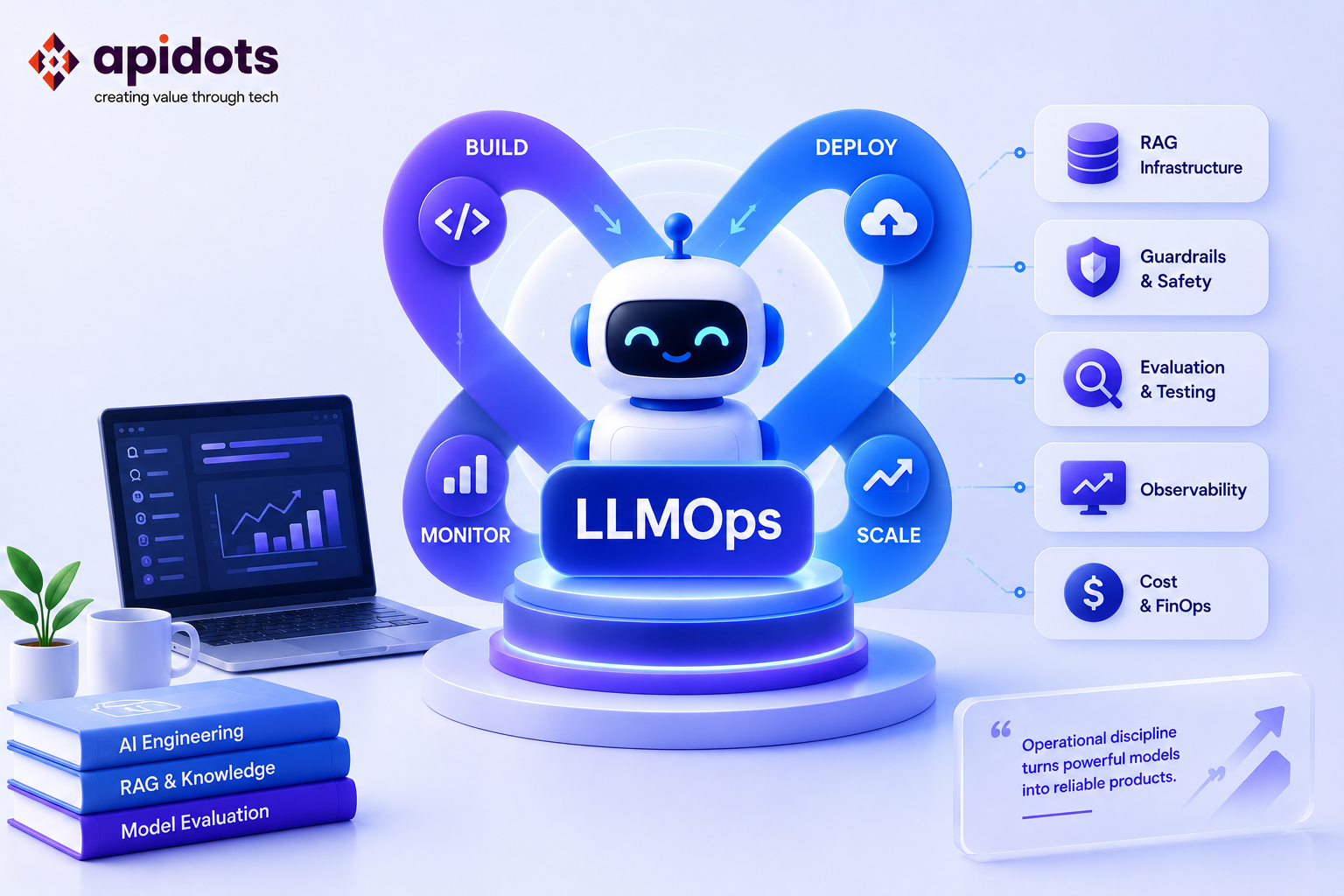
Every enterprise now has an AI pilot running somewhere. Very few have one running in production, reliably, at scale, without blowing up the compute budget or hallucinating in front of a customer. That gap is exactly why LLMOps has become one of the most important disciplines in AI software development heading into 2026. LLMOps is the set of practices, tooling, and governance that takes a large language model from a promising prototype to a dependable, auditable, cost-controlled product that thousands of employees or customers can rely on every single day.
In this blog, we break down what LLMOps actually means, why it has become a board-level priority in 2026, the components every enterprise stack needs, and the step-by-step lifecycle that separates companies that ship reliable LLM applications from companies that stay stuck in pilot purgatory.
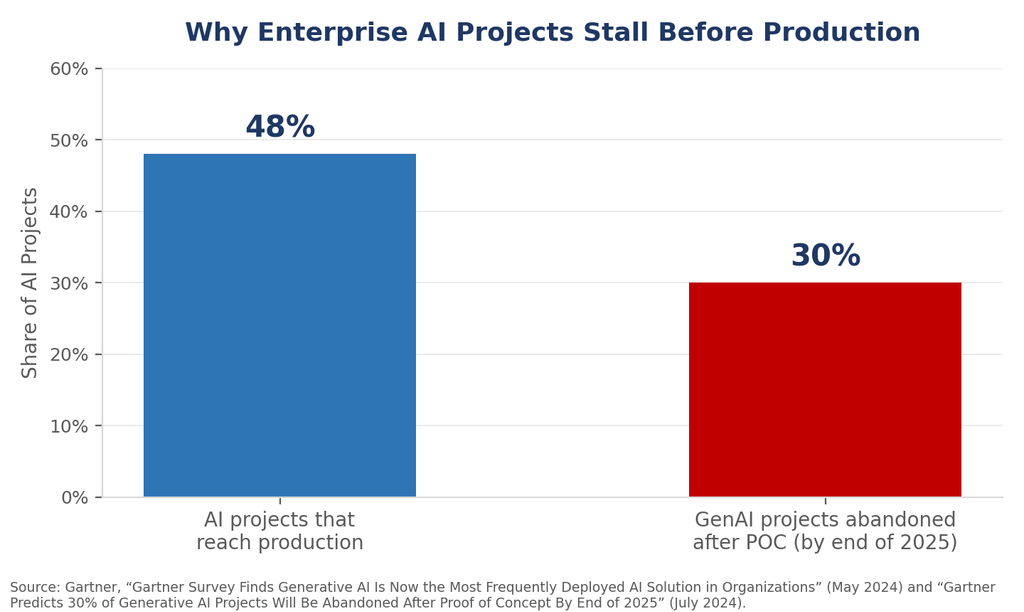
Industry surveys throughout 2025 and into 2026 consistently show that a large majority of enterprise generative AI pilots never reach production, and the reason cited most often isn’t the model, it’s the lack of operational discipline around it. Teams underestimate how much engineering work sits between a working demo and a system that can handle real traffic, real edge cases, and real compliance scrutiny. LLMOps is the answer to that gap, and enterprises that treat it as an afterthought are the ones still stuck rewriting the same prototype a year later.
LLMOps (Large Language Model Operations) is the specialized discipline of deploying, monitoring, evaluating, and continuously improving applications built on large language models. It borrows heavily from MLOps, but it isn’t just MLOps with a new name. Traditional ML models are trained once on structured data and produce a fairly predictable output range. LLMs are probabilistic, prompt-sensitive, expensive to run at scale, and capable of producing wildly different answers to the same question depending on context, temperature, or a single word changed in the system prompt.
That unpredictability means enterprises need an entirely new operational layer: prompt versioning, retrieval pipelines, output evaluation, safety guardrails, and token-level cost tracking, on top of the deployment and monitoring practices teams already use for traditional software and machine learning models.
Three forces have pushed LLMOps from a nice-to-have into a non-negotiable requirement this year:
There’s also a talent dimension to this shift. Data scientists who were comfortable owning a model end-to-end in a notebook are now working alongside platform engineers, prompt specialists, and compliance reviewers as part of a single delivery pipeline. LLMOps isn’t just tooling, it’s a cross-functional operating model, and enterprises that only invest in the tooling while ignoring the process end up with expensive infrastructure nobody actually uses correctly.
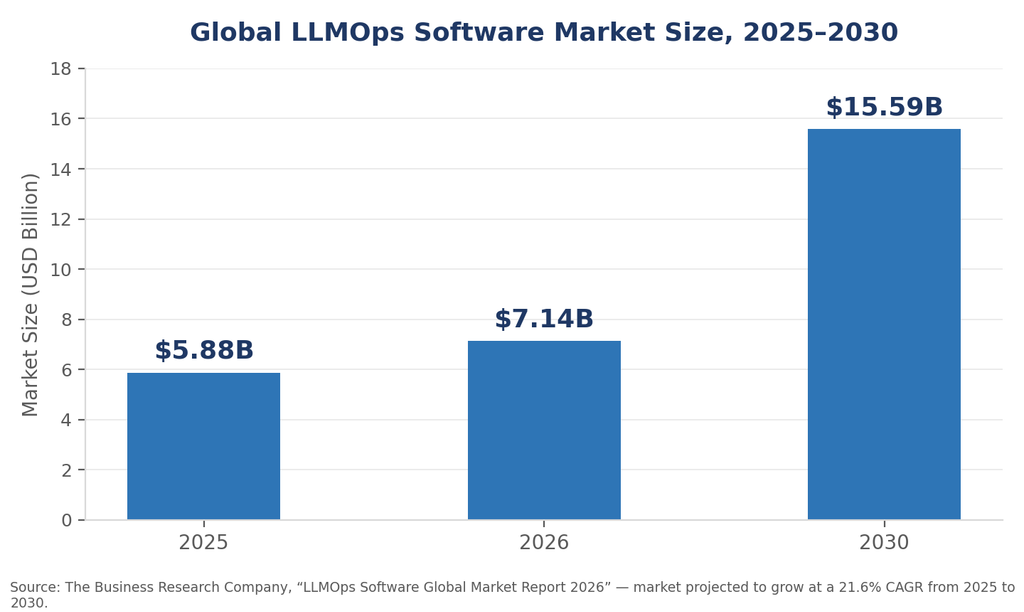
This shift is already showing up in enterprise budgets. The global market for LLMOps software is projected to grow from roughly $5.88 billion in 2025 to $15.59 billion by 2030, a 21.6% compound annual growth rate, as enterprise-scale LLM deployments, responsible AI mandates, and AI observability investments accelerate.
Prompts are treated as versioned, testable code artifacts rather than throwaway strings buried in application logic. Mature teams version prompts in a registry, run automated regression tests before any change is deployed, and can roll back instantly if a new prompt version degrades output quality
2. Retrieval-Augmented Generation (RAG) Infrastructure
Many enterprise applications of large language models (LLMs) need to provide answers based on private, up-to-date company data instead of solely depending on the model’s training data. This necessitates a thoughtfully designed RAG architecture, which includes vector databases, chunking strategies, embedding refresh pipelines, and re-ranking logic. This ensures that the model is based on accurate and current information rather than making guesses.
3. Evaluation and Testing Pipelines
Automated evaluation suites assess outputs for accuracy, relevance, tone, and safety prior to each deployment. Companies are increasingly integrating LLM-as-judge scoring with human reviews on a sampled basis, particularly for regulated or customer-facing applications.
4. Fine-Tuning and Model Customization
While not every application requires a fine-tuned model, domain-specific tasks such as legal document review, clinical summarization, and financial reporting can benefit significantly from lightweight fine-tuning or parameter-efficient techniques like LoRA. These methods can greatly enhance accuracy while keeping inference costs in check.
5. Guardrails, Safety, and Compliance
Guardrail layers are essential for filtering unsafe inputs and outputs, enforcing PII redaction, preventing prompt injection attempts, and ensuring the model operates within its intended scope. This has become a necessity for any application that deals with sensitive enterprise or customer data.
6. Observability and Cost Monitoring
Each request is logged with details on latency, token usage, cost, and quality score, providing engineering and finance teams with a real-time understanding of the operational costs associated with each AI feature and highlighting areas where optimization is required.
Quick reference: an overview of how these six components relate to the risks they mitigate if omitted from the stack.
| Stack Component | What It Does | Risk If Missing |
|---|---|---|
| Prompt & Context Management | Versions and tests prompts like code before release | Silent quality regressions |
| RAG Infrastructure | Grounds responses in current, private company data | Outdated or fabricated answers |
| Evaluation & Testing | Automated scoring of accuracy, tone, and safety | Undetected hallucinations reaching users |
| Fine-Tuning | Adapts the model to domain-specific tasks | Poor accuracy on specialized workflows |
| Guardrails & Compliance | Filters unsafe inputs/outputs and redacts PII | Regulatory and data-privacy violations |
| Observability & Cost Monitoring | Tracks latency, token spend, and quality in real time | Runaway inference costs |
Deploying a production LLM application isn’t a single deployment event, it’s a continuous cycle that mirrors the broader machine learning development lifecycle, extended with LLM-specific stages:
These three terms get used interchangeably, but they solve different problems. MLOps governs traditional predictive models — fraud scoring, demand forecasting, recommendation engines. LLMOps governs generative, language-based applications built on foundation models. And as enterprises move beyond single-prompt applications into autonomous, multi-step systems, they also need to think about AI agent architecture — the orchestration layer that governs how an agent plans, calls tools, and hands off tasks between multiple AI components.
In practice, mature enterprises run all three disciplines side by side: MLOps for their existing predictive models, LLMOps for their generative applications, and an emerging AgentOps layer for autonomous, tool-using agents built on top of those same LLMs.
| Dimension | MLOps | LLMOps | AgentOps |
|---|---|---|---|
| Primary Focus | Predictive ML models (classification, forecasting, scoring) | Generative, language-based applications on foundation models | Autonomous, multi-step agents that plan and call tools |
| Core Artifact | Trained model weights and feature pipelines | Prompts, embeddings, and retrieval pipelines | Agent plans, tool schemas, and execution traces |
| Key Risk | Model drift and stale training data | Hallucination and prompt-injection | Runaway or unsafe autonomous actions |
| Typical Tooling | Feature stores, model registries, MLflow-style tracking | Prompt registries, vector DBs, LLM evaluation platforms | Agent orchestration frameworks, tool-call monitors |
Not sure whether your team needs LLMOps, MLOps, or both? Talk to APIDots’ AI & ML engineering team →
None of these challenges are reasons to avoid production LLM deployment, they’re reasons to invest in the operational layer before scaling. Enterprises that fund LLMOps infrastructure early, even for a single use case, consistently spend less on rework than teams that scale first and try to retrofit monitoring, guardrails, and cost controls after the fact.
Building a production-grade LLMOps pipeline in-house takes specialized expertise across data engineering, MLOps tooling, prompt engineering, and application development — talent that’s expensive and hard to hire in-house at the speed most enterprises need. This is exactly the gap our machine learning development lifecycle and AI engineering teams close for clients: designing the evaluation frameworks, RAG infrastructure, and monitoring dashboards that turn a promising LLM prototype into a dependable production system. If you’re currently comparing vendors, our guide on choosing the right AI development partner walks through the evaluation criteria that actually predict project success.
Ready to move your LLM application from prototype to production without the cost overruns or compliance headaches? Book a free LLMOps consultation with APIDots →
MLOps manages traditional machine learning models trained on structured data for predictive tasks. LLMOps is a specialized extension focused on large language models, adding prompt management, retrieval pipelines, hallucination testing, and token-cost monitoring that traditional MLOps tooling doesn’t cover.
Yes, increasingly. Developers are adopting newer AI infrastructure platforms for production when they offer reliability, security, scalability, observability, and strong integration with existing development workflows.
Popular platforms include AWS SageMaker, Google Vertex AI, Azure Machine Learning, Databricks, MLflow, Kubeflow, and Weights & Biases. They provide tools for deployment, monitoring, evaluation, model management, and scaling.
Key LLMOps practices include version control, automated evaluation, continuous monitoring, prompt management, model/version tracking, security controls, cost monitoring, and CI/CD pipelines for reliable model deployment and updates.
Cost varies widely based on scale, number of use cases, and whether you’re using third-party model APIs or self-hosting open-weight models. Most enterprises start with a single high-value use case, build the core observability and evaluation pipeline around it, then reuse that infrastructure to add new use cases at a much lower incremental cost.
A typical stack includes a prompt registry and versioning tool, a vector database for retrieval, an evaluation and observability platform for tracking output quality and cost, a guardrails layer for safety, and an orchestration framework for chaining multiple model calls or tool invocations together.
For a well-scoped, single use case, most enterprises can move from prototype to a monitored production deployment in eight to twelve weeks. Timelines extend when the use case requires fine-tuning, complex RAG over large unstructured datasets, or strict regulatory sign-off.
LLMOps practices scale down well. Even a small team running one customer-facing chatbot benefits from basic prompt versioning, output evaluation, and cost monitoring — the core principles just get applied with lighter tooling than a Fortune 500 rollout would need.
LLMOps is what separates enterprises that talk about AI from enterprises that actually run it in production, reliably and profitably. The teams winning in 2026 aren’t the ones with the flashiest demo, they’re the ones with the evaluation pipelines, cost controls, and monitoring in place to keep that demo working at scale, every single day, for every single user.
We build and deploy end-to-end AI software solutions for businesses. Accelerating efficiency, automation, and intelligent decision-making.
Get AI Development Services