
Top
Search
People also search for:

Stay Inspired with Instagram




Unplanned downtime is one of the most expensive, and most avoidable, line items on an industrial balance sheet. A single failed compressor, a seized turbine bearing, or an MRI machine going offline for three days doesn’t just cost repair parts and labor — it cascades into missed production targets, canceled patient appointments, safety incidents, and reputational damage that outlasts the outage itself. Manufacturers routinely report that unplanned downtime costs them well into six or seven figures per incident once lost throughput, expedited parts, overtime labor, and contractual penalties are added up.
For twenty years, the industrial world managed this risk with two blunt instruments: reactive maintenance (fix it when it breaks) and preventive maintenance (fix it on a fixed calendar, whether it needs it or not). Both approaches are still common in 2026, and both are quietly bleeding enterprises dry — reactive maintenance through catastrophic failures and safety exposure, preventive maintenance through wasted parts, unnecessary labor, and machines pulled offline before they actually need attention.
AI Predictive Maintenance (AI PdM) changes the economics entirely. By continuously analyzing sensor data, historical failure patterns, and operating conditions, machine learning models can forecast when a specific asset is likely to fail — often weeks in advance — and flag why, so maintenance teams intervene at exactly the right moment. It is the difference between guessing and knowing.
This guide is a comprehensive, architecture-level resource for CTOs, CIOs, plant managers, operations executives, and enterprise decision-makers evaluating AI predictive maintenance for manufacturing, energy, oil & gas, healthcare, and logistics operations. It covers how the technology works, what to build, what it costs, and how to roll it out without disrupting existing operations. As a company that builds custom AI and ML solutions for industrial and enterprise clients, API DOTS put this guide together from real implementation patterns we use with clients — not generic theory.
Reactive maintenance was never really a strategy — it was the absence of one, tolerated because the tools to do better didn’t exist at scale. That’s no longer true. Enterprises still running “fix it when it breaks” operations today are doing so with full visibility into the alternative, which makes every unplanned failure a harder conversation with the board. Insurance carriers, regulators, and customers increasingly expect documented maintenance discipline, especially in oil & gas, aviation, and healthcare, where an unplanned failure isn’t just a cost event — it’s a compliance and safety event. The margin for reactive maintenance has been shrinking for a decade as competitors adopt condition-based strategies and use the resulting cost advantage to win contracts, tenders, and safety certifications that reactive-only operators simply can’t match.
The shift from preventive to predictive maintenance is really a shift in what data is allowed to do. Historically, maintenance planning was built around manufacturer specifications and generic failure curves — reasonable defaults, but blind to how your specific asset, in your specific environment, under your specific load, actually behaves. AI removes that blindness. A model trained on your own sensor and failure history learns the real degradation signature of your equipment, not a generic one, which is why enterprise predictive maintenance programs consistently outperform manufacturer-recommended service intervals once enough operational data accumulates. This is also why AI PdM has moved from a research topic to a standard line item in digital transformation budgets: the technology to collect, store, and model this data at enterprise scale has become dramatically cheaper and more accessible over the last five years, even as the cost of downtime has kept climbing.
AI Predictive Maintenance is the use of machine learning and sensor data to predict equipment failures before they happen, so maintenance can be scheduled precisely when it’s needed — not too early, not too late. Instead of relying on fixed schedules or waiting for a breakdown, AI models continuously score the health of an asset and estimate its Remaining Useful Life (RUL).
Preventive maintenance is time- or usage-based: replace the bearing every 6,000 hours, change the oil every 90 days, service the chiller every quarter. It reduces unplanned failures compared to doing nothing, but it’s inherently wasteful — most parts are replaced with useful life still remaining, and some still fail early despite being “on schedule,” because real-world wear doesn’t follow a calendar.
Predictive maintenance instead asks: given this asset’s current vibration signature, temperature trend, and load history, how much life does it actually have left? That single shift — from a fixed interval to a data-driven estimate — is what separates the two disciplines.
Reactive (“run to failure”) maintenance is the most expensive strategy in almost every industrial context, because failures rarely happen conveniently. A part that fails at 2 a.m. on a production line, or a pump that fails mid-shipment on an offshore rig, carries a multiplier on cost and risk that scheduled work never does. AI predictive maintenance eliminates surprise failures on monitored assets almost entirely, replacing emergency response with planned, resourced maintenance windows.
Understanding the mechanics matters before evaluating vendors or architecture, because every design decision downstream — which cloud, which model, which integration pattern — depends on getting these steps right.
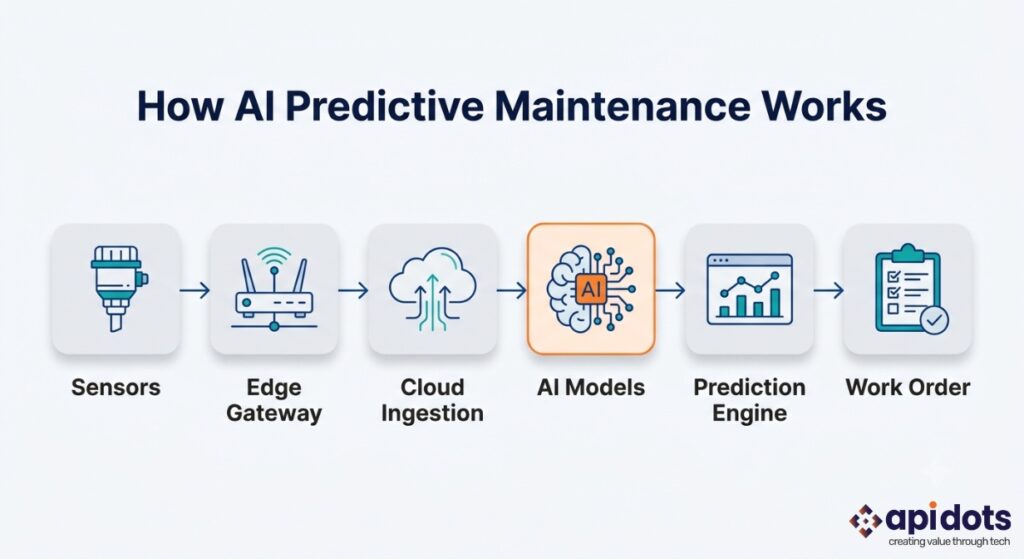
1. Sensors capture raw physical signals. Vibration, temperature, pressure, acoustic emission, current draw, humidity, and RPM sensors are attached to or embedded in critical assets. The sensor mix depends entirely on the failure modes you’re trying to catch — a bearing failure shows up in vibration and acoustic data long before it shows up in temperature.
2. IoT devices and PLC systems digitize and transmit that data. Programmable Logic Controllers (PLCs) and industrial IoT devices convert analog signals into structured digital data and push it onto a network, typically at intervals ranging from milliseconds (for high-speed rotating equipment) to minutes (for slower-changing thermal systems).
3. Edge computing performs first-pass filtering. Rather than streaming every raw data point to the cloud, edge gateways aggregate, compress, and apply lightweight anomaly detection locally. This cuts bandwidth costs and allows for millisecond-level alerts on catastrophic events without waiting for a round trip to the cloud.
4. Data collection and cloud infrastructure centralize the signal. Filtered, time-stamped data streams into a cloud environment (Azure IoT, AWS IoT Core, or a hybrid setup) where it’s stored in time-series databases optimized for high-frequency writes and range queries.
5. Machine learning models analyze patterns. This is where regression models, gradient-boosted trees, and deep learning architectures (discussed in detail below) learn the relationship between sensor patterns and historical failure events.
6. Deep learning and time-series forecasting project forward. Models like LSTMs and Transformers don’t just classify current health — they forecast how a metric is likely to trend over the coming days or weeks, which is what makes RUL estimation possible.
7. Failure prediction and automated alerts trigger action. When a model’s confidence crosses a threshold, the system generates a prioritized alert — not just “something is wrong,” but which component, what failure mode, and an estimated time window.
8. Maintenance scheduling closes the loop. The prediction routes into a CMMS or ERP work-order system, a technician is dispatched with the right parts already staged, and the cycle repeats with the outcome feeding back into model retraining.
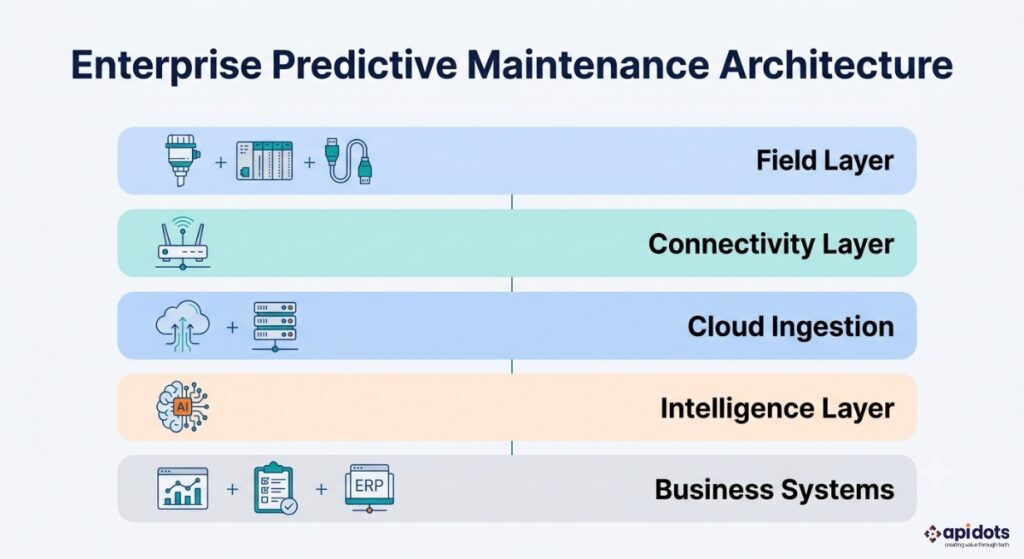
A production-grade AI PdM system is not a single application—it’s a layered architecture where each tier has a distinct responsibility. Enterprises evaluating vendors or planning an in-house build should think in these layers:
| Layer | Components | Purpose |
|---|---|---|
| Field Layer | Sensors, SCADA, PLC | Capture raw physical signals from equipment |
| Connectivity Layer | Industrial IoT Gateway, MQTT, Kafka | Move data reliably from the plant floor to the network |
| Cloud Ingestion | Azure IoT Hub, AWS IoT Core | Securely receive, authenticate, and buffer device data at scale |
| Processing Layer | Feature engineering pipelines, stream processors | Transform raw signals into model-ready features |
| Intelligence Layer | Machine learning models, prediction engine | Score asset health and forecast failure |
| Integration Layer | REST APIs, ERP connectors | Route predictions into business systems |
| Experience Layer | Dashboard, mobile app | Give humans visibility and control |
| Business Systems | SAP, Salesforce, Microsoft Dynamics, CMMS, Power BI | Convert predictions into work orders, reporting, and business decisions |
SCADA and PLC systems remain the backbone of most industrial environments and, in most cases, don’t need to be replaced — a well-designed IoT gateway sits alongside them and taps existing data streams rather than ripping and replacing decades-old control systems. This is often the single biggest concern for plant managers, and it’s usually unfounded: legacy compatibility is a core design requirement of any serious PdM architecture.
MQTT vs. Kafka: MQTT is lightweight and built for constrained IoT devices with intermittent connectivity — ideal for the last mile from sensor to gateway. Kafka is built for high-throughput, durable, ordered streaming across an enterprise — ideal once data reaches the network backbone and needs to fan out to multiple downstream consumers (storage, real-time scoring, dashboards). Most enterprise architectures use both: MQTT at the edge, Kafka in the middle tier.
Cloud platform choice (Azure IoT vs. AWS IoT Core) typically follows whatever the enterprise already standardizes on for its ERP and identity systems, since tight integration with Azure AD/Entra ID or AWS IAM materially reduces security overhead. For teams building on enterprise cloud infrastructure, this decision should be made jointly with the existing IT governance team, not by the maintenance team in isolation.
ERP and business system integration is what actually delivers ROI — a brilliant prediction that never reaches a work order in SAP, Dynamics, or a CMMS is just an interesting chart nobody acts on. Integration should be planned from day one via custom API and web integration work, not bolted on after the ML model is built.
Feature engineering, the step between raw sensor data and a model-ready dataset, is where a large share of predictive accuracy actually comes from — often more than the choice of model itself. Raw vibration data, for example, is rarely fed directly into a model; instead it’s transformed into frequency-domain features (via Fast Fourier Transform), rolling statistical windows, and rate-of-change metrics that expose the underlying degradation pattern far more clearly than the raw waveform does. Enterprises that underinvest in this layer, treating it as a quick preprocessing step rather than a discipline in its own right, are consistently the ones who see disappointing model accuracy despite having good sensors and a sound cloud architecture.
The prediction engine itself is usually a service layer that sits between the trained models and everything downstream — it handles model versioning, batches or streams incoming feature data through the appropriate model per asset class, applies business rules (such as suppressing duplicate alerts or adjusting confidence thresholds by asset criticality), and exposes results through REST APIs that dashboards, mobile apps, and ERP integrations all consume from a single source of truth. Designing this as a distinct service, rather than embedding model logic directly into the dashboard or mobile app, is what makes it possible to update models without redeploying every client application that depends on them.
Power BI and reporting layers typically sit downstream of the prediction engine rather than replacing it — Power BI is excellent for executive-level trend reporting and cross-site comparison, but it isn’t built for the real-time alerting and work-order automation that the operational dashboard and mobile app need to handle. Most mature architectures run both in parallel: an operational dashboard for maintenance teams acting on individual predictions, and a Power BI layer for executives tracking fleet-wide KPIs like MTBF and downtime cost trends over time.
Not every problem needs a deep learning model, and using one where a simpler model would do is a common, costly mistake. Here’s how to think about model selection:
| Model | Best Used For | Notes |
|---|---|---|
| Regression (linear/logistic) | Simple degradation trends, baseline RUL estimates | Fast, interpretable, good starting point |
| Random Forest | Failure classification with structured sensor data | Robust to noise, handles mixed data types well |
| XGBoost | Tabular sensor data, feature-rich failure prediction | Frequently the best accuracy-to-cost ratio for structured data |
| LSTM (Long Short-Term Memory) | Sequential time-series forecasting (RUL, degradation curves) | Captures long-range temporal dependencies |
| CNN (Convolutional Neural Network) | Vibration waveform and acoustic signal analysis, thermal imaging | Excellent at pattern recognition in raw signal/image data |
| Transformers | Multi-sensor, multi-asset forecasting at scale | State-of-the-art for long sequences and cross-asset patterns, higher compute cost |
| Autoencoders | Anomaly detection with no labeled failure data | Learns “normal” and flags deviation — useful when failure examples are rare |
| Anomaly Detection (Isolation Forest, One-Class SVM) | Early warning on rare, unlabeled failure modes | Doesn’t require historical failure labels |
| Reinforcement Learning | Optimizing maintenance scheduling policy over time | Emerging use case — optimizes when to act, not just what will happen |
A practical rule enterprises use: start with XGBoost or Random Forest for structured sensor data where failure history exists, add LSTM or Transformer models once enough time-series history has accumulated to forecast RUL with confidence, and layer in autoencoders or anomaly detection for new assets where failure history doesn’t yet exist. Reinforcement learning is generally a phase-two capability, applied once the prediction layer is mature and the goal shifts to optimizing scheduling policy itself. Our machine learning software development guide covers model selection trade-offs in more depth for teams building custom pipelines.
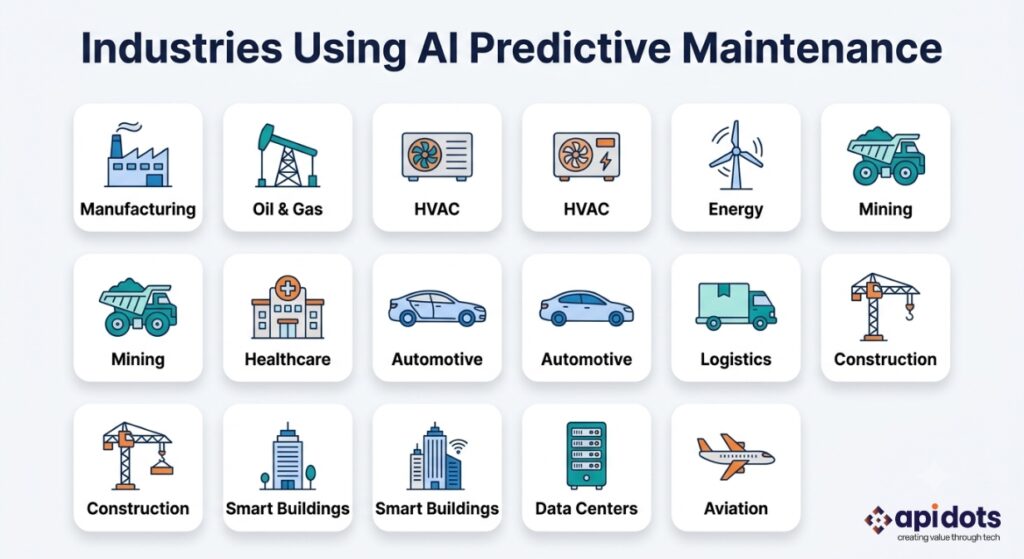
AI predictive maintenance is no longer confined to heavy manufacturing. Here’s how it shows up across sectors:
Oil & gas and healthcare deserve particular attention because the failure cost profile is asymmetric — a refinery pump failure carries environmental and safety risk far beyond the repair cost, and an MRI machine going down doesn’t just cost revenue, it disrupts patient care. We’ve written more specifically about AI in the oil & gas industry and broader AI use cases in oil & gas for teams in that sector, and about enterprise healthcare software for hospital systems evaluating this technology.
Factory motor failure prediction. Vibration and current-draw sensors on production-line motors feed an XGBoost classifier trained on years of failure history, flagging bearing wear 2–4 weeks before failure — enough lead time to source a replacement motor rather than expedite one at a premium.
Wind turbine maintenance. Turbines mounted in remote or offshore locations make reactive maintenance extraordinarily expensive due to access logistics. LSTM models forecasting gearbox and blade-bearing degradation let operators bundle maintenance visits, cutting the number of costly site trips.
Hospital MRI machines. Helium-cooling systems and gradient coils are monitored for thermal drift and vibration signatures; predictive alerts are routed to biomedical engineering teams so machines are serviced during scheduled low-utilization windows instead of during active patient scans.
Commercial HVAC chillers. Refrigerant pressure, compressor current, and condenser temperature are tracked continuously; anomaly detection flags refrigerant leaks and compressor wear before a building loses cooling capacity during peak demand — a pattern we cover in detail in our custom HVAC software development guide.
Oil refinery pumps. Seal integrity and cavitation risk are monitored via acoustic emission sensors; early detection prevents the kind of failure that can trigger unplanned shutdowns across an entire process unit.
Mining conveyor systems. Belt tension, roller bearing temperature, and motor load are tracked across kilometers of conveyor infrastructure, where a single unplanned stoppage can halt an entire extraction operation.
Warehouse robotics. Fleet-wide telemetry from autonomous mobile robots and conveyor sortation systems feeds anomaly detection models that flag degrading motors and actuators before a robot fails mid-pick, a use case closely related to the smart AI inventory management systems many logistics operators are now deploying alongside PdM.
Electric vehicles. Battery degradation modeling and drivetrain component monitoring, delivered over-the-air, let fleet operators plan battery replacement and service scheduling proactively rather than reactively.
Data center cooling. CRAC/CRAH unit and chilled-water loop monitoring predicts cooling failures before they force a thermal shutdown of racks — a scenario where downtime cost per minute can dwarf almost any other industrial failure.
Smart elevators. Door mechanism cycles, motor temperature, and cable tension are tracked continuously, letting building operators service elevators before they trip a safety fault and go out of service.
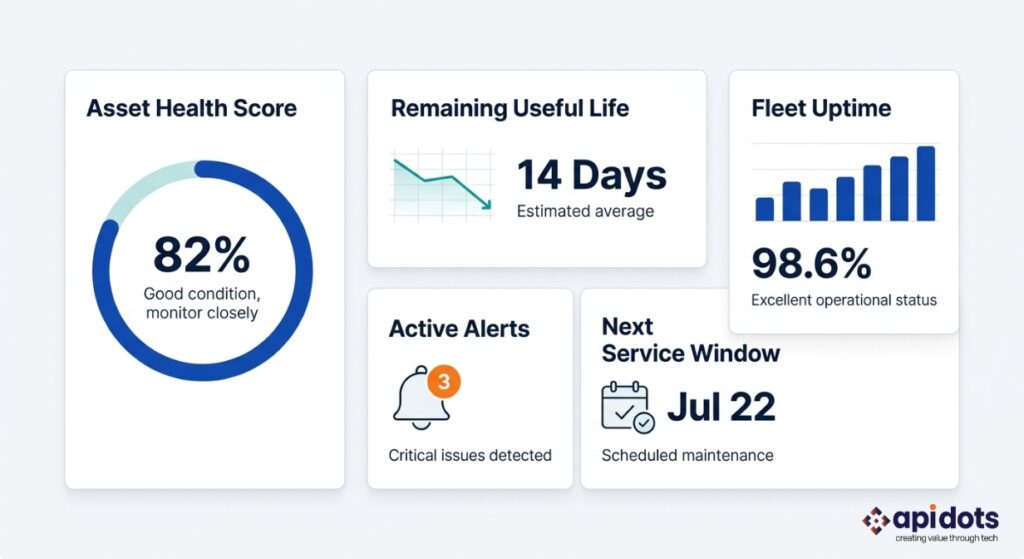
A capable AI PdM platform in 2026 typically includes:
A digital twin is a continuously updated virtual replica of a physical asset, built from its design specifications and live sensor data. Where predictive maintenance answers “when will this fail,” digital twins answer “what happens if we change this operating condition, this maintenance schedule, or this configuration.”
Simulation capability lets engineers test scenarios — running a turbine 10% harder, delaying a service interval, or swapping a component supplier — without touching the physical asset, using the digital twin as a sandbox.
Virtual equipment models are especially valuable during commissioning, when physical failure history doesn’t yet exist; the twin can be seeded with manufacturer specifications and physics-based models until enough operational data accumulates to switch to a fully data-driven prediction.
Remote diagnostics become possible because a twin exposes the full state of an asset to engineers anywhere, which matters enormously for offshore platforms, remote mining sites, and distributed utility infrastructure where sending a specialist on-site is expensive and slow.
Predictive analytics layered on a twin compound the value of both — the twin provides the structural and physics context, while the ML layer provides the data-driven forecast, and together they produce more accurate and more explainable predictions than either alone.
| Layer | Common Technology Choices |
|---|---|
| Backend | Node.js, Python (FastAPI/Django), Java (Spring Boot) |
| Frontend | React, Next.js, Angular |
| Cloud | Azure, AWS, Google Cloud Platform |
| Database | Time-series DB (InfluxDB, TimescaleDB), PostgreSQL, MongoDB |
| Machine Learning | Python (scikit-learn, PyTorch, TensorFlow), MLflow for model lifecycle |
| Streaming | Apache Kafka, MQTT brokers (Mosquitto, HiveMQ) |
| APIs | REST, GraphQL, gRPC for high-throughput internal services |
| IoT | Azure IoT Hub, AWS IoT Core, industrial protocol gateways (Modbus, OPC-UA) |
| DevOps | Docker, Kubernetes, CI/CD pipelines, Infrastructure-as-Code (Terraform) |
| Cybersecurity | Zero Trust network architecture, encrypted device identity, network segmentation |
Cybersecurity deserves explicit design attention rather than an afterthought bolt-on, particularly for OT (operational technology) environments that were never designed with internet connectivity in mind. We go deeper on this in our Zero Trust architecture guide, which is directly applicable to securing IoT gateways sitting between plant-floor equipment and the cloud.
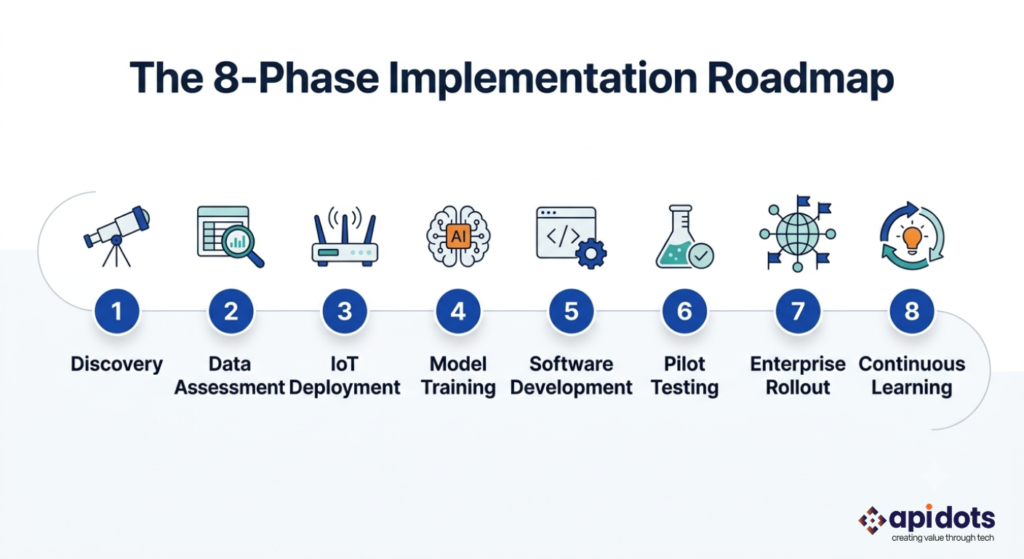
Phase 1 — Discovery. Define target assets, failure modes worth solving for, and success metrics before writing a single line of code. This phase should produce a prioritized list of assets ranked by downtime cost, not just “monitor everything.”
Phase 2 — Data Assessment. Audit what sensor data already exists, its quality, and its history. Many enterprises discover at this stage that their existing SCADA historian has years of usable data sitting idle — a huge accelerator if true, and a scope-defining constraint if not.
Phase 3 — IoT Deployment. Install or activate sensors and gateways on priority assets identified in Phase 1, starting with a limited pilot fleet rather than a full-site rollout.
Phase 4 — Model Training. Build and validate the initial ML models against historical failure data, using a held-out test set to confirm predictions generalize beyond the training window.
Phase 5 — Software Development. Build the dashboards, APIs, mobile app, and ERP/CMMS integrations that turn model output into something a maintenance team actually uses day to day.
Phase 6 — Pilot Testing. Run the system in shadow mode alongside existing maintenance practices on the pilot asset group, comparing predictions against real outcomes before anyone trusts it for scheduling decisions.
Phase 7 — Enterprise Rollout. Expand from pilot to full fleet or facility, with a staged rollout plan that accounts for change management and technician training, not just infrastructure scaling.
Phase 8 — Continuous Learning. Models are retrained on an ongoing basis as new failure and outcome data accumulates, and model drift is actively monitored rather than assumed away.
Most enterprise deployments take 4–9 months from Phase 1 to a working pilot and 12–18 months to a fully scaled multi-site rollout, though timelines vary significantly with how much of Phases 2 and 3 is already in place. Teams building this in-house alongside an AI development partner typically compress the discovery-to-pilot window considerably by reusing proven architecture patterns rather than starting from a blank page.
Exact pricing varies enormously by scope, so rather than quoting numbers that won’t hold up across contexts, here are the factors that actually drive cost, organized by enterprise size:
Small Business — Typically monitoring a handful of critical assets at a single site. Cost is driven mainly by sensor hardware and a lightweight cloud/ML pipeline; ERP integration needs are usually minimal or nonexistent.
Mid-Size Enterprise—Multi-line or multi-asset monitoring at one or a few facilities. Cost drivers expand to include custom model development per asset class, dashboard and mobile app development, and integration with an existing CMMS.
Large Enterprise—Multi-site deployment across a region or country. Cost drivers include enterprise-grade data infrastructure, ERP integration (SAP, Dynamics, and Salesforce), dedicated DevOps and MLOps pipelines, and formal change-management programs.
Global Enterprise — Multi-region, multi-facility deployment with strict compliance requirements (aviation, oil & gas, healthcare). Cost drivers include redundant cloud infrastructure, multi-region data residency compliance, 24/7 support operations, and continuous model governance across dozens or hundreds of asset classes.
Factors that most influence cost, regardless of size:
Our separate breakdown on custom software development cost and our dedicated AI software development cost guide for 2026 go deeper into how these factors translate into project budgets and timelines.
None of these are reasons to avoid predictive maintenance — they’re reasons to plan for them explicitly in the discovery and data assessment phases, where they’re far cheaper to address than after a system is already in production.
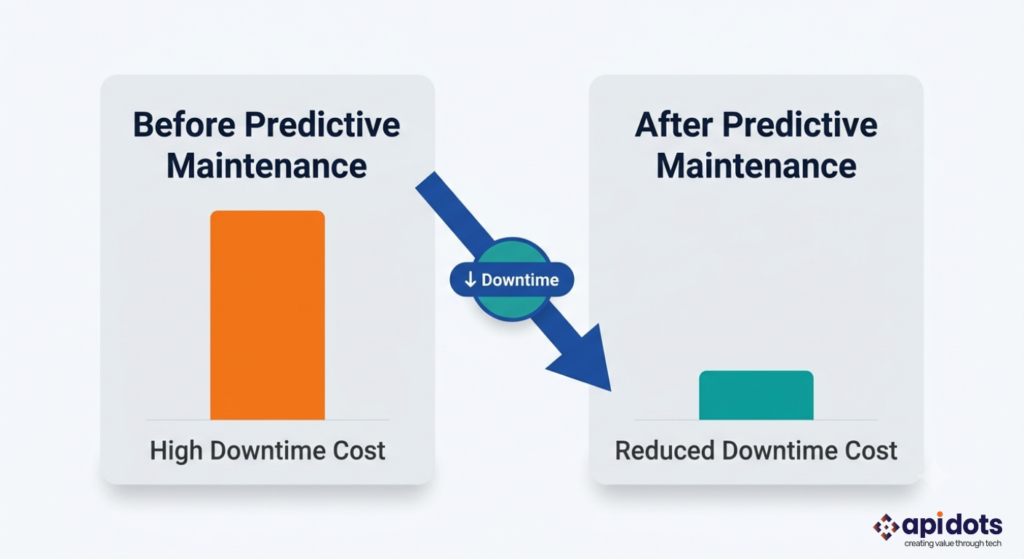
The way most enterprises actually build a business case for AI predictive maintenance is by starting with historical downtime cost on a small set of critical assets, then modeling what percentage of that downtime would realistically have been prevented with a few weeks of advance warning. That number, multiplied across the asset fleet the pilot is expected to scale to, is usually a far more persuasive figure to a CFO than any vendor’s generic industry benchmark. It’s also worth tracking soft ROI that doesn’t show up cleanly on a spreadsheet—technician morale improves meaningfully when the job shifts from constant firefighting to planned, resourced repair work, and that has real downstream effects on retention and safety culture that compound over multiple years.
What is AI Predictive Maintenance?
AI Predictive Maintenance uses sensor data and machine learning to forecast equipment failures before they happen, so maintenance can be scheduled precisely when needed rather than on a fixed calendar or after a breakdown.
How does predictive maintenance work?
Sensors capture data like vibration, temperature, and pressure; that data streams through edge and cloud infrastructure into machine learning models trained on historical failure patterns, which output a failure probability and estimated time window.
How much data is required to build a predictive maintenance model?
It depends on the model type. Classification models can work with as little as several months of labeled failure history, while RUL-forecasting models generally need at least one full failure cycle per asset class. Anomaly detection can start with far less, since it doesn’t require labeled failures at all.
What industries benefit most from AI predictive maintenance?
Manufacturing, oil & gas, energy, healthcare, and logistics see the fastest ROI, largely because unplanned downtime in these sectors carries an especially high cost per incident.
What is Remaining Useful Life (RUL)?
RUL is a model’s estimate of how much operating time or usage an asset has left before it’s likely to fail, expressed as a time window or usage threshold rather than a single hard date.
Can predictive maintenance work with legacy equipment?
Yes. Legacy PLCs and control systems can typically be integrated using protocol gateways (Modbus, OPC-UA) that sit alongside existing infrastructure without requiring equipment replacement.
Is AI predictive maintenance expensive?
Cost varies widely based on the number of assets, existing data quality, and integration complexity. A focused pilot on a handful of critical assets is far less expensive than a full-facility rollout, and most enterprises start with a pilot specifically to validate ROI before scaling.
Which sensors are required for predictive maintenance?
It depends on the failure modes being targeted — vibration and acoustic sensors for rotating equipment, thermal sensors for electrical and HVAC systems, and pressure/flow sensors for fluid systems are the most common starting points.
What cloud platforms support predictive maintenance? Azure IoT Hub and AWS IoT Core are the two most common enterprise choices, generally selected based on which platform the organization already standardizes on for identity and ERP systems.
How long does implementation take?
Most enterprise pilots take 4–9 months from initial discovery to a working proof of concept, with full multi-site rollout typically taking 12–18 months.
Do we need a data science team in-house to run this?
Not necessarily. Many enterprises partner with an outside development team for initial build and model development, then retain a smaller internal team for ongoing monitoring and business-side decision-making.
What’s the difference between anomaly detection and failure prediction?
Anomaly detection flags behavior that deviates from “normal” without necessarily knowing what it means; failure prediction goes further, tying a specific pattern to a specific failure mode and estimated timeline.
Can predictive maintenance integrate with our existing CMMS?
Yes — this integration is one of the most important parts of the architecture, since predictions only create value once they generate an actual work order in the system your maintenance team already uses.
What happens if a model’s prediction is wrong?
Models are evaluated on both false positives and false negatives; a well-designed system tracks prediction accuracy over time and retrains regularly to correct for drift, and human review remains part of the workflow rather than fully automated dispatch in most early-stage deployments.
Do digital twins require a separate investment from predictive maintenance?
They’re complementary rather than redundant — a digital twin provides simulation and remote diagnostics capability that a pure prediction model doesn’t, but many enterprises start with predictive maintenance alone and add a twin later for high-value assets.
How does predictive maintenance handle multiple sites with different equipment?
This typically requires a model architecture that supports per-asset-class models with shared infrastructure, rather than one universal model trying to cover fundamentally different equipment types.
What’s the biggest reason PdM pilots fail?
Poor data quality and unclear success criteria going in — not the sophistication of the machine learning model itself.
Does predictive maintenance replace maintenance technicians?
No — it changes what they do, shifting time away from routine inspection and emergency response and toward planned, higher-value repair work.
How do you measure ROI on a predictive maintenance system?
Most enterprises track reduction in unplanned downtime hours, maintenance cost per asset, and mean time between failures (MTBF) before and after deployment, alongside spare-parts inventory reduction.
What’s the role of edge computing in predictive maintenance?
Edge computing filters and pre-processes data locally, reducing bandwidth cost and enabling faster response for safety-critical failure modes that can’t wait for a round trip to the cloud.
API DOTS works with manufacturing, energy, healthcare, and logistics organizations to design and build predictive maintenance systems that fit into existing operations rather than requiring a rip-and-replace overhaul. Our work typically spans:
We’ve applied these same architecture patterns across predictive AI/ML projects in manufacturing and finance, and our broader AI-powered software solutions work informs how we approach every predictive maintenance engagement — starting from your existing data and systems, not a theoretical greenfield build.
Every quarter an enterprise runs without predictive maintenance is a quarter of avoidable downtime, unnecessary parts spend, and preventable risk. Whether you’re evaluating a pilot on a handful of critical assets or planning a multi-site rollout across a global operation, API DOTS can help you design an architecture that fits your existing systems and scales with your business.
Contact API DOTS today to discuss a custom AI Predictive Maintenance solution built around your assets, your data, and your existing infrastructure.
We leverage AI, cloud, and next-gen technologies strategically.Helping businesses stay competitive in evolving markets.
Consult Technology Experts
I’m a digital marketer with experience in SEO, content strategy, and online brand growth. I specialize in creating optimized content, improving website rankings, building high-quality backlinks, and driving traffic through effective digital marketing strategies. I enjoy helping businesses strengthen their online presence and turn visitors into customers.