
Top
Search
People also search for:

Stay Inspired with Instagram




A refinery in Port Arthur, Texas — one of the largest refining complexes in the United States — receives crude oil delivery schedules from six different suppliers across three continents. Every week, the scheduling team manually updates a spreadsheet that has 47 columns, inputs data from emails, phone calls, and PDFs from each supplier, and then produces a production schedule that the refinery operations team works from. The spreadsheet takes 14 hours to update. By the time it is finished, three of the input numbers have already changed. The refinery produces 8% more fuel than the market needs that week. The excess goes to storage, costing $340,000 in storage fees and reducing margins on the stored product by the time it sells.
This is not a story about a struggling refinery. This is standard operational reality in the oil and gas industry globally — from refineries in Texas and Louisiana to LNG terminals in Qatar and Australia.
AI is solving this problem in production deployments right now. This blog explains exactly how — covering five specific AI applications, with real examples from the US and globally, and clear guidance on how to implement each one.
The oil and gas industry is one of the most data-rich industries in the world. A single offshore platform generates millions of sensor readings per day. A modern refinery runs thousands of process control loops simultaneously. A pipeline network spanning thousands of miles generates continuous flow, pressure, and temperature data. The problem is not data scarcity. It is data use. Most oil and gas companies are collecting more data than they can possibly analyse manually — and until recently, most of that data went unexamined in historian databases that nobody had time to review.
AI changes this equation fundamentally. Machine learning models — software systems that learn patterns from historical data — can process years of sensor data in minutes, identify the specific patterns that precede equipment failures, and generate recommendations or automatic adjustments faster than any human team. For an industry where a single equipment failure costs millions of dollars and a single day of offshore platform downtime can exceed $10 million, the financial case for AI is not theoretical. It is one of the clearest ROI calculations in industrial technology today.
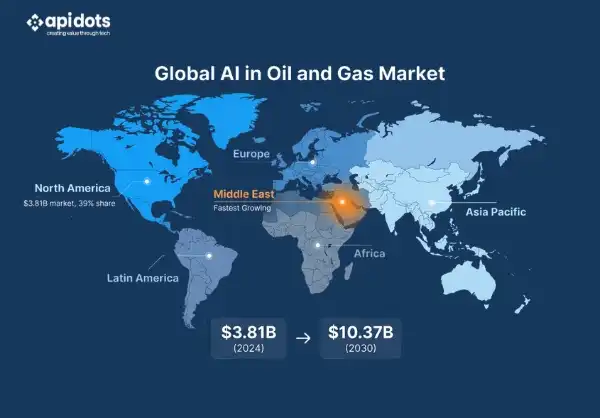
Key global market facts (Source: Grand View Research — AI in Oil and Gas Market Report):
Also Read: AI-Powered Software Solutions →
The cost of getting this wrong: $340,000 per week in one Port Arthur refinery. Multiplied across a global portfolio, overproduction and poor demand planning cost the industry an estimated $200 billion annually.
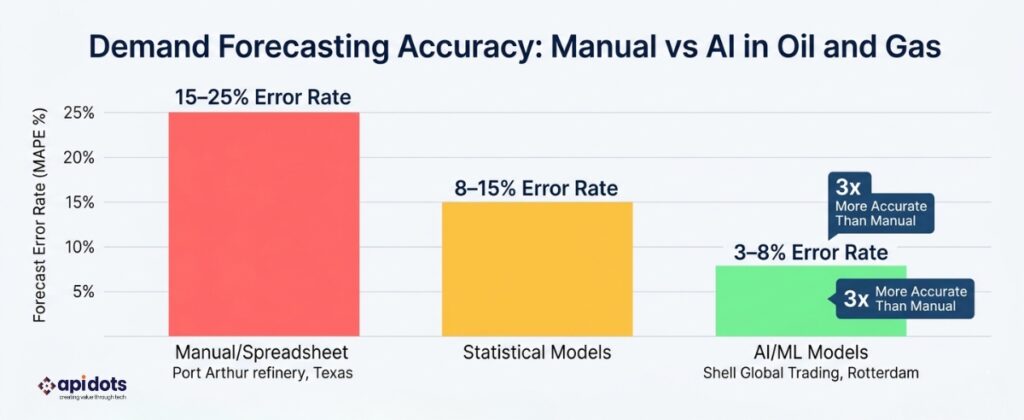
Demand forecasting in oil and gas means predicting how much oil, gas, refined products, or LNG customers and markets will need — before that demand materialises. Getting this wrong in either direction is expensive: produce too much and you pay for storage and sell at a discount; produce too little and you lose the sale to a competitor or pay a premium for emergency supply. For a 300,000-barrel-per-day refinery running 24 hours a day, a forecasting error of even 5% compounds into tens of millions of dollars in misallocated production every year.
Traditional forecasting in most oil and gas companies relies on historical averages, market analyst reports, and experienced human judgment — inputs that are useful but cannot process the real-time signals that actually drive demand changes: weather patterns, tanker movements, refinery outage reports, geopolitical developments, and competitor capacity changes. A scheduling team in Houston or Doha working from a weekly spreadsheet update is, structurally, always behind the market. By the time the spreadsheet is finished, the conditions that generated the inputs have already moved.
AI demand forecasting models ingest historical demand data alongside external signals — weather forecasts, shipping data, commodity futures markets, refinery utilisation rates, and news sentiment analysis — and produce forward-looking demand estimates updated in real time as new information arrives. The model does not replace the commercial team’s judgment. It gives them a quantitative baseline that is updated continuously rather than monthly. An operations manager in Corpus Christi, Texas and a commercial director in Abu Dhabi are looking at the same quality of real-time intelligence — not a spreadsheet that is already outdated.
Key benefits:
Shell’s global trading operation uses AI demand forecasting models to optimise crude oil cargo scheduling across its global refining network — including refineries in Rotterdam, Netherlands; Singapore; and Louisiana, USA. The AI model processes shipping AIS data (Automatic Identification System — the tracking technology used by commercial vessels), regional refinery utilisation rates, and weather pattern data to optimise cargo scheduling in real time. Shell has reported that AI-assisted scheduling reduces cargo optimisation time from days to hours and improves refinery feedstock planning accuracy significantly across its multi-continent operation.
ExxonMobil’s Baytown, Texas refinery — one of the largest in the US with a capacity of 560,000 barrels per day — uses AI demand forecasting to optimise its production slate across gasoline, diesel, jet fuel, and petrochemical feedstocks. The model integrates US EIA (Energy Information Administration) inventory data, futures market signals, and regional consumption patterns to adjust the refinery’s product mix in near-real-time. In an environment where the price difference between getting the product mix right and wrong runs to millions of dollars per week, this is not a marginal improvement.
What to do next:
Also Read: Smart AI Inventory Management →
The cost of manual administration: an independent operator in Oklahoma spends 3 hours per day on one regulatory filing. Across the US upstream sector, manual administrative processes consume an estimated $15 billion in skilled employee time annually that could be directed at operational value.
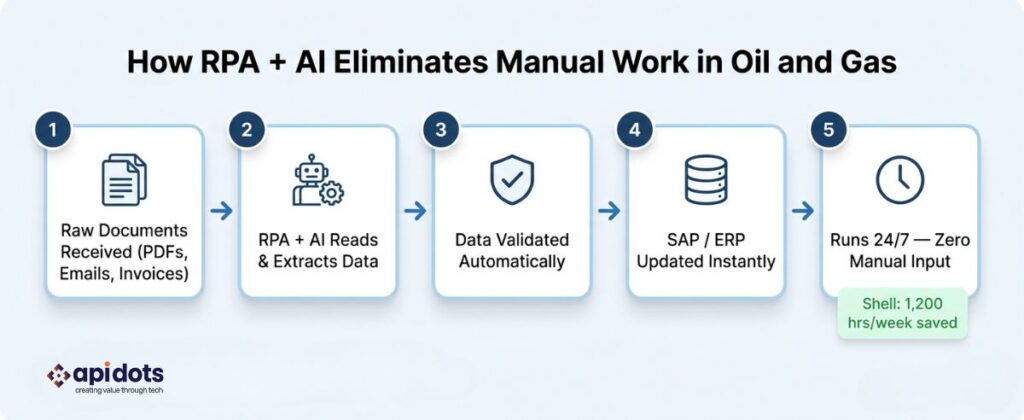
Robotic Process Automation — RPA — is software that mimics what a human does with a computer: reading data from one system, copying it into another, filling in forms, generating reports, sending emails, and processing documents. In oil and gas, enormous amounts of time are spent on exactly this kind of work: processing well production reports, updating materials management systems, reconciling supplier invoices, generating regulatory compliance reports, and managing procurement workflows. RPA automates these tasks completely, running 24 hours a day without breaks or errors.
Oil and gas companies are among the most administratively complex businesses in the world. A single well completion in the Permian Basin in Texas generates permits, environmental reports, equipment delivery documentation, contractor safety certifications, and production test reports — dozens of documents that currently require manual processing by administrative staff. A global LNG project involving suppliers from 15 countries generates invoices, certificates of origin, shipping documents, and regulatory filings in multiple languages and formats. In Nigeria, Angola, or Kazakhstan, add local content documentation and government approvals to that list. Manual processing of all of this creates delays, introduces errors, and consumes skilled employee time that should be spent on higher-value work.
When RPA is combined with AI — specifically with document recognition models that can read unstructured documents like PDFs and emails — the combination can process documents that vary in format, extract the relevant data fields automatically, route them to the right system, and flag exceptions for human review. This is not just automation of fixed templates. It is intelligent document processing that handles the messy, inconsistent, real-world documents that oil and gas companies actually receive: invoices from 50 different supplier formats, field service tickets written differently by every contractor, and regulatory reports with jurisdiction-specific requirements across Texas, Oklahoma, Louisiana, Norway, and the UK.
Key benefits:
Shell deployed RPA across 13 administrative processes globally, including accounts payable, procurement, and regulatory reporting across its operations in the Netherlands, UK, Nigeria, and Australia. The programme saved the equivalent of 1,200 hours of manual work per week — the output of approximately 30 full-time employees — and reduced invoice processing time from 14 days to 2 days on average. In Nigeria, where local content documentation requirements are particularly extensive, the automated processing system eliminated the manual reconciliation bottleneck that had previously caused regular payment delays to local suppliers.
A major independent operator in the STACK play in Oklahoma deployed RPA for their state regulatory reporting process — specifically for the daily production reports required by the Oklahoma Corporation Commission. The automated system reads production data directly from their historian (the database that stores time-series operational data), generates the required report format, and submits it to the Commission’s electronic filing system. What previously required 3 hours of daily staff time now runs automatically in 12 minutes with no manual intervention. The same operator extended the system to invoice processing for their oilfield services contractors, reducing accounts payable cycle time from 21 days to 4 days.
Action points:
Also Read: RPA vs Intelligent Automation Strategy 2026 →
The cost of equipment failure: a single compressor failure on a Gulf of Mexico offshore platform can cost $8 million to $15 million in deferred production and emergency response. Across the global industry, unplanned equipment downtime accounts for an estimated $88 billion in annual losses.
Predictive maintenance uses AI to predict when equipment will fail before it actually fails — so you can fix it at a planned time rather than after an unplanned breakdown. It works by continuously monitoring equipment sensor data (vibration, temperature, pressure, electrical consumption) and using machine learning models to detect patterns in that data that historically appeared before failures. The key word is “before.” A predictive system tells you a compressor bearing is degrading three weeks from now. A reactive system tells you the compressor has stopped and production is down.
Equipment failure in oil and gas operations is one of the most expensive single events a company can experience. For an onshore well in the Permian Basin in West Texas producing 500 barrels per day, a pump failure causes 10 to 20 days of downtime at $37,500 to $75,000 in lost production — before emergency labour and parts costs. For an offshore platform in the Gulf of Mexico or the Norwegian North Sea producing 15,000 barrels per day, a compressor failure can cause 8 to 15 days of full platform shutdown at $8 million to $15 million per event. For a Qatari LNG liquefaction train processing 7.8 million tonnes per year, an unplanned shutdown of even five days has production and contractual penalty costs that run to tens of millions of dollars.
Multiplied across a global portfolio of equipment — pumps, compressors, turbines, heat exchangers, electrical systems — unplanned downtime is one of the largest controllable cost drivers in the industry. The word “controllable” is important: this is not the price of oil. These are costs that operational decisions can directly reduce.
AI predictive maintenance systems train ML models on historical sensor data and historical failure records. The model learns what combinations of sensor readings consistently appeared in the hours, days, or weeks before each past failure. When real-time sensor data starts matching those patterns, the system generates an alert — days or weeks before the actual failure — giving maintenance teams time to plan an intervention during a scheduled maintenance window instead of scrambling for emergency parts and helicopter transport to an offshore platform in the North Sea or the Gulf of Mexico.
Key benefits:
Shell’s North Sea and Gulf of Mexico operations use an AI predictive maintenance system monitoring 4,000 data streams from rotating equipment across multiple platforms. The system predicts equipment failures an average of six weeks before occurrence. Shell estimates the system prevents losses of over $100 million annually in deferred production and emergency maintenance costs.
In Norway, Equinor has deployed AI predictive maintenance across its Troll, Oseberg, and Åsgard platforms in the Norwegian North Sea — assets that collectively produce over 500,000 barrels of oil equivalent per day. The system has reduced unplanned compressor shutdowns by 35% since full deployment. In the context of Norwegian offshore day rates and logistics costs, each avoided shutdown represents several million dollars of preserved value.
A mid-size independent operator with 300 wells in the Midland Basin section of the Permian Basin in West Texas deployed an AI artificial lift monitoring system. The ML model was trained on 24 months of pump vibration, temperature, and production data. In the 12 months following deployment, unplanned pump failures fell by 38%, and the system generated a payback from deferred production savings in four months — well ahead of the 12-month payback period the team had projected.
Action points:
Also Read: Predictive AI and ML Development for Finance and Manufacturing →
Running oil and gas operations in the US, Middle East, Europe, or Asia Pacific?
The team at apidots.com offers a free 30-minute operational scoping call. Tell us about your most expensive operational problem — unplanned downtime, manual processes, or forecasting errors — and we will tell you honestly whether AI can fix it and how long it takes.
The cost of supply chain failure: an emergency procurement event in Middle East offshore operations costs an average of $12,000 in premium charges per incident. A national oil company experiencing 35 such events per month is spending $5 million per year on supply chain inefficiency alone — before counting production downtime caused by parts shortages.
Supply chain and inventory management in oil and gas covers every physical item the industry needs to operate: drilling bits, completion chemicals, wellhead equipment, spare parts for processing facilities, lubricants, safety equipment, and consumables for thousands of wells and facilities worldwide. Getting inventory wrong is expensive in both directions: too much inventory ties up capital in warehouses in Midland, Texas or Aberdeen, Scotland; too little inventory causes operational shutdowns when a critical part is not available when a failure occurs. AI supply chain systems predict what parts will be needed, when, and in what quantities — before the shortage happens.
Oil and gas supply chains are genuinely global and genuinely complex. A single drilling programme in North Dakota might require 2,000 different line items sourced from suppliers in Houston, Aberdeen, Singapore, and Dubai. Managing this manually — using spreadsheets, email, and phone calls — creates lead time errors, duplicate orders, stockouts of critical items, and overstock of items that sit in a warehouse for years. The problem is amplified in offshore operations, where the logistics of getting the wrong part to a platform in the Gulf of Mexico or the North Sea includes helicopter costs, marine vessel scheduling, and customs clearance delays. In Nigeria’s Niger Delta, add local content regulation and port clearance complexity to that list.
AI supply chain systems predict what parts will be needed, when, and in what quantities — based on predictive maintenance alerts, production schedules, historical consumption patterns, and supplier lead times. When integrated with an ERP system (SAP, Oracle, or similar), the AI system can automatically trigger purchase orders before stockouts occur and recommend order quantities that balance holding costs against stockout risk. When integrated with a supplier network, it can track inbound shipments in real time and flag delays before they cause operational problems. The system learns from every order cycle — improving its predictions as it accumulates more operational history.
Key benefits:
Saudi Aramco’s supply chain transformation programme — part of their broader $5 billion digital transformation investment — uses AI-powered inventory optimisation across their warehousing network in the Eastern Province of Saudi Arabia. The system manages parts inventory for over 100 production facilities and has reduced emergency procurement events by 40% and inventory carrying costs by 22%.
TotalEnergies has deployed AI supply chain optimisation across their operations in Angola and the Republic of Congo, specifically to manage the logistics complexity of deepwater offshore supply chain management where helicopter and vessel lead times are long and stockout costs are extreme. For deepwater operations 150 kilometres offshore, a missing gasket that stops production for two days has a cost that is entirely disproportionate to the value of the gasket itself.
Halliburton — headquartered in Houston, Texas and operating across every major US producing basin including the Permian, the Haynesville in Louisiana, and the Appalachian basin in Pennsylvania and West Virginia — uses AI-driven inventory optimisation for its drilling services business, managing chemical inventories for completion operations across thousands of simultaneous well completions. The system reduced inventory waste by 18% and emergency re-supply events by 31% in its first year of full deployment across North American operations.
Action points:
Also Read: Weather Intelligence for Smarter Logistics →
The cost of unused data: the average oil and gas company analyses less than 1% of the operational data it collects. The operational insights buried in the remaining 99% — which completion designs produce the best long-term wells, which equipment configurations fail most often, which suppliers deliver quality consistently — represent billions in untapped value across the industry.
Data analytics in oil and gas means turning the massive volumes of operational data the industry generates — sensor readings, production tests, drilling reports, seismic surveys, financial transactions, and maintenance records — into decisions. Traditional analytics tools give managers dashboards that show what happened. AI-powered analytics goes further: it identifies patterns in historical data, predicts what will happen next, and in some cases recommends specific actions to improve outcomes. The distinction between reporting and predicting is where the real operational value lives. A dashboard tells a production engineer that well performance declined last month. An AI analytics system tells them which specific completion parameter change would improve it — and by how much.
Most oil and gas companies have more data than they can use. A medium-size operator with 500 wells generates millions of data points per day from their SCADA systems, production historians, and field sensors. Most of this data is stored, never analysed, and discarded after a retention period. The operational insights buried in that data — which completion techniques produce the best long-term production in a given formation, which equipment configurations are most reliable in a specific operating environment, which suppliers deliver quality equipment most consistently — remain invisible because nobody has the time or tools to extract them.
In the Permian Basin in Texas, where operators drill hundreds of wells per year in similar geological formations, the difference between the best-performing and worst-performing completions in any given landing zone can be 40 to 60% in 24-month production. AI analytics finds that difference and explains it. Without AI, operators are repeating the same completion design regardless of what the data is telling them.
AI analytics platforms apply machine learning to historical operational data to surface patterns and insights that manual analysis would never find. Instead of a geologist manually comparing 200 well completions to find the best practices for a given formation, an ML model analyses all 200 wells simultaneously, identifies the specific completion parameters that correlate with the best 36-month production curves, and generates a recommended completion design for the next well. This process takes hours instead of months and produces statistically robust conclusions rather than anecdotal ones. The same approach applies to safety analytics, equipment reliability analysis, and commercial performance benchmarking.
Key benefits:
BP uses AI analytics across their global exploration and production portfolio — including assets in the Gulf of Mexico, the North Sea, Azerbaijan, and Angola — to identify the geological and operational factors that drive production outperformance across their well portfolio. Their AI analytics programme, developed in partnership with their internal data science teams, has been linked to material improvements in capital allocation decisions — directing drilling investment toward the geological targets most likely to produce the highest returns per dollar of capital invested.
In the UK North Sea, where well economics are under constant pressure from high operating costs, BP’s AI analytics capability has enabled production optimisation decisions that extend asset life without additional capital investment — one of the most valuable applications in a mature basin.
Pioneer Natural Resources — one of the largest Permian Basin operators in West Texas before its acquisition by ExxonMobil — deployed comprehensive AI analytics across their Midland Basin well portfolio. The system analysed completion parameters, geological characteristics, and production data from thousands of wells to identify the specific combinations of hydraulic fracturing design and geological landing zones that produced the highest 24-month production curves. The insights from this analysis were reported to have improved their average well productivity by 15% over a three-year implementation period — a result that, across a portfolio of hundreds of wells per year, represents hundreds of millions of dollars in incremental production value.
Action points:
Also Read: Predictive Analytics Software Development →
A mid-size independent operator with 340 producing wells across the Midland Basin in Pecos County and Howard County, West Texas, and the Delaware Basin in Reeves County. The company produces approximately 18,000 barrels of oil equivalent per day with a mix of oil wells and associated gas production.
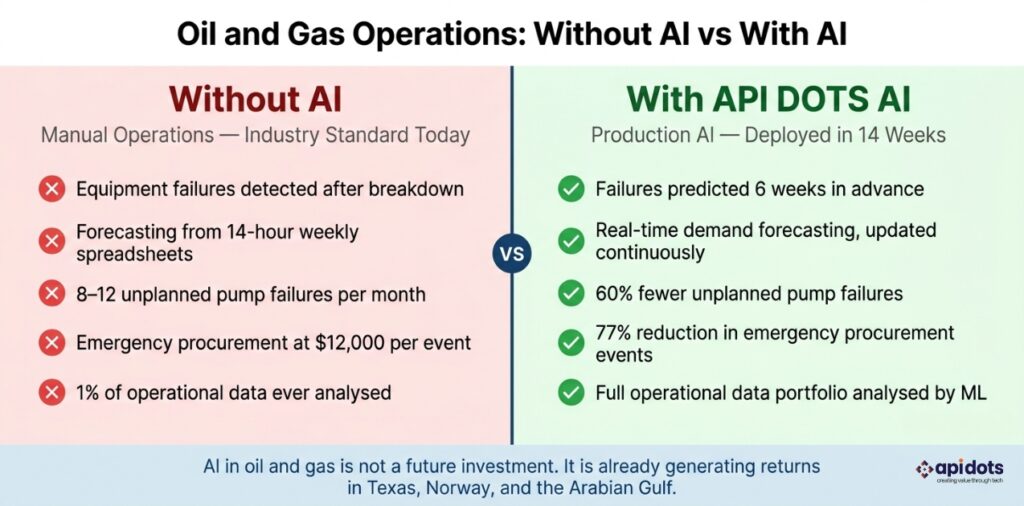
Their artificial lift electrical costs had increased by 40% over 18 months as water cut rose across their maturing well portfolio. Water cut — the proportion of produced fluid that is water rather than oil — is a natural feature of maturing oilfields, and it drives up the energy cost of artificial lift because the pump is working harder to lift more total fluid for the same amount of oil. Their three production engineers were managing lift settings manually across all 340 wells, reviewing data weekly and making adjustments based on experience. With each engineer responsible for 110 to 115 wells, daily optimisation was impossible. They were also experiencing 8 to 12 unplanned pump failures per month, each causing 5 to 12 days of downtime per well at a production cost of $18,500 to $44,400 per event.
The team at API DOTS built a combined predictive maintenance and artificial lift optimisation system. The predictive maintenance model was trained on 24 months of vibration, temperature, and current draw data from all pump types across the portfolio. The optimisation model used real-time production data to generate pump speed recommendations every 15 minutes for each well. Both models were integrated with the company’s existing SCADA system via API — no new field hardware was required. Engineers received daily summary reports and exception alerts through their existing operations dashboard.
Deployment timeline: Discovery and data audit — 2 weeks. Model development and validation — 8 weeks. SCADA integration and production deployment — 4 weeks. Total: 14 weeks from kick-off to full operation.
Results in 12 months:
Also Read: API DOTS Cloud Services →
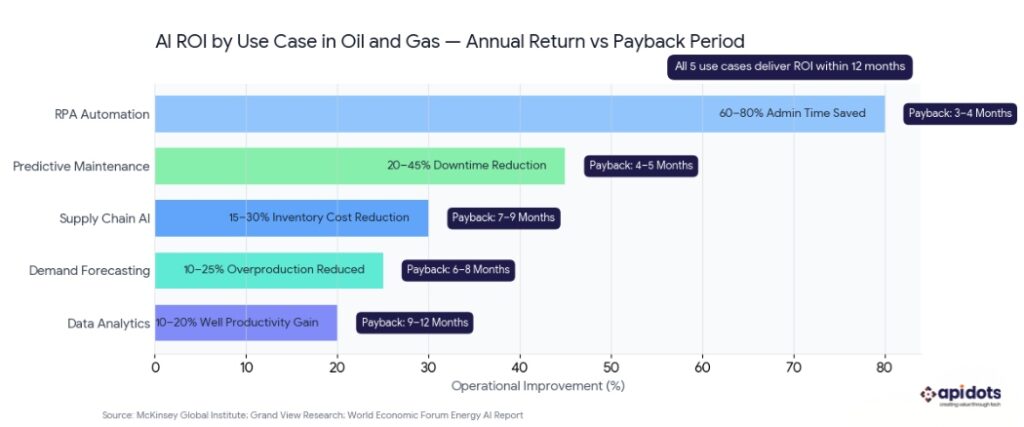
The five sections above each addressed a specific operational problem with a specific cost. Taken together, AI in oil and gas is not a technology initiative. It is a structural cost reduction programme with documented ROI across every segment of the value chain.
Upstream benefits:
Midstream benefits:
Downstream benefits:
Cross-value-chain benefits:
The McKinsey State of AI report documents consistent findings across industrial sectors: companies that deploy AI at scale in operations generate 15 to 20% improvements in key operational metrics within 12 to 18 months of full deployment. Read McKinsey’s analysis here →
Also Read: Agentic AI vs AI Agents for Digital Transformation →
The team at apidots.com builds production AI and machine learning systems for oil and gas companies globally — from independent operators in the Permian Basin and the Bakken to national oil companies in the Middle East and international operators in the North Sea. The word “production” matters: API DOTS does not deliver demos, pilots, or proof-of-concept models that never get deployed. Every engagement ends with a working AI system integrated into the client’s operational environment and generating measurable results.
The approach that consistently produces those results is not standard software development methodology applied to AI. It is an operations-first process that begins with understanding the specific financial problem before touching a line of code.
Delivery process:
Services specifically relevant to oil and gas:
Explore: API DOTS AI and ML Development → Explore: API DOTS Full Services → Also Read: Choose the Right AI Development Company →
Ready to deploy AI in your oil and gas operations?
Whether you operate in Texas, Oklahoma, Louisiana, the Gulf of Mexico, Saudi Arabia, the UAE, Norway, or anywhere globally, the team at apidots.com builds AI systems designed for your operational environment. Start with a free 30-minute consultation.
Contact API DOTS for a Free Consultation →
Q1. What is the fastest AI implementation for an oil and gas company to get returns from?
AI predictive maintenance for artificial lift equipment — specifically electric submersible pumps (ESPs) and rod lift systems — consistently delivers the fastest payback for onshore oil and gas operators. For a portfolio of 50 to 200 wells with an existing sensor network and historian, a predictive maintenance ML model can be built, validated, and deployed in 10 to 14 weeks. The financial return from preventing even two to three unplanned pump failures in the first month frequently covers the entire implementation cost. For offshore operators in the Gulf of Mexico, the North Sea, or the Arabian Gulf, predictive maintenance on gas compressors delivers similar or higher returns due to the substantially higher cost of offshore downtime.
Q2. Does AI in oil and gas require new sensor equipment and hardware?
In most cases, no. The most common starting point for AI in oil and gas uses sensor data that already exists in the operator’s historian or SCADA system. ML models are trained on this historical data and deployed as software that reads from the same existing data streams. No new field hardware is required for predictive maintenance, demand forecasting, supply chain optimisation, or data analytics implementations. The only AI applications that might require new hardware are those that need sensor types not currently installed — for example, acoustic sensors for advanced pipeline leak detection or optical gas imaging cameras for methane detection under evolving EPA and EU methane regulations.
Q3. How does AI for oil and gas handle the differences between onshore and offshore operations?
The core AI technology is the same for onshore and offshore — ML models trained on sensor data, integrated with existing data infrastructure via API. The differences are in the data environment and the deployment architecture. Offshore platforms typically have more sophisticated, higher-frequency sensor systems than onshore well pads, which gives AI models more data to train on and improves model performance. Offshore deployments also have stricter requirements for data security and system isolation — particularly for platforms with connectivity to corporate networks, where IT and OT (operational technology) separation is a safety requirement. The team at apidots.com has deployed AI systems in both environments and designs the deployment architecture specifically for the connectivity and security requirements of each.
Q4. What is the difference between RPA and AI in oil and gas operations?
RPA automates tasks that involve consistent, structured data — copying information from one system to another, filling in standard forms, sending standard emails. It follows fixed rules and handles variations poorly. AI adds intelligence to this: it can read unstructured documents like PDFs and emails, extract relevant information even when the format varies, and make decisions based on what it reads rather than following a fixed rule. For oil and gas operations, RPA alone handles standard data entry workflows. RPA combined with AI handles the document-heavy, format-variable administrative processes that dominate oil and gas administration: invoices from 50 different supplier formats, regulatory reports with jurisdiction-specific requirements, and field service tickets written in varying formats by different contractors across Texas, Oklahoma, Louisiana, and internationally.
Q5. How do oil and gas companies in the Middle East and globally implement AI differently from US operators?
The technology and approach are the same globally — ML models, SCADA integration, historian data, API connections. The differences are in the operational context and the data environment. Middle East national oil companies like Saudi Aramco and ADNOC tend to implement AI at much larger scale — across thousands of wells and multiple integrated facilities simultaneously — with significant internal AI teams managing the programme alongside external development partners. US independent operators typically start with a focused, high-ROI application like artificial lift predictive maintenance and expand from there. European operators in the North Sea (Equinor, Shell, BP) typically have strict data governance and safety management system requirements that shape how AI systems are designed and validated. The team at apidots.com has experience in all three operational contexts and designs implementation approaches accordingly. For further context, Gartner’s 2026 data and analytics predictions outline the accelerating enterprise AI deployment trend that is driving this convergence globally.
Q6. What should an oil and gas company do before approaching an AI development firm?
Three things before any vendor conversation will dramatically improve the quality of the engagement. First, define your most expensive operational problem in financial terms — not “we want better data” but “we lose approximately $X million per year in unplanned downtime from this specific equipment type.” Second, understand what operational data you have available: which sensors are installed, how long the historian data goes back, and whether it has been consistently tagged and calibrated across your asset portfolio. Third, decide who the internal project owner is — AI implementations that succeed have a named operations person who owns the outcome, not just an IT project manager who owns the delivery. The team at apidots.com offers a free 30-minute scoping call to help oil and gas companies assess their readiness before committing to any formal engagement.
We manage and optimize your IT infrastructure end-to-end.Ensuring stability, security, and operational continuity.
Consult IT Experts
I’m a digital marketer with experience in SEO, content strategy, and online brand growth. I specialize in creating optimized content, improving website rankings, building high-quality backlinks, and driving traffic through effective digital marketing strategies. I enjoy helping businesses strengthen their online presence and turn visitors into customers.