
Top
Search
People also search for:

Stay Inspired with Instagram




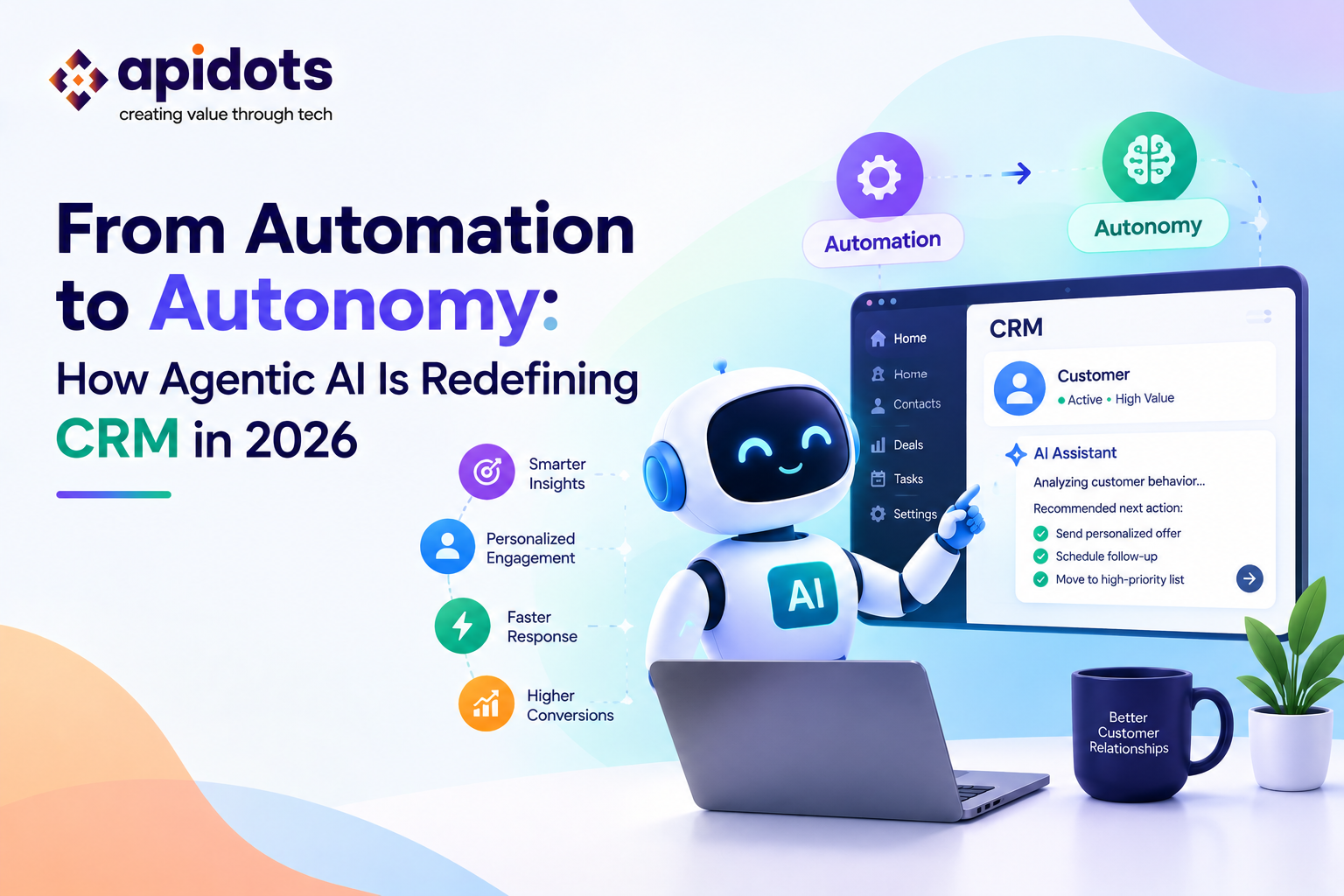
Customer relationship management has always been about helping businesses understand their customers, manage interactions, and move opportunities through the sales pipeline. But traditional CRM systems largely depend on people to enter data, update records, create tasks, follow up with leads, and decide what should happen next.
That model is changing.
In 2026, agentic AI is pushing CRM from a system that records activity toward a system that can understand context, make decisions, execute tasks, and continuously assist teams toward business outcomes.
Instead of simply telling a salesperson that a lead needs attention, an agentic CRM can potentially research the account, evaluate the lead, prepare a personalized follow-up, update the CRM, schedule the next action, and escalate the decision to a human when approval is required. This shift is creating new opportunities for businesses exploring agentic AI solutions, custom CRM development services, and intelligent CRM platforms.
Agentic AI refers to AI systems designed to perform multi-step tasks with a degree of autonomy rather than simply responding to individual prompts. In a CRM environment, an AI agent can work with customer data, business rules, workflows, external applications, and other systems to complete tasks toward a defined objective.
For example:
A new enterprise lead enters the CRM.
A traditional CRM may:
An AI-assisted CRM might:
An agentic CRM can go further:
The important distinction is action.
Agentic CRM isn’t simply about generating AI responses. It is about connecting intelligence with workflows and controlled execution. Microsoft describes agentic CRM as an approach in which agents can capture, enrich, and update information while helping teams take action within their existing workflows. (Microsoft)
Evolution can be understood through three stages.
| Capability | Traditional CRM | AI-Assisted CRM | Agentic CRM |
| Customer data management | ✓ | ✓ | ✓ |
| Reporting & dashboards | ✓ | ✓ | ✓ |
| Workflow automation | ✓ | ✓ | ✓ |
| AI recommendations | Limited | ✓ | ✓ |
| Content generation | ✗ | ✓ | ✓ |
| Multi-step task execution | Limited | Limited | ✓ |
| Autonomous decision support | ✗ | Limited | ✓ |
| Cross-system actions | Limited | Limited | ✓ |
| Continuous context awareness | Limited | ✓ | ✓ |
| Human approval controls | ✓ | ✓ | ✓ |
The goal isn’t necessarily to remove people from the process.
Instead, agentic AI can shift employees away from repetitive administrative work toward activities requiring judgment, creativity, relationships, and strategic decision-making.
One of the biggest problems with traditional CRM isn’t a lack of data It’s what happens after the data enters the system.
Sales teams may have thousands of customer records but still spend significant time:
This creates what is often described as the administrative burden of CRM.
Agentic AI changes the model by allowing software to work with customer information and take predefined actions. Microsoft’s current Dynamics 365 CRM offering, for example, includes AI agents designed for activities such as lead qualification, sales research, scheduling, follow-ups, and customer-service workflows. (Microsoft)
CRM data becomes less valuable when it isn’t updated.
Salespeople may forget to update opportunities after meetings or leave customer records incomplete because administrative work competes with selling time. An agentic system can capture signals from permitted business systems and use them to keep records more current.
For example:
Meeting completed → conversation analyzed → next action identified → opportunity updated → follow-up task created.
The exact implementation depends on the organization’s systems, permissions, privacy requirements, and approval policies.
The principle is simple:
CRM should increasingly work alongside employees instead of creating additional administrative work for them.
Lead qualification is another area where agentic AI can provide practical value.
Imagine receiving 500 leads in a month. Instead of asking sales representatives to manually research every lead, an AI agent could evaluate predefined criteria such as:
The system can then prioritize leads and provide supporting context to sales representatives.
Human teams still determine the qualification criteria and can review important decisions. This creates a more controlled model than simply allowing an AI system to make unrestricted decisions.
Generic automation sends the same message to large groups of people.
Agentic systems can potentially use customer context to create more relevant interactions.
For example:
Customer interaction history + account information + current opportunity + previous communication → personalized next action.
The result could be:
Salesforce’s current approach to CRM-integrated AI agents similarly emphasizes working with unified CRM data and performing actions within governed CRM environments. (Salesforce)
Sales pipelines often contain opportunities that appear healthy on paper but show warning signals underneath.
An agentic CRM could monitor signals such as:
The system could then flag an opportunity and recommend an action.
For example:
Risk detected: No meaningful customer interaction in 21 days.
Recommended action: Review account status and schedule a decision-maker follow-up.
This moves CRM toward proactive assistance rather than passive record keeping.
Agentic AI can potentially support multiple areas of the customer lifecycle.
An AI agent can gather approved information from connected sources and prepare an account brief before a sales meeting.
The salesperson receives:
Instead of simply reminding a salesperson to follow up, an agent could:
The important part is the workflow orchestration, not simply email generation.
Agentic AI can also support customer-service workflows.
For example:
Customer email → intent detection → case creation → priority assignment → relevant information retrieval → response draft → human review → resolution → CRM update.
Some implementations may allow agents to handle low-risk requests automatically while escalating complex or sensitive cases.
AI agents can monitor customer signals and identify accounts that may require attention.
Potential signals include:
Rather than waiting for a customer to leave, the CRM can help teams identify potential risks earlier.
Building an agentic CRM requires more than connecting an LLM to an existing database.
A production-ready system generally needs multiple layers.
This contains information such as:
This is where AI agents interpret context, reason through tasks, and determine appropriate actions.
Different agents may handle different responsibilities.
For example:
Agents often need access to other systems.
These may include:
This layer determines what an AI agent can and cannot do.
For example:
An agent can draft a contract email but cannot send it without approval.
Or:
An agent can update lead scores but cannot delete customer records.
Businesses need visibility into:
This is especially important as AI agents become more autonomous.
Off-the-shelf CRM platforms work well for many organizations.
But businesses with specialized processes may eventually need more flexibility.
For example, a company may require:
This is where custom CRM development services become relevant.
Instead of forcing business processes into a standard CRM structure, organizations can design the system around their actual workflows. A custom CRM doesn’t necessarily mean rebuilding everything from scratch. A practical approach can involve extending existing CRM platforms, integrating specialized services, and developing custom agentic capabilities where they create measurable value.
More autonomy creates more responsibility.
An AI agent that can only generate text has limited system access.
An AI agent that can:
has significantly greater potential impact.
Therefore, agentic AI development services should include governance as part of the architecture not as an afterthought.
Important controls include:
Agents should only access the data and actions they require.
High-impact actions should require human review when appropriate.
Businesses should be able to determine what happened and when.
Important decisions, tool calls, and system actions should be traceable.
Sensitive customer information must be handled according to applicable privacy and security requirements.
Organizations should continuously evaluate agent performance and unexpected behavior.
The future of CRM isn’t necessarily AI instead of humans.
A more practical model is:
AI handles repetitive execution → humans handle judgment and accountability.
For example:
AI identifies a duplicate customer record and suggests merging it.
AI prepares a personalized sales email for approval.
AI identifies a potential contract issue and escalates it to the appropriate employee.
This approach provides autonomy while maintaining control.
Businesses shouldn’t attempt to automate everything at once.
A phased approach is usually easier to manage.
Find CRM activities that consume time but follow relatively predictable rules.
Start with a workflow where improvement can be measured.
Examples:
AI is only as useful as the context it can reliably access.
Clean and structured CRM data should therefore be treated as part of the implementation.
Clearly establish:
Measure:
Once the first workflow is stable, additional agents and processes can be introduced.
Agentic CRM development can create significant opportunities, but several mistakes can reduce its value.
AI won’t automatically fix an inefficient workflow.
First improve the process, then automate it.
Autonomy without appropriate permissions can introduce unnecessary risk.
Poor CRM data produces poor context and unreliable outputs.
Businesses need clear metrics to determine whether an AI agent is actually improving a workflow.
Agentic AI works best when connected to business processes, data, APIs, permissions, and monitoring.
Some decisions require context, accountability, negotiation, or empathy that shouldn’t be delegated automatically.
CRM software is gradually moving from recording customer activity toward understanding context and assisting with action.
The next generation of CRM applications is likely to combine:
This doesn’t mean every CRM will become completely autonomous.
Instead, businesses will likely determine where autonomy creates value and where human control remains essential.
That distinction will be particularly important as organizations move from experimenting with AI to deploying it in real business workflows.
If you’re considering building an intelligent CRM, don’t evaluate a development company only on its ability to create dashboards or CRUD applications.
Look for experience across:
More importantly, the development partner should understand your business workflow, not just the technology.
The strongest CRM implementations begin with a business problem and then determine where AI can create measurable value.
The shift from automation to autonomy is changing how businesses think about CRM. Traditional CRM systems were designed primarily to store customer information and track activity. Modern AI-powered CRM systems are increasingly being designed to interpret context, recommend actions, and execute parts of the customer workflow.
Agentic AI takes that evolution further by allowing software agents to work across data, tools, workflows, and business rules. For companies considering this transition, the opportunity isn’t simply to add an AI chatbot to an existing CRM.
It’s to rethink how customer-facing processes work.
With the right architecture, governance, integrations, and human oversight, agentic AI solutions can become part of a broader strategy for building more responsive and intelligent CRM systems.
At APIDOTS, we help businesses explore and build technology solutions around AI, CRM, automation, and custom software development. Our expertise in custom CRM development services, agentic AI development services, and CRM software development can help organizations turn complex business workflows into practical digital solutions.
Whether you need a new custom CRM development software solution, intelligent workflow automation, AI-agent integration, or a complete CRM application, the focus should remain the same: build technology that solves a real business problem and creates measurable value.
Agentic AI in CRM refers to AI systems that can understand business context, make decisions within defined boundaries, and perform multi-step CRM tasks rather than simply generating responses or recommendations.
Traditional automation generally follows predefined rules such as “if X happens, do Y.” Agentic CRM can interpret context, coordinate multiple steps, use connected tools, and adapt its actions within defined permissions and business rules.
Common use cases include lead qualification, sales research, automated follow-ups, customer support, data enrichment, opportunity management, customer retention, and workflow orchestration.
It can be implemented safely when appropriate permissions, human approvals, monitoring, audit trails, data protection, and testing are built into the system. The level of autonomy should match the risk associated with each action.
Custom CRM development can make sense when standard CRM platforms cannot adequately support a company’s unique workflows, integrations, data models, approval processes, or AI requirements.
APIDOTS can help businesses with AI development, custom CRM development, integrations, workflow automation, and software solutions designed around specific business requirements and processes.
We build and deploy end-to-end AI software solutions for businesses. Accelerating efficiency, automation, and intelligent decision-making.
Get AI Development Services
Comments are closed.
1 Comment
[…] agentic AI CRM can potentially coordinate several of these steps […]