
Top
Search
People also search for:

Stay Inspired with Instagram




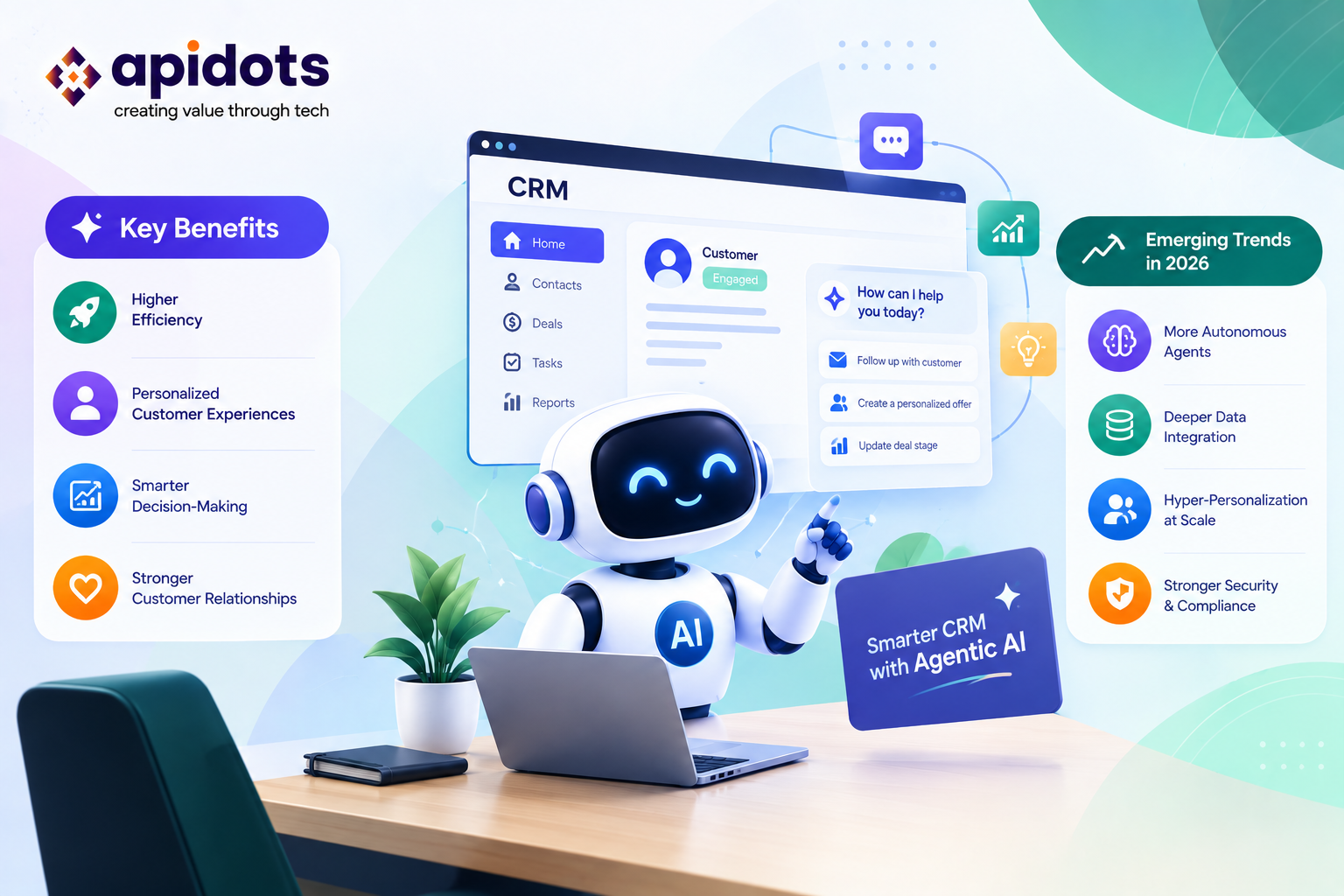
Customer relationship management has traditionally been about recording information: leads, conversations, opportunities, support tickets, purchases, and customer interactions. But the role of CRM is changing.
With the rise of agentic AI, CRM platforms are moving beyond simply storing customer information toward systems that can understand context, recommend actions, execute multi-step workflows, and continuously update business records.
This shift is important because sales, marketing, and customer service teams often spend significant time searching for information, updating records, qualifying leads, preparing follow-ups, and coordinating repetitive tasks. Agentic AI can potentially handle many of these activities while allowing people to remain in control of important decisions.
Gartner’s 2026 research indicates that spending on CRM software with agentic AI capabilities is expected to overtake spending on CRM software without those capabilities in 2028, with the agentic segment forecast to reach $216 billion by 2029. (Gartner)
But agentic AI is not simply another chatbot added to a CRM. It represents a different approach to how CRM software can understand information and act on business objectives.
This guide explains what agentic AI means for CRM, its benefits, practical use cases, how an agentic AI workflow works, implementation considerations, and the emerging trends shaping CRM in 2026.
Agentic AI refers to AI systems designed to pursue a defined goal by reasoning through tasks, using available tools, and taking actions within established boundaries.
In a traditional CRM, a salesperson might:
An agentic CRM can potentially coordinate several of these steps automatically.
For example, when a high-intent lead enters the CRM, an AI agent could analyze the available customer information, identify relevant buying signals, enrich the record, assess the lead, prepare personalized outreach, create a follow-up task, and update the CRM.
The important distinction is action.
Traditional AI might tell a salesperson what to do. An agentic system can be designed to carry out approved actions toward a business objective.
Modern CRM strategies are increasingly moving in this direction. Gartner describes agentic AI in CRM as extending across marketing, sales, customer service, digital commerce, and cross-CRM activities. (Gartner)
The biggest challenge with many CRM systems is not a lack of data. It is the gap between having customer data and acting on it effectively.
Customer information can exist across:
When these signals remain disconnected, teams have to manually reconstruct the customer context.
Agentic AI can help bridge this gap by combining customer information, business rules, tools, and workflows into a more proactive operating model.
Microsoft describes this evolution as a shift from CRM systems that primarily record activity toward systems that help move work forward, with AI agents operating within human-defined guardrails. (Microsoft)
The goal is not to remove people from CRM operations.
The goal is to let software handle more of the repetitive coordination while employees focus on activities that require judgment, relationships, negotiation, creativity, and accountability.
One of the most obvious benefits is reducing repetitive administrative work.
Sales and service employees may spend considerable time:
An AI agent can automate selected activities based on clearly defined rules and permissions.
For example, after a customer meeting, an agent could summarize the discussion, identify action items, update the opportunity record, and create follow-up tasks.
This makes the CRM more useful without requiring employees to manually document every detail.
Lead qualification is another strong use case for agentic AI.
Instead of relying only on static lead scores, an agent can evaluate multiple signals, such as:
The agent can then categorize leads according to business-defined criteria.
For example:
New lead → Analyze signals → Enrich data → Evaluate intent → Assign priority → Recommend next action
A human salesperson can then review high-value opportunities rather than manually examining every lead.
Personalization becomes more effective when AI has access to sufficient context.
An agentic system can analyze previous conversations, purchases, support history, preferences, and current activity before preparing an interaction.
Instead of sending the same follow-up message to every customer, the system can help generate communication based on the customer’s current situation.
However, personalization should not mean giving an AI unlimited authority to communicate with customers.
Businesses should define:
The objective is contextual personalization with controlled execution.
Agentic AI can also support customer service workflows.
A service agent could:
This approach can help reduce repetitive work while keeping human agents involved when cases require judgment or exceptions.
The important distinction is between automating predictable service workflows and allowing AI to make unrestricted decisions.
CRM data often becomes outdated because employees are expected to maintain records manually.
Agentic workflows can help update information as business activity occurs.
For example:
Meeting completed → Conversation analyzed → Customer intent identified → Opportunity updated → Follow-up created
This creates a useful feedback loop: better CRM data can provide better context for future AI actions.
Current CRM development is increasingly emphasizing unified and continuously updated customer data as the foundation for effective AI agents. (Microsoft)
An agent can help sales teams identify potential accounts, research prospects, enrich company information, prioritize opportunities, and prepare outreach.
The salesperson remains responsible for relationship-building and important decisions, while the agent handles repetitive research and coordination.
An agent can monitor opportunities for important changes.
For example, it could detect:
It can then recommend an appropriate next action or trigger an approved workflow.
Customer onboarding often involves multiple teams and systems.
An agent can coordinate tasks such as:
This is particularly valuable when onboarding has many predictable steps.
Agentic AI can monitor customer signals and identify potential retention risks.
For example:
Reduced usage + unresolved support issue + declining engagement → potential churn signal → account review → recommended retention action
The system does not necessarily need to make the final decision. Instead, it can bring the right information to the account manager at the right time.
Data enrichment is another practical application.
An agent can gather approved external information and combine it with existing CRM records.
It can potentially identify:
The resulting information should still pass validation rules before becoming part of the authoritative CRM record.
A reliable agentic AI workflow is not simply:
Prompt → AI → Action
A production-ready workflow should include several controlled stages.
The system first needs a clear objective.
For example:
“Identify high-intent leads and prepare the next sales action.”
A vague goal makes reliable automation much harder.
The agent retrieves the information it is authorized to access.
This could include:
The agent evaluates the available information and determines what should happen next.
The agent can interact with authorized systems, such as:
Before an action occurs, the system should check whether the action is permitted.
For example:
Current enterprise AI development increasingly emphasizes deterministic guardrails because important workflows need predictable controls around AI reasoning. (Salesforce)
High-risk or ambiguous decisions should be routed to a human.
The CRM should record what happened so that people and future workflows have an accurate history.
| Capability | Traditional CRM | AI-Powered CRM | Agentic CRM |
| Stores customer data | ✅ | ✅ | ✅ |
| Generates insights | Limited | ✅ | ✅ |
| Recommends actions | Limited | ✅ | ✅ |
| Automates repetitive tasks | Rule-based | AI-assisted | Goal-oriented |
| Executes multi-step workflows | Limited | Some | ✅ |
| Understands broader context | Limited | Moderate | Advanced |
| Human approval | Usually | Often | Configurable |
| Continuous monitoring | Limited | Some | ✅ |
| Autonomous action | Low | Limited | Controlled |
The important point is that agentic CRM does not mean fully autonomous CRM.
A well-designed system defines where AI can act independently and where humans must remain involved.
Businesses with complex processes may not get the full value of agentic AI from an off-the-shelf CRM.
This is where custom CRM development software solutions can become valuable.
A custom CRM can be designed around the organization’s:
For example, a real estate business may require a completely different workflow from a SaaS company or financial services organization.
Instead of adding AI features after the CRM has already been designed, businesses can consider AI capabilities as part of the architecture from the beginning.
This may include:
CRM platform + customer data + AI agents + integrations + workflow engine + permissions + observability
That architecture provides a stronger foundation for controlled automation.
Businesses do not necessarily need to replace their entire CRM to adopt agentic capabilities.
A practical implementation can follow these steps:
Start with one measurable problem.
For example:
AI cannot compensate for fundamentally poor customer data.
Check:
Decide exactly what the agent can:
Not every action should be autonomous.
High-impact decisions should have appropriate approval workflows.
Connect the CRM with the systems required to complete the workflow.
Test normal scenarios, edge cases, incorrect inputs, permission failures, and escalation paths.
Track outcomes, errors, user feedback, and business impact.
This approach is more practical than trying to make every CRM process autonomous at once.
Instead of relying on one general-purpose agent, CRM platforms can use specialized agents for different responsibilities.
For example:
These agents can coordinate around shared business context.
Better AI performance is not only about choosing a better model.
The system also needs to provide the right context at the right time.
That includes customer history, business rules, permissions, current activity, and relevant knowledge.
This is why context engineering has become a notable enterprise AI trend in 2026. (Salesforce)
Traditional CRM waits for employees to enter information or request reports.
Agentic CRM can monitor signals and identify what may need attention.
The shift is essentially:
Record → Analyze → Recommend → Act
rather than simply:
Record → Search → Report
Users increasingly expect customer intelligence to be available where they already work rather than requiring constant switching between applications.
Microsoft’s current CRM strategy highlights this movement toward bringing customer context and AI capabilities into existing workflows and tools. (Microsoft)
As AI agents gain more ability to take action, security and governance become more important.
Organizations need:
Gartner’s 2026 research specifically highlights the need for clear boundaries around human judgment as CRM autonomy increases. (Gartner)
Choosing a CRM application development company should involve more than checking whether it offers AI development.
Look for a partner that understands both CRM architecture and AI implementation.
Evaluate whether the development team can handle:
A strong partner should also be willing to challenge an AI use case when automation does not provide enough business value.
The objective should not be:
“Where can we add AI?”
It should be:
“Which customer or business workflow can AI improve safely and measurably?”
That difference can have a major impact on the success of a CRM implementation.
Agentic AI is likely to make CRM increasingly proactive.
Instead of employees constantly asking:
“What should I do next?”
the CRM can increasingly surface:
“Here is what changed, why it matters, and what should happen next.”
Over time, CRM platforms may become less like databases that employees update and more like intelligent operational systems that coordinate customer-facing work.
However, autonomy should not be treated as the ultimate goal.
Useful autonomy is the goal.
An agent that completes a task quickly but makes an incorrect or poorly governed decision is not creating meaningful business value.
The strongest CRM implementations will therefore combine:
AI intelligence + reliable data + business context + integrations + governance + human judgment.
That combination is what can turn agentic AI from an impressive technology demonstration into a practical business capability.
Agentic AI is changing how businesses think about CRM. Instead of using CRM primarily as a system for storing customer information and tracking activities, organizations can use AI agents to interpret customer signals, coordinate workflows, automate repetitive tasks, and proactively support sales, marketing, and service teams.
From lead qualification and sales prospecting to customer onboarding, data enrichment, support automation, and retention, the opportunities are significant. But successful implementation requires more than simply connecting an AI model to a CRM.
Businesses need clean data, thoughtful architecture, secure integrations, clearly defined permissions, measurable objectives, human oversight, and strong governance.
At APIDOTS, we help businesses build practical and scalable CRM solutions through our expertise in custom CRM development services, CRM software development, and agentic AI development services. Our approach focuses on understanding business workflows first and then designing technology around those requirements.
Whether you are planning a new CRM, modernizing an existing platform, or exploring an agentic AI workflow for sales, customer service, or business operations, APIDOTS can help you evaluate the right technology approach and develop a solution designed for long-term scalability.
The future of CRM is not simply about making software autonomous. It is about creating smarter, more proactive, connected, and human-centered customer operations.
Agentic AI in CRM refers to AI systems that can understand business goals, analyze customer context, use connected tools, and execute approved actions across CRM workflows. Unlike conventional automation, agentic systems can coordinate multiple steps toward a defined objective.
Key benefits include reducing manual CRM administration, improving lead qualification, personalizing customer interactions, automating repetitive support workflows, improving data quality, identifying opportunities, and helping teams prioritize important customer activities.
Common use cases include sales prospecting, lead qualification, opportunity management, customer onboarding, CRM data enrichment, customer support, follow-up automation, customer retention, and identifying potential churn risks.
Yes. Agentic AI can be incorporated into custom CRM development software solutions when a business has complex workflows, industry-specific requirements, or processes that are not adequately supported by standard CRM platforms. Custom development also provides greater control over integrations, permissions, data architecture, and AI workflows.
Businesses should begin with a clearly defined use case, validate data quality, establish agent permissions, implement human approval for sensitive actions, use deterministic business rules where necessary, monitor agent activity, maintain audit trails, and continuously test the workflow.
APIDOTS provides custom CRM development services, CRM software development, and agentic AI development services to help businesses design and develop CRM solutions around their specific workflows. The team can support CRM architecture, integrations, AI-enabled workflows, custom functionality, and scalable software development.
We build and deploy end-to-end AI software solutions for businesses. Accelerating efficiency, automation, and intelligent decision-making.
Get AI Development Services