
Top
Search
People also search for:

Stay Inspired with Instagram




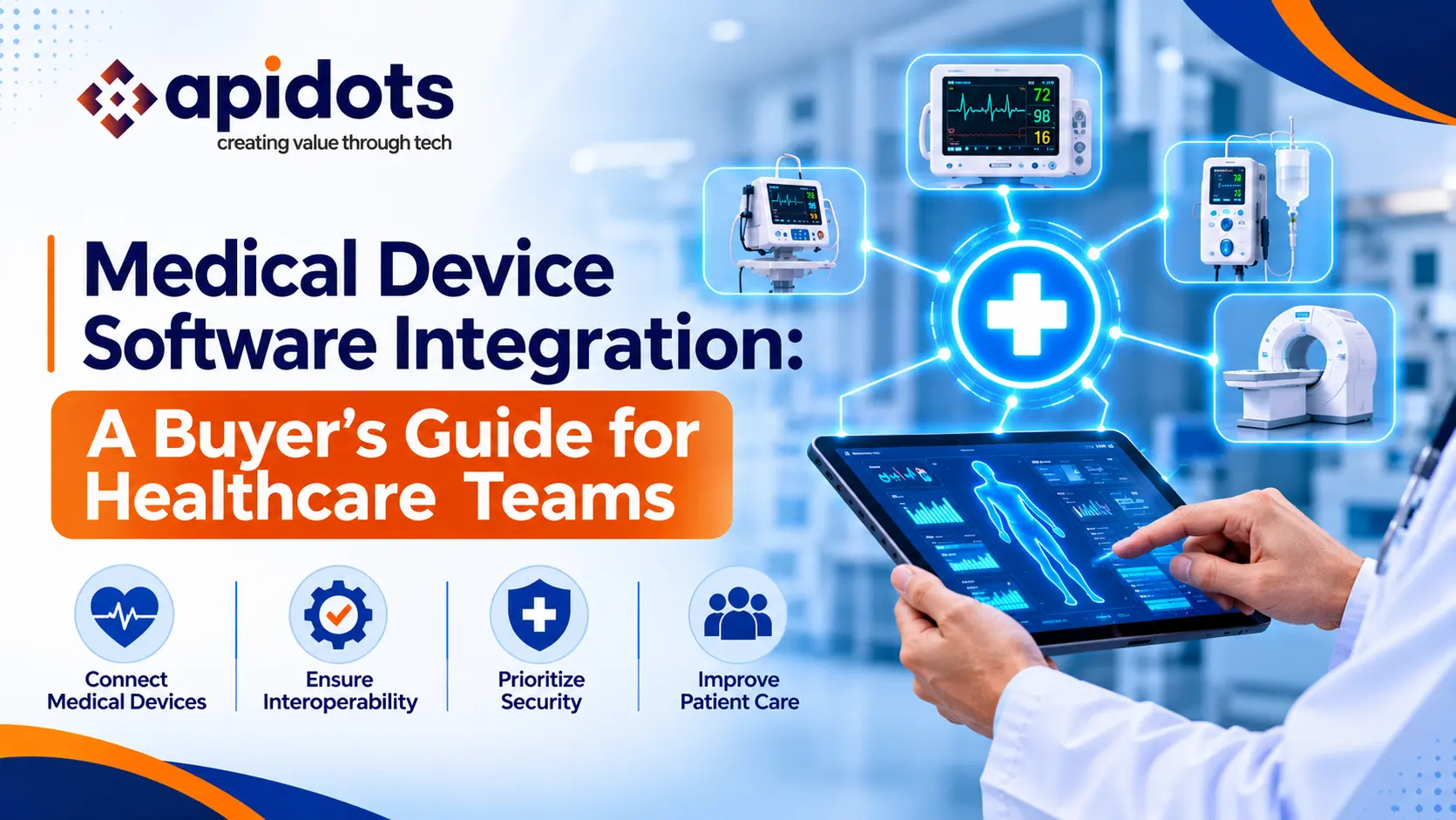
Healthcare technology has evolved significantly over the past decade. Hospitals, diagnostic laboratories, clinics, and other healthcare organizations increasingly rely on connected medical devices and software applications to collect patient information, monitor health conditions, support clinical decisions, and improve care delivery.
Modern healthcare environments use a wide range of medical devices, including patient monitoring systems, ECG machines, infusion pumps, imaging equipment, ventilators, wearable health trackers, and remote patient monitoring devices. Although these technologies provide valuable clinical information, their effectiveness depends on how efficiently they communicate with other healthcare systems.
This is where medical device software integration becomes important.
Medical device software integration connects medical equipment with electronic health records (EHRs), hospital information systems (HIS), laboratory information systems (LIS), telehealth platforms, patient monitoring applications, and other healthcare software. It enables healthcare teams to exchange relevant clinical information across different systems without depending entirely on manual data entry.
For example, when a patient’s vital signs are recorded through a connected monitoring device, an integrated system can transfer those readings into the appropriate clinical application. Healthcare professionals can then review the information alongside the patient’s medical history, laboratory results, and treatment records.
However, integrating medical devices is not simply a matter of connecting hardware to software. Healthcare organizations must consider interoperability, data accuracy, patient safety, cybersecurity, regulatory requirements, system compatibility, and long-term maintenance.
A poorly designed integration can introduce incorrect patient associations, delayed measurements, incomplete records, or communication failures. These problems can affect clinical workflows and undermine confidence in digital healthcare systems.
This buyer’s guide explains how medical device software integration works, which technologies support interoperability, what healthcare organizations should evaluate before choosing an integration solution, and how to plan a secure and scalable implementation.
Whether you are upgrading an existing hospital infrastructure, developing connected healthcare applications, or investing in remote patient monitoring, understanding these considerations will help you make more informed technology decisions.
Medical device software integration is the process of connecting medical equipment with healthcare applications, databases, and information systems so that clinical data can be exchanged, processed, stored, and accessed across different platforms.
It creates communication between physical medical devices and digital healthcare infrastructure.
For example, a hospital may use patient monitors from one manufacturer, an electronic health record system from another vendor, and a centralized patient management application developed internally. Without proper integration, healthcare professionals may need to transfer readings manually or switch between multiple applications.
An integration layer connects these systems and establishes a structured process for exchanging information.
A typical integration workflow involves several stages:
The workflow can vary depending on the medical device, clinical application, integration architecture, and intended use.
Consider an intensive care unit (ICU) where patients are continuously monitored through connected bedside devices.
These devices capture information such as:
An integration platform collects the readings and transfers relevant information to the hospital’s clinical information system.
Doctors and nurses can review patient measurements without repeatedly entering data manually.
However, the integration must also handle measurement timestamps, device identifiers, patient associations, missing readings, communication interruptions, and changes in measurement status.
For instance, a disconnected monitoring device should not silently make an old measurement appear current. The receiving application must communicate the data’s freshness and status accurately.
This illustrates why medical device integration requires more than basic connectivity. It needs reliable data exchange, validation, and clinical workflow awareness.
Healthcare organizations generate large volumes of clinical data through diagnostic equipment, monitoring devices, laboratory systems, and patient-facing applications.
When these technologies operate independently, valuable information can remain scattered across disconnected platforms.
Medical device integration helps organizations establish a more connected healthcare environment.
Here are the major reasons why healthcare providers invest in integration solutions.
Healthcare professionals need access to accurate and relevant patient information when making clinical decisions.
When medical devices communicate with EHRs and other healthcare applications, authorized professionals can review device-generated measurements alongside other clinical records.
This reduces the need to navigate multiple disconnected systems and can make information easier to access during patient care.
Manual documentation creates additional work for healthcare professionals.
It can also introduce transcription errors, missing values, incorrect units, and inconsistencies between device readings and patient records.
Automated integration can reduce repetitive data entry by transferring supported measurements directly into healthcare applications.
Nevertheless, automated transfer does not eliminate the need for clinical verification. Healthcare organizations should define which measurements require review, confirmation, or manual intervention.
A connected healthcare environment allows different departments to work with shared clinical information.
For example:
This improves information availability across departments and supports coordinated workflows.
Remote patient monitoring (RPM) allows healthcare professionals to collect patient health information outside traditional clinical settings.
Wearable devices, connected blood pressure monitors, glucose monitoring systems, and other supported medical technologies can transmit measurements to remote monitoring platforms.
Integrated telehealth solutions can bring this information together with patient profiles, appointment workflows, communication tools, and clinical records.
This is particularly useful for organizations providing chronic disease management, post-operative monitoring, and ongoing patient care.
Disconnected systems often require healthcare staff to spend additional time locating information, transferring records, and reconciling data.
A well-planned integration architecture can reduce these repetitive activities.
It can also support more consistent documentation, improve visibility into device status, and simplify reporting processes.
The actual operational benefits depend on the quality of implementation, device compatibility, clinical adoption, and the workflows being automated.
Medical device integration covers several categories of equipment. Each category generates different types of clinical information and may require specific connectivity methods.
Before selecting medical device integration solutions, healthcare teams should identify the devices they currently use and the information they need to exchange.
Common use: Hospitals, ICUs, emergency departments, and recovery units.
Patient monitoring devices continuously or periodically measure physiological parameters.
Common examples include:
Integration enables supported measurements to reach central monitoring applications and patient records.
Important considerations include measurement frequency, alarm status, timestamps, device connectivity, and the handling of missing or invalid readings.
Common use: Radiology departments, diagnostic centers, and hospitals.
Diagnostic imaging systems produce medical images and associated patient information.
Examples include:
These devices commonly work with Picture Archiving and Communication Systems (PACS) and Radiology Information Systems (RIS).
DICOM is a major standard for exchanging and managing medical imaging information. It defines communication protocols and data structures used by imaging systems. However, using DICOM alone does not guarantee that every connected system will work together correctly.
Laboratory equipment generates information used in diagnostic testing and patient monitoring.
Examples include:
Integration with a Laboratory Information System (LIS) helps transfer test orders, specimen identifiers, results, and other relevant information.
Healthcare teams should pay particular attention to specimen identification, result units, reference ranges, abnormal-result flags, and test status.
Wearable devices are increasingly used for personal health tracking and remote monitoring.
Examples include:
These devices can support remote patient monitoring when their intended use, accuracy, data quality, and regulatory status are appropriate for the clinical workflow.
Not every consumer wearable is a medical device, and not every measurement is suitable for clinical decision-making.
Therapeutic devices support patient treatment and, in some cases, directly influence patient care.
Examples include:
These integrations require particularly careful safety analysis.
For example, a system that only receives infusion status information has a different risk profile from software that can send commands to an infusion pump.
The more influence an integrated software system has over device operation, the more rigorous the engineering, verification, cybersecurity, and regulatory assessment must be.
A successful integration project begins with a clearly defined architecture.
Healthcare organizations should understand how data moves from the medical device to the destination application, where it is processed, and how errors are handled.
A typical architecture includes the following components.
This is the physical equipment that generates clinical information.
Each device may have different communication capabilities, supported protocols, data structures, and manufacturer-specific requirements.
During discovery, the integration team should document:
This information determines how the integration can be implemented.
The connectivity layer establishes communication between devices and the integration infrastructure.
Depending on the equipment, connectivity may use:
The connectivity design must consider network availability, device authentication, communication reliability, and the operating environment.
For critical medical environments, network segmentation and controlled communication paths are especially important.
Middleware acts as a communication and transformation layer between medical devices and healthcare applications.
Its responsibilities may include:
Middleware is particularly useful when healthcare organizations operate devices from multiple manufacturers.
Instead of building a separate point-to-point connection for every device and application, an integration engine can provide a centralized approach to communication.
Application Programming Interfaces (APIs) allow software systems to exchange information through defined interfaces.
Custom API development may be necessary when existing medical devices, EHR platforms, or hospital applications do not support the same communication standards.
For example, a medical device may transmit information through a proprietary protocol, while the receiving healthcare application expects structured FHIR resources.
An integration service can transform the incoming data into the required representation.
This layer should include authentication, authorization, input validation, rate limiting, error handling, and version management.
The storage layer maintains information according to the organization’s clinical, operational, and regulatory requirements.
Depending on the use case, data may be stored in:
The architecture should define retention policies, data ownership, backup procedures, recovery requirements, and access permissions.
The final layer provides access to integrated information through healthcare applications.
Examples include:
The user interface should clearly communicate measurement values, units, timestamps, device sources, and data status.
Clinical users should not have to guess whether a measurement is current, delayed, manually entered, or received automatically from a device.
Interoperability is one of the most important considerations when choosing medical device software integration solutions.
Different devices and healthcare applications may use different data structures, communication methods, and terminology systems.
Healthcare standards help establish common approaches for exchanging information.
However, organizations should understand that standards compliance does not automatically guarantee complete interoperability. Implementation details, supported versions, terminology mapping, and vendor-specific behavior still matter.
Health Level Seven Version 2 is widely used in healthcare environments to exchange clinical and administrative messages.
It supports workflows involving:
For example, an integration engine may receive an admission message from a hospital system and use the patient identifier to associate subsequent device measurements with the correct patient.
HL7 v2 remains important when integrating with established hospital infrastructure.
Fast Healthcare Interoperability Resources (FHIR) is an HL7 standard designed to support electronic healthcare information exchange.
FHIR organizes information into modular resources that represent healthcare concepts.
Common resources include:
| FHIR Resource | Purpose |
| Patient | Patient demographic information |
| Observation | Measurements and clinical observations |
| Device | Medical device information |
| DeviceMetric | Device measurement characteristics |
| Encounter | Patient healthcare encounters |
| DiagnosticReport | Diagnostic results and reports |
| Medication | Medication information |
| Procedure | Clinical procedures |
FHIR also provides an API approach based on established web technologies, making it useful for modern healthcare application development.
For example, a connected blood pressure monitoring system may send a reading to an integration service. The service can transform the information into an appropriate FHIR Observation resource before transferring it to a compatible healthcare application.
FHIR version compatibility, implementation guides, profiles, terminology bindings, and authentication requirements should be confirmed before development.
Digital Imaging and Communications in Medicine (DICOM) is the established standard for medical imaging communication and information management.
It is commonly used to connect:
DICOM supports image storage, exchange, and associated information.
Healthcare organizations should evaluate the DICOM services and conformance statements supported by each system rather than assuming that two DICOM-compatible products support identical workflows.
The IEEE 11073 family of standards supports communication involving personal health devices and point-of-care medical equipment.
It is relevant to connected health environments where devices need to exchange measurements and related information.
Potential use cases include:
The FDA identifies the ISO/IEEE 11073 series among standards relevant to medical device interoperability.
Not every medical device supports an open interoperability standard.
Some manufacturers provide proprietary communication protocols, software development kits, or vendor-specific APIs.
In these situations, healthcare teams may need custom integration components.
Before choosing this approach, verify:
A reliable integration strategy should account for both standardized and proprietary technologies.
Not every integration platform is suitable for every healthcare environment.
A hospital connecting a few patient monitors has different requirements from a healthcare network integrating hundreds of devices across multiple facilities.
Before selecting a solution, evaluate its technical capabilities, security controls, compatibility, and ability to support clinical workflows.
The integration solution should support the medical devices currently used by your organization and accommodate future equipment.
Check whether the provider supports:
Ask vendors to demonstrate compatibility with your actual device models and firmware versions.
A general claim of multi-device support is not sufficient evidence of compatibility.
Some healthcare workflows require frequent measurement updates.
For example, ICU monitoring systems may need to display continuously updated patient information.
Evaluate whether the integration solution supports the required data frequency and latency.
Consider:
Real-time performance requirements should be defined according to the intended clinical use rather than relying on marketing descriptions.
A centralized data management approach helps authorized healthcare professionals access information from multiple connected devices through a common interface.
Important capabilities include:
The architecture should also maintain the original measurement context so that information is not separated from its source or clinical meaning.
Automated validation helps identify incorrect, incomplete, or inconsistent information before it reaches downstream applications.
Validation rules may check:
For example, if a device sends a temperature reading in Fahrenheit but the receiving application expects Celsius, the integration service must handle the conversion correctly and retain appropriate unit information.
Validation should not silently modify clinically significant data without an approved transformation rule.
A medical device integration platform should provide visibility into its own operational health.
Healthcare IT teams should be able to identify:
An effective monitoring system should also support alerts, diagnostic logs, and controlled recovery procedures.
Healthcare infrastructure changes as organizations add devices, locations, departments, and digital services.
Choose an integration architecture that can accommodate additional devices and applications without requiring a complete redesign.
Scalable solutions should support modular integrations, controlled API versioning, flexible data routing, and infrastructure expansion.
Integrated device information can support operational and clinical reporting.
Depending on the intended use and data quality, healthcare organizations may use aggregated information to understand:
Analytics capabilities should be designed with appropriate access controls and clinical validation requirements.
Medical device integration introduces additional security considerations because connected systems may process protected health information (PHI), device-generated measurements, and other sensitive clinical records.
A security incident involving one connected system can potentially affect multiple applications and healthcare workflows.
For organizations handling electronic protected health information in the United States, the HIPAA Security Rule establishes requirements for protecting the confidentiality, integrity, and availability of ePHI through administrative, physical, and technical safeguards.
Healthcare organizations should evaluate security throughout the integration lifecycle.
Preferred Reading: HIPAA-Compliant App Development: A Non-Technical Checklist for Healthcare Founders
Encryption helps protect sensitive information against unauthorized access.
Use appropriate encryption for:
TLS should be configured appropriately for supported network communication, while stored data should use suitable encryption mechanisms.
Encryption alone does not establish HIPAA compliance. It must be part of a broader security and risk-management program.
Every connected device, application, and user should have an appropriate identity and access model.
Security controls may include:
For example, a nurse may need permission to review patient measurements, while a system administrator may need access to integration configuration settings.
These permissions should be separated according to organizational responsibilities.
Audit logs help healthcare organizations understand who accessed information, what actions were performed, and when system events occurred.
A comprehensive logging strategy may record:
Logs should be protected against unauthorized modification and reviewed according to organizational policies.
Medical devices should not automatically share unrestricted access to the wider enterprise network.
Network segmentation can help isolate device environments and restrict unnecessary communication.
For example, a hospital may separate its medical device network from administrative workstations, guest Wi-Fi, and general corporate infrastructure.
Firewalls, access policies, secure gateways, and network monitoring should control communication between segments.
Healthcare software should be developed with security requirements incorporated from the beginning.
Important engineering practices include:
Medical device manufacturers should also consider cybersecurity throughout the product lifecycle, including postmarket vulnerability management.
The FDA’s February 2026 cybersecurity guidance provides current recommendations concerning medical device cybersecurity, quality management, design, labeling, and premarket submission documentation.
When a technology provider creates, receives, maintains, or transmits PHI on behalf of a HIPAA-covered entity in a way that makes it a business associate, the applicable HIPAA requirements and contractual obligations must be addressed.
A Business Associate Agreement (BAA) generally establishes the permitted handling of PHI and relevant responsibilities.
Healthcare organizations should evaluate:
A vendor’s statement that its product is HIPAA compliant should never replace an independent review of its architecture, operational controls, contracts, and responsibilities.
A risk assessment helps organizations identify potential threats to ePHI and determine appropriate safeguards.
Consider risks associated with:
HHS identifies risk analysis as a foundational component of the HIPAA Security Rule. NIST SP 800-66 Rev. 2 provides additional practical guidance for implementing its security requirements.
Healthcare software projects may involve multiple regulatory frameworks depending on the device, software functionality, location, intended use, and organizations involved.
One important distinction is that integrating a medical device with another software system does not automatically make every component a regulated medical device. However, software functions that meet the applicable device definition may be subject to medical device requirements.
Healthcare teams should evaluate regulatory considerations before finalizing their integration architecture.
In the United States, the FDA regulates certain software functions that meet the definition of a medical device.
Its oversight depends on the software’s intended function and potential impact on patient safety.
For example, a basic administrative application that stores patient information may have a different regulatory position from software that analyzes physiological measurements to generate diagnostic information.
The FDA’s device software guidance explains its risk-based approach to software functions and mobile medical applications.
Healthcare organizations and manufacturers should assess:
The FDA’s Medical Device Software Guidance Navigator can help identify potentially relevant guidance documents.
IEC 62304 is an important international standard covering medical device software lifecycle processes.
It provides a framework for software development and maintenance activities, including planning, requirements, design, implementation, verification, release, and maintenance.
It is particularly relevant when software forms part of a medical device or otherwise falls within the standard’s scope.
Healthcare teams should ask development partners how they handle:
The Australian Therapeutic Goods Administration identifies IEC 62304 among relevant standards for software-based medical devices.
ISO 14971 provides a framework for identifying, evaluating, controlling, and monitoring risks associated with medical devices.
In integration projects, risk assessment should consider more than software defects.
Potential risks include:
Risk controls should be proportionate to the intended use and potential harm.
Medical device software development should include appropriate quality management processes.
Depending on the manufacturer’s regulatory obligations and applicable jurisdiction, relevant requirements may include quality system controls, design documentation, verification records, risk management, change control, and postmarket processes.
The FDA’s 2026 Computer Software Assurance guidance addresses risk-based assurance for software used in medical device production and quality management systems. It should not be confused with a universal software development standard for every healthcare application.
Healthcare software providers may need to consider different regulatory requirements in different markets.
| Market | Regulatory considerations |
| United States | FDA medical device requirements, HIPAA where applicable |
| European Union | MDR, IVDR where applicable, GDPR |
| United Kingdom | UK Medical Devices Regulations, UK GDPR |
| Australia | TGA requirements, Australian Privacy Act where applicable |
| India | Medical Devices Rules, 2017, CDSCO requirements, applicable data protection laws |
India’s CDSCO issued a final guidance document on medical device software dated July 21, 2026, covering regulatory expectations under the Medical Devices Rules, 2017.
Important: Regulatory applicability depends on the specific product, intended use, market, and organizational role. This section is a technical overview, not legal or regulatory advice. Healthcare organizations should consult qualified regulatory professionals before implementation.
Even with modern technologies, medical device integration can be complex.
The challenges often emerge from differences in hardware, software, clinical workflows, data formats, and organizational infrastructure.
Understanding these problems early helps healthcare teams reduce implementation risks.
Different manufacturers may use different protocols, message structures, and communication interfaces.
Some older medical devices may not support modern APIs or standardized data exchange.
Recommended approach:
Conduct a device compatibility assessment before selecting the integration platform.
Obtain vendor documentation and confirm supported models, firmware versions, communication methods, and licensing requirements.
A medical device may transmit measurements in one unit or format while the receiving application expects another.
Incorrect data mapping can lead to inconsistent patient records.
Recommended approach:
Create a documented data mapping specification.
Define measurement units, terminology, timestamps, patient identifiers, and transformation rules.
Test data conversions using representative device outputs and clinically reviewed test cases.
Many hospitals depend on older EHRs, laboratory systems, and medical equipment.
Replacing all existing infrastructure can be expensive and operationally disruptive.
Recommended approach:
Use an integration architecture that supports legacy interfaces while providing a controlled migration path toward modern standards.
Middleware and integration engines can help connect older systems with newer applications.
Medical devices may operate in environments where network connectivity is inconsistent.
Wireless interference, network congestion, hardware failures, and maintenance activities can interrupt data transmission.
Recommended approach:
Design for temporary disconnections and recovery.
Depending on the device and intended workflow, the architecture may require local buffering, message queues, retry mechanisms, connection monitoring, and reconciliation processes.
Avoid assuming that every measurement will arrive exactly once or in chronological order.
Incorrect patient association is one of the most important integration risks.
A device may be assigned to the wrong patient, or a patient may be transferred to another room while the device remains connected.
Recommended approach:
Use reliable patient identification workflows and validate device-to-patient associations.
Define how assignments are created, updated, confirmed, and removed.
Do not rely solely on physical location or room number to identify a patient.
Every additional connected system creates another potential point of access to sensitive information.
Recommended approach:
Apply least-privilege access, secure APIs, encryption, network segmentation, logging, vulnerability management, and periodic security assessments.
Security controls should cover devices, middleware, applications, cloud infrastructure, and third-party services.
A healthcare organization may become dependent on one vendor for proprietary interfaces, device drivers, or ongoing maintenance.
This can increase costs and make future upgrades difficult.
Recommended approach:
Review vendor documentation, licensing terms, support commitments, API availability, data export capabilities, and exit arrangements before signing an agreement.
Where possible, prioritize documented interfaces and standards-based interoperability.
One of the most important buying decisions is whether to use an existing integration platform or invest in custom healthcare software development.
Both approaches have advantages, and the right choice depends on the organization’s requirements.
Prebuilt integration platforms offer existing connectors, data transformation capabilities, and device communication features.
They may be appropriate when:
Advantages:
Limitations:
Custom healthcare software development involves creating integration services and applications around an organization’s specific technical and clinical requirements.
It may be appropriate when:
Advantages:
Limitations:
| Evaluation factor | Ready-made platform | Custom development |
| Initial implementation | Often faster | Depends on complexity |
| Custom workflows | Platform-dependent | Highly flexible |
| Device compatibility | Based on existing connectors | Can support specialized interfaces |
| Licensing | Often subscription-based | Depends on development and infrastructure model |
| Architecture control | Vendor-dependent | Greater control |
| Maintenance | Shared with vendor | Organization and development partner |
| Scalability | Depends on platform | Designed around requirements |
| Long-term flexibility | Depends on vendor roadmap | Greater architectural flexibility |
Healthcare organizations do not always need to choose only one approach.
A hybrid architecture can use an existing integration engine for common healthcare messaging while custom API development handles specialized device interfaces.
For example, a hospital might use an established HL7 integration engine for patient admissions and laboratory messages while developing a custom service to connect a proprietary monitoring device.
This approach can reduce unnecessary development while preserving flexibility where it matters.
Selecting a development partner is a significant decision because medical device integration requires knowledge of healthcare workflows, software engineering, interoperability, cybersecurity, and regulatory considerations.
A general software development company may have strong application development capabilities but limited experience with medical device communication or clinical data management.
Healthcare organizations should evaluate potential partners across several areas.
Look for a development partner with experience in healthcare software development and connected healthcare systems.
Relevant experience may include:
Ask for examples of similar projects and understand the technical responsibilities the provider actually handled.
Device integration requires an understanding of hardware interfaces, communication protocols, vendor documentation, and clinical data structures.
Ask potential partners:
The answers should demonstrate practical engineering knowledge rather than general claims about interoperability.
Your integration partner should understand the security requirements associated with healthcare applications.
Evaluate its approach to:
If the provider will handle ePHI as a business associate, clarify contractual requirements and the BAA before sharing production information.
Testing should be a core part of the development process.
Ask whether the partner performs:
For higher-risk integrations, testing should also cover failure scenarios and the consequences of incorrect or delayed data.
Good documentation makes healthcare integration easier to maintain.
The development partner should provide relevant documentation, including:
Avoid solutions that depend entirely on undocumented code or individual developers’ knowledge.
Medical device integration requires ongoing maintenance.
Healthcare organizations should evaluate the provider’s approach to:
A reliable development partnership should include clear responsibilities for support, escalation, and incident resolution.
A structured implementation approach helps healthcare organizations reduce uncertainty and control project risks.
The following process can be used as a starting point for planning an integration initiative.
Start by identifying the problems the integration project needs to solve.
For example:
Involve clinicians, IT teams, administrators, biomedical engineers, and compliance professionals in this process.
Document the intended use, users, clinical workflow, expected outcomes, and system boundaries.
Create a complete inventory of the existing infrastructure.
Include:
Identify which systems can communicate directly and which require additional middleware or custom interfaces.
Select an architecture that supports the required devices, applications, and workflows.
Determine whether the solution requires:
Define how data will move between systems and what happens when communication fails.
Create a detailed data mapping specification.
For each measurement or data element, identify:
This step is critical because technically successful data transmission does not necessarily mean the information has been interpreted correctly.
The development team implements the required device interfaces, middleware components, APIs, and application connections.
Depending on the architecture, this may involve:
The implementation should follow documented requirements and appropriate software lifecycle controls.
Before production deployment, verify that the entire data exchange process works as intended.
Testing should cover normal workflows as well as failure scenarios.
Examples include:
For clinical workflows, involve qualified healthcare professionals in reviewing test scenarios and expected results.
Avoid introducing a complex integration across an entire healthcare organization without adequate validation.
A phased deployment may involve:
The rollout plan should include rollback procedures, user training, support arrangements, and incident escalation.
After deployment, continuously monitor system performance and integration reliability.
Track relevant metrics such as:
Review the results periodically and improve the integration based on actual operational feedback.
The cost of medical device software integration depends on the complexity of the devices, healthcare applications, integration architecture, security requirements, and implementation scope.
There is no universal price because a basic device-to-EHR connection is fundamentally different from a multi-hospital integration platform supporting multiple manufacturers.
Instead of relying on generic pricing estimates, healthcare teams should evaluate the major cost components.
Integration costs can increase when devices use proprietary communication protocols or lack documented APIs.
A device requiring a custom communication adapter may involve more engineering effort than one supporting a well-documented standard interface.
Connecting multiple device models, EHR platforms, laboratory systems, and monitoring applications increases implementation complexity.
Each additional connection may require separate configuration, mapping, testing, and ongoing support.
If existing applications do not expose suitable integration interfaces, custom API development may be required.
The effort depends on:
Security-related costs may include:
These activities should be included in the project budget rather than treated as optional additions.
Cloud-based and hybrid solutions may introduce recurring costs related to:
Healthcare organizations should evaluate long-term operating expenses, not only initial development costs.
Integration systems need updates as devices, APIs, firmware, operating systems, and healthcare applications change.
The total cost of ownership should account for:
| Cost component | What to evaluate |
| Discovery and planning | Requirements, device inventory, architecture |
| Device integration | Protocols, SDKs, connectivity |
| API development | Interfaces, authentication, transformation |
| Middleware | Integration engine and configuration |
| Application development | Dashboards, portals, workflows |
| Security | Encryption, access control, assessments |
| Testing | Functional, integration, safety-related testing |
| Deployment | Infrastructure, migration, training |
| Maintenance | Support, updates, monitoring |
Buying recommendation: Request a detailed project estimate based on your actual device inventory, required integrations, and clinical workflows. A reliable vendor should explain assumptions, exclusions, recurring costs, and potential changes in scope.
Healthcare technology continues to evolve as medical devices become more connected and healthcare organizations adopt cloud platforms, artificial intelligence, and remote care models.
Several developments are likely to influence medical device integration strategies.
Artificial intelligence is increasingly being explored for healthcare applications involving clinical data analysis, workflow automation, and decision support.
Integrated medical device information may provide useful input for AI-powered applications, depending on data quality, intended use, and appropriate validation.
Potential applications include:
However, AI-generated outputs should not automatically be treated as clinically reliable.
Organizations must consider model validation, data quality, bias, explainability, security, and applicable medical device regulations.
Remote patient monitoring is changing how healthcare organizations collect patient information.
Connected devices allow supported measurements to be transmitted outside traditional clinical environments.
This creates demand for integration between medical devices, mobile applications, cloud platforms, EHRs, and telehealth solutions.
Healthcare providers should design these systems to manage intermittent connectivity, device ownership, patient consent, and measurement verification.
Cloud infrastructure provides options for hosting healthcare applications, integration services, and data processing systems.
Cloud-based architectures can support centralized management and infrastructure expansion.
However, organizations must evaluate data residency, access control, availability, vendor responsibilities, encryption, and disaster recovery.
A cloud deployment does not automatically guarantee security or regulatory compliance.
Modern healthcare applications increasingly depend on APIs to exchange information.
FHIR-based interfaces, secure authentication, and standardized data resources can make it easier to connect healthcare applications.
At the same time, organizations should continue supporting existing HL7 v2 and other established interfaces where required.
The most practical integration architecture is often a combination of modern APIs and carefully managed legacy connectivity.
As healthcare devices become more connected, cybersecurity becomes an increasingly important part of product design and operational management.
Healthcare organizations should plan for:
Security must remain an ongoing responsibility rather than a one-time implementation activity.
Healthcare providers increasingly need information to move across organizational boundaries.
This includes hospitals, laboratories, diagnostic centers, telehealth providers, and remote monitoring services.
Standards-based data exchange, consistent terminology, reliable identity management, and documented APIs will remain important for building connected healthcare ecosystems.
Before selecting a technology provider or signing an integration agreement, use the following checklist to assess whether the solution meets your organization’s requirements.
A vendor that can answer these questions with clear technical evidence is better positioned to support a reliable integration project than one relying on broad claims about connectivity or compliance.
Medical device software integration is the process of connecting medical equipment with healthcare applications such as EHRs, hospital information systems, laboratory platforms, and remote monitoring solutions. It enables clinical information to move between connected systems through APIs, communication protocols, and interoperability standards.
Medical device integration helps hospitals improve clinical data accessibility, reduce manual documentation, and connect information across departments. It allows healthcare professionals to access relevant measurements from connected equipment through integrated applications, supporting more consistent clinical workflows.
Commonly used standards and technologies include HL7 v2, HL7 FHIR, DICOM, and IEEE 11073. The appropriate standard depends on the device type, intended workflow, receiving application, and vendor-supported interfaces.
HIPAA affects integrations that involve protected health information handled by covered entities and their business associates. Organizations must implement appropriate administrative, physical, and technical safeguards to protect electronic PHI. These may include encryption, access controls, authentication, audit logging, and risk assessments.
Yes, many legacy medical devices can be integrated using middleware, protocol adapters, gateways, or custom API development. However, integration feasibility depends on the device’s communication interfaces, manufacturer documentation, licensing restrictions, and technical limitations.
Medical device integration focuses on connecting medical equipment with healthcare software to exchange device-generated information. EHR integration focuses on exchanging patient records and clinical information between electronic health record systems and other applications. The two approaches often work together in connected healthcare environments.
The timeline depends on device compatibility, the number of integrations, software complexity, security requirements, and testing scope. A straightforward integration may require considerably less effort than a multi-device, multi-system healthcare platform. A proper technical assessment is necessary to establish a realistic timeline.
Custom integration development is appropriate when existing platforms do not support required devices, proprietary protocols, specialized clinical workflows, or unique application requirements. It can also help organizations build a flexible integration architecture around their existing healthcare infrastructure.
Medical device software integration is becoming an important part of modern healthcare infrastructure. As hospitals, diagnostic centers, and digital health organizations adopt connected medical equipment, the ability to exchange accurate clinical information across different systems becomes increasingly important.
However, successful integration requires more than connecting devices to applications. Healthcare organizations must consider device compatibility, interoperability standards, patient identification, data validation, cybersecurity, regulatory responsibilities, and long-term system maintenance.
Choosing the right integration approach starts with understanding existing infrastructure and defining clear clinical and technical requirements. Organizations should evaluate whether ready-made platforms, custom healthcare software development, or a hybrid architecture best supports their needs.
Equally important is selecting a development partner with practical experience in healthcare software development services, custom API development, medical device connectivity, and secure application architecture.
At APIDOTS, we understand the importance of building scalable software solutions around business and technology requirements. Our software development capabilities can support healthcare organizations looking to develop custom applications, connect existing platforms, and build integrated digital solutions.
Whether you are planning a healthcare application, exploring telehealth solutions, or evaluating custom healthcare software development, a well-defined technical strategy is the foundation for building a connected and reliable healthcare ecosystem.
The goal should not simply be to connect more devices. It should be to create an integrated environment where healthcare information can be exchanged securely, interpreted correctly, and made available to the right people when needed.
We leverage AI, cloud, and next-gen technologies strategically.Helping businesses stay competitive in evolving markets.
Consult Technology Experts