
Top
Search
People also search for:

Stay Inspired with Instagram




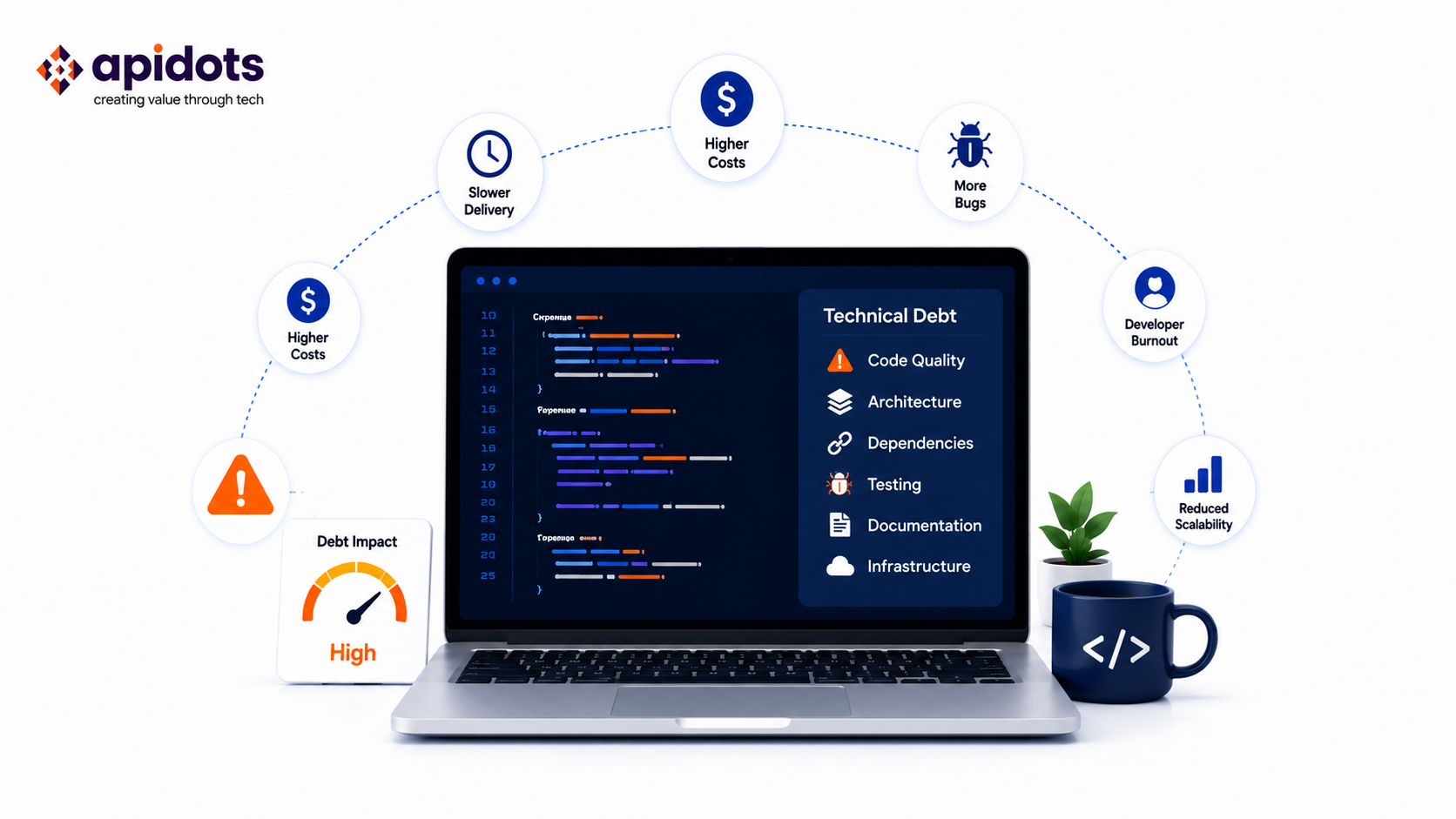
Technical debt is the future cost created when a team chooses an expedient software solution over a more maintainable one or when a once-sound system becomes harder to change as requirements, dependencies, and infrastructure evolve. Like financial debt, it can be a rational tradeoff when the cost and repayment plan are understood. It becomes dangerous when the resulting maintenance burden is invisible, unowned, or repeatedly deferred.
Every software team takes shortcuts. Sometimes that’s the right call — ship fast, learn from users, fix it next sprint. The problem isn’t the shortcut. It’s when the shortcut becomes permanent, spreads across a codebase, and silently slows everything down.
That’s technical debt. And it’s more expensive than most companies realize until something breaks, a new feature takes six weeks instead of two, or a senior engineer quits because they can’t stand working in the codebase anymore.
This guide explains what technical debt actually is, how to spot it in your own system, what the data says it costs, and what to do about it — without catastrophizing or pretending the answer is always a full rewrite.
Ward Cunningham introduced the debt metaphor in the early 1990s to explain why shipping an imperfect but useful system can accelerate learning, while leaving that system misaligned with what the team later understands creates an ongoing cost.
As Cunningham later explained in his discussion of the technical debt metaphor, the idea was never to justify poor engineering; it was to acknowledge that incomplete understanding can be a strategic trade-off when managed intentionally. The metaphor is useful, but technical debt is not literally money and cannot always be measured with financial precision.
The analogy holds in one important way that most people miss: it has two components, principal and interest.
The principal is the actual work that needs to be done to clean things up — rewriting a poorly structured module, replacing a deprecated library, migrating a brittle integration to a proper API. It’s finite, knowable, and fixable.
The interest is the friction tax every project pays today. It’s the extra time to work around the fragile integration, the debugging session that takes four hours because the original code is undocumented, the deployment that breaks because two systems are coupled in ways nobody expected.
As Martin Fowler explains in his article on technical debt and software design, this ongoing reduction in development speed is the true cost of debt—the hidden interest that quietly accumulates every time developers modify a difficult-to-maintain system.
A useful mental model: technical debt is like a house with a slow roof leak. You can live in it. You can even enjoy it. But every month you don’t fix the roof, the ceiling gets worse, the walls get damp, and eventually you’re not just replacing tiles — you’re replacing the whole ceiling. The fix compounds in cost the same way the problem does.
Technical debt is not the same as legacy code, though they overlap. Legacy code is old code. Technical debt is code — old or new — that was built in a way that makes it harder to change safely. You can accumulate technical debt in a codebase that’s six months old. You can have clean, maintainable legacy code that’s ten years old.
Technical Debt Quadrant also makes an important distinction: some technical debt is incurred deliberately to achieve a short-term goal, while other debt results from reckless or inadvertent design decisions. Understanding that difference helps teams decide which debt should be repaid immediately and which can be managed strategically.
There is no single universally accepted four-type taxonomy. The categories below are a practical grouping for diagnosis; teams may use other models, including Martin Fowler’s deliberate/inadvertent and prudent/reckless quadrant.
A conscious tradeoff made with full awareness. “We’ll use a direct SQL query for now and add an ORM layer in Q2.” This is acceptable when it’s tracked, owned, and actually fixed on schedule. Most teams think their debt is this type. Most of it isn’t.
Nobody intended it. The team learned better practices after the code was written. A junior developer made architecture decisions they didn’t have the experience to make correctly. The problem isn’t negligence — it’s that nobody went back.
Code that was fine when it was written but has degraded as the surrounding ecosystem changed. Dependencies that haven’t been updated in three years. An API integration built against a version that’s no longer supported. Infrastructure sized for 10,000 users that now serves 200,000.
Structural constraints in architecture, data models, interfaces, or deployment topology that make important changes unusually risky or expensive. A monolith is not automatically debt; it becomes debt when its structure no longer fits the system’s needs, and the cost of change is persistently high.
Technical debt accumulates through three predictable patterns, and every software team hits at least two of them.
The most common cause. A feature needs to ship before a conference, before a fundraise, before a competitor. The team writes the version that works now and skips the version that’s maintainable in the long term. The plan is always to go back and clean it up. The cleanup rarely makes it onto the roadmap because the next deadline is already visible.
As our analysis of why cheap development costs more shows, this pattern compounds fastest when teams are under-resourced — every shortcut gets a little messier and a little harder to unwind.
Code gets written by developers who know something the next developer won’t. When that developer leaves, the knowledge leaves with them. The new developer inherits a system they can’t fully understand, makes safe-looking changes that break things in unexpected ways, and adds their own layer of workarounds on top. Documentation that was never written becomes debt. Architectural decisions that were never explained become constraints nobody can justify removing.
AI-assisted development can increase code throughput, which raises the amount of code that reviewers and maintainers must understand. That does not mean AI-generated code is inherently unmaintainable. Controlled research published in 2025 found no systematic downstream maintainability advantage or disadvantage in its task setting, while newer large-scale repository research found that some AI-authored commits introduced code smells, bugs, or security issues that persisted. The practical conclusion is narrower: teams should scale review, testing, architectural checks, and ownership controls with the speed of generation.
Prompt-driven or “vibe-coded” applications are especially risky when teams skip architecture decisions, threat modeling, tests, dependency review, and human ownership. The risk comes from weak engineering controls and limited system understanding—not from the use of AI alone.
Technical debt is invisible on a balance sheet, which is exactly why it’s so dangerous. The cost shows up as slower delivery, more bugs, longer onboarding, and developers who leave because they’re exhausted from fighting the codebase instead of building things. But it also has a measurable financial footprint.
The operational cost is just as real. McKinsey’s survey of 50 CIOs at large financial services and technology companies found that 10 to 20 percent of the technology budget nominally dedicated to new products is silently diverted to resolving tech debt instead. That money is not building anything new. It’s paying interest on old shortcuts.
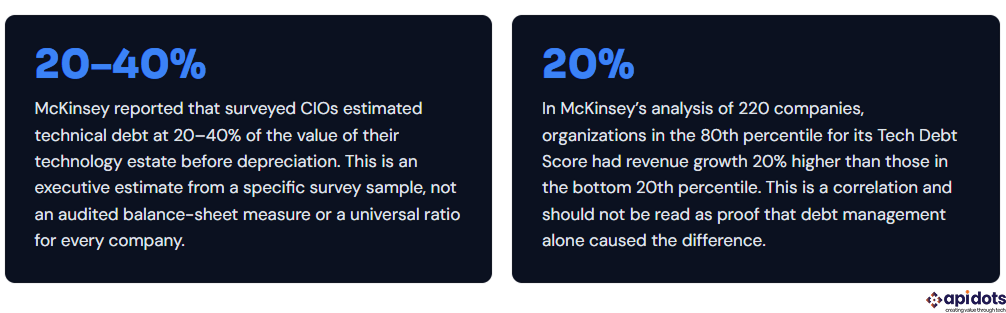
Sources: McKinsey, Tech Debt: Reclaiming Tech Equity (2020) and McKinsey, Demystifying Digital Dark Matter (2022). Survey of 50 CIOs and analysis of 220 companies across five geographies and seven sectors.
McKinsey also reported that reducing technical debt can free engineers to spend as much as 50% more time on value-generating work. The article cites a large cloud provider that reduced the share of engineering time spent on its tech-debt “tax” from 75% to 25% after changing its management approach. Treat these as reported examples and potential outcomes, not guaranteed results for every organization.
Some of these signals require reading code. Others are visible from the outside — in delivery velocity, in how developers talk about the system, in the shape of your sprint retrospectives.
| Signal | Who Can See It | Severity |
| New features take noticeably longer than they used to | Product and engineering leadership | High |
| Bug fixes keep introducing new bugs | QA, developers, product team | High |
| Developers are afraid to touch certain parts of the codebase | Engineering team (if you ask directly) | High |
| Onboarding a new developer takes months, not weeks | Engineering leadership, HR | Medium |
| Deployments are risky, manual, or avoided on Fridays | DevOps, engineering team | Medium |
| Test coverage is low or tests are frequently skipped | Engineering team, code review | Medium |
| Dependencies haven’t been updated in over a year | Engineering team, security scans | Medium |
| Documentation is sparse, outdated, or non-existent | Any new team member | Medium |
| Senior developers consistently mention “the old way” needs fixing | Sprint retrospectives, 1:1s with developers | Awareness Signal |
| The estimate for any non-trivial task includes “and then we’d need to refactor…” | Sprint planning sessions | Awareness Signal |
Not all technical debt is a problem. A deliberate shortcut made by an experienced team with a clear plan to fix it is a rational business decision. The issue is the debt that’s unowned, untracked, and silently compounding.
Before treating every imperfect piece of code as a crisis, apply this three-question test:
If a piece of debt passes all three questions — it was deliberate, it has an owner, it has a real timeline — it’s manageable. If it fails any of them, it needs attention before the interest charges get worse.
The wrong answer is “rewrite everything.” Full rewrites are expensive, risky, and frequently fail to deliver the improvement they promised because teams bring the same habits to the new codebase. The right answer is systematic, prioritized debt reduction alongside ongoing feature delivery.
Make it visible first.
You can’t manage debt you can’t see. Run a dependency audit, a static analysis scan (SonarQube, CodeClimate, or similar), and a frank conversation with your senior developers about which parts of the codebase they’re afraid to touch. Map what you find against business criticality — not all debt is in equally important systems.
Price it into the roadmap.
Debt reduction needs explicit capacity, but there is no universal percentage that fits every team. Some teams reserve a recurring capacity band; others fund remediation around risk, product changes, or reliability objectives. Start by measuring delivery friction and operational risk, then allocate sufficient capacity to improve those indicators without obscuring the trade-off from product stakeholders.
Prioritize by business impact, not engineering preference.
Engineers naturally want to fix the messiest code. That’s not always the highest-priority debt. Prioritize by: how often does this code change, how many systems depend on it, and what’s the cost of a failure here. Architectural debt in a high-traffic payment flow beats aesthetic debt in a rarely-touched admin panel every time.
Refactor incrementally, not in big bang rewrites
Break down cleanup work into units that can be delivered alongside features. The strangler fig pattern — replacing a legacy component piece by piece while keeping the system running — is more reliable than a full rewrite. Each incremental improvement reduces interest expense from day one, rather than waiting months for a big-bang release. The same approach applies when choosing between replatforming and rearchitecting at the infrastructure level.
Stop accumulating new debt at the same rate.
Cleaning up existing debt while continuing to generate it at the same rate is a treadmill. Code review standards, automated linting, test coverage requirements, and architecture decision records (ADRs) slow the accumulation rate. They don’t eliminate debt, but they change the trajectory from exponential to manageable.
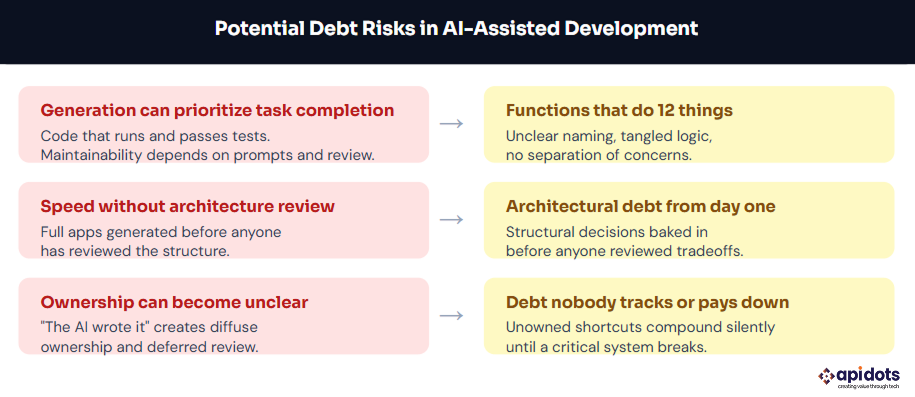
AI coding assistants can increase implementation speed, but faster generation changes the control problem: review, testing, security analysis, architecture governance, and knowledge transfer must keep pace with the volume of change.
The current evidence is mixed rather than one-sided. A 2025 controlled experiment with 151 participants found no systematic downstream maintainability advantage or disadvantage for code co-developed with AI in the tasks studied.
A 2026 preprint analyzing more than 304,000 verified AI-authored commits reported that over 15% of commits from each assistant introduced at least one static-analysis issue and that 24.2% of tracked issues remained in the latest revision. The studies use different methods and measure different things, so neither supports a universal claim that AI code is always better or worse.
The defensible operational response is to review AI-assisted changes according to risk. Require tests and clear ownership; scan dependencies and security-sensitive paths; enforce architecture and style rules automatically where possible; and ensure at least one maintainer can explain the change without relying on the original prompt.
AI can also help reduce existing debt by explaining unfamiliar code, generating tests, assisting migrations, and proposing refactors. Its net effect depends on how well the team validates output and preserves system knowledge.
Technical debt is not a sign that your team is doing something wrong. It’s a sign that your team is building software under real-world constraints, which every team does. The problem is not the debt, it’s the debt that nobody tracks, nobody owns, and nobody has resources to fix.
The strongest cited figures are specific to their samples: 63% of respondents to Stack Overflow’s professional-developer frustration question selected technical debt; surveyed CIOs in McKinsey research estimated that 10–20% of new-product technology budgets were diverted to debt-related issues; and McKinsey found a correlation between a stronger Tech Debt Score and higher revenue growth. These figures show material business relevance, but they are not universal benchmarks or proof of causation.
The fix is not a rewrite. It’s visibility, prioritization, and consistent allocation of engineering time to paying the debt down incrementally — the same discipline you’d apply to any other financial obligation. If your codebase is carrying more than you can handle internally, getting an outside perspective on what’s there and how to sequence the cleanup is often the fastest path to a sustainable trajectory.
That’s work the API DOTS custom software development team does regularly — auditing existing systems, identifying where debt is concentrated, and building a remediation plan that doesn’t require stopping feature delivery to execute.
No. Not all technical debt is harmful. Teams often take on intentional technical debt to ship a feature faster, validate an idea, or meet a critical deadline. The key is documenting the trade-off and planning to address it later. Technical debt becomes a problem when it accumulates unnoticed, its cost exceeds its value, or the team no longer understands why it exists.
A bug is a defect that causes software to behave incorrectly. Technical debt is a design or implementation decision that makes the software harder to maintain, extend, or modify. While technical debt doesn’t always create bugs, it often increases the likelihood of introducing them because developers must work around fragile or overly complex code.
There is no universal rule, but many engineering organizations dedicate 10–20% of each sprint or development cycle to refactoring, dependency updates, and improving code quality. The appropriate investment depends on how much technical debt is slowing delivery. If developers spend more time working around the code than building new features, it’s usually a sign that debt reduction should become a higher priority.
In most cases, incremental refactoring is the better approach because it reduces risk while continuously improving the codebase. A complete rewrite is typically justified only when the existing architecture can no longer support business requirements, the technology stack has become obsolete, or the cost of maintaining the current system consistently exceeds the cost of rebuilding it. Most successful engineering teams prefer gradual modernization over starting from scratch.
Not inherently. AI can produce clean, maintainable code when developers review, test, and refactor its output. However, blindly accepting AI-generated code without understanding it can introduce hidden complexity, duplicated logic, inconsistent patterns, and security issues—all of which contribute to technical debt. Ultimately, the quality of the review process matters more than whether the code was written by a human or an AI.
This article distinguishes survey estimates, correlations, controlled experiments, and preprints. Figures are presented with their sample or evidentiary limits where material.
We leverage AI, cloud, and next-gen technologies strategically.Helping businesses stay competitive in evolving markets.
Consult Technology Experts
Hi! I’m Aminah Rafaqat, a technical writer, content designer, and editor with an academic background in English Language and Literature. Thanks for taking a moment to get to know me. My work focuses on making complex information clear and accessible for B2B audiences. I’ve written extensively across several industries, including AI, SaaS, e-commerce, digital marketing, fintech, and health & fitness , with AI as the area I explore most deeply. With a foundation in linguistic precision and analytical reading, I bring a blend of technical understanding and strong language skills to every project. Over the years, I’ve collaborated with organizations across different regions, including teams here in the UAE, to create documentation that’s structured, accurate, and genuinely useful. I specialize in technical writing, content design, editing, and producing clear communication across digital and print platforms. At the core of my approach is a simple belief: when information is easy to understand, everything else becomes easier. Reach me at amysbrew.com