
Top
Search
People also search for:

Stay Inspired with Instagram




In December 2024, Microsoft CEO Satya Nadella declared on the BG2 podcast that “SaaS is dead.” The comment sent ripples across the technology industry and sparked intense debate. After all, software-as-a-service has shaped enterprise computing for nearly two decades, accounting for a significant share of global IT spending and powering digital transformation across industries.
Yet, when we examine that statement through API DOTS’ analytical lens, a clearer reality emerges. SaaS is not dying; it is transforming. The traditional model of standalone cloud applications is evolving into AI-native, intelligence-driven platforms where automation, copilots, and data orchestration redefine value delivery.
SaaS is not being replaced by AI. It is absorbing AI. The delivery model remains intact: subscription-based, cloud-native, continuously updated, but the intelligence layer is becoming core rather than optional. In 2026, SaaS is not disappearing; it is transitioning into its next phase as the foundation of the AI-powered software economy.
While traditional software spend continues to expand, cloud spend, which drives SaaS and related models, is also increasing. Gartner forecasts that worldwide IT spending will reach approximately USD 6.15 trillion in 2026, reflecting strong investment across the board, including in cloud transformation.
If you are planning to build a SaaS product, this guide will walk you through the complete process. In this guide, you’ll discover why SaaS market growth is still accelerating in 2026 and why SaaS remains a winning model in an AI-first world. We cover the full SaaS application development process from ideation and MVP to tech stack choices, architecture, and scalable deployment, along with a clear cost breakdown by product scope.
You’ll also learn the biggest challenges SaaS teams face today, including security, multi-tenancy, churn, and cloud cost control, plus the key factors that drive total build cost. Finally, we break down what’s next for SaaS, including AI-native platforms, vertical SaaS, hybrid pricing, and API-first ecosystems.
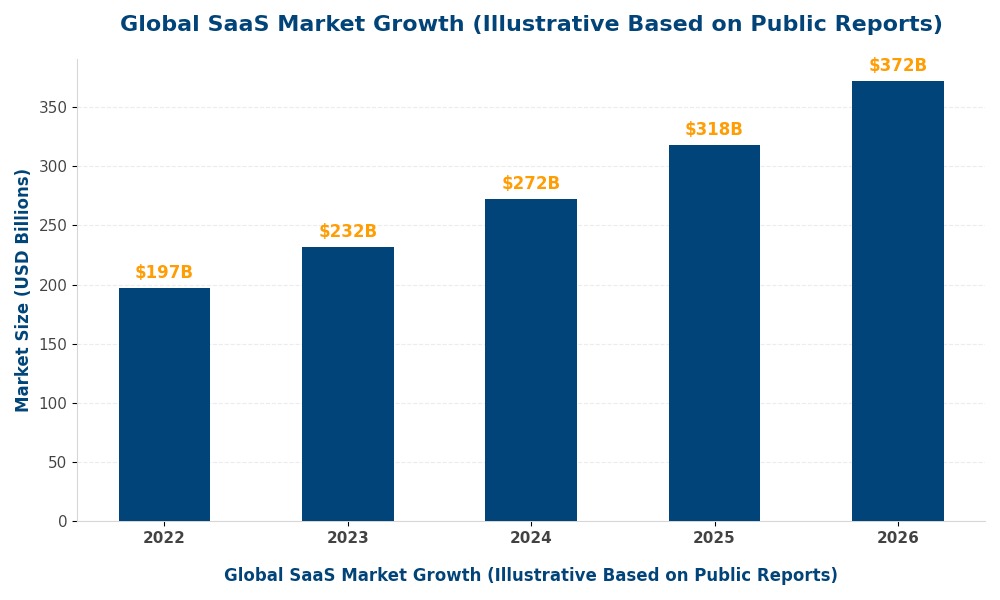
The chart above illustrates the steady expansion of the global SaaS market from 2022 through 2026, based on aggregated public industry reports.
In 2022, the SaaS market was valued at approximately $197 billion. By 2023, it grew to $232 billion, reflecting strong enterprise cloud adoption and post-pandemic digital acceleration. Growth continued in 2024, reaching $272 billion, driven by increasing demand for automation, remote collaboration tools, and vertical SaaS solutions.
The momentum did not slow down. In 2025, the market crossed $318 billion, fueled by deeper enterprise cloud migration and the integration of AI into SaaS platforms. By 2026, projections place the market at roughly $372 billion, showing consistent year-over-year expansion.
This is not short-term hype. The upward trend reflects structural changes in how software is built, delivered, and consumed:
A SaaS product is software hosted centrally and delivered over the internet, typically via a subscription. Users access it through a browser or app without installing anything locally. The vendor is responsible for hosting, maintenance, updates, security, performance, and backups. Customers simply use the product.
That sounds simple on the surface, but it changes everything about how you build software. SaaS is not only a deployment method. It’s a product and business model that must support recurring billing, onboarding, usage tracking, customer support workflows, and long-term reliability.
SaaS has become a core part of modern business operations. It allows companies to access software through the cloud without investing in expensive infrastructure or managing complex installations.
Because SaaS products are hosted centrally, updates are automatic, maintenance is simplified, and scaling is easier. Businesses can increase or reduce usage depending on their needs, making SaaS suitable for startups, growing companies, and large enterprises alike.
From project management platforms to CRM systems and accounting tools, SaaS applications help businesses operate more efficiently and adapt quickly to change.
The strongest reason is leverage. A SaaS product can serve thousands of customers using the same core platform and infrastructure. As demand grows, you scale resources rather than rebuild the product. This makes the model attractive for both micro-SaaS founders and enterprise product teams.
SaaS market growth is still strong heading into 2026. Fortune Business Insights reports the global SaaS market was valued at $315.68B in 2025 and projects growth to $375.57B in 2026.
SaaS benefits are often explained in broad terms, such as flexibility or convenience. In reality, the true value of SaaS lies in the structural advantages it creates for growth, revenue stability, and product evolution.
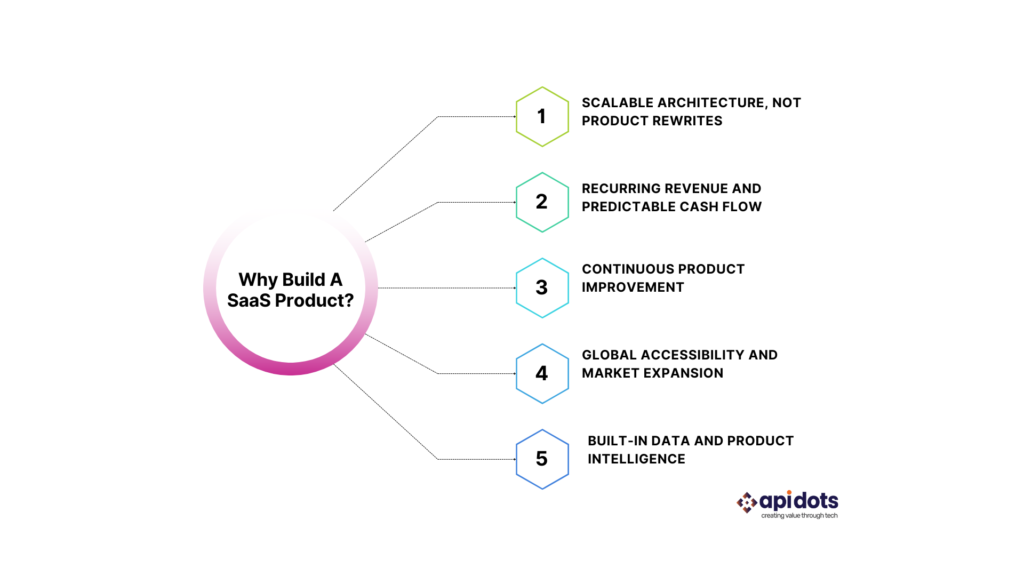
Scalability in SaaS is not just about handling more users. In a properly designed multi-tenant architecture, onboarding new customers becomes an infrastructure optimization task rather than a product redesign. Growth shifts from rewriting code to scaling resources efficiently. This allows the product to grow without constant structural changes.
When planning your SaaS architecture, it’s crucial to understand the differences between multi-tenant and single-tenant models and how they affect cost, performance, and security. Read more in our Multi-Tenant vs Single-Tenant SaaS Architecture blog.
Pricing models are evolving beyond traditional subscriptions. Learn more about SaaS pricing models and monetization strategies to design flexible revenue systems that scale with growth.
The subscription-based pricing model reduces customer purchase friction while improving the vendor’s revenue predictability. Instead of relying on one-time license sales, SaaS businesses build recurring revenue streams that compound over time. This financial stability enables better forecasting, strategic hiring, and reinvestment into product development.
Unlike traditional software, SaaS products evolve continuously. Teams can deploy updates, fix bugs, enhance onboarding, and release new features without requiring customers to manually upgrade. This enables faster innovation cycles and quicker adaptation to market feedback.
Cloud-based delivery removes geographic limitations. Browser access and distributed infrastructure allow SaaS companies to serve remote teams, international clients, and multi-region deployments without physical installations. From day one, your addressable market becomes global.
SaaS products naturally generate structured usage data. Every click, workflow, and interaction becomes measurable. This data supports better onboarding design, pricing optimization, churn reduction, customer success strategies, and roadmap prioritization. Over time, the product improves because it learns from real usage patterns
Despite AI “replatforming” and new delivery models, SaaS remains the default way to deliver business software in 2026, and the numbers back it up.
Why SaaS keeps winning over traditional license/on-prem models:
In short: if you’re building B2B or B2C software in 2026, SaaS application development is still the most defensible, scalable way to capture and retain value.
From intelligent assistants and predictive analytics to automated workflows and real-time decision engines, AI is reshaping how users interact with software.
For SaaS founders, this combination unlocks higher product stickiness, deeper personalization, and stronger data-driven insights. For customers, it reduces manual effort, improves accuracy, and delivers measurable efficiency gains. AI enhances the value proposition of SaaS by turning
AI and SaaS are no longer separate conversations. The most competitive SaaS platforms are built with intelligence at their core, from automation and predictive analytics to AI-driven workflows. But embedding AI requires more than adding APIs; it demands a scalable data architecture that efficiently handles both structured and unstructured data.
Choosing between relational and non-relational databases becomes critical at this stage, which is why understanding SQL vs NoSQL for scalable SaaS systems is essential when designing AI-ready infrastructure. SaaS platforms that align their data strategy with future AI requirements gain a significant long-term advantage.
Moving forward, AI-native SaaS will outperform traditional SaaS because intelligence becomes embedded in the workflow itself. The future belongs to platforms that combine recurring revenue models with continuously improving machine-driven capabilities.
A SaaS that survives beyond MVP doesn’t emerge from a single “build” phase; it moves through a disciplined lifecycle in which each stage de-risks the next.
Ideation
The journey usually begins with ideation. Here, you define the core problem, the segment you serve, and how your SaaS is meaningfully better than spreadsheets, email workflows, or existing tools. This is where you articulate the business case and the outcomes you’ll help your customers achieve.
Validation
Next comes validation, where you stop guessing and start listening. Instead of rushing to code, you test assumptions through interviews, prototypes, and early pricing conversations. The goal is to verify that the pain is real, frequent, and worth paying for. At this stage, you also refine your value proposition and initial feature set.
MVP Development
Once you know what matters, you move into MVP development. The key is to build the smallest, most functional product that delivers a clear win for a narrow audience. For SaaS, that usually means focusing on a single end-to-end workflow, while implementing only the essential supporting capabilities such as authentication, basic billing, and minimal analytics.
Archictecture
When the MVP vision is clear, you design the architecture with the future in mind. This is where 2026 SaaS teams differentiate themselves: you don’t over-engineer with dozens of microservices on day one, but you do ensure your data model, APIs, and multi-tenant strategy can handle growth, integrations, and higher security expectations later.
Development Phase
The development phase then turns that architecture into reality. Here, strong engineering practices matter: modular code, test coverage, CI/CD, and security baked into the pipeline. You’re not just coding features; you’re building a platform that your team can safely evolve for years.
Deployment Phase
After development, you reach deployment, where automation becomes crucial. You establish environments, release processes, monitoring, and rollback strategies. A modern SaaS deployment pipeline lets you ship small changes frequently, minimizing risk while maximizing learning.
Scaling Phase
Finally, the scaling phase begins once you see repeatable usage and revenue. Performance tuning, database optimization, horizontal scaling, and sometimes service decomposition come into play. You refine your architecture and infrastructure so the product can handle more tenants, more data, and more complex use cases without degrading reliability or exploding costs.
Also read: SaaS Product Development: From Concept to Market-Ready with Apidots
Throughout this lifecycle, a strategic SaaS partner continually aligns technical decisions with metrics such as customer acquisition cost, lifetime value, churn, and gross margin.
Behind every successful SaaS application is a clear, layered architecture. With the help of a visual diagram, we will try to explain all the layers that are vital in SaaS applicationd Development.
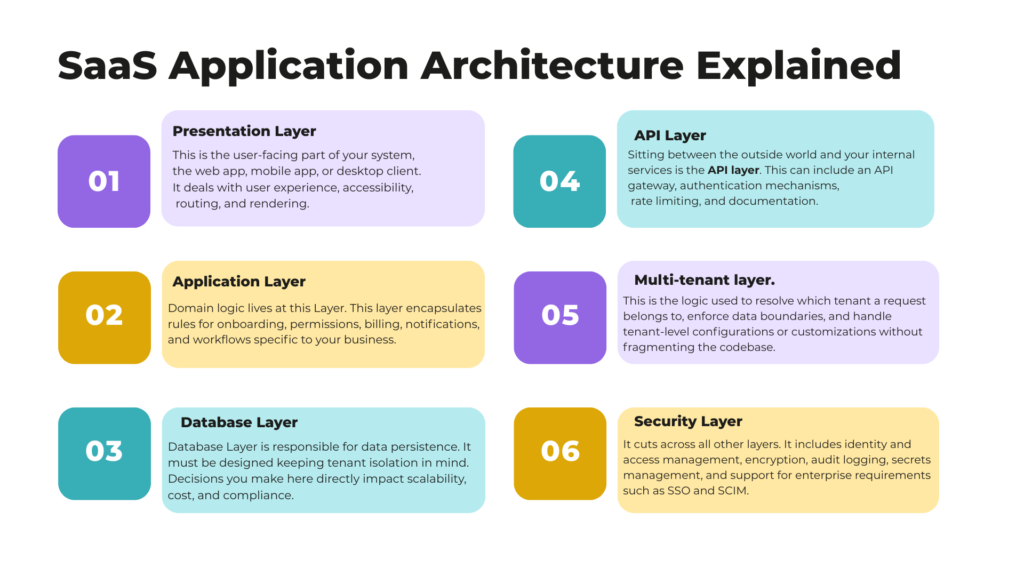
Presentation Layer:
This is the user-facing part of your system, the web app, mobile app, or desktop client. It deals with user experience, accessibility, routing, and rendering.
Application Layer:
Domain logic lives at this Layer. This layer encapsulates rules for onboarding, permissions, billing, notifications, and workflows specific to your business.
Database Layer:
The database layer is responsible for data persistence. It must be designed keeping tenant isolation in mind. Decisions you make here directly impact scalability, cost, and compliance.
API Layer:
Sitting between the outside world and your internal services is the API layer. This can include an API gateway, authentication mechanisms, rate limiting, and documentation.
Multi-tenant Layer:
This is the logic used to resolve which tenant a request belongs to, enforce data boundaries, and handle tenant-level configurations or customizations without fragmenting the codebase.
Security Layer:
It cuts across all other layers. It includes identity and access management, encryption, audit logging, secrets management, and support for enterprise requirements such as SSO and SCIM.
Thinking in layers like this helps your teams reason about change, isolate failures, and maintain a clean platform as new features and integrations are added.
The tech stack you choose speaks directly to your ability to hire, scale, and integrate with modern tooling. There’s no single “right” choice, but proven combinations work very well for SaaS application development. In the following table, we aim to include the most commonly used tech stacks for SaaS application development.
| Category | Tech Stack |
| Frontend (Web) | React, Next.js, Vue, Angular |
| Mobile | React Native, Flutter, Kotlin, Swift |
| Backend | Node.js, Django, FastAPI, .NET, Spring Boot |
| Relational Database | PostgreSQL, MySQL |
| NoSQL / Distributed Database | MongoDB, Redis, DynamoDB |
| Caching | Redis, Memcached |
| Message Queue / Streaming | RabbitMQ, Apache Kafka, Amazon SQS |
| API Gateway & Reverse Proxy | Kong, Amazon API Gateway, NGINX |
| Authentication & Identity | OAuth 2.0, OpenID Connect, Auth0, AWS Cognito |
| Cloud Provider | Amazon Web Services (AWS), Microsoft Azure, Google Cloud Platform (GCP) |
| Containerization | Docker |
| Container Orchestration | Kubernetes, Amazon ECS |
| Infrastructure as Code (IaC) | Terraform, AWS CloudFormation, AWS CDK, Azure Bicep |
| CI/CD | GitHub Actions, GitLab CI, Jenkins, CircleCI, Azure DevOps |
| Monitoring & Logging | Prometheus, Grafana, ELK Stack, Datadog, New Relic, Amazon CloudWatch |
| Product & User Analytics | Google Analytics, Mixpanel, Amplitude, Segment |
| Testing | Jest, Mocha, Cypress, Playwright, PyTest, xUnit, Postman |
| Storage & CDN | Amazon S3, Azure Blob Storage, Google Cloud Storage, Amazon CloudFront, Cloudflare CDN |
| Search | Elasticsearch, OpenSearch, Algolia, Meilisearch |
| Communication & Notifications | SendGrid, Mailgun, Twilio, Firebase Cloud Messaging |
| Payments & Billing | Stripe, Braintree, PayPal |
| Feature Flags & Experimentation | LaunchDarkly, ConfigCat, Unleash |
Some SaaS Tech Stack Combos (2026)
In 2026, the best SaaS stacks are usually combinations that optimize speed-to-market, scalability, and hiring availability. React/Next.js is still a common default for SaaS frontends, and Node.js remains heavily used across web apps, with many developers also expressing interest in Next.js. Docker usage is also used among professional developers, which is why container-friendly stacks keep winning.
| SaaS Type | Frontend | Backend | Database | Best For |
| Startup / MVP | Next.js | Node.js | PostgreSQL | Fast launch & scalability |
| AI / Data-Heavy | Next.js | FastAPI | PostgreSQL | AI features & high-performance APIs |
| Enterprise | React / Next.js | ASP.NET Core | SQL Server / PostgreSQL | Compliance & large-scale systems |
| Real-Time Apps | Next.js | Node.js | PostgreSQL + Redis | Live collaboration & dashboards |
What matters most is not chasing trends but choosing a stack that balances developer productivity, community support, performance, and long-term maintainability for your specific SaaS product.
When planning your SaaS product, one of the first practical questions founders face is “How much will it cost to build this?” The truth is that there is no single number; development costs vary widely depending on the product’s complexity, team structure, features, and market requirements. However, industry data from 2026 shows consistent patterns that support realistic budgeting. Here is the table outlining the cost breakdown in your SaaS product development journey.
| Product Type | Typical Cost Range (USD) | Description | Timeline |
| Lean MVP | $5,000 – $40,000 | Basic proof of concept with minimal core features | 2–4 months |
| Standard MVP | $20,000 – $120,000 | Functional MVP with UI/UX, backend, and essential workflows | 3–6 months |
| Mid-Tier SaaS | $60,000 – $200,000+ | Integrations, billing, user roles, moderate scalability | 4–9 months |
| Enterprise / Complex SaaS | $300,000 – $1,000,000+ | Advanced architecture, security, compliance, analytics, AI | 8–18+ months |
Development cost isn’t just about writing code; it also includes UI/UX design, backend infrastructure, testing, deployment, and often marketing or launch readiness. Hidden costs such as QA, maintenance, and cloud hosting should be factored into your budget planning
Several factors influence where a project will land within these ranges:
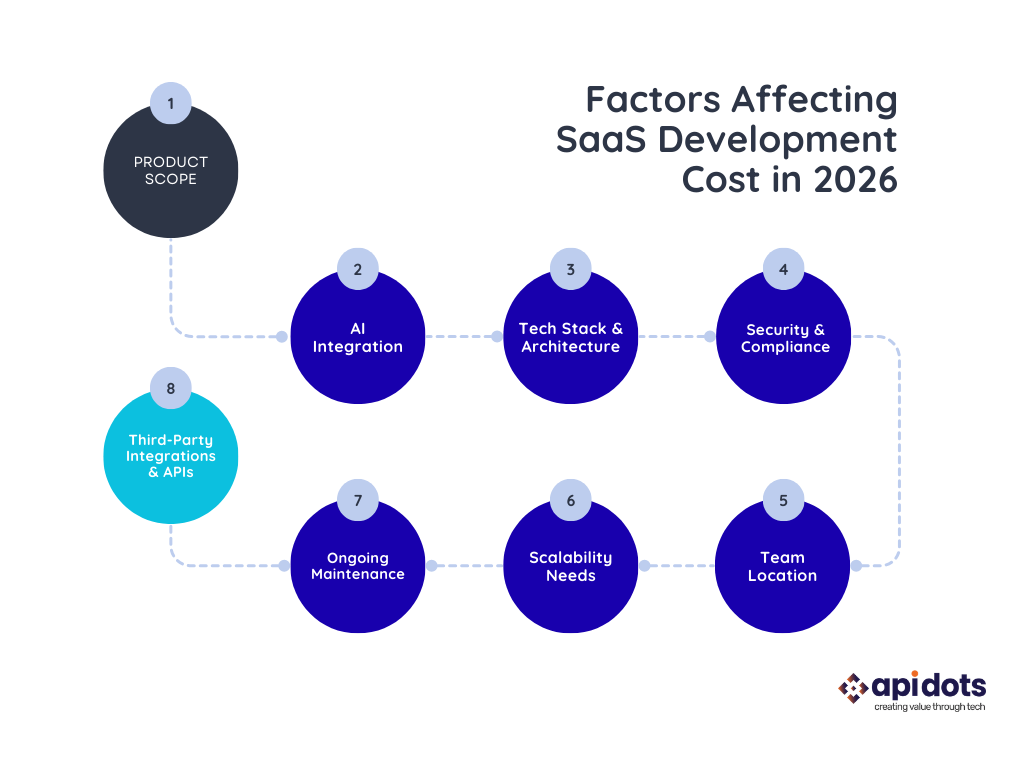
1. Product Scope
The breadth and complexity of features directly impact development time and cost. A simple MVP requires fewer resources, while enterprise-grade platforms with advanced workflows demand significantly more engineering effort.
2. AI Integration
Embedding AI capabilities such as automation, recommendations, or intelligent assistants increases both development complexity and infrastructure costs. AI-ready architecture and data pipelines must be planned from the start.
3. Tech Stack & Architecture
Technology choices influence scalability, performance, and long-term flexibility. Decisions between monolithic vs. microservices or serverless vs. containerized setups affect both upfront investment and future expansion.
4. Security & Compliance
Industries with regulatory requirements require enhanced security layers, encryption standards, audit logs, and compliance alignment. These safeguards add development effort but are essential for trust and legal adherence.
5. Team Location
Development costs vary significantly by region and team structure. Hiring models (in-house, outsourced, hybrid) directly influence budget, delivery speed, and operational overhead.
6. Scalability Needs
Applications built for high traffic or rapid growth require advanced infrastructure planning. Load balancing, caching, distributed systems, and monitoring tools increase technical complexity and cost.
7. Ongoing Maintenance
Post-launch updates, bug fixes, performance tuning, and security patches require continuous investment. Maintenance typically represents a recurring percentage of the initial development cost.
8. Third-Party Integrations & APIs
Integrating external services such as payment gateways, CRMs, or analytics tools adds additional development and testing requirements. Each integration introduces dependencies that must be maintained over time.
Understanding these factors upfront makes it easier to forecast the budget and decide where to invest heavily now and where to stage capabilities over time.
Looking at well-known SaaS products helps illustrate how architecture, pricing, and scalability strategies come together in practice.
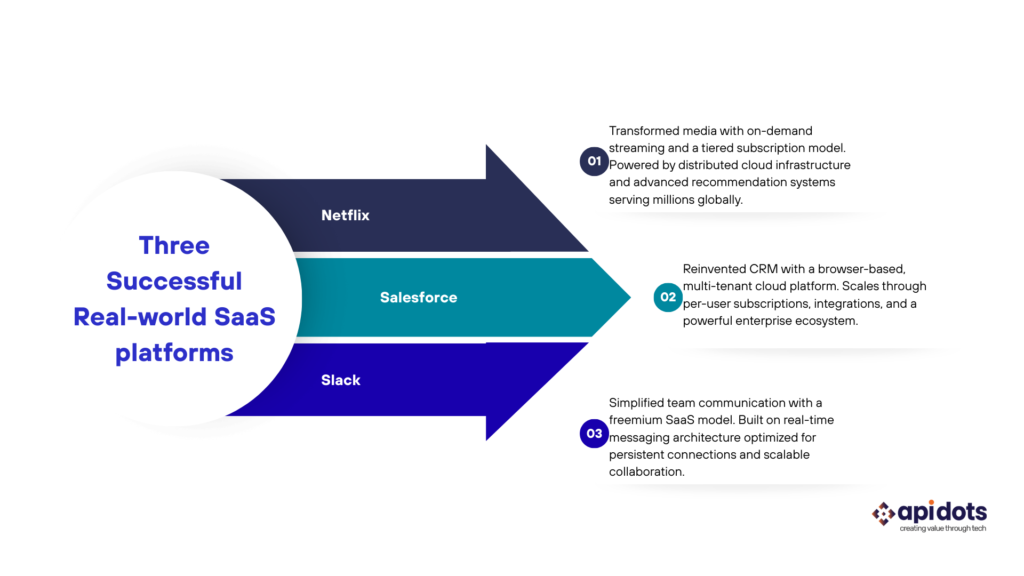
These examples share three patterns: a clear problem solved, a recurring revenue model, and a deliberate approach to scalability and platformization. When designing your own SaaS application, it helps to think in terms of related concepts rather than just features.
SaaS remains attractive in 2026, but building a resilient, profitable product requires anticipating modern challenges early.
With centralized user data and AI-driven workflows, SaaS platforms are prime targets. Beyond encryption and access control, teams must now secure AI pipelines, prevent prompt injection, monitor model outputs, and ensure compliance with evolving data regulations.
Multi-tenant efficiency increases architectural risk. A single logic flaw can expose cross-tenant data. Strong tenant isolation, strict query filtering, and automated testing are critical in 2026 environments.
Growth depends on retention, not just acquisition. SaaS companies must focus on onboarding, product adoption, customer success, and continuous value delivery to reduce churn and improve lifetime value.
Cloud and AI usage can silently erode margins if left unchecked. Over-provisioned servers, inefficient queries, unused resources, and uncontrolled AI API consumption can quickly inflate operational costs. As SaaS platforms embed more automation and intelligent workflows, understanding the broader automation landscape becomes critical.
We have explored this in detail in our guide on RPA vs intelligent automation strategy, which explains how different automation approaches impact infrastructure load, scalability, and long-term cost efficiency. Sustainable SaaS growth in 2026 requires disciplined FinOps practices, real-time cost monitoring, and smarter automation decisions that balance performance with profitability.
What works for 50 users may fail at 5,000. In 2026, scaling often requires caching layers, distributed databases, queues, microservices, and optimized AI inference pipelines to maintain performance and uptime.
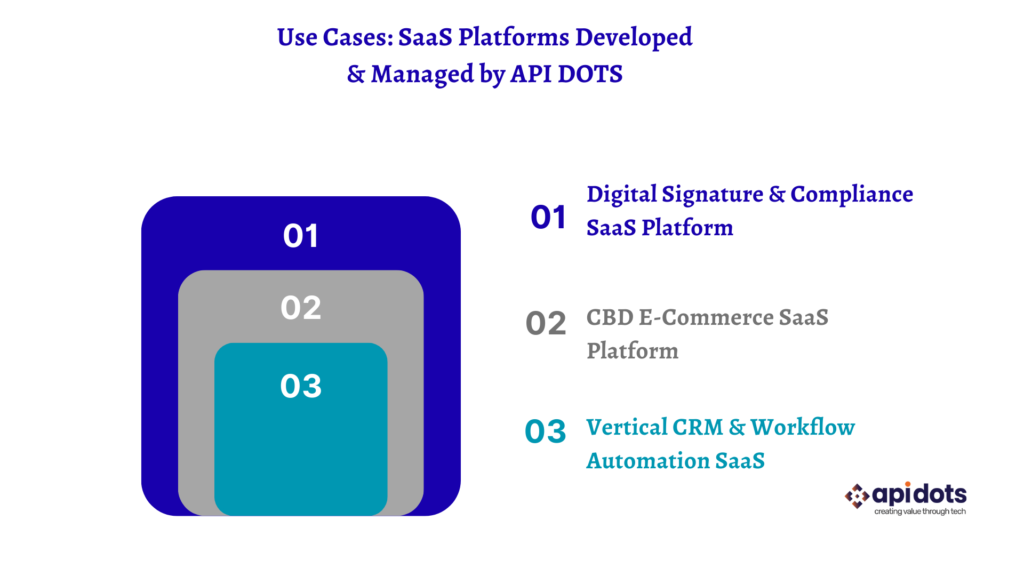
API DOTS developed and now manages a cloud-based digital signature and document workflow SaaS solution tailored for high-compliance environments. The platform supports secure multi-tenant access, subscription billing, and structured audit controls while maintaining data isolation across organizations. Ongoing management focuses on performance optimization, reliability engineering, and iterative feature enhancements aligned with compliance trends. This use case demonstrates how robust architecture and disciplined system management enable scalable and secure SaaS operations.
API DOTS builds and maintains a SaaS-enabled e-commerce platform designed for the regulated consumer product sector. The system incorporates recurring revenue mechanics, secure payment workflows, and compliance-aware backend processes. Infrastructure management emphasizes cloud cost control, traffic resilience, and performance consistency even during demand fluctuations. This engagement highlights how SaaS frameworks can power regulated commerce systems with scalable operations and repeatable subscription logic.
For an industry-specific CRM and workflow automation platform, API DOTS delivered a modular SaaS solution that includes role-based controls, automated task logic, and integration-ready APIs. Since launch, apidots continues to manage performance tuning, platform stability, and system extensions. The design allows for seamless feature expansion without disrupting core processes. This use case showcases how a tailored SaaS architecture supports complex business workflows with stability and long-term adaptability.
As SaaS evolves into 2026 and beyond, intelligent features, vertical specialization, and hyper-personalization are becoming strategic differentiators. Explore these developments in detail in our blog on AI, verticalization, and personalization trends in SaaS to understand how market expectations are shifting.
The SaaS landscape in 2026 is no longer defined by simple subscription software. It is increasingly shaped by intelligence, specialization, flexible monetization, and ecosystem-driven growth. The architectural decisions made today determine whether a product can evolve with market expectations over the next several years.
AI has shifted from an optional feature to a foundational one. Modern SaaS platforms are expected to embed intelligent assistants, workflow automation, predictive analytics, and contextual recommendations directly into core user journeys.
Designing without structured data pipelines, scalable compute layers, and AI-ready infrastructure makes future integration expensive and inefficient, a mistake many teams make when rushing AI adoption. We’ve outlined these common pitfalls in detail in our guide on AI adoption strategy mistakes and how companies can fix them.
Vertical SaaS is expanding rapidly as businesses shift from generic tools to industry-specific platforms tailored to regulatory requirements and operational nuances. This specialization increases retention but requires deeper domain expertise and compliance-aware architecture.
Monetization is also evolving beyond simple subscriptions toward usage-based and hybrid pricing models, especially in AI-driven products, making flexible billing systems essential from day one.
In 2026, the most resilient SaaS platforms function as ecosystems built API-first, integration-ready, and designed for interoperability. Products that embrace specialization, pricing flexibility, and extensibility are better positioned for long-term growth.
How long does it take to build a SaaS application?
A focused SaaS MVP can often be built in three to six months, assuming a clear scope and a dedicated cross-functional team. Getting to a production-ready, multi-tenant product with robust security, observability, and early integrations typically takes six to twelve months or more, especially if you’re targeting enterprise buyers or regulated industries.
How much does SaaS development cost?
Costs vary widely, but a serious, market-ready SaaS product rarely comes in at “hobby” budgets. A narrow MVP might be achievable with a relatively small investment, but a scalable SaaS with multi-tenant architecture, integrations, analytics, and security often requires an initial budget in the low six-figure range and up, spread over design, development, and launch. After that, you should plan ongoing investment to evolve and maintain the product.
What is multi-tenancy in SaaS?
Multi-tenancy is an architectural approach in which a single application instance serves multiple customers (tenants), while keeping their data and configurations isolated. Instead of running separate copies of the app for each customer, you share infrastructure and code but partition data. This allows for better economics and simpler maintenance, but it demands careful design to ensure security and reliability.
How do SaaS apps scale?
SaaS applications scale by combining horizontal infrastructure scaling with smart software design. That often includes distributing workloads across containers or nodes, optimizing databases and queries, using caches, offloading long-running work to background jobs, and splitting particularly heavy components into independently scalable services.
Hi! I’m Aminah Rafaqat, a technical writer, content designer, and editor with an academic background in English Language and Literature. Thanks for taking a moment to get to know me. My work focuses on making complex information clear and accessible for B2B audiences. I’ve written extensively across several industries, including AI, SaaS, e-commerce, digital marketing, fintech, and health & fitness , with AI as the area I explore most deeply. With a foundation in linguistic precision and analytical reading, I bring a blend of technical understanding and strong language skills to every project. Over the years, I’ve collaborated with organizations across different regions, including teams here in the UAE, to create documentation that’s structured, accurate, and genuinely useful. I specialize in technical writing, content design, editing, and producing clear communication across digital and print platforms. At the core of my approach is a simple belief: when information is easy to understand, everything else becomes easier.