
Top
Search
People also search for:

Stay Inspired with Instagram




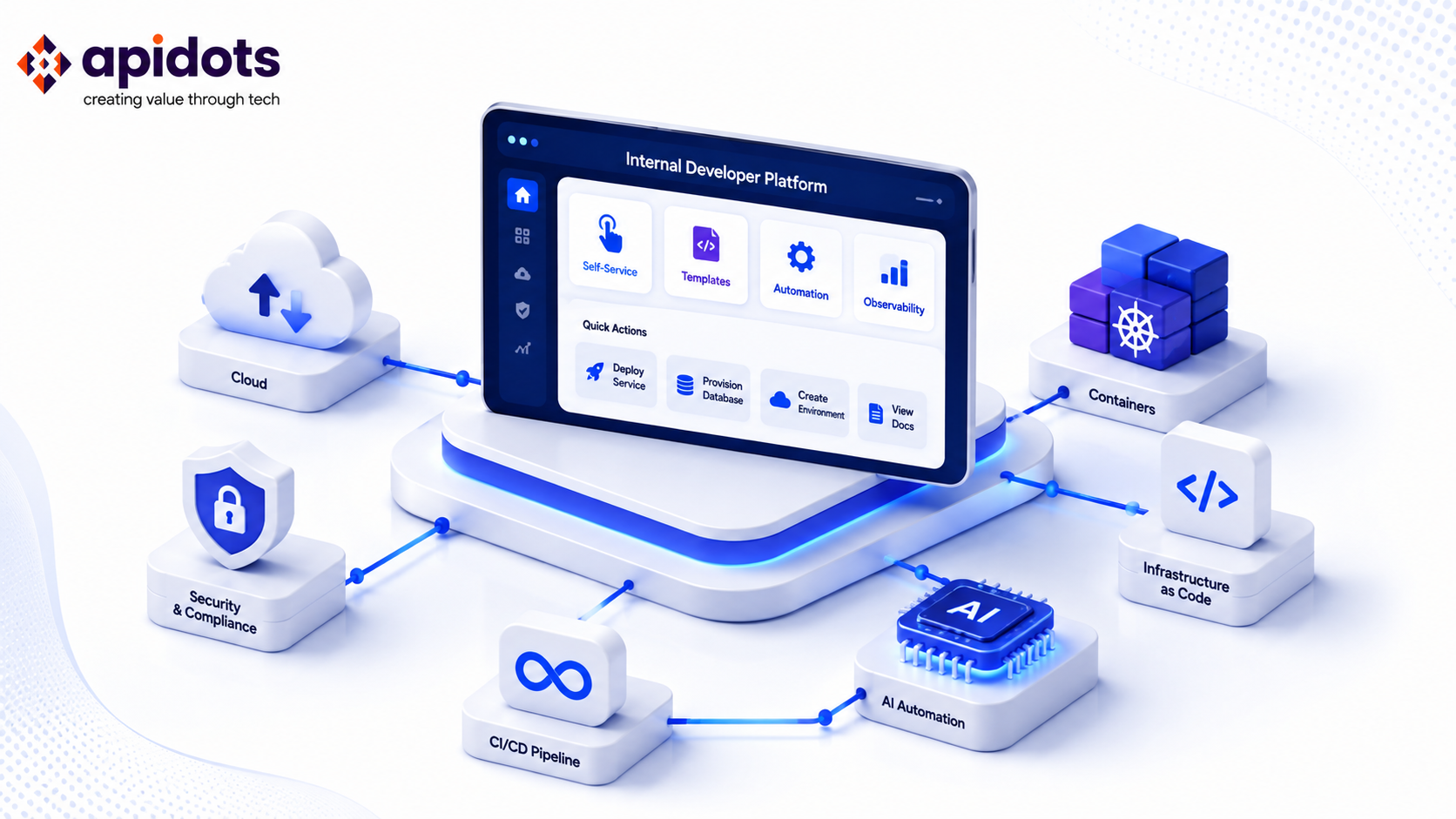
Platform engineering in 2026 is reshaping how engineering teams ship software, especially in regulated industries, by automating compliance at the infrastructure layer.
Platform engineering 2026 has moved from conference buzzword to budget line item. Engineering leaders at healthcare, fintech, and enterprise SaaS companies aren’t asking whether to invest in an internal developer platform. They are asking how fast they can build one without repeating the mistakes of teams that got there first.
This guide explains what platform engineering actually is and why internal developer platforms (IDPs) are accelerating in 2026. It also covers why compliance-heavy industries are leading the shift, and where teams commonly get stuck.
Platform engineering is the discipline of building internal, self-service tools for developers. These tools let developers provision infrastructure, deploy code, and manage environments without filing a ticket.
The output of a platform team is not a set of manual runbooks. It is an internal developer platform (IDP): a product, built for an internal audience, that developers use every day.
DevOps describes a culture and a set of practices. It breaks down silos between development and operations, automates the delivery pipeline, and treats infrastructure as code.
Platform engineering takes those DevOps practices and packages them into a reusable, self-service product. Any development team in the organization can consume it directly.
A traditional DevOps or infrastructure team often works reactively, responding to individual requests from product teams. A platform team works differently. It builds golden paths, pre-approved, pre-secured templates for common tasks.
Examples include spinning up a new service, provisioning a database, and deploying to production. The distinction matters operationally. Traditional DevOps consulting services typically focus on pipeline design and infrastructure automation for a specific engagement. Platform engineering is an ongoing internal capability. It’s owned and staffed inside the organization, and keeps evolving as the company scales.
| Dimension | Traditional DevOps / Infra Team | Platform Engineering Team |
| Primary output | Scripts, pipelines, manual runbooks | Self-service internal developer platform (IDP) |
| Engagement model | Ticket-driven, request-response | Product-driven, roadmap and backlog owned by platform team |
| Consumer relationship | Infra team serves requests as they arrive | Developers self-serve through golden paths and portals |
| Success metric | Uptime, ticket resolution time | Developer adoption, onboarding time, deployment frequency |
| Compliance approach | Manual review gates, checklist audits | Compliance encoded directly into the platform’s golden paths |
Comparison based on common industry role definitions from platform engineering practitioners and Gartner’s infrastructure and operations research.
The single biggest shift platform engineering introduces is treating internal infrastructure the way a company treats an external product. That means the platform team has a roadmap and gathers feedback from its internal developer users. It tracks adoption metrics and iterates based on what actually gets used. A platform nobody adopts is a platform that failed, regardless of how technically sound its architecture is.
Several forces are converging to push platform engineering investment in 2026 higher than in previous years. The clearest signal comes directly from Gartner’s own research on infrastructure and operations trends.
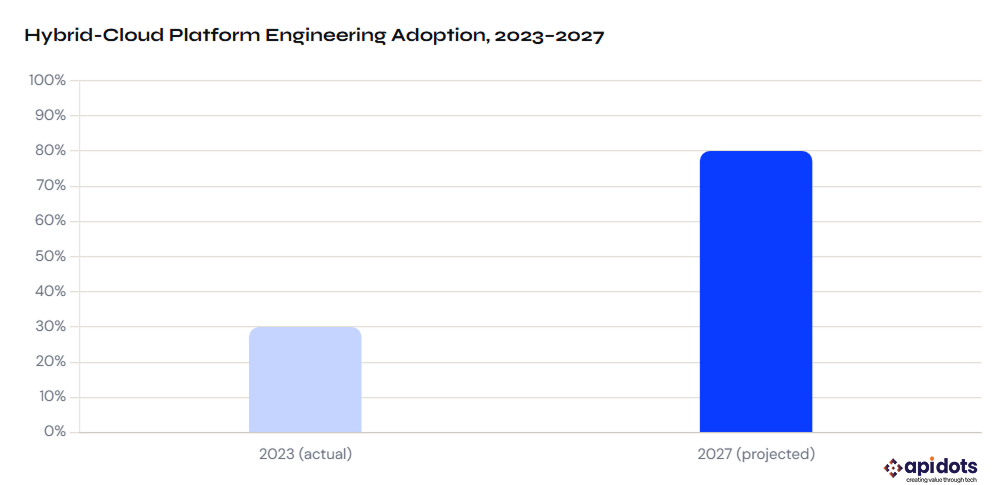
Source: Gartner, “Unlock Infrastructure Efficiency with Platform Engineering,” 2026. By 2027, 80% of large organizations will embrace platform engineering to scale DevOps in hybrid cloud environments. That’s up from less than 30% in 2023. Gartner also projects platform engineering principles will influence more than 50% of infrastructure and operations technology decisions by 2027. That’s up from less than 20% today. View source →
The underlying driver is complexity. As organizations extend DevOps toolchains into hybrid cloud environments, the cognitive load on individual development teams grows. A platform absorbs that complexity. Developers do not need to become experts in every regulatory and security requirement their infrastructure touches.
AI adoption inside platform engineering itself is a second major driver. Independent survey data backs this up.
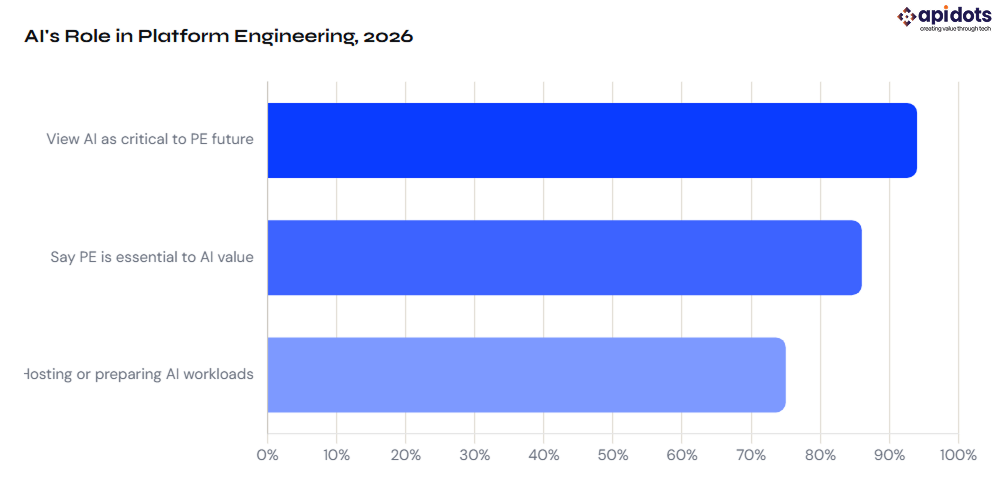
Source: Platform Engineering.org, State of Platform Engineering Report Volume 4, January 2026 (survey of 518 engineering practitioners worldwide). View source →
Platform teams are becoming the primary distribution point for AI tooling inside engineering organizations. Individual teams no longer need to evaluate and secure their own AI coding assistants.
Platform teams increasingly vet, configure, and roll out approved AI coding tools with the right guardrails already in place. The Cloud Native Computing Foundation’s own analysis of AI-native workloads makes a similar point.
Platforms originally designed for human-paced, developer-centric delivery now need to evolve. They must support AI-driven coding acceleration and agentic workflows.
Cost visibility is moving earlier in the development lifecycle. Instead of discovering an expensive infrastructure decision on next month’s cloud bill, mature platforms flag it early. Projected cost surfaces at the point of provisioning. Security follows the same pattern. Rather than a separate review bolted onto the end of a deployment pipeline, checks happen earlier. Security scanning, secret management, and policy checks are built directly into the golden path itself.
Healthcare, financial services, and government organizations are adopting platform engineering faster than the broader market. The reason is straightforward. Manual compliance checks do not scale. Regulated industries cannot afford the risk of a missed audit trail or an unlogged production change.
The core idea behind compliance-by-construction is simple. Instead of asking a developer to remember every regulatory requirement before every deployment, the platform enforces it automatically. SOC 2-relevant logging, immutable audit trails, and role-based access controls are built into the golden path itself.
A developer cannot accidentally skip a required control. Our own work on healthcare compliance automation follows this exact pattern. Policy gets embedded in CI/CD pipelines as code, rather than enforced through manual review after the fact.
| Compliance Capability | Bolted On Post-Hoc | Built Into the Platform |
| Audit logging | Manually configured per project, often inconsistent | Standard on every deployment through the golden path |
| Access control | Requested and granted ad hoc | Role-based access enforced by default at provisioning |
| Secrets management | Hard-coded or inconsistently rotated | Centralized vault integration required by the platform |
| Change evidence for auditors | Reconstructed manually during an audit | Continuously generated and queryable |
Illustrative framework based on common compliance-by-construction patterns in regulated-industry platform engineering.
For a healthcare platform, this might mean every new service automatically inherits HIPAA-aligned logging and encryption defaults. For a fintech platform, it might mean every database connection is provisioned with FINRA-ready audit logging by default. No engineer needs to configure it by hand.
Our guide on HIPAA data handling covers how this gets built in from the first line of code. The same approach extends naturally into the platform layer.
Why this matters for budget conversations: Compliance-by-construction does not just reduce audit risk. It removes a recurring cost, since teams stop rebuilding the same compliance logic project by project.
Not every platform investment pays off. Many organizations stand up a platform team but never see measurable results.
The most common failure mode is structural. A platform team gets created, but instead of building self-service golden paths, it starts fielding requests one by one. Those are the same individual infrastructure requests the old operations team used to handle.
When that happens, the organization has simply renamed its ticket queue. The team is not automating operations at the platform layer. It is manually processing requests one at a time, which defeats the entire premise of platform engineering.
Nearly 3 in 10 platform teams are not measuring their own success at all. That’s according to the same State of Platform Engineering Report Volume 4 survey cited above. Without tracking metrics like developer onboarding time, deployment frequency, or platform adoption rate, teams cannot demonstrate ROI to leadership. That puts the platform investment at risk during the next budget cycle.
Organizations evaluating a platform engineering investment generally face two paths. They can build the capability internally from scratch, or partner with a team that has already built similar platforms.
Early internal developer platforms were often built as single, all-encompassing systems meant to handle every team’s needs at once. In 2026, the more common and more successful approach is composable. Teams build smaller, focused platform capabilities, often segmented by function such as frontend, backend, data, and AI.
This replaces one monolithic system trying to serve everyone. It mirrors patterns seen across machine learning software development, where teams build modular infrastructure instead of one rigid pipeline.
Building a platform engineering capability from zero typically requires dedicated headcount and months of internal tooling work. It also takes enough experience to avoid the ticket-queue trap described above. Organizations that want to move faster without hiring a full platform team often partner with an experienced team instead. That choice shortens the timeline while keeping compliance-by-construction intact from day one.
Platform engineering 2026 is not a trend engineering leaders can wait out. Whether an organization builds its internal developer platform in-house or partners with an experienced team, the direction is clear: infrastructure that treats compliance, developer experience, and AI readiness as first-class requirements rather than afterthoughts.
Platform engineering is the practice of building internal, self-service tools for developers. These let developers provision infrastructure and deploy code without waiting on a separate operations team. The output is an internal developer platform, treated and maintained like a product for internal users.
DevOps is a culture and set of practices for uniting development and operations. Platform engineering packages those practices into a reusable, self-service internal developer platform. Developers use it directly, instead of relying on a ticket-based infrastructure team.
An internal developer platform is the self-service system a platform team builds and maintains. It gives developers golden paths to provision environments, deploy services, and manage infrastructure without manual tickets.
Healthcare, fintech, and government organizations adopt platform engineering to automate compliance. Building audit trails, access controls, and logging into the platform’s golden paths removes a key risk. Developers can no longer skip a required control during a manual deployment.
Cost varies widely based on scope, team size, and existing infrastructure maturity. Organizations building internally typically need dedicated platform engineering headcount plus months of tooling work. Partnering with an experienced development team can reduce both timeline and cost by reusing proven, compliant components.
We leverage AI, cloud, and next-gen technologies strategically.Helping businesses stay competitive in evolving markets.
Consult Technology Experts
Hi! I’m Aminah Rafaqat, a technical writer, content designer, and editor with an academic background in English Language and Literature. Thanks for taking a moment to get to know me. My work focuses on making complex information clear and accessible for B2B audiences. I’ve written extensively across several industries, including AI, SaaS, e-commerce, digital marketing, fintech, and health & fitness , with AI as the area I explore most deeply. With a foundation in linguistic precision and analytical reading, I bring a blend of technical understanding and strong language skills to every project. Over the years, I’ve collaborated with organizations across different regions, including teams here in the UAE, to create documentation that’s structured, accurate, and genuinely useful. I specialize in technical writing, content design, editing, and producing clear communication across digital and print platforms. At the core of my approach is a simple belief: when information is easy to understand, everything else becomes easier. Reach me at amysbrew.com
Comments are closed.
2 Comments
[…] platform engineering primer covers what the discipline is and why adoption is accelerating. This piece goes further into the […]
[…] platform engineering primer covers what the discipline is and why adoption is accelerating. This guide picks up where that one […]