
Top
Search
People also search for:

Stay Inspired with Instagram




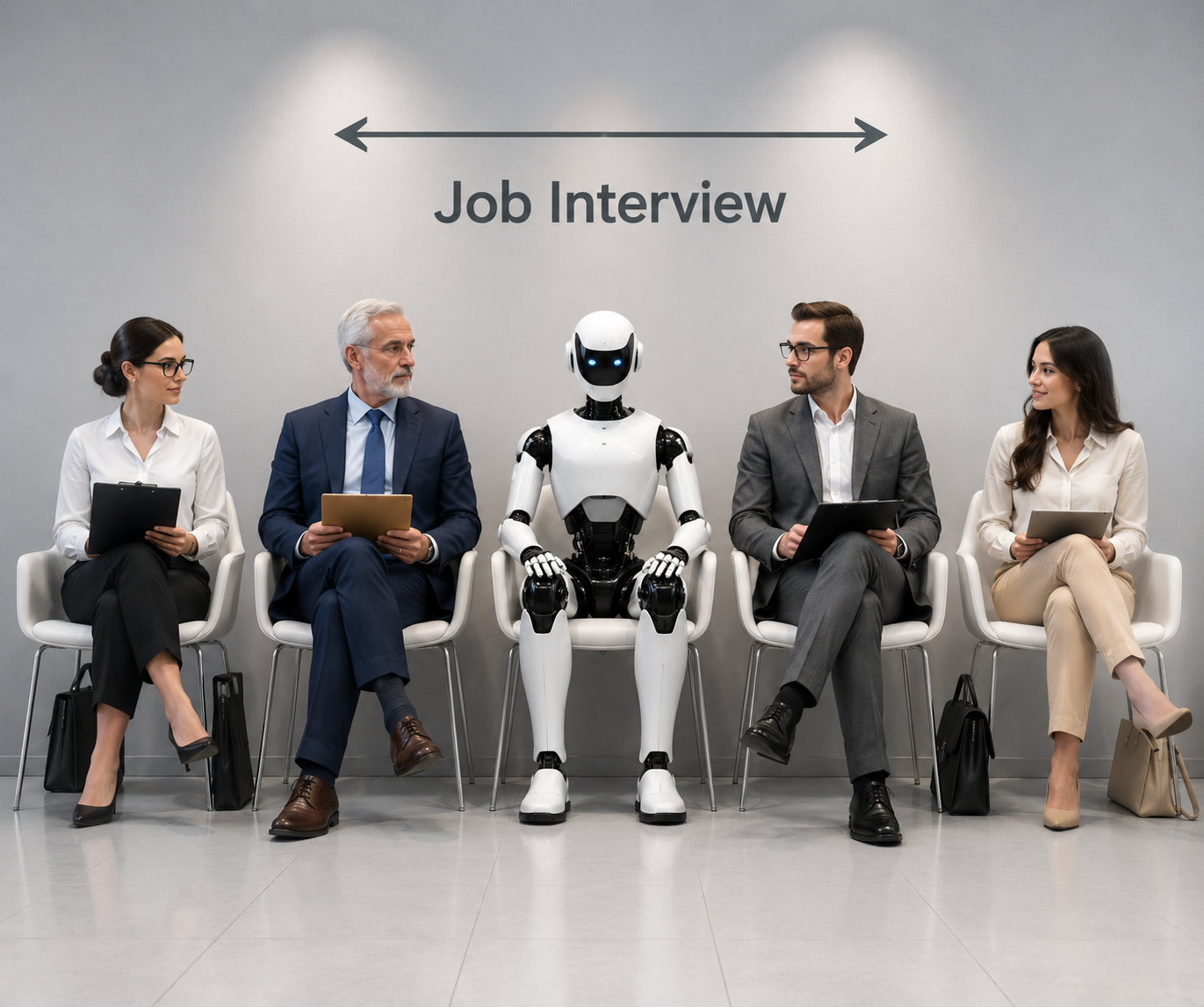
A new Microsoft Research study has identified the 40 jobs most at risk from AI and the 40 jobs least exposed to AI, based on real Copilot usage data from 200,000 conversations.
A new research paper from Microsoft has put a number on what many workers have feared, but few have been able to quantify: how much of your job can generative AI already do? The study, titled “Working with AI: Measuring the Applicability of Generative AI to Occupations” (Tomlinson et al., 2025), did not rely on hypothetical task lists or expert surveys. Instead, researchers measured what people actually ask AI to do at work and how well AI performs those tasks.
The result is an “AI applicability score” for 785 occupations, drawing on 200,000 anonymized conversations between users and Microsoft Bing Copilot. This is one of the most grounded assessments of AI’s impact on work produced to date. Below is a full breakdown of who is most exposed, who is safest, and what the findings mean for professionals and businesses planning ahead.
The jobs most at risk from AI are roles built around writing, translation, customer service, sales communication, research, data processing, and information retrieval. Microsoft Research found that interpreters and translators, writers, customer service representatives, sales representatives, technical writers, editors, journalists, and market research analysts have high exposure to generative AI.
The jobs safest from AI are hands-on roles that require physical presence, manual dexterity, patient care, sensory judgment, or real-time decision-making. These include phlebotomists, nursing assistants, roofers, surgical assistants, highway maintenance workers, tire repairers, machine operators, and other physical or care-based jobs.
A job being “at risk” does not mean it will disappear. It means many tasks in that role can now be supported, accelerated, or partially automated by AI tools.
The research team cross-referenced Copilot conversations with the U.S. government’s O*NET occupational database, which lists the specific work activities associated with each role. For every conversation, they measured three things: how often AI assistance was sought for a given task type, how successfully the AI completed the task, and what share of that occupation’s total activity was covered. Combining these three factors produced a single AI applicability score per occupation.
The researchers were careful to flag a key nuance. A high applicability score shows that AI tools are already useful for a large portion of a role’s tasks. It does not prove that the entire job can be automated. Lead author Kiran Tomlinson stated: “Our research shows that AI supports many tasks, particularly those involving research, writing and communication, but it does not indicate it can fully perform any single occupation.”
The top-scoring occupations involved knowledge work — writing, translation, communication, analysis, and information retrieval. The bottom-scoring roles relied on physical presence, manual dexterity, or unpredictable human interaction.
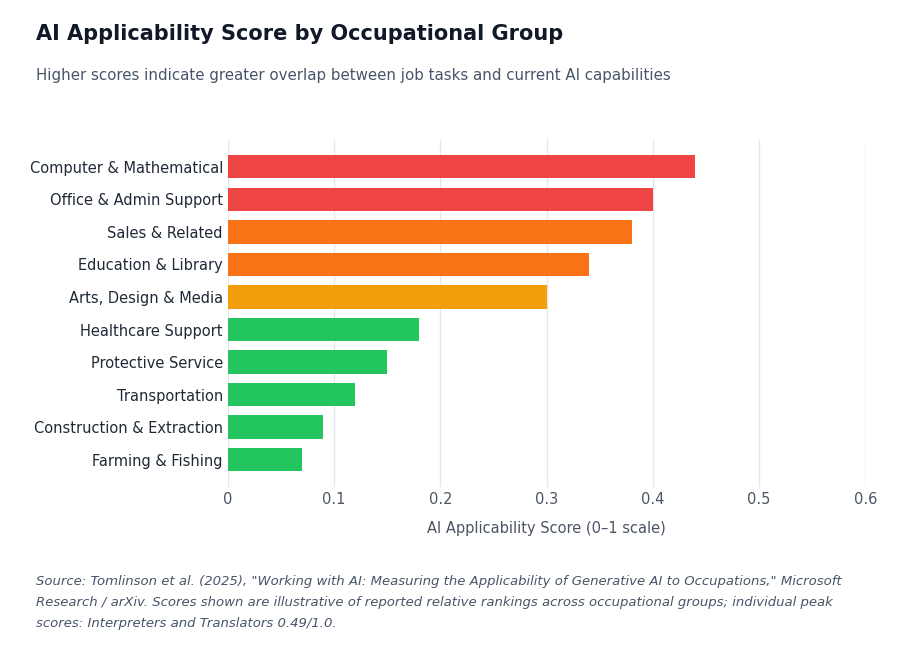
The chart above reflects the study’s core finding: computer, mathematical, and administrative occupational groups cluster at the top, while construction, farming, and installation trades occupy the bottom. Knowledge work sits at the intersection of AI’s current strengths: synthesizing text, retrieving information, drafting communications, and summarizing data.
The following roles received the highest AI applicability scores in Microsoft’s study. Jobs near the top of this list involve tasks that align closely with what generative AI already does well: translating text, fielding customer queries, writing copy, processing information, and fielding communications. Interpreters and Translators scored highest of all at 0.49 out of a maximum of 1.0.
Customer service representatives and sales roles made the list partly because of sheer scale — those two categories alone account for roughly five million jobs in the United States, making the economic stakes significant even at a modest automation rate.
“It is tempting to conclude that occupations with high overlap will experience job loss. This would be a mistake, as our data do not include the downstream business impacts of new technology, which are very hard to predict.” (Tomlinson et al., Microsoft Research, 2025)
Several of these roles will look familiar to anyone who has watched AI tooling develop over the past two years. Translation apps, AI writing assistants, customer service chatbots, and automated PR drafting tools have all reached commercial maturity. The study puts empirical weight behind what many practitioners already sensed: the tasks that define these jobs can increasingly be delegated to a well-prompted language model.
At the opposite end of the spectrum sit roles where current large language models have almost no foothold. The common thread across the safest jobs is physical presence, manual skill, real-time sensory judgment, or direct care for other human beings — none of which a text-based AI can replicate through a screen.
Phlebotomists ranked as the single most AI-resistant occupation in the study. Drawing blood requires fine motor control, patient communication, sterile technique, and the ability to adapt instantly to a frightened or medically complex patient. None of those requirements map onto what a generative AI does.
The researchers also issued a meaningful caveat for people considering a mid-career pivot toward manual trades for safety. The study analyzed large language models specifically. Specialized AI combined with robotics could eventually reach physical roles that text-based AI cannot touch today. Truck drivers, machine operators, and construction workers may face a different risk profile in a five-to-ten-year horizon once purpose-built robotic systems scale beyond current pilot deployments.
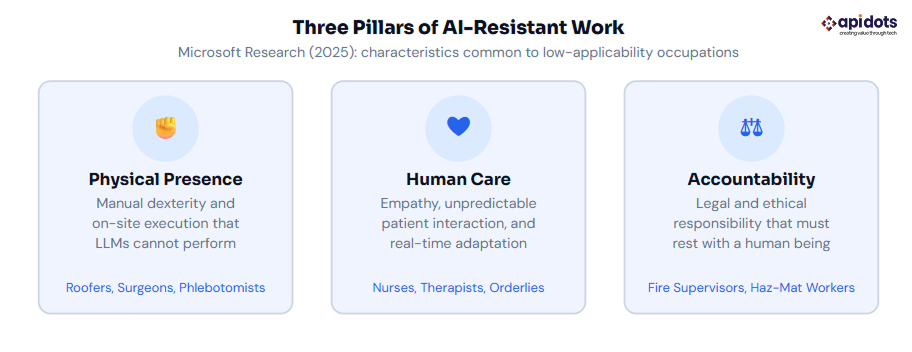
Looking across both lists, three characteristics consistently protect jobs from high AI applicability scores.
Every low-scoring occupation requires the worker to be somewhere specific, doing something with their hands or body. Roofers, surgeons, and phlebotomists cannot be replaced by a language model because the work product is physical, not informational. A chatbot cannot fix a leaking pipe or draw blood from a moving patient.
Nursing assistants, massage therapists, and surgical assistants work with human bodies and emotions that are inherently variable. Each patient is different, each situation is improvised in real time. The emotional and sensory loop between caregiver and patient is not something a generative model can enter. This is why tech jobs that blend human judgment with technical skill also tend to resist automation pressure.
A surgeon, a fire supervisor, or a hazardous materials worker operates under legal and ethical accountability that cannot be delegated to a software model. Society and law require a human to bear responsibility for decisions that carry physical risk. That accountability structure itself acts as a barrier to automation.
The Microsoft findings do not exist in a vacuum. The World Economic Forum’s Future of Jobs Report 2025, which surveyed more than 1,000 employers representing 14 million workers across 55 economies, offers the most comprehensive macroeconomic counterpoint available. The WEF projects that by 2030, 92 million existing roles will be displaced by automation and AI — but 170 million new roles will be created in the same period, producing a net gain of 78 million jobs globally.
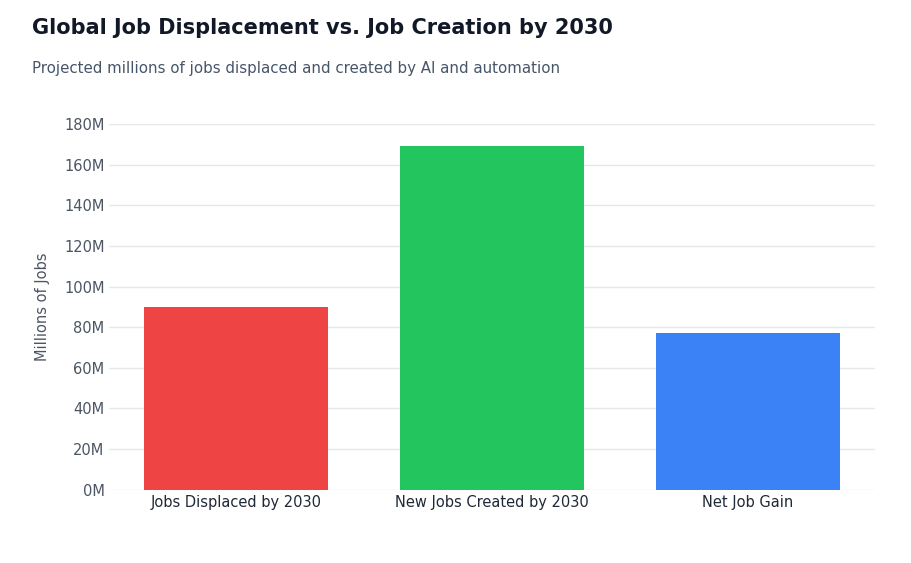
Source: World Economic Forum, “Future of Jobs Report 2025,” January 2025. Survey of 1,000+ companies across 22 industries and 55 economies representing 14 million workers.
The WEF data reinforces a point the Microsoft researchers also make: automation and augmentation are not zero-sum. If AI makes a software developer 50 percent more productive, a company can either achieve more with the same headcount or hire more developers to pursue ambitions that were previously too expensive to attempt. The outcome depends entirely on business strategy, not on a fixed ratio between AI capability and headcount.
The skills picture is similarly nuanced. The WEF found that 39 percent of core job skills are expected to change by 2030 — down from 44 percent in its 2023 edition, suggesting that upskilling efforts are beginning to close the gap. Still, 63 percent of employers cite skills shortages as their primary barrier to transformation. The demand for AI literacy, cybersecurity, and human skills including creative thinking and resilience is growing simultaneously.
| Metric | Figure | Context | Risk Level |
|---|---|---|---|
| Jobs displaced by 2030 | 92 million | Automation and AI-driven role elimination | High |
| New roles created by 2030 | 170 million | AI, green transition, and digital economy growth | Opportunity |
| Net job gain by 2030 | 78 million | Net change across all industries globally | Positive |
| Core skills changing by 2030 | 39% | Down from 44% in 2023 as upskilling accelerates | Moderate |
| Businesses citing skills gaps | 63% | Primary barrier to transformation per employers | Moderate |
| Businesses affected by AI by 2030 | 86% | AI and information processing transformation rate | High Impact |
Data: World Economic Forum, Future of Jobs Report 2025.
For CTOs, founders, and product managers, the Microsoft findings contain one counterintuitive detail worth examining closely. Web developers appear on the high-risk list at position 33. At first glance, that looks alarming. In context, it is more specific: the study reflects that AI tools can already handle substantial portions of routine front-end coding, documentation, and boilerplate generation. The study does not suggest that software architects, senior engineers, or technical leads face the same exposure.
The roles most protected within technology are those that require systems thinking, cross-functional communication, security judgment, and the ability to translate ambiguous business problems into technical solutions. Those are the same capabilities that define strong development teams at custom software development agencies — and the reason that hiring for judgment, not just execution speed, remains the most defensible strategy for technology teams.
There is also a capability shift happening at the level of whole teams rather than individual roles. AI tools are making smaller teams capable of shipping what previously required larger ones. For founders and CTOs evaluating development partners, this is relevant: an experienced team with deep AI tooling fluency can now deliver at a pace and cost profile that was previously out of reach for early-stage and mid-market companies.
As AI becomes part of how businesses create and distribute information, AI literacy also means understanding how AI search systems discover, interpret, and cite content. For a practical look at this shift, see how I explain it in my guide to how to get cited by AI.
The relevant question is not whether AI will replace your developers, but whether your development partner is using AI to move faster without sacrificing architecture quality or security posture.
For a deeper look at the specific tech roles that remain strongly protected even as AI tooling advances, see our guides on 7 tech jobs AI cannot replace and high-paying AI-resistant careers in 2026.
API DOTS helps CTOs and founders build custom AI systems that enhance your team’s capabilities rather than replace them. From AI/ML development to full-stack SaaS platforms. Talk to Our Team
The jobs most at risk from AI are roles that involve writing, translation, customer communication, research, sales support, information processing, and content creation. According to Microsoft Research, the highest-exposure jobs include interpreters and translators, writers and authors, customer service representatives, sales representatives, technical writers, editors, proofreaders, journalists, and market research analysts.
These jobs are not necessarily disappearing completely, but many of their daily tasks can now be supported or partially automated by generative AI tools.
The jobs safest from AI are usually hands-on roles that require physical presence, manual dexterity, real-time judgment, patient care, or work in unpredictable environments. Microsoft’s study found that lower-risk jobs include phlebotomists, nursing assistants, roofers, surgical assistants, highway maintenance workers, tire repairers, machine operators, massage therapists, and other physical or care-based occupations.
These jobs are harder for text-based AI systems to replace because they require movement, touch, physical skill, and direct human interaction.
Microsoft Research analyzed 200,000 anonymized Copilot conversations and compared them with occupational task data from O*NET. The researchers created an “AI applicability score” for 785 occupations to estimate how much each job overlaps with tasks that generative AI can already assist with.
The study found that knowledge-work jobs involving communication, writing, analysis, and information retrieval tend to have higher AI exposure. Physical, medical, maintenance, and hands-on service jobs tend to have lower exposure.
No. A high AI applicability score does not mean a job will definitely be replaced by AI. It means that many tasks within that occupation overlap with things generative AI can already help with, such as drafting text, answering questions, summarizing information, or processing documents.
In many cases, AI may change how a job is done rather than eliminate the job completely. Workers who learn to use AI tools may become more productive and competitive.
The most AI-proof careers in 2026 are careers that combine human judgment, physical work, technical skill, emotional intelligence, and accountability. Examples include healthcare support roles, skilled trades, emergency services, maintenance jobs, construction roles, surgical support, and hands-on technical operations.
No career is completely AI-proof, but jobs that require physical presence and human responsibility are currently much less exposed to generative AI than routine digital or administrative work.
Yes, writers and authors are among the jobs with higher AI exposure because generative AI is strong at drafting, editing, summarizing, rewriting, and generating written content. However, AI is more likely to change writing jobs than erase them entirely.
Writers who bring original reporting, expert analysis, brand strategy, storytelling, research judgment, and editorial taste can still remain valuable. Basic content production is more vulnerable than high-quality, expert-led writing.
Customer service jobs are highly exposed to AI because chatbots and AI assistants can already answer common questions, summarize customer issues, draft responses, and support call-center workflows. However, complex complaints, emotional situations, escalations, and relationship-based support still require human agents.
The future of customer service is likely to involve smaller teams using AI tools to handle routine requests faster.
Some software development tasks are at risk, especially routine coding, boilerplate generation, debugging support, documentation, and simple front-end work. However, senior software engineers, architects, security specialists, and technical leads are less exposed because their work requires judgment, system design, collaboration, and accountability.
AI is more likely to become a productivity tool for developers than a full replacement for skilled engineering teams.
The best skills for reducing AI job risk include AI literacy, critical thinking, communication, problem-solving, technical judgment, emotional intelligence, cybersecurity awareness, leadership, and the ability to work with AI tools.
Workers who combine domain expertise with AI fluency are more likely to benefit from automation instead of being displaced by it.
AI is expected to displace some jobs while creating new ones in areas such as AI development, data, cybersecurity, green technology, automation management, digital transformation, and AI-assisted services. The overall impact will depend on how companies adopt AI, how quickly workers reskill, and whether businesses use AI to replace labor or expand output.
The most likely outcome is not a simple job-loss story, but a major reshaping of the labor market.
Workers in high-exposure jobs should start learning how AI tools affect their field. Instead of avoiding AI, they should use it to become faster, more strategic, and more valuable. The safest approach is to move away from repetitive tasks and toward judgment-based work, client relationships, strategy, technical oversight, creative direction, and specialized expertise.
The goal is not just to survive AI disruption, but to become the person who knows how to use AI effectively.
We leverage AI, cloud, and next-gen technologies strategically.Helping businesses stay competitive in evolving markets.
Consult Technology Experts
Hi! I’m Aminah Rafaqat, a technical writer, content designer, and editor with an academic background in English Language and Literature. Thanks for taking a moment to get to know me. My work focuses on making complex information clear and accessible for B2B audiences. I’ve written extensively across several industries, including AI, SaaS, e-commerce, digital marketing, fintech, and health & fitness , with AI as the area I explore most deeply. With a foundation in linguistic precision and analytical reading, I bring a blend of technical understanding and strong language skills to every project. Over the years, I’ve collaborated with organizations across different regions, including teams here in the UAE, to create documentation that’s structured, accurate, and genuinely useful. I specialize in technical writing, content design, editing, and producing clear communication across digital and print platforms. At the core of my approach is a simple belief: when information is easy to understand, everything else becomes easier. Reach me at amysbrew.com