
Top
Search
People also search for:

Stay Inspired with Instagram




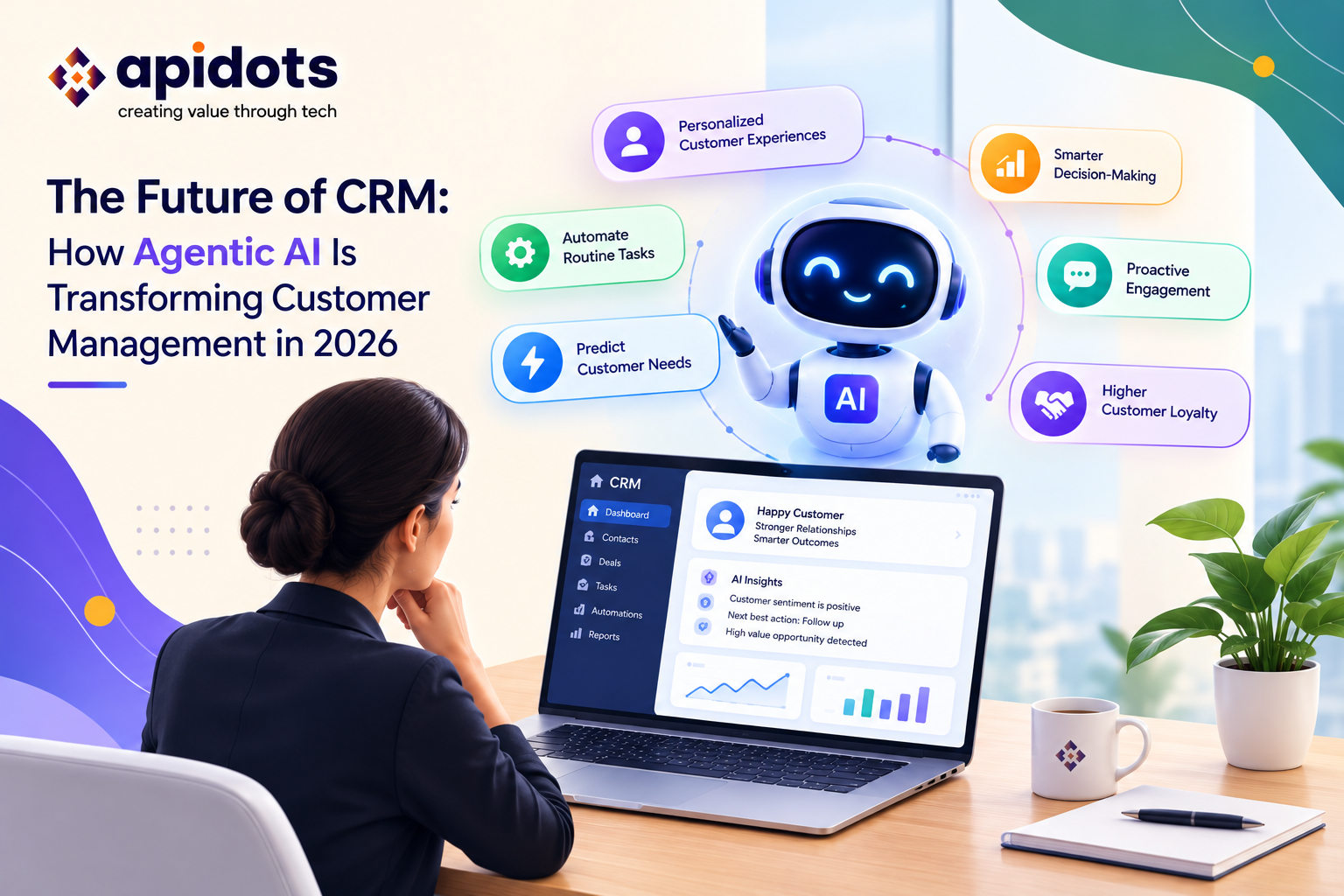
Customer relationship management (CRM) is entering a new phase in 2026. For years, businesses have relied on CRM platforms to store customer information, manage sales pipelines, track interactions, and coordinate marketing and customer service activities. While these capabilities remain essential, organizations increasingly expect CRM systems to do more than record what has already happened.
Agentic AI is helping move CRM toward a more proactive approach to customer management. Instead of simply generating recommendations or responding to prompts, AI agents can interpret business goals, analyze customer context, coordinate tasks, and execute approved actions across connected systems.
For example, when a potential customer submits an inquiry, an AI agent could review the available information, assess buying intent, enrich the CRM record, recommend a suitable next step, and prepare a personalized follow-up. Depending on the organization’s permissions and approval policies, some of these actions could happen automatically.
This shift creates new opportunities for sales, marketing, customer service, and customer success teams. However, it also introduces important considerations around data quality, security, governance, and human oversight.
In this guide, we explore how agentic AI is transforming customer management in 2026, the benefits and practical use cases, the role of custom CRM development services, and what businesses should consider before adopting these technologies.
Agentic AI refers to AI systems designed to pursue defined goals by reasoning through tasks, using available tools, and taking actions within established boundaries.
Traditional CRM automation generally follows predefined rules. For example, when a lead submits a form, the CRM might assign that lead to a salesperson and send an automated confirmation email.
An AI-powered CRM may go further by summarizing customer interactions, predicting lead quality, or recommending the next best action.
An agentic CRM can potentially coordinate several steps toward a goal. It might examine the lead’s information, check previous interactions, retrieve relevant company details, evaluate the lead against business criteria, prepare a personalized message, and create a follow-up task.
The key difference is the ability to coordinate actions rather than simply produce information.
However, agentic AI does not mean giving software unlimited independence. Businesses should define which actions an agent can perform, which require approval, and when the system must escalate a decision to a human.
A reliable agentic CRM combines AI reasoning with business rules, connected data, access controls, monitoring, and clear accountability.
Modern businesses collect customer information from multiple sources, including CRM platforms, email, website analytics, support systems, marketing tools, billing platforms, and customer conversations.
Although this information can be valuable, employees often need to switch between applications and manually assemble the context required to make decisions.
This creates several challenges:
Agentic AI can help connect information with action. Instead of waiting for an employee to identify every issue, an agent can monitor approved signals, identify potential opportunities, and initiate appropriate workflows.
For example, an agent might detect that a valuable customer has experienced repeated support issues. It could summarize the history, flag the account for review, and prepare a recommended retention plan.
The purpose is not to replace relationship management. It is to give employees better context and reduce the manual work surrounding customer interactions.
Sales teams often spend significant time researching prospects, updating CRM records, preparing meeting summaries, and scheduling follow-ups.
Agentic AI solutions can coordinate parts of these processes. An agent might review a meeting transcript, extract key requirements, update the opportunity record, identify outstanding questions, and create follow-up tasks.
This can reduce administrative effort and help salespeople concentrate on discovery conversations, negotiations, and customer relationships.
Businesses should still evaluate the quality of AI-generated summaries and recommendations before relying on them for important sales decisions.
Lead qualification is another promising application.
Rather than relying only on a static lead score, an agent can evaluate several approved signals, such as company characteristics, previous engagement, product interest, inquiry details, and buying intent.
It can then prioritize leads according to the organization’s qualification criteria and explain which signals influenced its recommendation.
For example, a lead that repeatedly visits pricing pages and requests a product demonstration may deserve more immediate attention than a contact who has only downloaded a general guide.
These signals are indicators, not proof of purchase intent. Human review and validated business criteria remain important.
Personalization is most useful when communication reflects the customer’s actual situation.
With appropriate access to customer history and preferences, an agent can help prepare messages based on previous conversations, purchases, support issues, or current product interests.
Instead of sending the same generic follow-up to every customer, the CRM can help employees communicate with greater relevance.
Businesses should establish brand guidelines, consent requirements, communication limits, and approval rules. Sensitive or high-impact communications may require human review before being sent.
Agentic AI can help coordinate customer service workflows by reviewing incoming requests, retrieving relevant knowledge, categorizing issues, and suggesting or executing approved resolutions.
For example, an agent could identify a common configuration problem, retrieve the relevant support instructions, prepare a response, and update the ticket.
If the request involves a complaint, sensitive information, an unusual situation, or a decision outside its authority, the agent should escalate it to a human employee.
This approach can help improve consistency without removing the judgment and empathy that effective customer service requires.
Customer retention often depends on identifying problems before they become reasons to leave.
An agent can monitor permitted signals such as declining product usage, unresolved support tickets, reduced engagement, or changes in account activity. When several signals indicate a potential risk, it can prepare an account summary and recommend a suitable next step.
The account manager can then review the evidence and decide whether to contact the customer, arrange a meeting, or investigate the underlying problem.
AI should support retention decisions rather than automatically assume that every decline in activity means a customer intends to leave.
An agent can research potential accounts using approved data sources, organize relevant company information, identify possible business needs, and prepare prospect summaries for sales representatives.
This can make prospect research more structured while allowing sales teams to verify information before contacting potential customers.
Onboarding often requires coordination between sales, customer success, technical teams, and finance.
An agent can track required steps, create tasks, send approved reminders, identify missing information, and update onboarding status. If a customer misses a critical step, the agent can alert the responsible employee.
An agent can monitor sales opportunities for missed follow-ups, inactivity, approaching deadlines, or changes in customer engagement.
It can summarize the situation and recommend actions such as scheduling a meeting, confirming requirements, or reviewing the forecast.
This gives sales managers additional context without requiring them to inspect every record manually.
Incomplete CRM records reduce the usefulness of reporting and personalization.
An agent can help identify missing fields, retrieve information from authorized sources, detect potential duplicates, and suggest record updates. Validation rules should determine which changes can be applied automatically and which require review.
For subscription businesses, an agent can help coordinate renewal reminders, identify unresolved issues, summarize account health, and prepare renewal discussions.
These capabilities can be especially useful when account managers handle large customer portfolios. However, renewal recommendations should consider reliable evidence and the specific circumstances of each account.
A successful agentic AI workflow requires more than connecting an AI model to a CRM. It needs a defined objective, reliable information, authorized tools, and controls around execution.
A typical workflow includes the following stages:
Step 1: Define the objective. Establish what the agent should achieve, such as prioritizing high-intent leads or preparing customer follow-ups.
Step 2: Gather context. Retrieve the relevant CRM records, interaction history, business rules, and approved external information.
Step 3: Analyze the situation. Evaluate the available evidence and determine the appropriate next step.
Step 4: Select an action. Choose from the tools and actions available to the agent, such as creating a task, updating a record, or preparing a message.
Step 5: Apply permissions and guardrails. Check whether the action is allowed and whether it requires human approval.
Step 6: Execute or escalate. Perform the authorized action or route the decision to a responsible employee.
Step 7: Record and monitor the outcome. Store the action history, capture relevant results, and monitor errors or unexpected behavior.
For example, a lead-management workflow might look like this:
Lead received → Customer context reviewed → Lead qualification performed → Next action recommended → Approval checked → Follow-up prepared or executed → CRM updated.
Businesses should test these workflows against incomplete data, unusual requests, incorrect inputs, integration failures, and permission restrictions before deploying them in production.
Not every business can implement its preferred AI workflows using standard CRM features alone. Some organizations have specialized approval processes, industry-specific data requirements, legacy systems, or unique customer journeys.
This is where custom CRM development software solutions can provide flexibility.
A tailored CRM can be designed around the organization’s actual processes instead of forcing teams to adapt every workflow to a standard platform.
Custom CRM development services can support:
For example, a real estate company may need agents to coordinate property inquiries, viewing schedules, buyer preferences, and follow-ups. A SaaS provider may need workflows for product usage, support requests, subscription renewals, and customer success.
Although both businesses use CRM, their workflows and automation requirements differ.
Effective custom CRM development starts by identifying business problems, selecting suitable use cases, and designing the data and integration architecture required to support them.
Agentic AI introduces new capabilities, but it also creates risks that businesses must manage carefully.
Agents depend on relevant, accurate information. Duplicate records, outdated contact details, inconsistent fields, and disconnected systems can lead to poor recommendations.
Businesses should improve data quality before expanding automation.
AI agents may interact with sensitive customer information and business systems. They should receive only the permissions necessary to perform their assigned tasks.
Organizations should also maintain activity logs, protect credentials, review integrations, and monitor unusual behavior.
Some CRM actions are low risk, such as drafting a meeting summary. Others, such as approving discounts, changing contractual terms, or sending sensitive communications, may require human authorization.
Approval requirements should reflect the potential impact of an incorrect action.
Agents can make incorrect assumptions, encounter unexpected inputs, or fail when connected systems are unavailable. Multi-step workflows can also increase processing costs and response times.
Businesses should test reliability, measure cost per completed workflow, establish fallback procedures, and monitor business outcomes.
CRM platforms may increasingly use specialized agents for research, sales assistance, customer support, data enrichment, and customer success.
These agents can divide complex tasks into smaller responsibilities. However, coordination, permissions, and monitoring become more important as the number of agents grows.
The usefulness of an agent depends on whether it has the right information for a particular task.
CRM systems are therefore likely to place greater emphasis on combining customer history, business rules, current interactions, and relevant knowledge into a reliable context.
Rather than removing employees from workflows, agentic CRM can give them better summaries, recommendations, and prepared actions.
A practical model allows agents to handle routine work while employees retain control over complex, sensitive, or high-impact decisions.
CRM agents become more useful when they can interact with authorized systems such as email, calendars, support platforms, billing software, and analytics tools.
API integrations and reliable data synchronization will therefore remain important components of agentic CRM architecture.
As agents gain more ability to act, governance must be built into the system rather than added later.
Organizations will need clear permissions, auditability, approval rules, monitoring, testing, and processes for disabling or correcting problematic workflows.
Choosing a CRM application development company requires more than finding a team that can integrate an AI model.
Look for a development partner that understands CRM processes, software architecture, data security, integrations, and the practical limitations of AI.
Evaluate the team’s experience with:
A reliable partner should also help you determine whether an AI agent is the right solution for a particular problem. Some processes are better handled by simple rule-based automation, while others may benefit from AI reasoning and multi-step coordination.
The right decision depends on business value, complexity, risk, and the quality of the available data.
Agentic AI is helping transform CRM from a system that primarily stores customer information into a more proactive platform for coordinating customer management activities. From sales prospecting and lead qualification to customer onboarding, support, and retention, AI agents can help businesses connect information with action and reduce repetitive work.
However, meaningful results require more than adding AI features. Organizations need reliable data, well-designed workflows, secure integrations, appropriate permissions, measurable objectives, and human oversight.
At APIDOTS, we help businesses turn these opportunities into practical digital solutions through our expertise in custom CRM development services, CRM software development, and agentic AI development services. Our approach focuses on understanding business requirements and developing scalable solutions around real operational needs.
Whether you want to modernize an existing CRM, develop custom CRM software, integrate AI capabilities into your workflows, or explore new agentic AI solutions, APIDOTS can help you evaluate the right approach and build a solution aligned with your business goals.
The future of customer management is not about making every decision autonomous. It is about combining intelligent automation with reliable technology and human judgment to create better customer experiences.
Agentic AI in CRM refers to AI systems that can understand defined goals, analyze customer context, use connected tools, and perform approved actions across customer management workflows. These systems can coordinate multiple steps instead of only generating recommendations or responding to prompts.
Benefits may include reduced administrative work, more efficient lead qualification, personalized customer communication, proactive support, improved workflow coordination, and earlier identification of customer retention risks. Results depend on implementation quality, data reliability, and the suitability of the chosen use cases.
Yes. Agentic AI can often be integrated with an existing CRM through APIs, workflow tools, and approved data connections. The implementation depends on the platform’s capabilities, integration options, data quality, security requirements, and the actions the agents need to perform.
Businesses may need custom CRM development services when standard platforms cannot fully support their workflows, industry requirements, integrations, or approval processes. Custom development can provide greater flexibility over the data model, automation logic, permissions, and AI capabilities.
Businesses should start with a specific use case, assess data quality, define agent permissions, apply approval rules to sensitive actions, test failure scenarios, maintain audit logs, and continuously monitor performance. Agents should only access the information and tools required for their assigned responsibilities.
APIDOTS supports businesses with custom CRM development services, CRM software development, integrations, and AI-enabled workflow implementation. The objective is to create scalable CRM solutions that fit business processes and support secure, practical automation.
We build and deploy end-to-end AI software solutions for businesses. Accelerating efficiency, automation, and intelligent decision-making.
Get AI Development Services