
Top
Search
People also search for:
Stay Inspired with Instagram




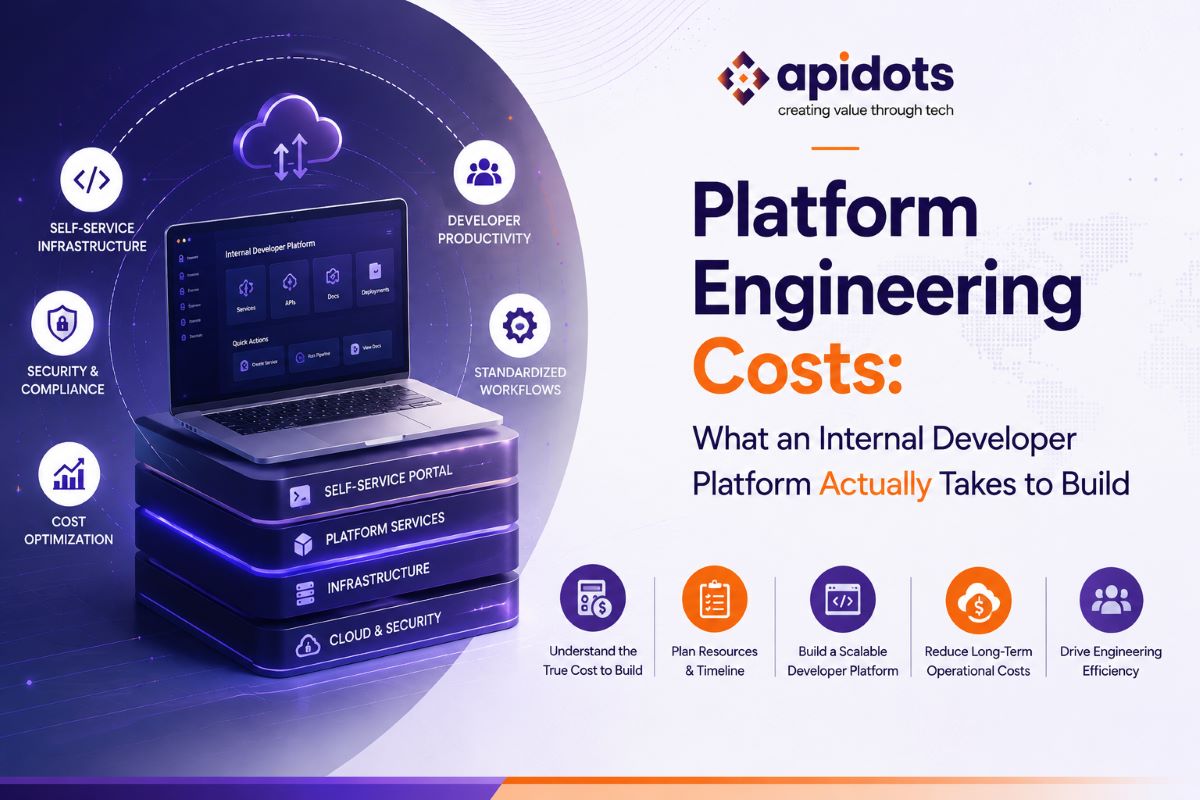
Real Gartner and DORA data on adoption, plus a build vs buy vs. open-source cost framework for CTOs.
Platform engineering cost questions rarely start with a number. They start with a team debating whether they even need a dedicated platform team yet. That debate now has real data behind it, not just opinion.
Our platform engineering primer covers what the discipline is and why adoption is accelerating. This piece goes further into the numbers CTOs actually need before approving a budget: what it costs.
Gartner and Google’s DORA research both show internal developer platforms moving from a nice-to-have into standard practice. This guide breaks down what platform engineering actually costs and what drives that cost up or down. It also covers how to decide between building, buying, or adopting open source tools.
The question rarely gets asked at the right time. Some teams wait too long, and inconsistent deployment practices start costing them more than a platform would have. Others build a platform before they have enough repeated work to justify the investment.
This piece is written for CTOs and engineering leaders sizing that decision. It is not written for platform engineers already deep in tooling debates. The goal is a clear enough cost picture to bring into a budget conversation.
Platform engineering cost is not a single line item. It spans engineering salaries, cloud infrastructure, and third-party tools. It also includes the ongoing work of maintaining golden paths for other teams to follow.
Most of that cost is people, not software licenses. A small platform team of three to five engineers is the core cost. That team typically costs more over a year than the project’s tooling budget.
Our SaaS architecture guide covers similar cost patterns for cloud native products. Platform engineering follows the same rule: the people building and maintaining the system cost more than the system itself.
A golden path is the reason platform engineering exists in the first place. It is a pre-approved way to deploy a service, provision a database, or configure a pipeline. Developers use it without waiting for another team. Building and maintaining these golden paths is ongoing work, not a one-time setup.
Team size scales with company size, not with a fixed formula. A company with 50 engineers might run platform engineering with two people. A company with 500 engineers usually needs a dedicated team of ten or more to keep pace.
Self-service is the practical test of whether a platform is working. A developer should be able to spin up a new service or request a database without filing a ticket. The same goes for rolling back a deployment without waiting on another team. If developers still need to ask permission for routine tasks, the platform is not doing its job yet. That holds regardless of how much was spent building it.
| Tier | What it includes | Typical Build cost |
| Starter platform | Self-service CI/CD, basic golden paths, single cloud | $80K to $180K |
| Mid-size platform | Service catalog, role-based access, developer portal | $180K to $400K |
| Enterprise platform | Multi-cloud, compliance automation, full self-service | $400K to $900K+ |
| Ongoing operation | Dedicated team, minimum 1 to 2 engineers | 20% to 30% of build cost, per year |
Table: Apidots market analysis of platform engineering cost tiers, based on 2026 North America engineering rates.
Gartner’s platform forecast puts hard numbers behind this shift. By 2026, Gartner expects 80 percent of large software engineering organizations to have a platform engineering team. That is up from 45 percent in 2022.
This prediction did not appear out of nowhere. Gartner has tracked the shift for years, moving platform engineering from an emerging idea toward standard practice. It now sits as a formal item on Gartner’s hype cycle. The forecast reflects a steady climb, not a sudden spike.
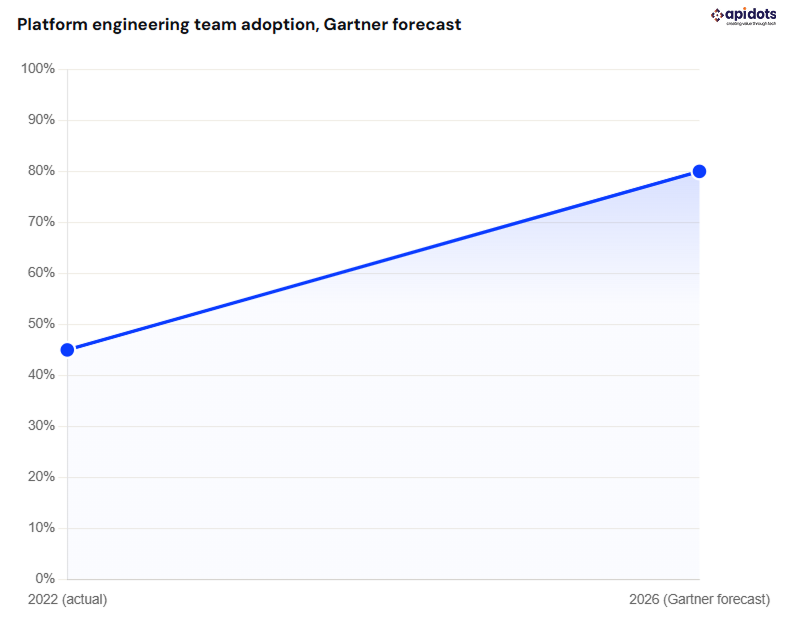
Chart: Share of large software engineering organizations with a dedicated platform engineering team. Source: Gartner, “Unlock Infrastructure Efficiency with Platform Engineering.” gartner.com
Independent research backs this up. DORA research found that 90 percent of organizations now use at least one internal developer platform. Of those, 76 percent have a dedicated platform team, not a shared backlog with no clear owner.
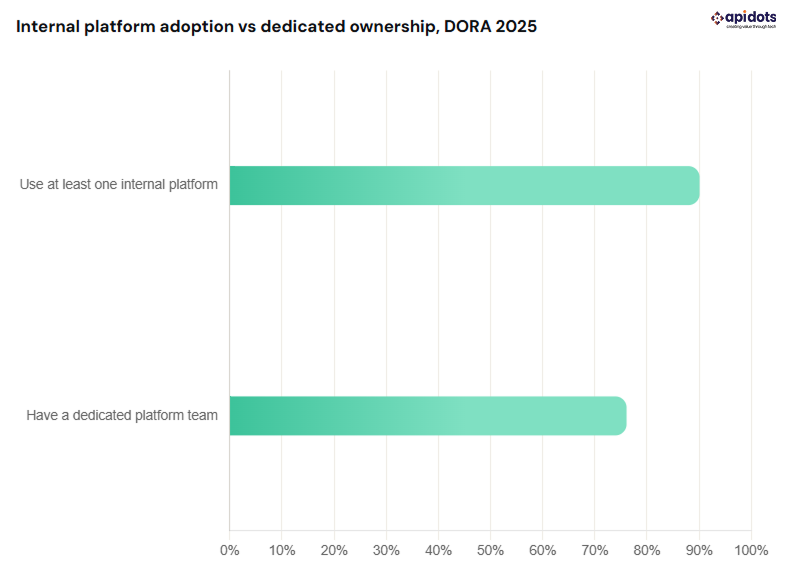
Chart: Share of organizations reporting each practice. Source: DORA, “Capabilities: Platform engineering,” Google Cloud, 2025. dora.dev
DORA surveyed nearly 5,000 technology professionals to reach these numbers. That scale makes the finding hard to dismiss as a niche trend among a handful of large tech companies.
The same research found something CTOs should pay attention to. Platform quality directly affects how much value a team gets from AI coding tools. A weak platform makes AI adoption inconsistent, no matter how good the model is.
This connects the platform engineering conversation to a much bigger budget line. Many organizations are spending heavily on AI coding tools this year. If the underlying platform cannot support consistent deployment and testing, that AI spend delivers uneven results. This happens even when the tools themselves work well.
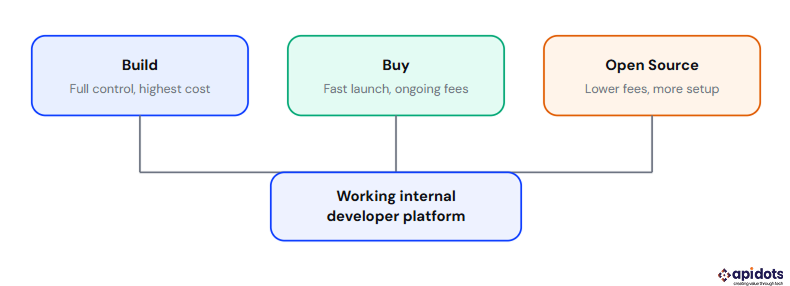
Three paths lead to a working internal developer platform. You can build one from scratch or buy a commercial platform product. A third option is to adopt an open-source project like Backstage and customize it.
Building from scratch gives full control but costs the most in engineering time. Buying a commercial product is faster to launch but comes with licensing fees that scale with usage. Open-source tools like Backstage lower licensing costs but shift more work to your team.
Backstage, the open-source project most teams reach for first, is maintained by the Cloud Native Computing Foundation. It gives a team a working developer portal on day one. The tradeoff is that Backstage still needs engineers to configure plugins, maintain upgrades, and adapt it to internal systems.
Teams weighing this decision often look at our offshore development guide for how staffing models affect total cost. The same logic applies here. A platform team built with a specialist partner can launch faster than hiring an entire team from scratch.
Consider two companies choosing between these paths. A ten-person startup with one product usually doesn’t need a platform team at all. A two-hundred-person company running dozens of services faces a different tradeoff. It will lose more time to inconsistent deployments than it would spend building a platform.
Migration cost is often left out of this comparison entirely. Moving from a setup where every team configures its own pipeline to a shared platform is not free. You must migrate existing services one at a time. That work competes with regular product roadmap time for months.
| Path | Best Fit | Trade Off |
| Build from scratch | Unique workflows, large engineering org | Highest cost, longest timeline |
| Buy commercial platform | Fast launch, smaller team | Ongoing license cost, less customization |
| Adopt open source | Moderate budget, some in-house DevOps skill | Lower license cost, more setup work |
Table: Build versus buy versus open source decision framework for internal developer platforms.
A few factors drive platform costs up or down more than anything else. Cloud complexity is one. A single cloud provider setup is far cheaper to build than a multi-cloud environment.
Integration surface area adds cost too. A platform that only touches one CI/CD tool and one cloud provider is simple to build. A platform that must integrate with legacy systems, multiple clouds, and several ticketing tools takes far longer.
Compliance requirements are another driver. A platform serving a regulated industry needs audit logging, access controls, and policy enforcement built in from day one. Our AI development cost guide covers a similar pattern, where compliance and security reviews drive the highest cost.
Team maturity matters too. A team new to DevOps practices needs more upfront investment in training and process design. A team with mature CI/CD pipelines needs less.
Team size within the platform group matters, too. Doubling the platform team does not double output, since coordination overhead grows too. Most organizations get the best return from a small, focused team rather than a large one.
None of these factors make platform engineering optional forever. They change how much it costs to get there and how fast.
Measuring return on this investment takes longer than most budget cycles expect. Deployment frequency and lead time for changes usually improve within the first two quarters. Developer satisfaction and retention effects take longer to show up, often a full year after launch.
Timing the investment matters as much as sizing it correctly. Starting six months too early ties up engineers who could be shipping product features. Starting too late means teams have already built infrastructure around the absence of a platform. Neither mistake is cheap to reverse.
A useful signal to watch is how often engineers ask the same infrastructure question in chat. If three teams ask how to provision a database in one month, that is work a platform should absorb. Waiting for a formal mandate usually costs more than starting small.
Apidots helps engineering organizations scope, build, and staff internal developer platforms without over-investing too early.
Cost depends heavily on scope, but a starter platform typically runs from 80,000 to 180,000 dollars to build. Enterprise-grade platforms with compliance automation can exceed 400,000 dollars.
No. DevOps is a set of practices and culture. Platform engineering builds a specific internal product, the platform itself, that makes those practices easier to follow.
Usually not right away. Platform engineering pays off once an organization has enough engineers and enough repeated work to justify a dedicated team.
People cost, not tooling. A small dedicated team typically costs more per year than any commercial platform license or open source tooling budget.
Build if your workflows are unique enough that no commercial tool fits well. Buy or adopt open source if you need to move fast with a smaller team.
We create custom digital systems tailored to your operations.Focused on efficiency, scalability, and sustainable growth.
Consult Business Experts
Hi! I’m Aminah Rafaqat, a technical writer, content designer, and editor with an academic background in English Language and Literature. Thanks for taking a moment to get to know me. My work focuses on making complex information clear and accessible for B2B audiences. I’ve written extensively across several industries, including AI, SaaS, e-commerce, digital marketing, fintech, and health & fitness , with AI as the area I explore most deeply. With a foundation in linguistic precision and analytical reading, I bring a blend of technical understanding and strong language skills to every project. Over the years, I’ve collaborated with organizations across different regions, including teams here in the UAE, to create documentation that’s structured, accurate, and genuinely useful. I specialize in technical writing, content design, editing, and producing clear communication across digital and print platforms. At the core of my approach is a simple belief: when information is easy to understand, everything else becomes easier. Reach me at amysbrew.com