
Top
Search
People also search for:

Stay Inspired with Instagram




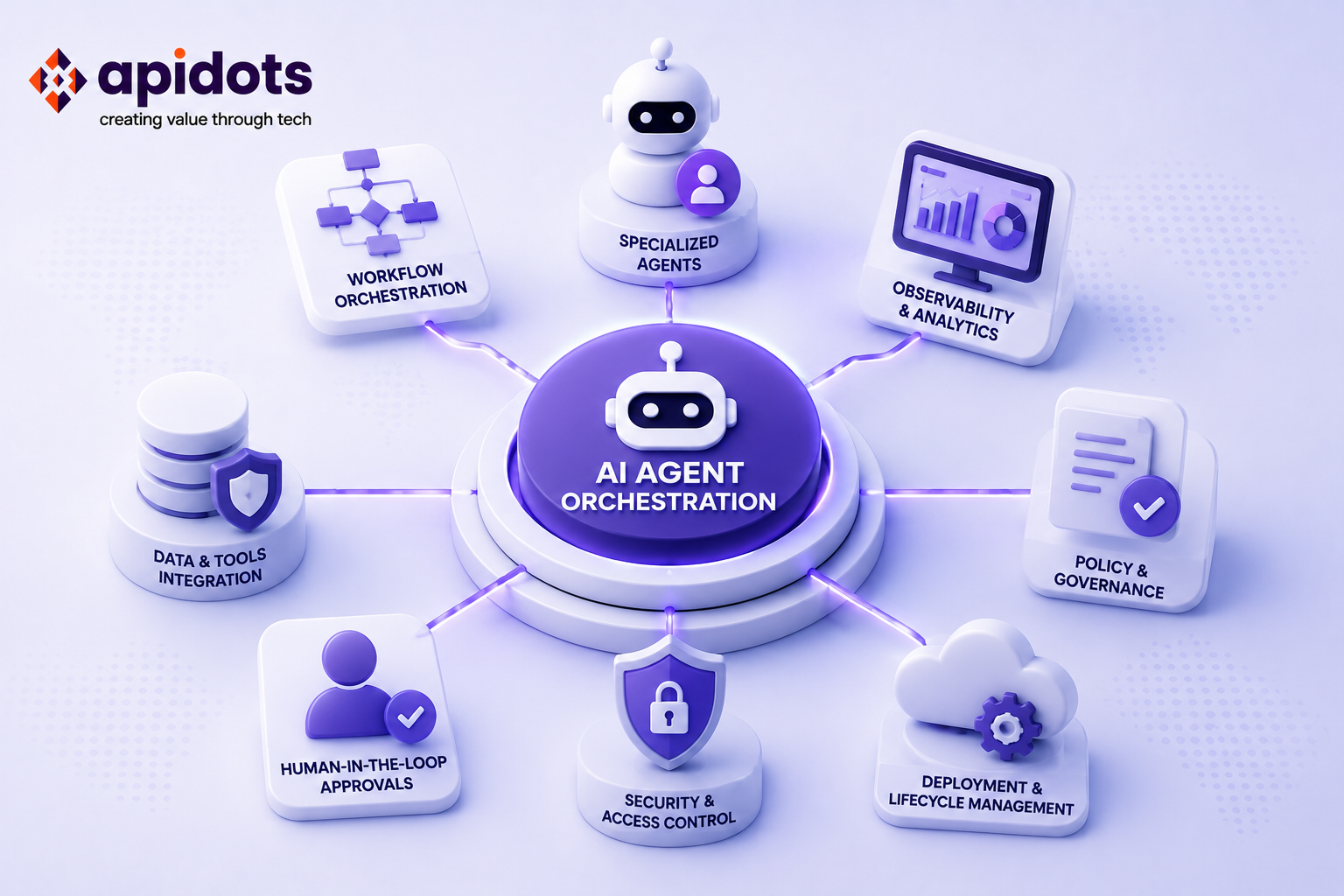
How multi-agent orchestration coordinates specialized agents, where an AI agent control plane fits, and how to decide between managed platforms and custom infrastructure.
AI agent orchestration coordinates how multiple agents divide work, share context, call tools, hand off tasks, and involve humans. An AI agent control plane is a broader operational and governance layer used to manage agents across an environment—including policy, permissions, observability, lifecycle, and usage controls. You can have orchestration without building a custom control plane; the right architecture depends on risk, integration depth, operational scale, and governance requirements.
Many teams begin with one AI agent connected to a small set of tools. Complexity rises when more agents, data sources, APIs, and approval steps enter the same workflow. At that point, the architecture has to answer practical questions: Which agent should act next? What context should it receive? Which tools can it call? When does a human need to approve an action? How do you reconstruct what happened after a failure?
Those questions sit at the center of multi-agent orchestration and AI agent governance. If you are comparing the broader concepts behind autonomous workflows, API DOTS overview of agentic AI systems explains how task-focused agents differ from agentic AI. These same requirements are why enterprise platforms are adding richer routing, tracing, identity, and policy controls instead of treating every agent as an isolated chatbot.
AI agent orchestration is the coordination of multiple agents and workflow components so they can complete a shared objective in a controlled way. In practice, orchestration can determine the execution order, route work to a specialist, pass context between agents, combine outputs, retry failed steps, or pause for human approval.
Current agent frameworks expose these ideas directly. Microsoft’s Agent Framework documents sequential, concurrent, handoff, group-chat, and manager-led orchestration patterns, while the OpenAI Agents SDK supports agents as tools, handoffs, guardrails, sessions, and tracing.
These implementations differ, but both show that “multi-agent” is not one architecture, it is a family of coordination patterns chosen for different workflow needs. API DOTS also explores how AI coding workflows are evolving toward agentic loops and coordinated multi-agent development.
An AI agent control plane is an operational layer for managing agents as a system rather than as isolated components. IBM describes an agent control plane as a centralized layer for operating, monitoring, and governing agents across an organization, in a practical architecture, that can include inventory, policy enforcement, permissions, observability, lifecycle controls, usage or cost controls, and deployment management.
The term is not a single formal industry standard, and vendors implement it differently. That distinction matters: a framework may orchestrate a workflow without providing enterprise-wide governance, while a control-plane product may govern agents built with several different frameworks.
Security becomes especially important at this layer; API DOTS’ analysis of agent identity controls covers IAM, delegated access, and purpose-bound authorization for agentic systems.
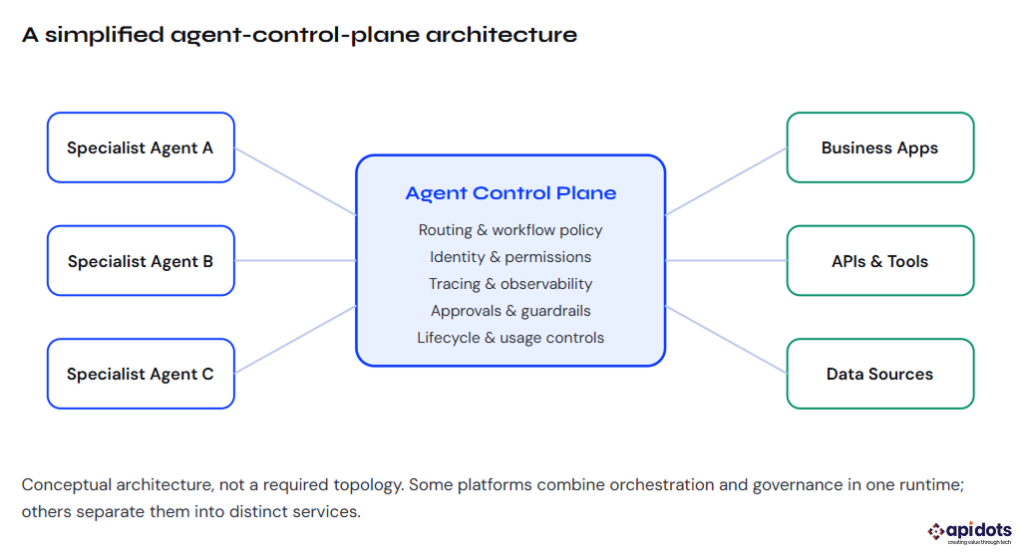
| Question | Orchestration | Control Panel |
| Primary concern | How work moves between agents, tools, and humans | How agents are operated and governed across an environment |
| Typical functions | Routing, sequencing, parallelism, handoffs, state flow, aggregation | Policy, identity, permissions, inventory, observability, lifecycle, usage controls |
| Scope | Often a workflow or application | Often multiple workflows, teams, agents, or frameworks |
| Can one exist without the other? | Yes. A framework can orchestrate agents without a separate enterprise control plane. | Yes. A control plane can manage agents built with several orchestration frameworks. |
Microsoft’s current architecture guidance recommends choosing the lowest level of complexity that reliably meets the requirement because additional agent coordination introduces overhead, latency, and cost. Its documented patterns provide a useful vocabulary for architecture discussions. For engineering teams deciding which agentic coding environment fits their delivery model, API DOTS coding tool comparison adds a practical view of review, maintainability, and production controls.
| Pattern | How It Works | Useful when |
| Sequential | Agents execute in a defined order and pass results downstream. | The workflow has clear dependencies or staged review. |
| Concurrent | Multiple agents work in parallel and their outputs are collected. | You want independent analyses, alternatives, or parallel subtasks. |
| Handoff | One agent transfers control to another specialist based on context. | Different specialists own different request types or workflow phases. |
| Group chat | Agents collaborate in a shared conversation. | Iterative discussion among roles is useful. |
| Manager-led / Magentic | A manager dynamically coordinates specialized agents. | Open-ended work needs adaptive planning and delegation. |
Source: Microsoft Azure Architecture Center, AI agent orchestration patterns. Pattern names and implementation details can vary by framework.
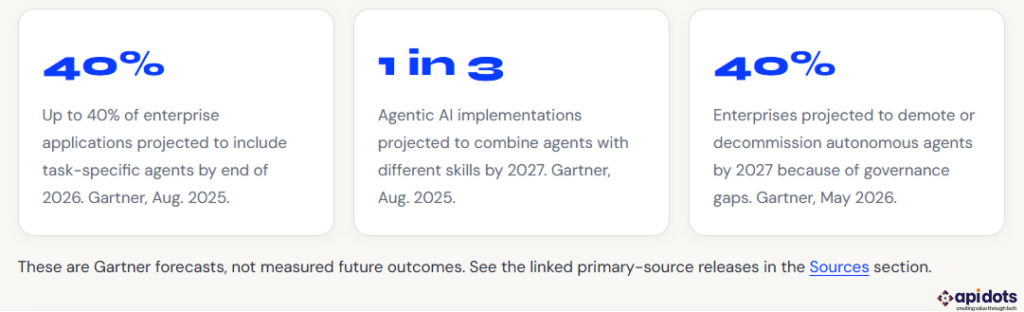
Enterprise interest in agents is accelerating, but the strongest public forecasts also emphasize governance risk. In August 2025, Gartner projected that up to 40% of enterprise applications would include task-specific agents by the end of 2026, compared with less than 5% at the time of that forecast. The same release projected that one-third of agentic AI implementations would combine agents with different skills by 2027.
Gartner has also published cautionary forecasts. In June 2025, it predicted that more than 40% of agentic AI projects would be canceled by the end of 2027 because of escalating costs, unclear business value, or inadequate risk controls. In May 2026, it separately predicted that 40% of enterprises would demote or decommission autonomous agents by 2027 because of governance gaps identified after production incidents.
The build decision should be based on requirements rather than a made-up timeline or agent-count threshold. Start by defining the actions agents can take, the data they can access, the level of autonomy allowed, the evidence you must retain, and the systems that need to be integrated. If external delivery support is part of the decision, API DOTS AI development partner framework outlines how to evaluate production capability, data handling, MLOps, compliance, and post-launch support.
| Decision factor | Managed/Low-Code Platform | Custom Control Layer |
| Time to first workflow | Usually faster when platform features match the use case. | Requires engineering and operating ownership before production use. |
| Orchestration patterns | Use the patterns and limits the platform exposes. | Implement workflow semantics around your exact business rules. |
| Identity & permissions | Depends on available IAM integrations, credential handling, and tool controls. | Can be designed around existing enterprise identity, authorization, and secrets systems. |
| Observability | Depends on platform traces, logs, exports, retention, and redaction controls. | You define telemetry, storage, retention, redaction, and integration with existing observability tools. |
| Compliance/data requirements | Fit depends on region, data handling, audit features, contracts, and certifications. | Offers more architectural control, but also makes your team responsible for implementing and validating controls. |
| Portability | May depend on proprietary workflow definitions or hosted runtimes. | Can reduce platform dependence if interfaces and state are designed for portability. |
| Operating cost | Compare platform pricing and usage charges with internal engineering and operations costs. | Custom software adds build, maintenance, security, monitoring, and on-call costs; it is not automatically cheaper. |
NIST’s AI Risk Management Framework is useful at this stage because it treats governance as a cross-cutting function throughout the AI lifecycle rather than a final compliance step. That reinforces a practical principle: define risk ownership, monitoring, incident response, and change management before autonomous actions become business-critical.
“Outgrowing” a platform is not about reaching an arbitrary agent count. It is about repeatedly hitting requirements the current architecture cannot satisfy without fragile workarounds.
A custom control layer is software infrastructure, not just an LLM prompt router. The exact components vary, but production architectures commonly need several of the capabilities below. Teams building agent capabilities into software products can also compare these requirements with API DOTS AI native SaaS architecture guidance, which focuses on data, intelligence, feedback, safety, and experience layers.
Agents that can take actions in external systems need a deliberate identity and permission model. Use least privilege, separate credentials where practical, and avoid embedding reusable secrets in prompts or agent code. The goal is to make tool access explicit, revocable, and auditable rather than implicitly inherited from a broad application credential.
This layer decides which agent or tool should act, what state is passed forward, how retries and timeouts work, when outputs are aggregated, and where human approval is required. Frameworks such as Microsoft Agent Framework and the OpenAI Agents SDK provide building blocks, but your application still owns the business rules.
Guardrails should be attached to the action boundaries that matter. OpenAI’s Agents SDK, for example, distinguishes input, output, and tool guardrails, while Microsoft documents human-in-the-loop approval patterns. The important architectural question is not whether a system “has guardrails,” but which actions are checked, when they are checked, and what happens when a check fails.
Capture enough telemetry to debug and govern the system: agent transitions, tool calls, errors, approvals, latency, and relevant usage metadata. At the same time, define what sensitive inputs or outputs must be redacted and how long traces are retained. OpenAI’s current Agents SDK includes built-in tracing and options related to sensitive trace data, illustrating why observability and privacy have to be designed together. For a related implementation perspective, API DOTS AI code debugging article shows why testing, scanning, and human review remain important when AI contributes to production code.
Production agents often become valuable when they can safely interact with business applications and APIs. Integration design therefore needs normal software-engineering discipline: stable interfaces, validation, authentication, idempotency where relevant, failure handling, rate limits, and tests around side effects. Similar architecture tradeoffs appear in SaaS AI integration, where model access, data governance, APIs, and legacy systems all shape implementation choices. API DOTS existing API development and integration services are an example of the non-agent infrastructure that may sit underneath an agentic workflow.
Agents and prompts change over time. Treat versions, evaluations, rollout controls, monitoring, rollback, and decommissioning as part of the system lifecycle. NIST’s AI RMF explicitly includes post-deployment monitoring, incident response, recovery, and change management in its risk-management outcomes.
For a broader view of how engineering teams are adapting their processes and tool choices, see API DOTS AI development tools analysis for 2026.
AI agent orchestration coordinates multiple agents, tools, and workflow steps so specialized agents can work toward a shared goal. Depending on the pattern, orchestration may sequence tasks, run agents concurrently, route requests, hand off control, share state, aggregate results, or pause for human approval.
Orchestration focuses on how work moves among agents. A control plane is the broader operational and governance layer used to manage policies, permissions, observability, lifecycle, and usage controls across agents. A workflow can be orchestrated without a separate enterprise control plane.
Not necessarily. A dedicated control plane becomes more valuable as agents gain access to sensitive systems, operate across teams, require stronger auditability, or multiply across the organization. Even a single high-impact agent may still need strong identity, approval, tracing, and monitoring controls.
Often yes. The answer depends on the platform’s routing, state, approval, identity, observability, data-control, and integration capabilities. Use those requirements—not a fixed agent-count threshold—to decide whether the platform is sufficient.
Evaluate a custom layer when platform constraints materially block required security, policy enforcement, data residency, integration depth, observability, portability, or operating-model requirements. There is no authoritative universal threshold for agent count, project duration, or budget.
Claims with dates, percentages, architecture patterns, or named product capabilities were checked against primary or first-party sources. Forecasts are labeled as forecasts rather than presented as observed outcomes. Unsupported implementation-time and cost estimates from the earlier draft were removed.
We build and deploy end-to-end AI software solutions for businesses. Accelerating efficiency, automation, and intelligent decision-making.
Get AI Development Services
Hi! I’m Aminah Rafaqat, a technical writer, content designer, and editor with an academic background in English Language and Literature. Thanks for taking a moment to get to know me. My work focuses on making complex information clear and accessible for B2B audiences. I’ve written extensively across several industries, including AI, SaaS, e-commerce, digital marketing, fintech, and health & fitness , with AI as the area I explore most deeply. With a foundation in linguistic precision and analytical reading, I bring a blend of technical understanding and strong language skills to every project. Over the years, I’ve collaborated with organizations across different regions, including teams here in the UAE, to create documentation that’s structured, accurate, and genuinely useful. I specialize in technical writing, content design, editing, and producing clear communication across digital and print platforms. At the core of my approach is a simple belief: when information is easy to understand, everything else becomes easier. Reach me at amysbrew.com