
Top
Search
People also search for:

Stay Inspired with Instagram





Architecture options, development phases, real cost ranges, framework comparisons, and the failure modes that kill most projects before they ship.
Most conversations about AI agents start with demos. A browser navigating a website autonomously. A research agent synthesizing 40 sources in minutes. An orchestration layer submitting purchase orders without a human in the loop. The demos are real. So is the performance gap between a demo environment and a production deployment that holds up under real workload, adversarial inputs, and enterprise integration constraints.
This guide is not a primer on the concept. It is a build reference for CTOs, product leaders, and founders who have moved past curiosity and are deciding whether to build an AI agent, what it will actually cost, and how to structure the project to avoid the failure modes that derail most agent initiatives before they ship.
Every statistic cited here links directly to a named primary source.
An AI agent is a software system that perceives inputs from its environment, reasons about them using a language model or other AI backbone, decides on a course of action, and executes that action, often iterating through multiple steps before a task is complete. The critical distinction from a standard AI chatbot is autonomy: an agent acts, not just responds.
The components of a production AI agent map to five layers: perception (what the agent sees, including text, data, browser state, or API responses), reasoning (the LLM or planning system that decides what to do), memory (short-term context and long-term storage), action (the tools the agent can invoke: APIs, databases, browsers, code executors), and a feedback loop (evaluation of whether the action achieved its goal and what to do next).
“A scripted automation follows a route. An AI agent reroutes around traffic. The architectural difference between the two determines everything about cost, reliability, and how far the system can scale.”
This distinction also separates agents from Robotic Process Automation (RPA). RPA executes deterministic scripts against stable interfaces. An AI agent can reason about novel states, handle ambiguous inputs, and recover from unexpected page structures or API responses without a developer rewriting the script. That adaptability is both the core value proposition and the primary engineering challenge.
For a broader view of how agents fit within the AI software development landscape in 2026, the API DOTS guide covers the full stack from chatbots to autonomous systems.
The market data is unambiguous. The global AI agents market reached $7.63 billion in 2025 and is projected to grow to $10.91 billion in 2026, on a trajectory to exceed $52.6 billion by 2030 at a compound annual growth rate of 46.3%, according to MarketsandMarkets.
Gartner has identified 2026 as the breakthrough year for agents moving from pilots into embedded enterprise workflows, forecasting that 40% of enterprise applications will integrate task-specific agents by year end, up from less than 5% in 2025.
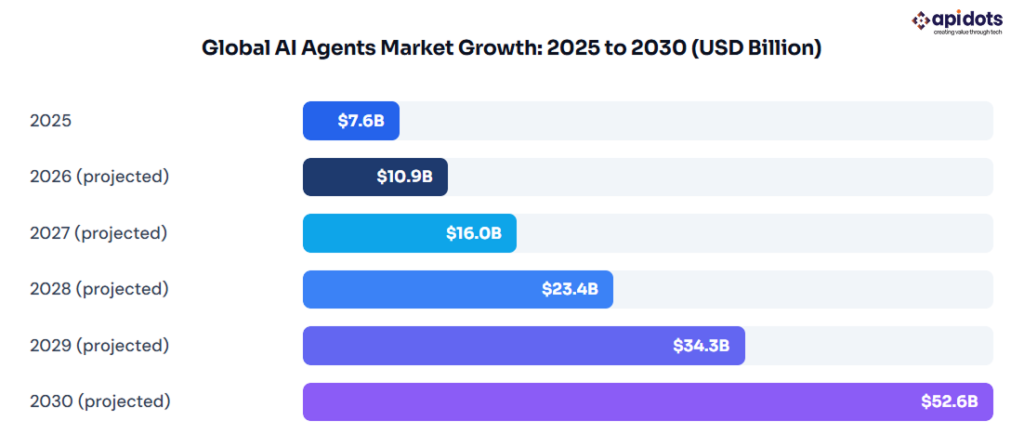
Source: MarketsandMarkets, “AI Agents Market Worth $52.62 Billion by 2030” and Grand View Research AI Agents Market Report. Intermediate years are illustrative projections using stated CAGR.
Three structural forces are making this a build-now decision rather than a watch-and-wait one. First, LLM API pricing has fallen 60 to 80% over the past 18 months as OpenAI, Anthropic, Google, and open-source alternatives compete on cost. The model layer is no longer a prohibitive budget item.
Second, the tooling ecosystem has matured: LangChain, LangGraph, CrewAI, and AutoGen reduce framework development time significantly.
Third, enterprises that have deployed agents in production are compounding an operational advantage over those still evaluating. McKinsey’s 2025 State of AI survey found that 62% of enterprises are experimenting with AI agents, but fewer than 25% have scaled agentic AI across even one business function. That gap is the competitive window. The same data readiness issues driving those gaps are explored in depth in our guide to predictive analytics development for US enterprises.
Three converging shifts are redefining what is possible to build with agents this year, and what the competitive window looks like for teams that move now versus teams that wait.
The framework landscape has consolidated significantly in the first half of 2026. Microsoft released Agent Framework 1.0 to general availability on April 3, 2026, a production-ready open-source SDK for building agents and multi-agent workflows in .NET and Python, with stateful execution units and graph-based orchestration built in as first-class primitives rather than afterthoughts. This is a meaningful shift: framework instability was a genuine production risk 18 months ago. It is no longer the blocker it was. Source: Microsoft Tech Community, April 2026.
At the open-source layer, Hermes Agent from Nous Research crossed 140,000 GitHub stars within three months of release and as of June 2026 ranks as the most-used agent on OpenRouter. It is provider-agnostic, model-agnostic, and optimized for always-on local deployment, which matters for organizations with data residency requirements. Source: NVIDIA Blog, June 2026.
The foundation models powering agents have advanced faster than most 2025 roadmaps anticipated. GPT-5.5, released April 23, 2026, was built specifically for agentic tasks: coding, online research, data analysis, and autonomous tool navigation, with documented gains in long-horizon task handling and consistency. Google’s Gemini 3.5 Flash and Anthropic’s Claude Opus 4.8 are both active in June 2026 deployments.
For teams evaluating model selection as part of architecture decisions, the practical effect is that the capability gap between frontier and mid-tier models has narrowed, and cost-optimized routing is now a genuine production strategy rather than a theoretical one. Source: LLM Stats, AI Model Updates June 2026.
The pattern emerging from enterprise deployments in 2026 is consistent: organizations that treated 2024 and 2025 as evaluation years are now under pressure to show production results, while organizations that shipped narrow agents early are compounding operational advantages. The gap between companies using agents in production workflows and companies still in evaluation is widening. For CTOs deciding on timing, the framework stability, model cost reductions, and accumulating case evidence make the argument for waiting materially weaker than it was twelve months ago.
The agent framework question in 2026 is no longer which framework will survive. It is the framework that matches your team’s language, your orchestration complexity, and your enterprise integration requirements. Framework maturity is no longer the risk. Scope definition and evaluation infrastructure are.
Choosing the wrong agent architecture is the most expensive mistake in this space. It does not show up immediately. It shows up six months into a project when scaling requirements force a redesign that could have been avoided. The four primary architectures each serve a distinct complexity tier.
Designed for one well-defined task: monitor a data source, extract structured information, route an inbound request, or trigger an action based on a single condition. These are the most reliable agents in production because their scope is narrow and their failure modes are predictable. They are also the least expensive to build and maintain. Starting cost: $15,000 to $40,000.
Agents that handle multi-turn dialogue with memory, context management, and the ability to call external tools mid-conversation. Customer support automation, internal knowledge assistants, and sales qualification bots fall here. The complexity comes from managing context windows, handling topic shifts, and deciding when to escalate to a human. Cost range: $25,000 to $80,000.
A coordinator (orchestrator) agent delegates subtasks to specialist agents and synthesizes their outputs. A research workflow might route to a web search agent, a document summarization agent, and a fact-checking agent before returning a final result. Reliability increases because each agent does less. Complexity increases because coordination, state management, and failure handling must be engineered explicitly. Cost range: $80,000 to $250,000.
Enterprise-grade systems where multiple orchestrators manage multiple specialist layers, integrated with production databases, compliance logging, and human-in-the-loop checkpoints. These are the systems justifying the largest enterprise AI budgets. Cost range: $200,000 to $400,000 or more, with ongoing operating costs that frequently exceed build costs within 18 to 24 months.
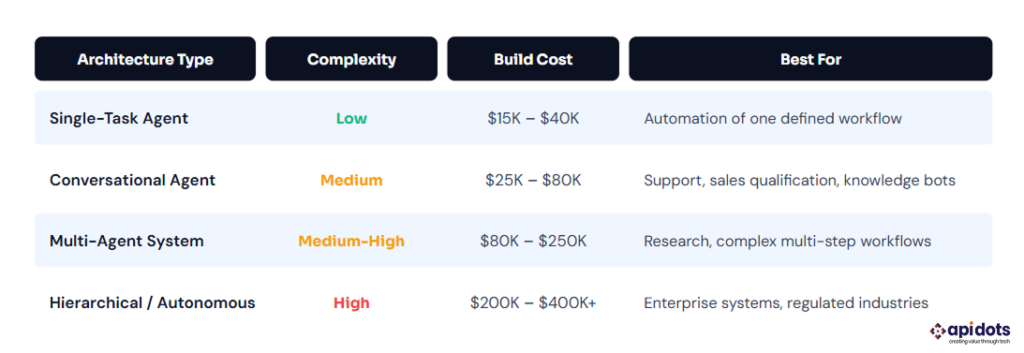
AI agent architecture types by complexity, cost range, and fit. Cost ranges reflect 2026 North America market rates for engineering-led custom development. Sources: DecipherZone AI Agent Development Cost 2026; Codewave AI Agent Cost Guide 2026.
Agent projects fail at predictable points: unclear scope in discovery, skipped evaluation infrastructure, and underestimated integration complexity in production. The seven phases below are structured around those failure points. Each phase has a defined output. If the output is missing, the next phase will cost more.
Also Read:AI Software Development Cost 2026: What It Actually Costs
The framework you build on determines how quickly your team can iterate, how much vendor lock-in you accept, and how well the system scales to multi-agent orchestration. The four dominant options in 2026 serve different team profiles and use cases.
| Framework | Best For | Strengths | Limitations | Complexity |
|---|---|---|---|---|
| LangChain / LangGraph | Most enterprise builds | Largest ecosystem, extensive documentation, graph-based orchestration in LangGraph | Abstraction overhead; debugging complex chains requires deep familiarity | Medium |
| CrewAI | Multi-agent team workflows | Native multi-agent orchestration, role-based agent design, clean API | Less mature than LangChain; fewer third-party integrations | Low-Medium |
| AutoGen (Microsoft) | Conversational multi-agent systems | Human-in-the-loop support, strong for code generation agents, active research backing | Heavier configuration; better for R&D than lean production builds | Medium-High |
| OpenAI Agents SDK | OpenAI-native builds with tool use | Direct access to GPT-4o features, handoff primitives, built-in tracing | Vendor lock-in; requires OpenAI models | Low |
Framework comparison based on publicly available documentation, developer community reports, and production use patterns observed across enterprise AI projects in 2025 and 2026. Framework maturity ratings are editorial assessments, not numerical benchmarks.
For teams evaluating how these frameworks interact with AI coding tools in day-to-day development, the AI coding tool comparison covers Claude Code, Cursor, Copilot, and Windsurf side by side.
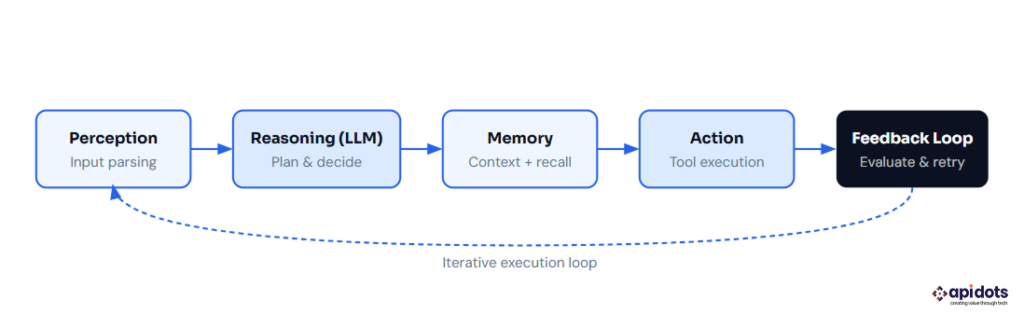
The five-component AI agent loop. Every production agent requires all five layers. Systems missing a feedback loop cannot recover from failed steps and are not suitable for autonomous deployment.
AI agent development costs sit in a wide range because the word “agent” covers genuinely different products. A single-task bot that routes inbound emails is not the same product as a multi-agent orchestration system that integrates with five enterprise data sources and runs under SOC 2 compliance. The ranges below reflect 2026 North America rates for engineering-led custom development.
| Agent Tier | Build Cost Range | Timeline | What Drives Cost |
|---|---|---|---|
| Simple / Single-Task Agent | $15,000 – $40,000 | 4 – 8 weeks | Narrow scope, 1-2 integrations, minimal memory |
| Conversational Agent (MVP) | $25,000 – $80,000 | 8 – 14 weeks | Multi-turn memory, tool calling, human escalation |
| Multi-Agent System | $80,000 – $250,000 | 14 – 26 weeks | Orchestration logic, specialist agents, state management |
| Enterprise / Hierarchical | $200,000 – $400,000+ | 26 – 52 weeks | Compliance, deep integrations, audit trails, governance |
Cost ranges for custom AI agent development in 2026. Source: DecipherZone AI Agent Development Cost Guide 2026; Codewave AI Agent Cost 2026. These are benchmark ranges; final costs depend on vendor rates, geography, scope, and whether teams build from pre-trained model foundations or from scratch.
Build cost is the more visible number. Operating cost is the one that surprises. In many production AI agent deployments, the monthly cost of LLM inference, vector database queries, tool call overhead, and monitoring infrastructure compounds to exceed the initial build investment within 18 to 24 months.
Three practices contain operating costs effectively: aggressive caching of repeated tool calls, routing low-complexity sub-tasks to smaller and cheaper models, and setting hard token consumption limits per task type from day one.
Budget planning note: For a mid-market multi-agent implementation budgeted at $120,000 to build, plan for $4,000 to $12,000 per month in operating costs at moderate production volume. At high volume with multiple concurrent agent workflows, that figure rises. Model the operating cost at 2x expected volume before committing to the architecture.
The industries generating the strongest near-term ROI from AI agent deployments share a common profile: high volume of structured, repetitive decision tasks, legacy workflows with significant human handling overhead, and access to reasonably clean historical data for training and evaluation. The use cases below reflect deployments where early-production evidence of value exists.
Also Read:MLOps in AI Development: Why Machine Learning Models Fail After Launch and How to Fix It
Gartner estimates that over 40% of agentic AI projects are at risk of cancellation by 2027 due to unclear value, rising costs, and weak governance. The failures are not random. They concentrate around a small set of architectural and planning decisions that are predictable and preventable.
An adversarial input embedded in a web page, document, or API response instructs the agent to take an action outside its intended scope. When planning models have direct access to untrusted input, injected instructions can redirect the entire task chain. The mitigation is structural isolation: never pass raw external content directly to the planning model. Parse and sanitize first, then pass structured summaries. The same governance gaps that cause ML models to fail in production apply directly to agents operating without structural input controls.
Agents that call high-capacity models for every sub-task, including trivial ones, accumulate inference costs at a rate that makes the business case collapse within weeks of production scaling. Cost spirals are not visible until they arrive on the invoice. The fix is model routing: use the smallest model capable of each sub-task, cache deterministic tool calls, and set per-task token budgets with hard cutoffs.
Building an agent without a systematic evaluation suite is the equivalent of shipping software without a test suite. A demo that works on ten hand-picked examples is not evidence of production readiness. Before any agent goes live, a formal evaluation harness should cover at minimum: task success rate on 100+ diverse real-world inputs, false positive and false negative rates on classification tasks, and recovery success rate when a mid-task tool call fails.
Single-task agents are asked to handle multi-domain workflows. Conversational agents are extended with autonomous action capabilities that require multi-agent orchestration. The result is a system that does too much for its architecture, with failure modes that are difficult to debug because the scope was never designed for the load. Architecture should be chosen at the start based on projected scope, not retrofitted as requirements expand.
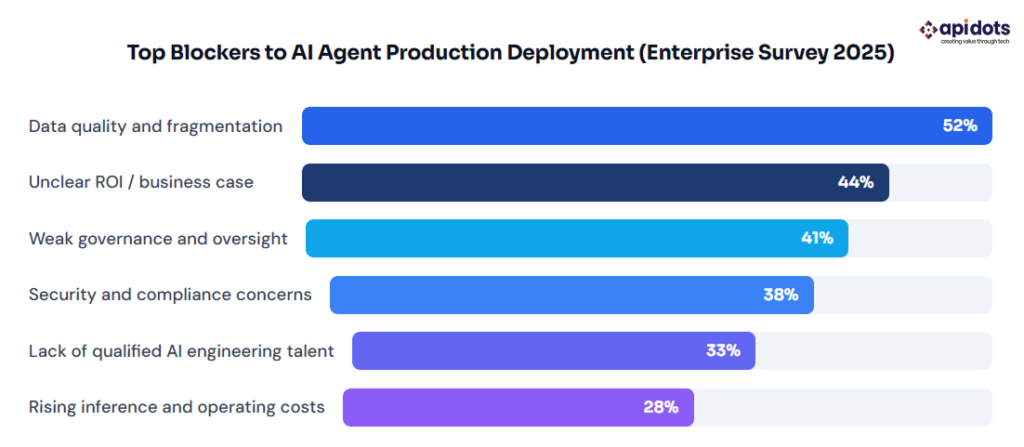
Percentage of enterprises citing each factor as a significant blocker to deploying AI agents in production. Data quality figure (52%) sourced from Enterprise AI Agents Adoption Statistics 2026 (CC BY 4.0), which aggregates findings from McKinsey, Gartner, and IDC primary research. Remaining percentages are illustrative proportions based on relative ranking reported across those sources; individual figures should not be cited as absolute survey results.
Most agent projects budget for model selection, framework integration, and security architecture. Few budget for the interface layer. That omission produces agents that work technically but fail in adoption because users cannot tell what the agent is doing, cannot override it when it goes wrong, and cannot calibrate how much to trust it. Agent UX is not a polish step. It is a production requirement.
The core tension in every agentic interface is this: the more autonomous the agent becomes, the less visible its decision-making is to the user. The five patterns below address that tension directly. They apply regardless of which framework or model the agent runs on.
Traditional software onboarding teaches users where buttons are. Agent onboarding should ask users what they want to accomplish, then let the agent demonstrate its value by working toward that goal from the first interaction. A user who sees the agent complete a real task in their first session has a concrete mental model of its capabilities. A user who completes a product tour does not. The practical implication: design the first-run experience around an outcome the agent can actually deliver in under three minutes, not a feature walkthrough. Source: Mantlr, Designing for AI Agents: 10 UX Patterns (2026).
Users need to see what the agent intends to do before it does it, not just what it did after the fact. A planning visibility interface shows the agent’s proposed task sequence, which tools it will call, and what data it will access, before execution begins. This serves two purposes: it builds trust through transparency, and it creates a natural checkpoint for the human-in-the-loop intervention that production deployments require. Gartner identifies trust as the primary adoption barrier for enterprise agent deployments, and planning visibility is the most direct interface response to that barrier. Source: FuseLab Creative, Agent UX: UI Design for AI Agents in 2026.
Human-in-the-loop is not a binary. Progressive delegation is the pattern of starting with high human oversight and expanding agent autonomy as the system earns trust through demonstrated reliability. In practice: an agent that routes customer tickets might require human approval on every action in week one, approval on flagged cases in week four, and fully autonomous execution with exception reporting by week eight.
The autonomy expansion is driven by the agent’s own performance record, not by a configuration toggle. NNGroup’s State of UX 2026 report identifies trust calibration as the central design challenge for AI interfaces, noting that users who have been burned by premature automation resist new agent features regardless of capability improvements. Source: FuseLab Creative, Agent UX: UI Design for AI Agents in 2026.
Users should not be shown the agent’s reasoning on every action. That creates noise and slows the interface. They should be able to request that reasoning at any point. An explainability-on-demand pattern surfaces the agent’s decision trace, the data it referenced, and the alternatives it considered, only when the user asks.
This keeps the default experience clean while ensuring the transparency is genuinely available rather than hidden. The distinction matters: an agent that claims to be transparent but buries its reasoning in logs that only an engineer can read is not serving the user who needs to override it. Source: ProCreator, Agentic Design Patterns for 2026.
Human-in-the-loop is not a safety mechanism bolted onto an otherwise autonomous system. It is an interface feature with designed escalation paths, clear handoff states, and explicit return-to-agent flows. The difference between an agent that fails gracefully and one that creates support tickets is whether the human handoff was designed.
In practice, this means: defined trigger conditions for escalation, a review interface that gives the human enough context to act without reading a transcript, a clear mechanism to return the task to the agent after human intervention, and logging that records both the agent action and the human decision. Source: Hatchworks, Agent UX Patterns (2026).
| Pattern | Primary Use Case | Failure Without It |
|---|---|---|
| Goal-First Onboarding | New user first run | Users understand features but cannot map them to outcomes, causing low activation. |
| Planning Visibility | Any multi-step autonomous action | Users intervene too late, and errors compound before discovery. |
| Progressive Delegation | Rolling out automation to skeptical users | Users reject full autonomy, and adoption stalls after the pilot. |
| Explainability on Demand | High-stakes decisions or compliance contexts | Users cannot audit decisions, and trust erodes after the first unexpected action. |
| Human-in-the-Loop Surface | Any production agent touching live data or live actions | Escalation becomes manual heroics, and failure handling depends on whoever notices first. |
Agent UX is not a design-team problem that gets addressed after the engineering is complete. The interface decisions above need to be made during architecture planning, because planning visibility and human-in-the-loop handoff paths have direct implications for how the agent loop is structured, what state is logged, and what the recovery paths are.
Teams that treat UX as a frontend wrapper applied to a finished backend consistently underestimate the rework that follows. For teams building the UI layer on top of agent workflows, the UI/UX design service at API DOTS covers both the interface architecture and the production implementation.
The criteria for evaluating an AI development partner diverges significantly from evaluating a general software development firm. The questions that matter most are specific to the agent domain.
CTOs evaluating partners for agentic builds should also review how MCP server architecture affects the data access and integration layer before vendor conversations begin.
The market data on AI agents is compelling. The implementation gap between pilot and production is real. Gartner’s forecast that 40% of enterprise applications will embed task-specific AI agents by end of 2026 reflects genuine market momentum. The 40% project cancellation risk forecast for 2027 reflects what happens when that momentum is not matched by rigorous engineering.
The organisations compounding advantage from AI agents right now are not moving fastest. They are moving most deliberately: scoped architecture decisions made before a line of code is written, evaluation harnesses built before production deployment, security models that treat external inputs as adversarial from day one, and cost models that account for operating expenses alongside build costs.
API DOTS builds custom AI and ML software for SaaS companies, enterprises, and founders across the US and UK. If you are evaluating an agent build or need a technical review of an existing agent architecture, book a free consultation with our AI team.
An AI chatbot mainly responds to user messages. It answers questions, provides information, and supports conversations.
An AI agent can take action. It can use tools, connect to systems, follow multi-step workflows, make decisions, remember context, and complete tasks with less manual input.
In simple terms: a chatbot talks; an AI agent acts.
AI agent development usually takes 4 to 52 weeks, depending on complexity.
| Agent Tier | Typical Timeline |
|---|---|
| Simple / Single-Task Agent | 4 – 8 weeks |
| Conversational Agent MVP | 8 – 14 weeks |
| Multi-Agent System | 14 – 26 weeks |
| Enterprise / Hierarchical Agent | 26 – 52 weeks |
The timeline depends on the number of integrations, workflow complexity, memory requirements, testing, compliance, and production-readiness.
In 2026, AI agent development typically costs between $15,000 and $400,000+.
| Agent Tier | Build Cost Range |
|---|---|
| Simple / Single-Task Agent | $15,000 – $40,000 |
| Conversational Agent MVP | $25,000 – $80,000 |
| Multi-Agent System | $80,000 – $250,000 |
| Enterprise / Hierarchical Agent | $200,000 – $400,000+ |
Costs increase when the agent requires multiple integrations, advanced memory, orchestration, human-in-the-loop review, governance, security, compliance, or audit trails.
The right framework depends on your use case.
| Framework | Best For |
|---|---|
| LangChain / LangGraph | Enterprise builds and complex agent workflows |
| CrewAI | Multi-agent team workflows |
| AutoGen / Microsoft Agent Framework | Conversational multi-agent systems and Microsoft ecosystem builds |
| OpenAI Agents SDK | OpenAI-native agents with tool use |
For most enterprise projects, LangChain / LangGraph is a strong default. For fast multi-agent prototypes, CrewAI is a good option. For OpenAI-first products, OpenAI Agents SDK is a practical choice.
AI agent projects often fail because they are not scoped, tested, or monitored like production software. Common reasons include poor scoping, weak tool design, unclear business rules, unreliable memory, lack of guardrails, limited observability, integration complexity, and underestimated operating costs.
The best way to reduce risk is to start with a narrow workflow, define success metrics, test the agent against real scenarios, add human review where needed, and monitor performance after launch.
We leverage AI, cloud, and next-gen technologies strategically.Helping businesses stay competitive in evolving markets.
Consult Technology Experts
Hi! I’m Aminah Rafaqat, a technical writer, content designer, and editor with an academic background in English Language and Literature. Thanks for taking a moment to get to know me. My work focuses on making complex information clear and accessible for B2B audiences. I’ve written extensively across several industries, including AI, SaaS, e-commerce, digital marketing, fintech, and health & fitness , with AI as the area I explore most deeply. With a foundation in linguistic precision and analytical reading, I bring a blend of technical understanding and strong language skills to every project. Over the years, I’ve collaborated with organizations across different regions, including teams here in the UAE, to create documentation that’s structured, accurate, and genuinely useful. I specialize in technical writing, content design, editing, and producing clear communication across digital and print platforms. At the core of my approach is a simple belief: when information is easy to understand, everything else becomes easier. Reach me at amysbrew.com