
Top
Search
People also search for:
Stay Inspired with Instagram




A mid-size operator in South Texas’s Eagle Ford Shale was losing $1.8 million a year to unplanned pump failures. His production team reviewed well data every Friday — by which point most failing pumps had already been dead for days. Six months after deploying an AI monitoring system that ran on the sensor data he already had, failure rates dropped 42%. No new hardware. No additional staff. Just the same data, finally being read in real time.
That pattern is repeating across oil and gas operations globally — from upstream drilling programs in North Dakota and Alberta to LNG terminals in Qatar and offshore platforms in Brazil. This blog walks through seven specific AI applications generating measurable returns right now, with real examples from operators who have deployed them. The global AI in oil and gas market is growing from $3.81 billion in 2024 to $10.37 billion by 2030, according to Grand View Research — and the operators driving that growth are running production systems, not pilots.
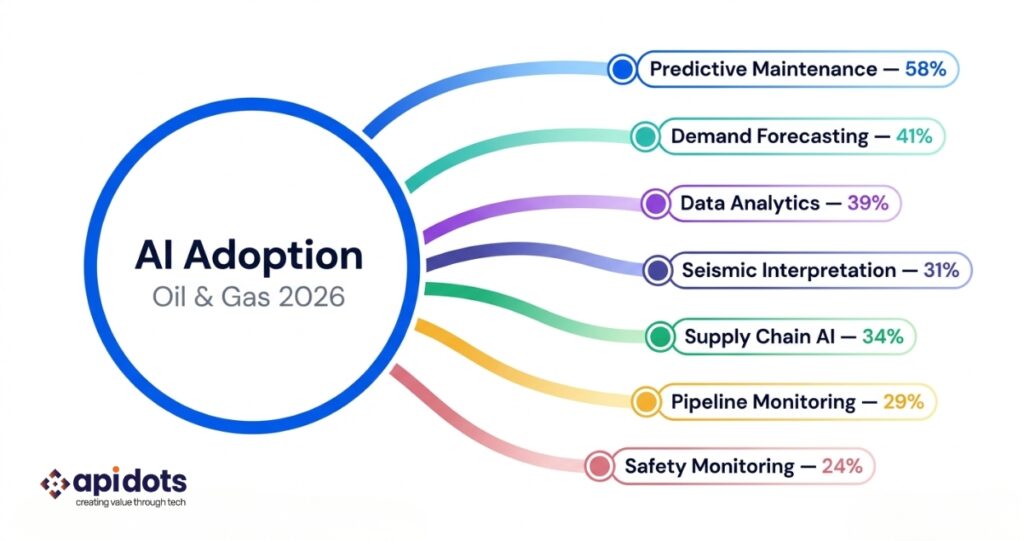
Predictive maintenance uses machine learning models trained on historical sensor data—vibration, temperature, pressure, and current draw—to detect the specific patterns that precede equipment failure days or weeks before breakdown occurs. It is fundamentally different from threshold alarming, which tells you a pump has failed; predictive maintenance tells you a pump is about to fail.
The problem it solves. An onshore well producing 400 barrels per day in the Permian Basin loses $30,000 per day of production during an unplanned pump shutdown. Emergency workover mobilization adds $50,000 to $150,000 in service costs, depending on crew availability and parts lead time. For an operator running 200 wells experiencing 10 to 15 failures per year, the annual exposure runs to $5 million to $12 million in controllable costs — controllable because the failure signatures exist in the sensor data weeks before breakdown, waiting to be read.
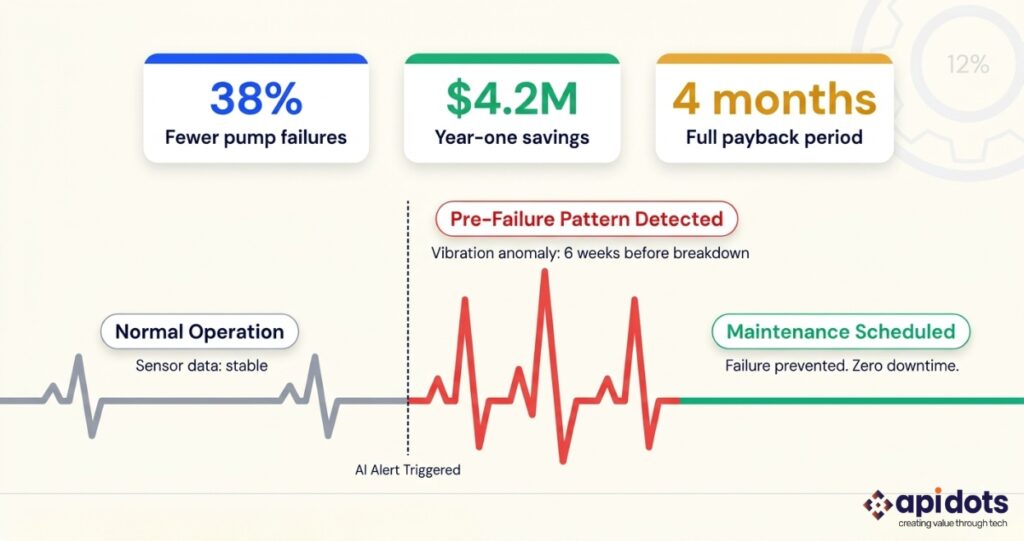
Global example. Shell’s North Sea and Gulf of Mexico operations run an AI predictive maintenance platform monitoring 4,000 data streams across rotating equipment on multiple platforms. The system identifies failures an average of six weeks before they occur and prevents losses Shell estimates at over $100 million annually in deferred production and emergency maintenance.
US state-specific example. A mid-size independent operator in the Midland Basin in West Texas deployed an ML predictive maintenance system across 300 wells. The model trained on 24 months of ESP vibration and current draw data already stored in their historian. In the first 12 months post-deployment, unplanned pump failures fell by 38%, and the system generated a payback from deferred production savings in four months — ahead of the projected 12-month return.
Key results:
What this means for oil companies. Predictive maintenance AI doesn’t replace the maintenance team. It tells the maintenance team exactly which equipment to look at, three weeks before they would otherwise know there was a problem — converting unplanned emergency response into scheduled, planned intervention.
Operators currently running API DOTS’ predictive analytics software connect directly to their existing SCADA and historian infrastructure, with no field hardware changes required before the model goes live.
Currently deployed in: Permian Basin (Texas), Bakken (North Dakota), Norwegian North Sea, Ghawar (Saudi Arabia), Montney (Alberta)
AI drilling optimization uses real-time downhole measurement data, offset well records, and surface drilling parameters to generate continuous recommendations for weight-on-bit, rotary speed, and mud flow rate. The system adjusts recommendations as formation conditions change—something static drilling programs cannot do.
The problem it solves. Non-productive time (NPT)—stuck pipe, bit failures, wellbore instability—accounts for 15–30% of total drilling cost on the average horizontal well. A land well in the Haynesville Shale in Louisiana costs $7 million to $9 million; an offshore well in Brazil’s pre-salt Santos Basin exceeds $100 million. On a deepwater rig costing $500,000 per day, a 24-hour stuck pipe event is a $500,000 loss that better formation evaluation and parameter management could have prevented.
Global example. In Saudi Aramco’s onshore drilling programs in the Empty Quarter and the Rub’ al Khali basin, AI drilling optimization is integrated into their smart oilfield initiative. The system uses offset well learning—continuously updating its recommendations based on what worked and what didn’t across hundreds of nearby wells drilled in similar formations.
US state-specific example. In the Weld County section of the DJ Basin in Colorado, Civitas Resources deployed AI-assisted drilling parameter optimization across a 20-well development program. Real-time formation evaluation from LWD tools fed into an ML model trained on 340 offset wells. Penetration rates improved 22% compared to the previous year’s program, and NPT fell from 18% of total drilling time to 9%.
Key results:
What this means for oil companies. Drilling optimization AI compounds in value across a multi-well program. A 20% penetration rate improvement across a 30-well program in the Permian doesn’t save one drilling day — it saves six, at $50,000 to $100,000 per land rig day.
Companies that have integrated AI and ML development into their drilling workflows through platforms like API DOTS’ AI and ML development services start with their existing MWD and drilling records before adding new data infrastructure.
Currently deployed in: Permian Basin (Texas), Santos Basin (Brazil), DJ Basin (Colorado), Montney (Alberta), Empty Quarter (Saudi Arabia)
AI pipeline monitoring uses acoustic sensors, pressure transient analysis, distributed temperature sensing, and satellite methane data to detect leak signatures in real time. ML models distinguish genuine leak events from operational pressure transients — valve operations, compressor starts — that cause false alarms in conventional systems.
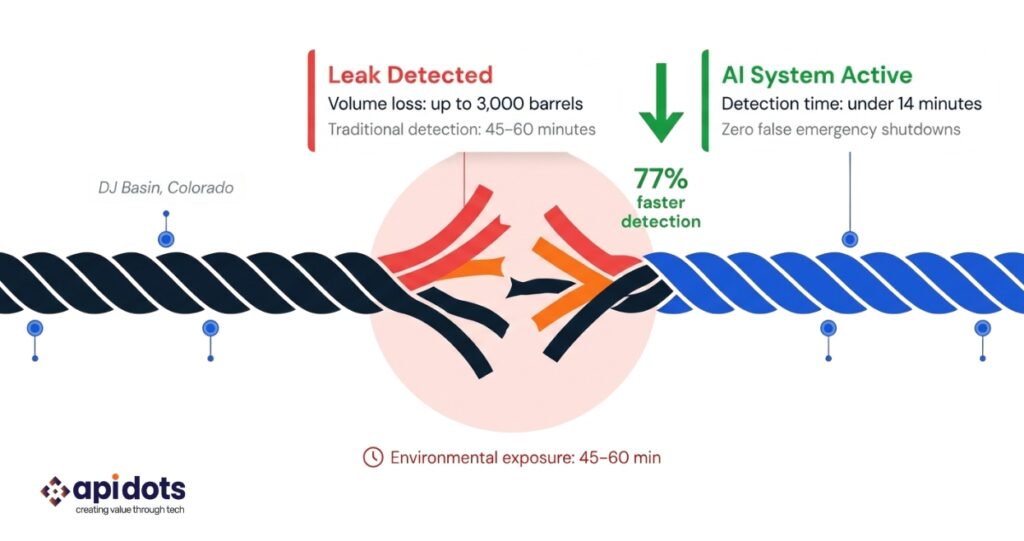
The problem it solves. Traditional pressure-balance leak detection has a minimum detection threshold of 1–3% of throughput volume and a detection lag of 30 to 60 minutes for significant leaks. For a 100,000-barrel-per-day crude pipeline in West Texas, that means up to 3,000 barrels — and 30 to 60 minutes of environmental exposure — before a conventional alarm triggers. Under the EPA’s updated methane reporting requirements and the EU Methane Regulation that took effect in 2025, that detection lag carries direct regulatory liability.
Global example. In Nigeria’s Niger Delta, where pipeline integrity is a persistent operational and political challenge, Shell and Seplat have deployed AI acoustic monitoring on sections of the Trans Niger Pipeline. The system has reduced leak detection time from hours to under 12 minutes in tested segments and improved the accuracy of third-party interference detection—distinguishing mechanical damage from natural pressure variation.
US state-specific example. A midstream operator running 800 miles of NGL gathering pipeline in the DJ Basin in Colorado deployed an AI leak detection system integrated with their existing SCADA pressure readings and a new acoustic sensor network. In 14 months of operation, the system identified three leaks that conventional monitoring would have taken 45–90 minutes longer to detect and generated zero false emergency shutdowns — a significant improvement over the previous system’s average of four false alarms per month.
Key results:
What this means for oil companies. AI pipeline monitoring has shifted from an operational improvement to a compliance requirement. Operators with pipelines subject to EPA’s methane monitoring rules need detection systems that can document continuous monitoring — not just respond to failures.
API DOTS integrates pipeline monitoring AI with existing cloud services and data infrastructure, avoiding the need for a separate technology platform for environmental compliance reporting.
Currently deployed in: DJ Basin (Colorado), Permian Basin (Texas), Niger Delta (Nigeria), North Sea pipeline networks (Norway/UK), Karachaganak field (Kazakhstan)
AI refinery optimization connects to distributed control systems and historian databases to monitor process variables in real time, identify drift from optimal operating windows, and generate setpoint recommendations that advanced process control systems implement automatically. The ML models capture multi-variable process relationships too complex for manual optimization or conventional APC.
The problem it solves. A 300,000-barrel-per-day refinery runs thousands of process loops simultaneously—distillation, hydrocracking, fluid catalytic cracking, and blending. Getting those loops to their optimal operating point is a multi-variable optimization problem that conventional APC systems solve only partially. A 3% yield improvement at a $10 crack spread on 300,000 barrels per day is $9 million per year — a number that fully justifies AI software investment in the first month.
Global example. Saudi Aramco’s downstream operations in Jubail and Yanbu have deployed AI process optimization across multiple refinery units as part of their $5 billion digital transformation program. Reported results include improvements in energy intensity and product yield across their integrated refining and petrochemical complexes—facilities that together process over 5 million barrels per day.
US state-specific example. ExxonMobil’s Beaumont, Texas, refinery—processing 619,000 barrels per day after its 2023 expansion — uses AI process control integrated with their proprietary planning systems to continuously optimize the product slate. The model adjusts gasoline, diesel, and jet fuel production ratios in near-real-time based on feedstock quality changes and EIA inventory signals, improving yield consistency across a complex that produces 10% of US refining capacity.
Key results:
What this means for oil companies. Refinery AI is a software integration, not a capital project. The DCS and historian systems are already in place. The question is whether the process data is being used to continuously optimize operations or simply stored until something goes wrong.
Operators exploring API DOTS’ broader apidots services for refinery automation typically start with a specific process unit—the FCC or a hydrocracker—before scaling the optimization model across the facility.
apidots builds AI systems that connect directly to your existing SCADA, historian, and ERP infrastructure—no new hardware required. Start with a free 30-minute scoping call.
Book a Free Consultation → apidots.com/contact
AI demand forecasting models ingest historical production and sales data alongside real-time external signals — weather forecasts, tanker AIS positioning, futures prices, and refinery utilization rates — to generate continuously updated demand estimates. The model produces a quantitative baseline updated in real time rather than a weekly spreadsheet updated manually.
The problem it solves. A refinery producing 8% more gasoline than the market needs in a given week doesn’t lose 8% of its margin — it pays storage fees, discounts excess inventory, and creates supply contract conflicts. Across a global refining portfolio, poor demand planning costs an estimated $200 billion annually in overproduction, excess storage, and emergency procurement. Most commercial teams are working from data three to five days old in a market that moves by the hour.
Global example. Shell’s global trading operation uses AI demand forecasting to optimize crude cargo scheduling across refineries in Rotterdam, Singapore, and Louisiana. The model processes AIS shipping data, regional refinery utilization rates, and weather patterns to optimize cargo timing in real time. Shell reports that AI-assisted scheduling has reduced cargo optimization time from days to hours and improved feedstock planning accuracy across its multi-continent operations.
US state-specific example. ExxonMobil’s Baytown, Texas refinery — one of the largest in the US at 560,000 barrels per day—uses AI forecasting integrated with EIA inventory data, futures signals, and regional consumption patterns to adjust the product mix in near-real time. For a facility where the price difference between getting the product slate right and wrong runs to millions of dollars per week, the model’s continuous adjustment provides consistent margin improvement across gasoline, diesel, and jet fuel production.
Key results:
What this means for oil companies. Demand forecasting is not a back-office function. It is the commercial intelligence layer that determines whether a refinery or trading desk produces for the market or for storage — a decision with multimillion-dollar weekly consequences.
The full implementation guide for companies evaluating this is covered in the AI demand forecasting guide that walks through data readiness, model selection, and ERP integration steps.
Currently deployed in: Baytown and Port Arthur (Texas), Rotterdam (Netherlands), Jamnagar (India), Ras Laffan (Qatar), Karratha (Australia)
AI safety monitoring uses computer vision — cameras paired with ML models trained on safety event footage — to detect hazardous conditions in real time: workers entering restricted zones without proper PPE, personnel in proximity to heavy equipment operating envelopes, gas cloud formation near ignition sources, and behavioral patterns associated with fatigue.
The problem it solves. The US oil and gas extraction sector recorded an injury rate of 1.8 per 100 workers in 2023 — above the all-industry average and at significant cost to operators in insurance premiums, regulatory penalties, and lost production. In offshore environments, the consequences of a single hazard detection failure are measured in lives. Conventional permit-to-work systems document compliance; they don’t intervene before incidents.
Global example. In the Norwegian North Sea, where the Petroleum Safety Authority Norway mandates continuous improvement in safety management systems, Equinor and Aker BP have deployed computer vision safety monitoring on offshore platforms. The systems generate real-time alerts for supervisors when high-risk situations are detected — workers near crane swing radii, proximity violations in gas compression areas — reducing hazard response time from minutes to seconds.
US state-specific example. A large independent operator in the Delaware Basin in New Mexico deployed AI video monitoring across 40 active well sites. The system monitored PPE compliance, vehicle exclusion zones around wellheads, and H2S sensor proximity violations in real time. In 18 months of operation, recordable incident frequency fell by 34%, and the operator used the monitoring data to demonstrate continuous safety improvement to their insurance underwriters — resulting in a 12% premium reduction.
Key results:
What this means for oil companies. AI safety monitoring generates two types of financial return simultaneously: direct incident cost reduction and regulatory compliance documentation. Both matter increasingly as ESG scrutiny of oil and gas operations intensifies from investors, insurers, and regulatory bodies.
The integration architecture for safety monitoring connects to existing camera networks on platforms and wellsites — the same DevOps services pipeline that handles operational data streams from SCADA systems applies equally to video data processing at the edge.
Currently deployed in: Delaware Basin (New Mexico), Norwegian North Sea platforms, Jubail petrochemical complex (Saudi Arabia), Bowen Basin (Queensland), Santos Basin platforms (Brazil)
Machine learning models applied to 3D seismic volumes automate horizon picking, fault interpretation, and channel body detection — tasks that previously required months of manual geoscientist interpretation. Convolutional neural networks classify lithology and fluid content from amplitude data with accuracy that rivals experienced interpreters, in a fraction of the time.
The problem it solves. A modern 3D seismic survey covering a deepwater block generates petabytes of data. Processing and interpreting that data through conventional workflows takes months — months during which lease obligations accrue, drilling windows shift, and competitive intelligence changes. BCG has documented that AI-assisted seismic interpretation can reduce drillable prospect identification time from months to as few as two weeks. The global shortage of experienced geoscientists makes manual interpretation timelines structurally unsustainable for most operators.
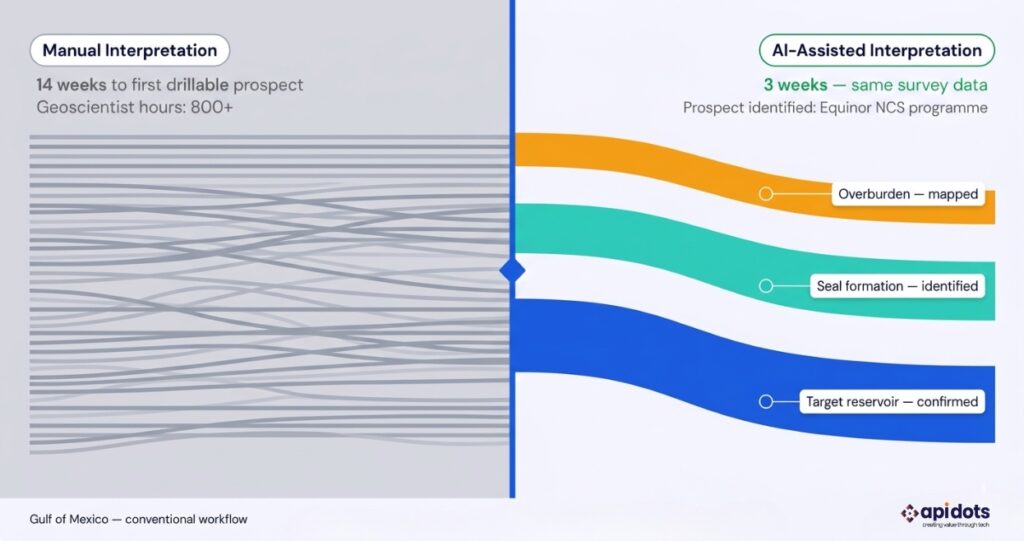
Global example. CGG’s HorizonAI platform and Schlumberger’s Delfi cognitive E&P environment have been deployed across major exploration programs in the UK North Sea, West Africa’s deepwater blocks, and the Asia Pacific basin. In Equinor’s Norwegian Continental Shelf exploration program, ML-assisted fault interpretation reduced the manual interpretation cycle on a 3D survey block from 14 weeks to 3 weeks — a compression that accelerated the farm-out negotiation timeline for a prospect package.
US state-specific example. In the deepwater Gulf of Mexico — specifically in the Mississippi Canyon and Green Canyon protraction areas — several major operators have deployed ML seismic classification to improve salt geometry interpretation below the allochthonous salt canopy, where conventional interpretation is most error-prone. Improved pre-salt geometry understanding has directly improved well placement accuracy in a basin where a single deepwater exploration well costs $80 million to $150 million.
Key results:
What this means for oil companies. Exploration AI is not just a time-saving tool — it is a capital efficiency tool. Finding a prospect six weeks earlier changes the economics of the drill-or-drop decision, the farm-in negotiation, and the lease commitment timeline simultaneously.
For the broader context of how AI in oil and gas industry is reshaping exploration and production globally, the AI in oil and gas industry pillar guide covers the full upstream value chain.
Currently deployed in: Gulf of Mexico deepwater (US), Norwegian Continental Shelf, Santos Basin (Brazil), Browse Basin (Australia), West Africa deepwater blocks
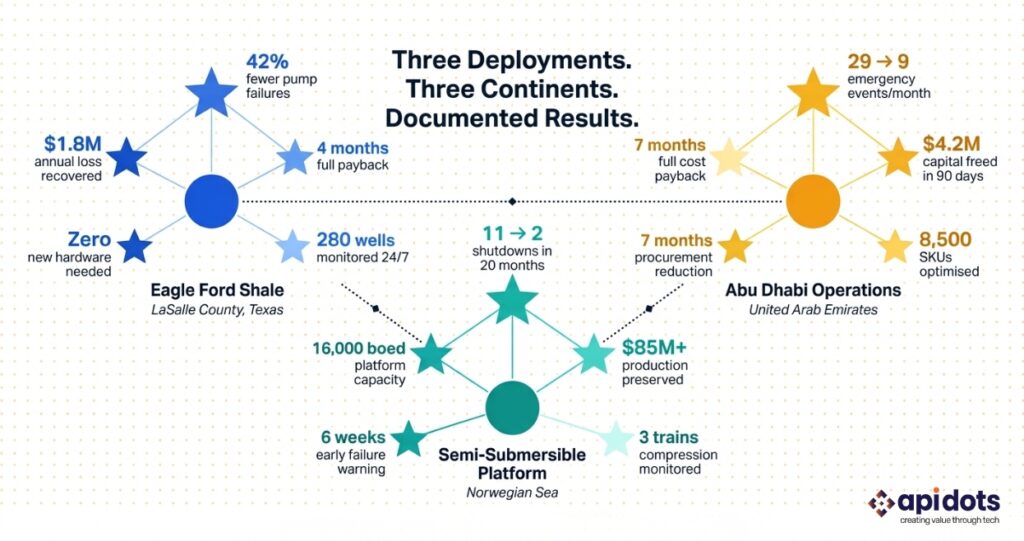
An independent operator managing 280 producing wells across the Eagle Ford Shale in LaSalle and Webb Counties, Texas, was losing $1.8 million annually to unplanned ESP and rod lift failures. The production engineering team reviewed well data weekly—a schedule that guaranteed pump failures were discovered after breakdown, not before. Emergency workover mobilization in South Texas typically runs 7 to 12 days from the point of failure, meaning each event cost $140,000 to $450,000 in deferred production on top of the workover bill.
The company deployed an AI monitoring system trained on 22 months of pump vibration, current draw, and fluid temperature data already stored in their historian. The model was connected via API — no new field hardware was installed. Within 60 days of go-live, the system flagged three pumps operating in pre-failure condition, allowing the team to schedule interventions during a planned workover campaign already mobilized for other wells on the same pad. Failure rates fell 42% in the first six months. The system paid back its full cost from two avoided emergency workovers alone. The production engineering team was able to redirect two days per week of previously reactive monitoring time to well performance optimization — an indirect benefit the operator hadn’t anticipated in their original ROI model.
A national oil company operating 94 production facilities across Abu Dhabi’s onshore and offshore assets was managing spare parts inventory using SAP combined with manual warehouse processes. Emergency procurement events — situations where a critical part was unavailable when needed — occurred at an average of 29 per month. Each event carried a premium logistics charge of $11,000 to $14,500, before counting production delay costs from equipment waiting for parts.
An AI inventory optimization system was integrated directly into their SAP environment. The ML model analyzed two years of parts consumption history, predictive maintenance alerts from their sensor network, and supplier lead time data to generate dynamic reorder recommendations. The system flagged slow-moving overstock items at three warehouses — releasing $4.2 million in tied-up capital in the first 90 days — and reduced emergency procurement events to 9 per month within six months of deployment.
The operator’s procurement team now spends the majority of their time on supplier contract optimization rather than emergency sourcing calls — a shift in function that the COO cited as one of the most tangible operational changes the AI program had produced. For companies evaluating similar workflows, the smart AI inventory management implementation framework covers the ERP integration requirements in detail.
A major European operator running a semi-submersible production platform in the Norwegian Sea—producing 16,000 barrels of oil equivalent per day — was experiencing 5 to 7 unplanned gas compression train shutdowns per year, each requiring 3 to 9 days of reduced or halted production. At Norwegian offshore operating costs and deferred production rates, each event cost between $7 million and $22 million. The platform’s existing vibration alarm system only triggered when damage was already occurring — preventing early intervention.
An ML predictive monitoring system was trained on 36 months of compressor operational data: vibration spectra, bearing temperatures, rotor dynamics, seal gas differential pressures, and lube oil quality readings across all three compression trains. The model validated against 12 historical failure events before deployment. In the 20 months following go-live, the platform experienced 2 unplanned compressor shutdowns—compared to 11 in the equivalent prior period. Two impending seal failures were identified six weeks ahead of predicted failure and addressed during scheduled maintenance windows, preventing what historical analysis suggested would have been platform-level production shutdowns. The avoided production loss in the first 20 months exceeded $85 million at prevailing Brent prices.
McKinsey’s State of AI in Industrial Operations documents that companies deploying AI at scale — rather than in isolated pilots — generate 15–20% improvements in key operational metrics within 12–18 months of full deployment. The difference between companies running AI pilots and companies running production AI systems is widening: the early movers in the Permian Basin, in Abu Dhabi, and in the Norwegian North Sea are already operating at a structural cost advantage that compounds with each passing year.
Gartner’s 2026 Data and Analytics Predictions identify AI-ready data infrastructure as the fastest-advancing enterprise technology category — and the primary determinant of whether AI investments generate returns or stall in integration. Oil and gas companies that have invested in data governance and historian standardization before deploying AI are seeing significantly faster implementation timelines than those starting with fragmented data environments.
For operators building the business case internally, the AI-powered software solutions guide covers the ROI modeling framework that API DOTS uses in initial client engagements.
The parallel for administrative and process automation is equally compelling. RPA and intelligent automation implementations in oil and gas — covering regulatory reporting, invoice processing, and procurement workflows — consistently deliver 60–80% reductions in manual processing time, with payback periods of three to six months for focused automation programs.
Ready to see which of these 7 AI applications fits your operation?
Whether you operate in Texas, Norway, Abu Dhabi, or Queensland — API DOTS starts every engagement with a 2-week discovery sprint that defines your exact problem, audits your data readiness, and maps the integration requirements before writing a single line of code.
Talk to the API DOTS Team → apidots.com/contact
Q1. Which AI application gives the fastest ROI for oil and gas companies?
AI predictive maintenance for artificial lift equipment — specifically electric submersible pumps and rod lift systems — consistently delivers the fastest payback for onshore operators. For a portfolio of 50 to 200 wells with existing sensor infrastructure and historian data, a predictive ML model can be deployed in 10 to 14 weeks. The financial return from preventing two or three unplanned pump failures in the first month frequently covers the entire implementation cost. Offshore operators in the Gulf of Mexico or the Norwegian North Sea see even faster returns, because offshore downtime costs are five to ten times higher than onshore equivalents — each avoided compressor shutdown is worth $7 million to $22 million in preserved production.
Q2. Can small and mid-size operators afford AI — or is it only for companies like Aramco and Shell?
Mid-size operators with 50 to 300 wells are running production AI systems today across the Permian Basin, the Eagle Ford, and the Bakken. The economics work because AI predictive maintenance is built on sensor data that already exists in the operator’s historian — not on new hardware purchases or cloud infrastructure they don’t already own. A focused implementation for a 100-well portfolio typically costs $150,000 to $350,000 in development and integration, with payback from two to four avoided emergency workovers. The AI demand forecasting guide covers the readiness requirements and cost structure in detail for operators evaluating their first AI deployment.
Q3. Does AI in oil and gas require new sensors or hardware in the field?
In most high-ROI applications — predictive maintenance, demand forecasting, supply chain optimization, and data analytics — no new field hardware is required. These systems connect to sensor data already stored in the operator’s SCADA historian via API and process it in software. The only applications that reliably require new hardware are those needing sensor types not currently installed: acoustic sensors for advanced pipeline leak detection, optical gas imaging cameras for continuous methane monitoring under evolving EPA regulations, or edge computing hardware for offshore platforms with limited connectivity. Hardware needs should be confirmed during the data audit phase, before any development budget is committed.
Q4. How is AI being used differently in the Middle East versus US oil and gas operations?
The technology is identical across geographies — ML models, SCADA integration, historian data, API connections. The operational context differs significantly. Middle East national oil companies like Saudi Aramco and ADNOC implement AI at scale across thousands of wells and multiple integrated facilities simultaneously, with large internal data science teams coordinating alongside external development partners. US independent operators typically start with a single high-ROI application — artificial lift monitoring or supply chain optimization — and expand from there. European North Sea operators add a third dynamic: strict OT/IT security separation requirements from the Norwegian Petroleum Safety Authority and the UK Health and Safety Executive that shape how AI systems are architected and validated. API DOTS has deployed in all three contexts and designs the implementation architecture specifically for each.
Q5. What should an oil and gas company check before approaching an AI development firm?
Three things. First, define the problem in financial terms — not “we want better data visibility” but “we lose approximately $X million per year in unplanned downtime from this specific equipment type, and we can document it.” Second, understand your historian data: how many months of sensor data exist, whether it’s consistently tagged across your asset portfolio, and whether it includes failure event timestamps that allow the model to correlate sensor patterns with outcomes. Third, identify who will own the operational outcome — the person who makes maintenance decisions based on AI alerts, not the IT project manager who manages the technical delivery. AI implementations that succeed have a named operations owner. The ones that stall typically don’t.
Q6. What are the biggest challenges in deploying AI across oilfield operations?
Data quality and consistency is the challenges that delays more AI projects than any technical problem. Most operators have more sensor data than they realize, but significant portions of it are inconsistently tagged across different assets, have calibration gaps, or aren’t accessible to external systems because the historian was configured for internal reporting rather than API access. The second challenge is OT/IT integration—connecting AI software to operational technology environments (SCADA, DCS) requires careful security design that standard software development doesn’t address by default. The third challenge is operational adoption: a predictive maintenance model that generates alerts the maintenance team doesn’t act on generates no value, regardless of its technical accuracy. Workflow integration and team training deserve the same investment as model development.
We build and deploy end-to-end AI software solutions for businesses. Accelerating efficiency, automation, and intelligent decision-making.
Get AI Development Services
I’m a digital marketer with experience in SEO, content strategy, and online brand growth. I specialize in creating optimized content, improving website rankings, building high-quality backlinks, and driving traffic through effective digital marketing strategies. I enjoy helping businesses strengthen their online presence and turn visitors into customers.