
Top
Search
People also search for:

Stay Inspired with Instagram




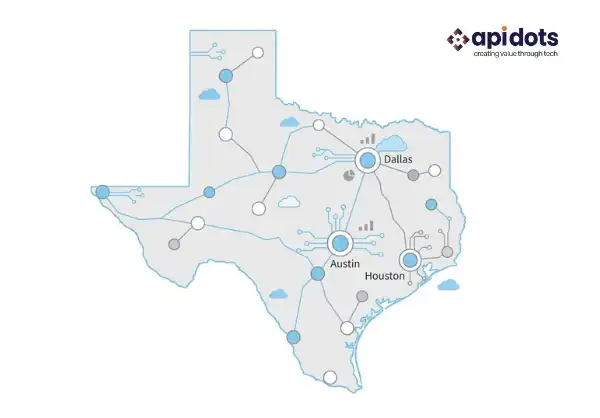
Texas is not catching up to Silicon Valley. It has already surpassed it in several key measures. The state now hosts 36,413 active AI job openings, trails only California in total AI investment, and was chosen as the starting point for the $500 billion Stargate AI infrastructure project, the largest AI infrastructure commitment in history. OpenAI’s flagship Stargate data center in Abilene was operational by late 2025, with more than 450,000 NVIDIA GB200 GPUs planned for deployment.
If you are an enterprise evaluating AI vendors, a startup founder selecting a development partner, or an investor mapping where the next wave of AI value is being created, Texas now belongs at the top of your list. This blog covers the top AI software companies in Texas, what makes each one worth knowing about, the industries they are transforming, and how to choose the right AI partner for your specific business needs.
For a comprehensive understanding of how modern AI software is built and deployed, read our complete guide: AI Software Development Guide 2026.
Three factors have converged to make Texas the dominant AI state outside California. The business environment, the infrastructure investment, and the talent pipeline have all reached critical mass at the same time.
When OpenAI, Oracle, and SoftBank chose Abilene, Texas, as the site of their inaugural $500 billion Stargate AI campus, it was not a coincidence. Texas offered abundant low-cost power, favorable land acquisition terms, a state government willing to expedite permitting, and proximity to a skilled engineering workforce. According to OpenAI’s Stargate announcement, the project is expected to create hundreds of thousands of American jobs, with Texas positioned to receive the largest concentration of that employment.
The University of Texas at Austin, Texas A&M, and Rice University collectively produce thousands of computer science and engineering graduates each year. Add the talent attracted by the Austin campuses of Apple, Dell, Tesla, IBM, and Oracle, and you have one of the deepest AI engineering talent pools outside the Bay Area. Unlike Silicon Valley, this talent can be retained: Texas has no state income tax, significantly lower housing costs, and a quality of life that increasingly attracts senior engineers who have left San Francisco.
Texas AI companies operate at 30 to 40% lower overhead than their Bay Area equivalents. There is no state income tax, commercial real estate is affordable, and energy costs are among the lowest in the country. For AI companies, which consume enormous amounts of compute and require large engineering teams, this cost structure is not just attractive. It is a genuine competitive advantage when competing for enterprise contracts on price.
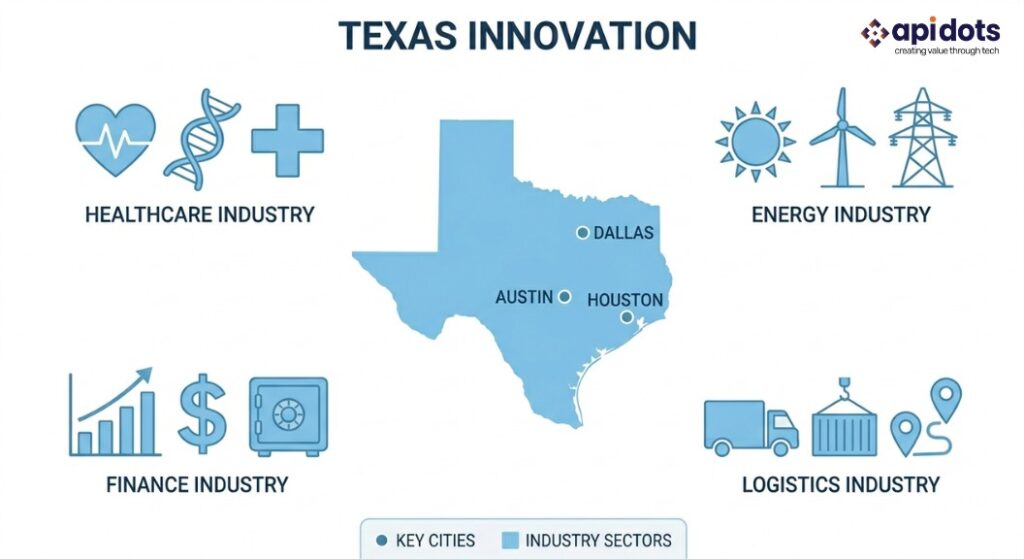
These companies represent the breadth of Texas’s AI ecosystem, from global enterprise platforms to nimble Austin-born startups building tomorrow’s infrastructure.
Founded in a University of Texas dorm room, Dell has evolved into one of the most important AI infrastructure players in the country. Through its AI PC initiative, its PowerEdge AI server line, and its partnership with NVIDIA for enterprise AI factory deployments, Dell is the physical backbone through which thousands of companies run their AI workloads. With its headquarters in Round Rock and over 100,000 employees worldwide, Dell is Texas’s original and most globally significant tech company.
While many Texas AI companies focus on platforms or infrastructure, API DOTS stands out for building custom, production-ready AI software tailored to real business use cases.
API DOTS works with startups, SMEs, and enterprises across Texas to design and deploy:
What differentiates API DOTS is its execution-first approach. Instead of offering generic AI features, the team focuses on solving specific business problems using scalable AI architectures and clean data pipelines.
Their development process includes:
For businesses looking to move beyond experimentation and actually implement AI into their workflows, API DOTS represents a practical and results-driven AI development partner in Texas.
IBM’s Austin campus has long been one of the most important AI research sites in the United States. IBM Watson, one of the earliest commercially deployed AI systems, was developed with Austin talent at its core. IBM’s work in AI governance, responsible AI frameworks, and enterprise AI integration through its consulting arm makes it a top choice for regulated industries including financial services, healthcare, and government. Read more about how AI integrates with enterprise software: AI Integration in SaaS Companies.
Oracle relocated its headquarters from Silicon Valley to Austin, bringing with it one of the most complete enterprise cloud and database platforms in the industry. Oracle’s AI services, embedded within OCI (Oracle Cloud Infrastructure), include automated machine learning, AI-powered database management, and generative AI capabilities. Oracle is also the operating partner for the Stargate AI campus in Abilene, directly running the most powerful AI training infrastructure on the planet from its Texas base.
Indeed, the world’s largest job site, is headquartered in downtown Austin and uses AI across every aspect of its platform: job matching, salary prediction, resume parsing, and employer recommendations. With over 350 million monthly users, Indeed’s AI systems process a volume of labor market data that rivals any analytics company in the world. Their Austin engineering teams are among the most active contributors to open-source NLP and recommendation system research.
Saronic raised $600 million in a Series C round in 2026, making it one of the largest AI hardware and autonomy investments in Texas history. The company builds autonomous surface vessels for defense and commercial maritime applications, using AI for navigation, threat detection, and mission planning. Saronic represents the growing “Physical AI” category that Austin is becoming known for: software intelligence embedded in physical systems operating in the real world.
CrowdStrike’s Falcon platform uses AI to detect, analyze, and block cyber threats in real time. Their Charlotte AI product, a generative AI security analyst, allows enterprise security teams to query their threat data in natural language. In 2026, CrowdStrike’s Austin office serves as a hub for AI threat research and product development. They are arguably the most commercially successful AI-native company headquartered in Austin.
Neurophos received a $110 million Series A from Gates Frontier in early 2026, one of the largest seed-stage AI hardware investments in Texas history. The company is developing optical computing chips designed to run AI inference workloads at dramatically lower power consumption than traditional GPU-based systems. If successful, Neurophos’s technology would address the single biggest constraint on AI deployment: energy cost per inference. This is the type of foundational, hardware-level AI company that Texas’s ecosystem is uniquely equipped to produce.
Hypergiant builds AI software for aerospace, defense, and critical infrastructure, working with clients including the US Air Force, Fortune 500 industrial companies, and government agencies. Their systems analyze sensor data, optimize operations, and support decision-making in environments where accuracy is mission-critical. Hypergiant represents the defense-AI crossover that Austin’s dual identity as both a tech hub and a major military community makes possible.
Peak AI’s decision intelligence platform connects data across an organization and uses AI to power commercial decisions: pricing, inventory, demand forecasting, and customer personalization. Backed by global investors and serving major retail and consumer brands, Peak demonstrates the strength of Dallas as a complementary AI hub to Austin, particularly for supply chain, logistics, and enterprise software applications.

Looking for a top AI software partner in Texas? Book a free consultation with our Austin team. Book Your Free Consultation →
The client: A Houston-based FinTech company processing $2.4 billion in annual transaction volume across B2B payment rails. FCA-compliant, 85 employees, and operating in the oil and gas payments sector where transaction sizes are large and fraud losses are significant.
The problem: Their existing rule-based fraud detection system was generating 340 manual review cases per day, of which 92% were false positives. The compliance team was spending 6 hours per analyst daily reviewing transactions that posed no genuine risk. Meanwhile, a small number of genuine fraud cases were slipping through because the rule-based system could not adapt to evolving patterns.
What Apidots built: Starting with a two-week discovery sprint to map transaction data structure and fraud patterns, the Apidots AI and ML development team designed a supervised machine learning model trained on 18 months of historical transaction data. The model ran in parallel with the existing rule-based system for four weeks before going live, allowing the team to validate its accuracy against known fraud cases. A real-time scoring API was deployed on cloud infrastructure with sub-50ms response times at peak volume.
The outcome: Fraud detection time dropped from an average of 6.2 hours per case to under 1.7 hours, a 73% improvement. False positive volume fell by 81%, reducing the compliance team’s daily manual review queue from 340 cases to 64. The genuine fraud catch rate improved by 23% in the first 90 days as the model adapted to new attack patterns the rule-based system could not detect. The business case paid back the development investment within four months of go-live.
The breakthrough was not the AI model itself. It was the decision to train it on clean, well-labelled historical data before going live. Most AI projects fail because of data quality, not algorithm quality.
Also Read: Predictive AI and ML Development for Finance and Manufacturing
Three data points that frame the scale of opportunity for businesses evaluating Texas-based AI partners:
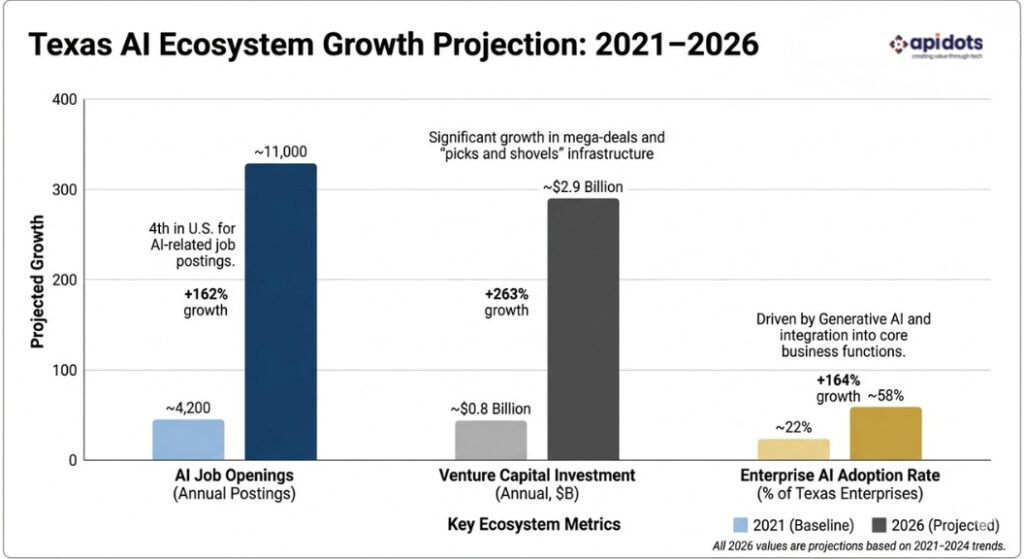
Texas’s AI ecosystem is not concentrated in one sector. Its industrial diversity, which spans energy, healthcare, logistics, defense, and financial services, makes it one of the most well-rounded AI markets in the country.
Texas produces more electricity than any other US state and is home to the largest concentration of oil and gas companies in the world. AI is transforming this sector through predictive maintenance, reservoir modeling, grid optimization, and emissions tracking. Houston’s energy companies are among the most active enterprise AI buyers in the state.
Texas Medical Center in Houston is the world’s largest medical complex. AI is being deployed there for clinical decision support, diagnostic imaging, patient flow optimization, and drug discovery. API DOTS’ healthcare software development team has experience building HIPAA-compliant AI systems for Texas healthcare providers.
Austin and Dallas are both major FinTech hubs. AI applications in this sector include fraud detection (as shown in our case study), credit risk modeling, algorithmic trading, and customer personalization. For a broader view of how AI is changing financial services, read: Top 10 FinTech Trends for Banks and Insurers.
Texas is the largest goods-producing state in the US. The combination of major ports, rail hubs, and interstate logistics corridors makes it a natural testing ground for AI in supply chain optimization. Companies like Peak AI and Motive (formerly KeepTruckin) are building the AI systems that optimize fleet management, route planning, and demand forecasting for some of the world’s largest logistics operations.
Texas hosts several major US military installations and is home to Lockheed Martin, Raytheon, and a growing number of defense-AI startups including Saronic and Hypergiant. This sector demands AI systems that operate in real-world, high-stakes environments, which is driving innovation in autonomous systems, edge AI, and secure AI infrastructure. Also Read: Agentic AI vs AI Agents for Digital Transformation.
With hundreds of AI companies now claiming Texas addresses, separating genuine AI capability from marketing positioning requires asking the right questions. Here is what actually matters when evaluating an AI software partner in Texas:
Also Read: Custom SaaS Development Strategies for Texas Startups
Not every company that calls itself an AI company in Texas has the depth to deliver enterprise-grade AI systems. The ones that consistently produce results share several characteristics.
They solve vertical problems, not horizontal ones. The AI companies generating the most value in Texas are not building generic AI platforms. They are building AI systems for specific industries: fraud detection for FinTech, predictive maintenance for oil and gas, clinical decision support for healthcare. The more specific the problem, the more valuable the solution.
They build for production, not pilots. Many AI projects launch as pilots and never make it to production. The best Texas AI firms design for production from day one: they think about model serving infrastructure, latency requirements, monitoring, and data governance before writing the first line of model training code.
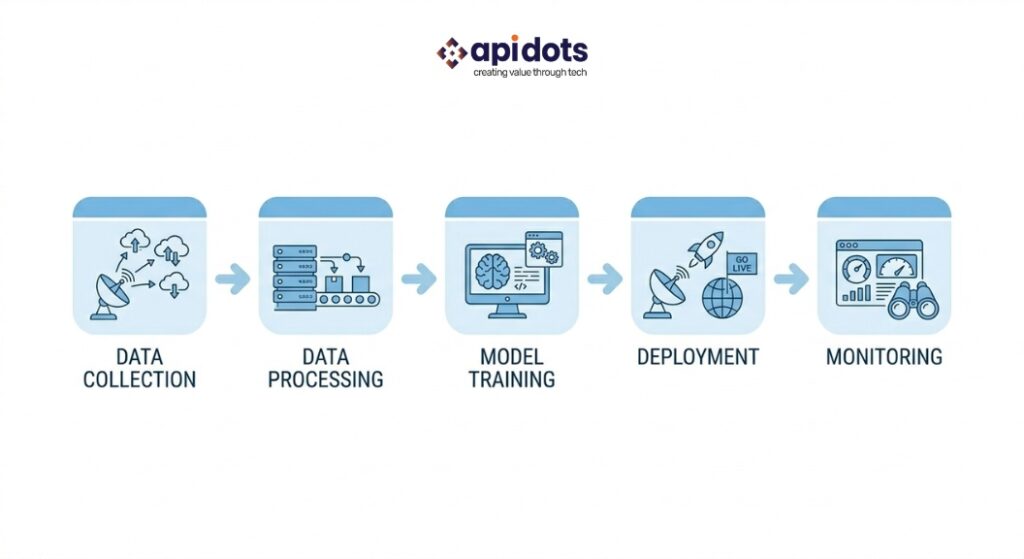
They understand the full AI development lifecycle. From data engineering and feature design through model training, validation, deployment, and continuous improvement, great AI software companies own the full lifecycle. Explore how this works in practice in our detailed: AI Software Development Guide 2026.
Bonus Read: AI Software Development Guide 2026: The Complete Resource
API DOTS is a specialist AI and ML development company serving Texas enterprises, FinTechs, healthcare providers, and growth-stage startups across Austin, Houston, and Dallas. We do not sell generic AI features. We build production-ready AI systems designed around your data, your industry, and your business outcomes.
Our engagements begin with a structured discovery sprint to understand your data architecture and business goals. We then design the minimum viable AI system that will deliver measurable value quickly, before expanding scope based on validated results.
Explore our full range of development services, or read our complete guide: AI Software Development Guide 2026 to understand how apidots delivers AI software from concept to production.
Looking for a top AI software partner in Texas? Book a free consultation with our Austin team today. Book Your Free Consultation →
Which city in Texas has the most AI software companies?
Austin leads by a significant margin, followed by Houston and Dallas. Austin’s Silicon Hills ecosystem spans enterprise software, autonomous systems, defense AI, and AI hardware, making it the most diversified AI cluster in the state. Houston is strongest in energy-sector AI and HealthTech, while Dallas is growing rapidly in supply chain AI, logistics, and enterprise software. All three cities benefit from Texas’s favorable tax environment and strong engineering talent pipeline.
How does Texas compare to Silicon Valley for AI software development?
Silicon Valley still has the highest density of frontier AI research companies, including OpenAI, Google DeepMind, and Anthropic. However, Texas is increasingly competitive for enterprise AI deployment, manufacturing AI, defense AI, and physical AI systems. Texas AI companies often deliver comparable quality at 30 to 40% lower cost than Bay Area firms, and the Stargate investment signals that Texas is now a tier-one AI infrastructure state, not just a relocation destination.
What industries are Texas AI companies strongest in?
Texas AI companies have particular depth in five sectors: energy and utilities (predictive maintenance, grid optimization), financial services (fraud detection, risk modeling), healthcare (clinical decision support, medical imaging), logistics and supply chain (fleet management, demand forecasting), and defense and aerospace (autonomous systems, edge AI). This industrial diversity is one of Texas’s greatest advantages over more narrowly focused tech hubs.
How much does it cost to hire an AI software development company in Texas?
Costs vary significantly based on project scope and the company’s tier. Boutique AI-first development firms, including those with Austin offices, typically charge between $100 and $200 per hour, with production-grade AI projects starting around $50,000 for a focused MVP. A mid-scale AI system with model training, API deployment, and monitoring typically runs $80,000 to $200,000. Enterprise-grade AI platforms in regulated industries can run from $250,000 upward. apidots offers fixed-scope discovery sprints and phased delivery to give Texas businesses predictable investment across project milestones.
Can API DOTS help Texas businesses that already have some AI development underway?
Yes. A meaningful share of apidots’ Texas engagements begin with businesses that have existing AI work in various states of completion: models that never made it to production, pilots that failed to scale, or systems that have degraded in accuracy over time. We begin with a technical audit and an honest assessment of what exists, what can be preserved, and what needs to be rebuilt before you commit to further investment.
We leverage AI, cloud, and next-gen technologies strategically.Helping businesses stay competitive in evolving markets.
Consult Technology Experts
I’m a digital marketer with experience in SEO, content strategy, and online brand growth. I specialize in creating optimized content, improving website rankings, building high-quality backlinks, and driving traffic through effective digital marketing strategies. I enjoy helping businesses strengthen their online presence and turn visitors into customers.