
Top
Search
People also search for:

Stay Inspired with Instagram




You have a product idea, an operational problem that software could solve, or a legacy system that is costing your business more each month. Sound familiar? For thousands of SME owners and business leaders across Greater Manchester, this is the starting point for their SaaS journey — and it is a point where the wrong development partner can cost you six months and a significant amount of capital.
Manchester is now the UK’s leading SaaS city outside London. As of early 2026, 97 active SaaS companies call Manchester home, generating $643.7 million in combined revenue and serving 145 million customers worldwide. The city has attracted $188 million in capital investment into its SaaS sector, with companies like Auto cab—operating in 34 countries—and Cloud Technology Solutions, which hit $110.3 million in revenue in 2024, proving that Manchester-built SaaS products can compete on a global stage.
At APIDOTS, we have been part of this ecosystem — delivering end-to-end SaaS development services for SMEs and growth-stage businesses that want to move quickly without compromising on architecture, security, or long-term scalability. This blog explains what professional SaaS development services in Manchester include, what the city’s ecosystem offers your business, and how to build, scale, and launch your product faster with the right team behind you.
For a broader view of how these principles apply across the UK, read our pillar guide: SaaS Development Services UK.
SaaS — Software as a Service — refers to cloud-based software that users access through a browser or app, hosted and maintained by the provider. Unlike traditional software installed on individual machines, a SaaS product is updated centrally, scales automatically, and is billed on a subscription basis.
For SMEs, the appeal is clear: lower upfront infrastructure costs, predictable monthly spend, and the ability to grow your user base without rebuilding the product from scratch. According to Fortune Business Insights, the global SaaS market is projected to grow from $375.57 billion in 2026 to $1,482.44 billion by 2034 — driven by the near-universal shift to cloud-first operations.
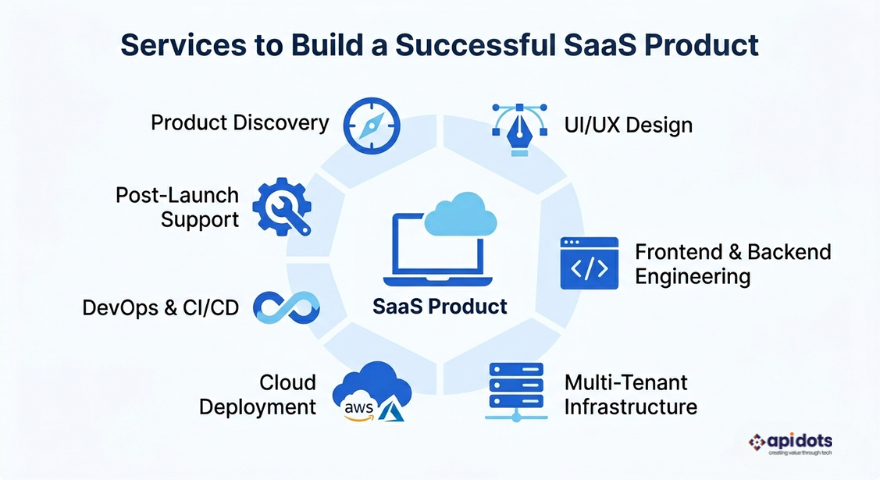
When you engage a professional SaaS development partner, the end-to-end service typically covers:
For businesses at an earlier stage, MVP development services provide a lean starting point — validating your product with real users before committing to the full build.
Choosing where to build your SaaS product is not just a geographic decision — it determines the talent pool you access, the development costs you carry, and the ecosystem support available to your business. Manchester makes a compelling case on all three.
Manchester’s tech corridor — spanning the Northern Quarter, Spinning fields, and Oxford Road’s innovation district — is home to some of the UK’s most ambitious SaaS companies. Auto cab, now operating in 34 countries, was built here. Cloud Technology Solutions grew to $110.3 million in revenue from Manchester. Global Technologies hit $102.2 million in 2024. These are not emerging businesses — they are globally competitive SaaS products with Manchester roots.
This density of SaaS expertise matters for SMEs. It means your development partner has access to engineers, product managers, and architects who have built and scaled real products — not just prototypes.
The University of Manchester, Manchester Metropolitan University, and the University of Salford collectively produce thousands of engineering and computer science graduates each year. This deep, locally-rooted talent pipeline keeps quality high and costs competitive. Manchester-based SaaS development agencies consistently deliver at 25–35% lower cost than equivalent London agencies — without any compromise in technical capability.
Greater Manchester’s Combined Authority has invested substantially in its digital economy. The region benefits from MediaCityUK, the UK’s largest creative and technology cluster outside London, alongside accelerator programmes, funding routes, and co-working infrastructure that help early-stage SaaS businesses find their footing faster.
“Manchester gives SMEs access to enterprise-level SaaS talent at a cost structure that makes their runway last longer — a combination you simply cannot replicate in London.”
Also Read: SaaS Development Services UK — The Complete Guide
Speed to market is not about cutting corners. It is about making the right architectural decisions early, running disciplined delivery processes, and avoiding the rework that comes from poor planning. Here is what consistently separates high-performing SaaS development partners from the rest.
The most common — and most expensive — mistake in SaaS development is treating architecture as a purely technical concern. In reality, your architecture determines your pricing flexibility, your ability to onboard enterprise customers, your compliance posture, and your long-term infrastructure costs.
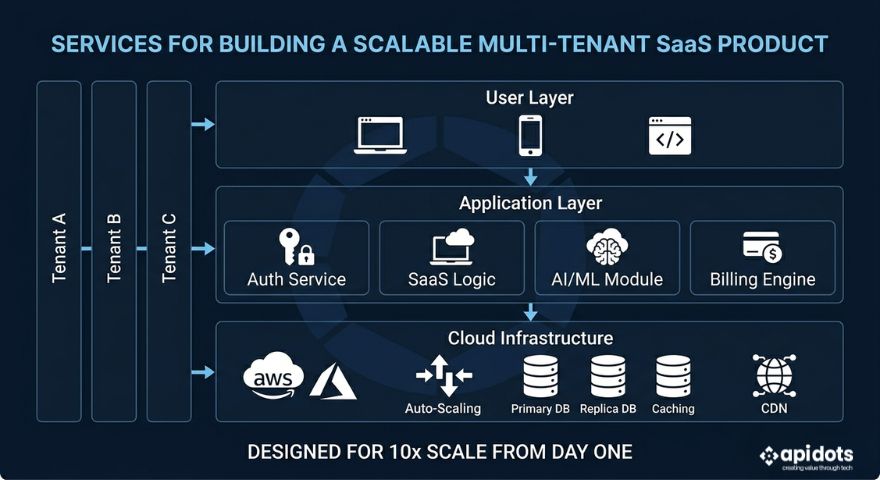
Professional SaaS development teams design multi-tenant systems from the outset — where each customer’s data is logically separated, access is role-based, and the underlying infrastructure can handle 10x your current user load without a full rebuild. This single decision can save months of painful rearchitecting later.
Rather than spending four to six months building a complete product, the most effective approach for SMEs is to launch an MVP (Minimum Viable Product) — a working version of your product with the core features needed to generate real user feedback and early revenue.
An MVP strategy typically reduces initial investment by 40–60% and compresses your time to first launch from six months to eight to twelve weeks. More importantly, it gives you validated data before you commit capital to the full build — reducing the risk that you build features your users do not actually want.
SaaS products live and die on uptime. A platform that goes down during peak hours loses customers and damages trust that takes months to rebuild. Leading Manchester development agencies deploy applications on proven cloud infrastructure using blue-green deployments, auto-scaling groups, and real-time monitoring — ensuring your product handles traffic spikes, releases updates without downtime, and meets the SLAs that enterprise buyers require.
According to Gartner, over 80% of companies are expected to have deployed AI-enabled applications in their IT environments by 2026 — up from just 5% in 2023. For SaaS products, this means AI is no longer a competitive advantage — it is becoming a baseline expectation.
The best AI and ML development teams embed AI capabilities directly into product architecture from the start: intelligent automation, predictive analytics, personalised user experiences, and AI-assisted workflows. Retrofitting AI into a product not designed for it is significantly more expensive and technically complex than building for it from day one.
The most effective SaaS development partners in Manchester work in structured two-week sprints, delivering working, testable software at every cycle. This keeps business owners in control—you can review real functionality, not just documents and wireframes—and ensures that course corrections happen weeks into the project, not months.
A disciplined agile process also enables better budget predictability. Rather than a large fixed-price contract that shifts scope as reality sets in, sprint-based delivery allows your investment to track directly against delivered value.
Ready to define your SaaS product architecture? Talk to our team about your requirements — Book a Free Discovery Call →
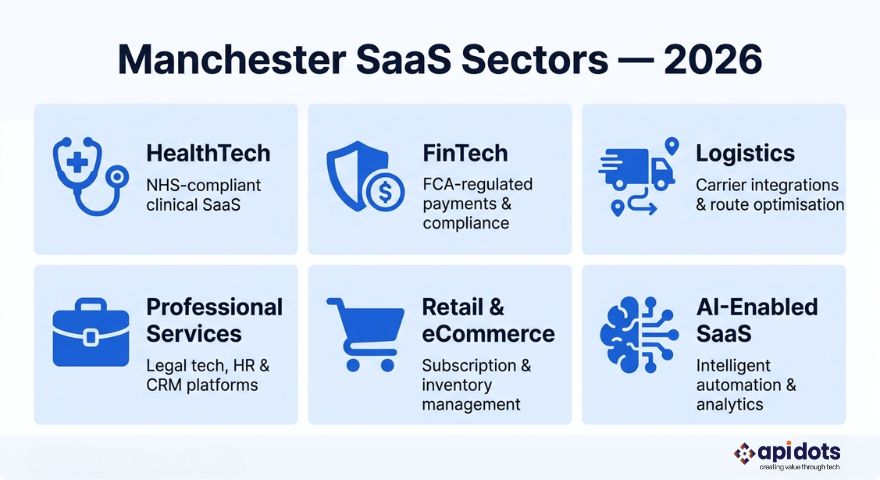
Manchester’s SaaS development community has particular depth in sectors that demand reliability, compliance, and complex integration capability. The most active sectors commissioning custom SaaS products in 2026 include:
Manchester’s proximity to major NHS trusts and its concentration of life sciences businesses makes it a natural hub for Health Tech SaaS development. Products in this space require GDPR compliance, NHS data standards adherence, and integration with clinical systems such as EMIS and System One. The healthcare software development team at APIDOTS has deep experience navigating these requirements.
Manchester’s financial services sector — anchored by Co-operative Bank, the Manchester financial district, and a growing cluster of FinTech startups — drives strong demand for custom SaaS in payments, compliance automation, and open banking. Our FinTech app development services are built for FCA-regulated environments, with security and audit capability built in.
As one of the UK’s major logistics and distribution hubs, Manchester has an active market for SaaS tools that manage carrier integrations, route optimization, warehouse operations, and last-mile delivery. Products in this sector need to handle high transaction volumes, real-time data, and complex API integrations with national and international carriers.
Legal tech, HR management platforms, project management SaaS, and CRM tools for professional services firms are all active areas of development in Manchester. Our custom CRM development capability gives businesses a starting point for replacing generic tools with products tailored to their specific workflow and client management requirements.
Greater Manchester’s retail economy — from independent brands to national chains — creates consistent demand for custom e-commerce development and subscription management SaaS. Products that manage inventory, personalise customer journeys, or handle recurring billing at scale are all areas where Manchester development teams are delivering strong results.
With a growing number of agencies offering SaaS development services in Manchester, choosing the right partner requires evaluating beyond price. Here are the criteria that matter most:
Bonus Read: How to Choose the Best Software Development Company
Cost is one of the most common questions SMEs ask before beginning a SaaS build, and it is also one of the most variable answers in the industry. The cost of SaaS development in Manchester depends on the complexity of your product, the experience level of the team, and the delivery model you choose.
As a general benchmark:
These ranges reflect Manchester market rates—on average 25–35% below London agency pricing. For more detail on what drives software development costs, read: Custom Software Development Cost Guide.
It is also worth understanding the ongoing cost structure after launch: hosting, monitoring, support, and feature development typically run at 15–25% of the initial build cost annually for actively maintained SaaS products.
Also Read: SaaS Monetisation and Pricing Models
The business case for investing in SaaS development has never been stronger. Here are three data points from authoritative sources that frame the opportunity:
Bonus Read: AI Integration in SaaS Companies — What You Need to Know
Whether you are at the idea stage, ready to replace a legacy system, or looking to add AI capability to an existing product, APIDOTS delivers end-to-end SaaS development services built for Manchester SMEs and UK businesses that want to move quickly without sacrificing quality.
Our team brings together product strategy, UI/UX design, full-stack engineering, and cloud infrastructure under one roof — so you get a single accountable partner from discovery to deployment. We have built SaaS products that are live, generating revenue, and serving thousands of users across HealthTech, FinTech, logistics, and professional services.
Explore our full range of services, or read our detailed pillar guide on SaaS Development Services across the UK to understand how we work with businesses at every stage of the SaaS journey.
Ready to build your SaaS product? Contact our Manchester team today →
What is the difference between custom SaaS development and an off-the-shelf SaaS tool?
Off-the-shelf SaaS tools are pre-built for general use — they are faster to deploy but often require your business to adapt its processes to fit the software. Custom SaaS development builds a product specifically for your workflows, your users, and your integration requirements. For businesses with complex or unique operations, custom SaaS typically delivers a stronger long-term ROI despite a higher initial investment.
How long does it take to build a SaaS product in Manchester?
A lean MVP typically takes 8–12 weeks from kick-off to launch. A fully featured v1 product takes 4–9 months depending on complexity. Timelines are shaped by the number of integrations required, the complexity of your data model, and the size of the development team engaged.
Can a Manchester SaaS development agency support GDPR compliance?
Yes. GDPR compliance is a baseline requirement for any SaaS product handling UK or EU customer data. Professional Manchester-based development agencies — including APIDOTS — build GDPR-compliant data handling, access controls, audit trails, and data deletion workflows directly into the product architecture, not as an afterthought.
What is an MVP and why should SMEs start with one?
An MVP (Minimum Viable Product) is a working version of your SaaS product containing only the core features needed to solve the primary user problem. Starting with an MVP reduces your initial investment by 40–60%, gets your product in front of real users in weeks rather than months, and gives you validated feedback before you commit capital to the full build.
How do I know which Manchester SaaS development agency is right for my business?
Evaluate agencies on four criteria: portfolio of live, scaled SaaS products; technical depth in cloud-native stacks; experience in your specific sector (HealthTech, FinTech, logistics, etc.); and their post-launch support model. Ask for case studies, speak to their existing clients if possible, and assess how well they communicate at the discovery stage — the quality of that conversation is usually a reliable indicator of the quality of the engagement ahead.
Related Reading
Also Read: SaaS Development Services UK — Pillar Guide
Also Read: Building a Scalable SaaS MVP: Essential Steps for Startup Success
Also Read: Data Security and Compliance in SaaS
Also Read: SaaS Product Development: Concept to Market Ready
Bonus Read: AI Integration in SaaS Companies
Bonus Read: Go-to-Market Strategy for SaaS
We manage and optimize your IT infrastructure end-to-end.Ensuring stability, security, and operational continuity.
Consult IT Experts