
Top
Search
People also search for:

Stay Inspired with Instagram




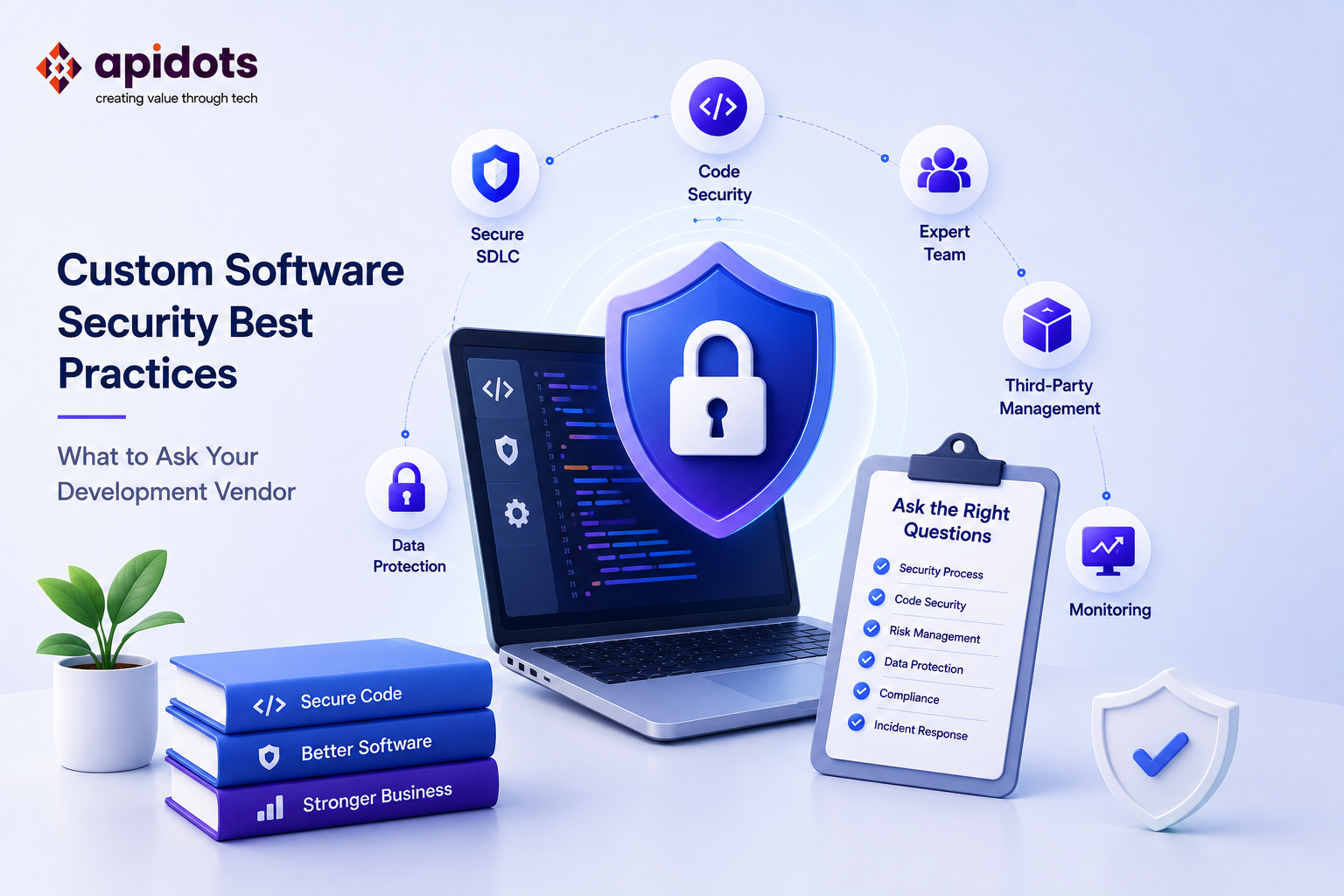
A practical question list for CTOs, VPs of Engineering, and technical founders vetting a development partner on real security discipline, not marketing claims.
Vetting a custom software development vendor on price, portfolio, and delivery speed alone leaves a major blind spot: security. A secure software development process should be visible before you sign the contract, not introduced after the first security finding.
That matters even more in 2026. IBM’s latest Cost of a Data Breach Report puts the global average cost of a breach at $4.99 million, a record high. IBM also reports that AI-driven attacks increased 56% year over year.
At the same time, Veracode’s 2026 State of Software Security research found that 82% of organizations carry security debt and 60% carry critical security debt.
The practical question for a buyer is not whether a vendor says it takes security seriously. It is whether the vendor can show you the controls, evidence, people, tools, and release gates that make that statement meaningful. This guide gives you the questions to ask and the red flags to watch for.
When you outsource software development, you are not outsourcing only implementation. You are also relying on the vendor’s engineering practices, dependency choices, CI/CD controls, access management, testing discipline, and incident-response process.
The supply chain deserves particular attention. Veracode’s 2026 research says 66% of critical security debt comes from third-party code, while 62% of applications contain vulnerabilities originating from open-source libraries. Third-party flaws also have a remediation half-life of 358 days.
That is why vendor due diligence should test the entire development lifecycle rather than asking a single question such as “Are you SOC 2 compliant?”
A mature partner should be able to explain how it designs, tests, monitors, documents, and improves security throughout the project.
A secure software development lifecycle (secure SDLC) builds security into requirements, design, development, testing, deployment, and maintenance. NIST’s Secure Software Development Framework (SSDF) provides a practical set of practices that organizations can integrate into their existing SDLC.
Ask the vendor to walk through the lifecycle stage by stage. You want to hear what happens in practice, who owns each activity, and what evidence is produced.
Vague answers here are a warning sign. A vendor with a mature secure SDLC can name specific tools and checkpoints. They can also name the person accountable for sign-off at each stage.
No single security test catches every problem. A mature application security program uses complementary controls.SAST analyzes source code for vulnerable patterns, DAST tests a running application from the outside, and SCA identifies vulnerabilities and other risks in open-source and third-party dependencies.
Ask which tests run automatically in CI/CD, which findings block a release, how false positives are handled, and what happens when a critical vulnerability is discovered after deployment.
Do not stop at the names of tools. Ask for evidence of the process: a sample security gate, a redacted scan report, the severity policy, or an example of how the team handled a critical finding. A vendor that can explain its remediation workflow is easier to evaluate than one that simply lists security products on a slide.
If your vendor uses AI coding assistants, AI-generated code shouldn’t get a free pass through the normal development process. Veracode’s 2026 GenAI Code Security research found a 56% security pass rate in its benchmark, meaning roughly 44% of tested AI code-generation tasks produced code with a known vulnerability. The research covered more than 100 models and continued a multi-year benchmark of AI code security.
Ask whether AI-assisted code is subject to the same code review, SAST, dependency scanning, testing, and release controls as human-written code. Also ask whether developers may paste confidential source code, customer data, credentials, or proprietary information into external AI tools.
Secure coding is only one layer. Application and infrastructure controls reduce the likelihood that a vulnerability becomes a serious incident and can limit the impact when something goes wrong.
IBM’s 2026 report identifies mismanaged secrets and keys, excessive privileges, and weak role management among factors that can increase breach cost. Ask the vendor how these controls are implemented in a typical build.
If a vendor cannot answer these questions for a past project, treat that as a warning sign. A firm building a custom software product for you should default to these controls. They should not add them only when a client insists.
Compliance evidence can strengthen vendor due diligence, but certification is not the same thing as application security. Ask what is actually in scope, when the evidence was issued, and which controls apply to the people and systems working on your project.
| Framework | What it signals | Follow-up Questions |
| SOC 2 | Independent examination of controls against the applicable Trust Services Criteria | Can they share the current report, scope, period covered, and any relevant exceptions? |
| ISO 27001 | An independently certified information security management system | Is the certificate current, and does its scope cover the services and locations involved in your project? |
| GDPR / privacy | Privacy obligations may apply when personal data is processed | What is the data-processing role, where is data processed, and what contractual safeguards apply? |
| PCI DSS | Relevant when the organization or service is in scope for payment-card requirements | Is the project in scope, and which responsibilities belong to the vendor versus the customer? |
Businesses in regulated industries should treat this section as non-negotiable, not a nice-to-have. Our API DOTS security and technology guides cover similar fintech compliance patterns in more depth.
Every vendor will eventually face a security incident somewhere in their client base. What matters is whether they have a plan, and whether that plan includes you. Ask them to describe their breach notification timeline and who on their team would contact you. Ask what evidence they would preserve for your own investigation.
A vendor that treats incident response as a hypothetical, rather than a rehearsed process, reveals how prepared they actually are.
| Ask About | Red Flag Answer |
| Secure SDLC | “We handle security case by case” |
| Code testing (SAST, DAST, SCA) | Manual review only, no automated scanning |
| Third-party dependencies | No inventory of libraries in production |
| AI-generated code | No distinct review process for AI output |
| Compliance certifications | Certificates they cannot produce or that have lapsed |
| Incident response | No documented notification, escalation, or evidence-preservation process |
| Secrets and access | Shared credentials, hard-coded secrets, or broad production access |
| Supply chain | No dependency inventory, SCA process, or clear ownership for vulnerable packages |
| Security evidence | Claims compliance without providing current scope or evidence |
A secure software development lifecycle, or secure SDLC, integrates security practices into requirements, design, development, testing, deployment, and maintenance. NIST’s SSDF provides a recognized set of practices that organizations can integrate into their SDLC.
Modern applications rely heavily on open-source and third-party components. Veracode’s 2026 research reports that 66% of critical security debt originates from third-party code, making dependency visibility and remediation an important part of application security.
Yes. AI coding tools are now common in development workflows. Testing found that AI-generated code introduced a security flaw in 45 percent of cases. Ask whether that code gets the same review as human-written code.
SOC 2 and ISO 27001 are common baseline signals of a mature security program. Vendors handling payment data or EU personal data should also address PCI DSS and GDPR requirements directly.
Ask for their breach notification timeline and who would contact you during an incident. A documented, rehearsed plan is a stronger signal than a verbal assurance.
Apidots helps businesses build custom software, AI platforms, and SaaS products with security considered throughout the development lifecycle.
This article was updated in August 2026 using current material from IBM’s 2026 Cost of a Data Breach Report, Veracode’s 2026 State of Software Security and GenAI Code Security research, and NIST’s Secure Software Development Framework. OWASP’s current Top 10:2025 remains a useful application-security reference. These sources support the data points and security-practice guidance above.
AI Data Privacy: Risks, Compliance & Protection Strategies
Top Web App Development Companies 2026
SaaS Product Development: Concept to Market Ready
We leverage AI, cloud, and next-gen technologies strategically.Helping businesses stay competitive in evolving markets.
Consult Technology Experts
Hi! I’m Aminah Rafaqat, a technical writer, content designer, and editor with an academic background in English Language and Literature. Thanks for taking a moment to get to know me. My work focuses on making complex information clear and accessible for B2B audiences. I’ve written extensively across several industries, including AI, SaaS, e-commerce, digital marketing, fintech, and health & fitness , with AI as the area I explore most deeply. With a foundation in linguistic precision and analytical reading, I bring a blend of technical understanding and strong language skills to every project. Over the years, I’ve collaborated with organizations across different regions, including teams here in the UAE, to create documentation that’s structured, accurate, and genuinely useful. I specialize in technical writing, content design, editing, and producing clear communication across digital and print platforms. At the core of my approach is a simple belief: when information is easy to understand, everything else becomes easier. Reach me at amysbrew.com