
Top
Search
People also search for:
Stay Inspired with Instagram




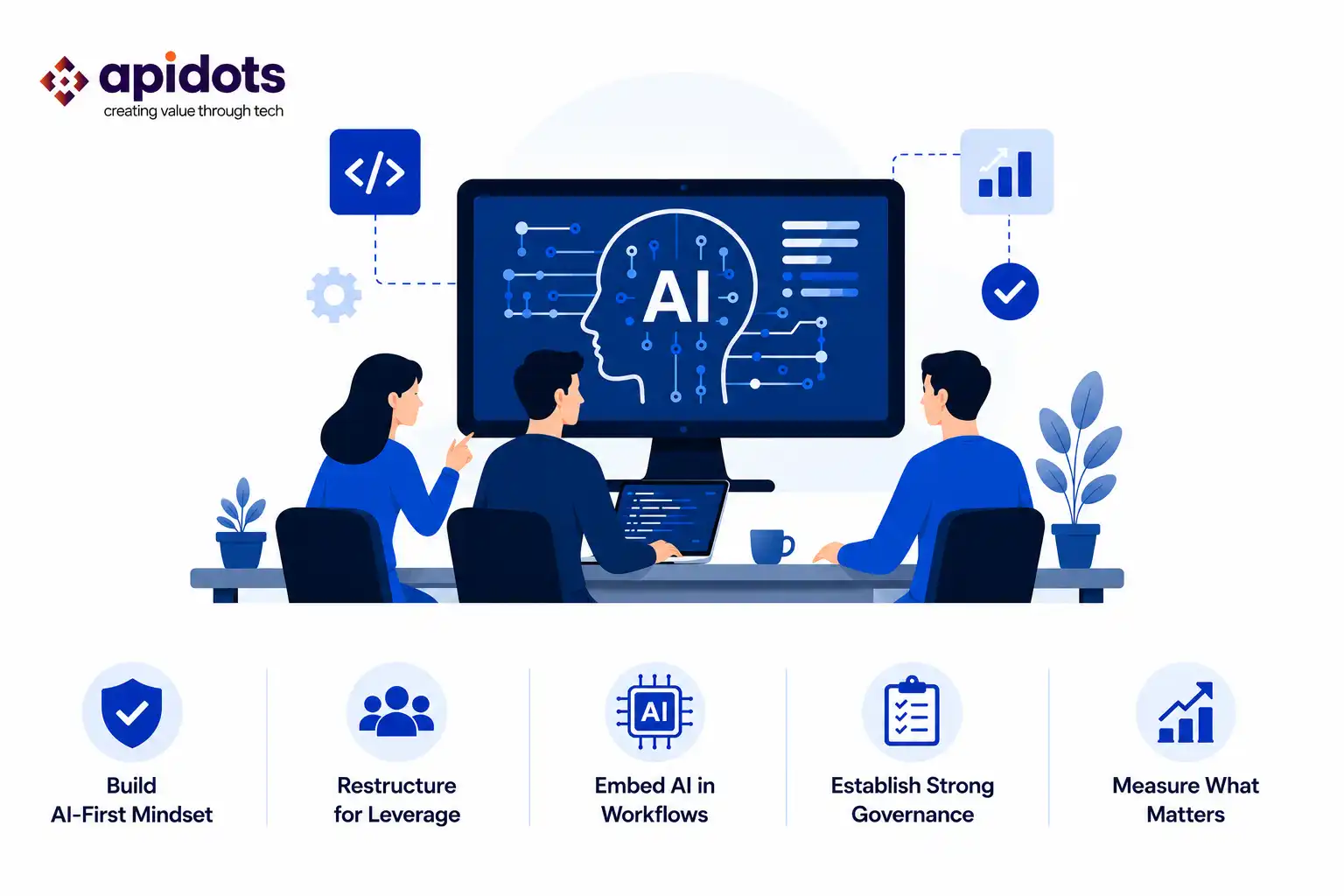
A practical playbook for tech leaders ready to move beyond AI adoption into AI-driven organizational excellence.
In 2026, that question has been settled. A striking 92.6% of developers now use an AI coding assistant at least once a month, and AI-authored code accounts for roughly 27% of all production code. The more urgent question facing every CTO today is structural: how do you build an organization that consistently extracts compounding value from AI, rather than one that simply has AI tools installed?
The data tells a sobering story. Despite near-universal adoption, only 10% of productivity gains are being realized at the organizational level. The gap is not about tooling — it’s about culture, governance, and intentional organizational design.
Before restructuring anything, CTOs need an honest assessment of where their organization currently sits. The five-level AI maturity model below provides a diagnostic framework grounded in 2026 industry data.
| Maturity Level | Team Structure | AI Usage Pattern | Velocity Gain |
|---|
| Level 1: Experimenting | Traditional hierarchy, full team | Ad hoc tool usage, no standards | ~5-10% |
| Level 2: Adopting | Mostly traditional with AI leads | Tool per project, minimal governance | ~15-25% |
| Level 3: Integrating | Slightly flatter, AI champions | Standardized tools, light governance | ~30-45% |
| Level 4: AI-First | Lean pods of 3-5, full-stack AI | AI-native workflows, strong governance | ~55-75% |
| Level 5: AI-Native Elite | 2-3 person squads + agents | Agentic pipelines, autonomous review | ~100-120% |
Table 1: AI Engineering Maturity Model — From Experimenting to Elite AI-Native (2026 benchmarks)
Most enterprise engineering teams today sit between Level 2 and Level 3. The real competitive gap opens between Level 3 and Level 4 — and the organizations that cross it are not doing so by buying more tools. They’re doing it by redesigning how work flows.
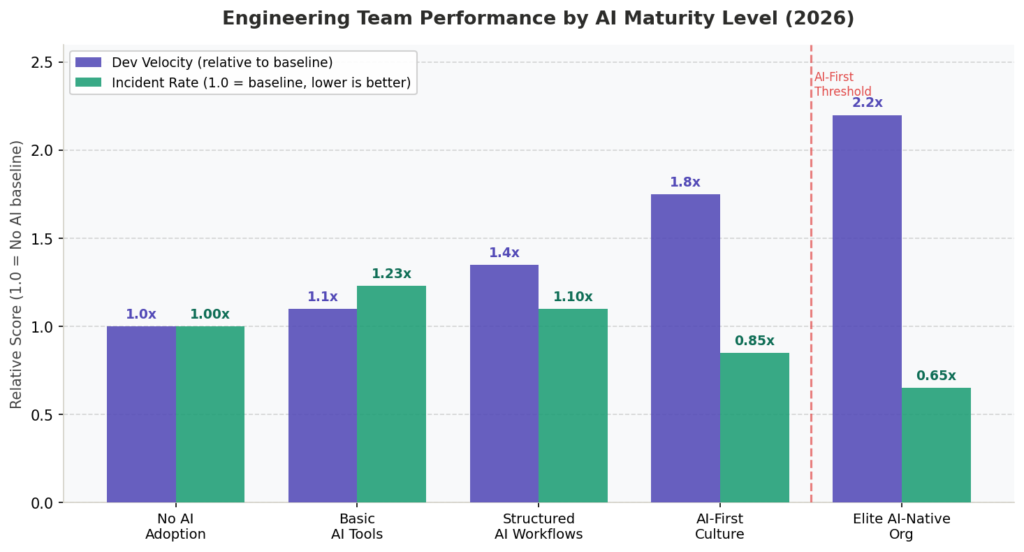
Chart Description:: Engineering Team Performance by AI Maturity Level — Velocity gain vs. incident rate relative to a no-AI baseline. Data synthesized from Opsera, Faros AI, and Larridin 2026 benchmarks.
The biggest mistake CTOs make in 2026 is treating AI transformation as a procurement decision. Subscribing teams to Cursor, Claude Code, or GitHub Copilot is table stakes — not strategy. The CTO’s real job is to design the organizational conditions in which AI thrives.
A Karat survey of 300+ CTOs found that 73% now consider strong engineers to be worth at least 3x their total compensation — a direct reflection of how AI amplifies individual leverage. Your job is to create the conditions where that leverage compounds across the entire team.
The most visible structural change in leading engineering organizations in 2026 is shrinking team sizes. One Series C startup restructured its 12-person team into a 3-person team using Cursor and Claude, achieving a 40% increase in development velocity. This is not an anomaly — it is an accelerating pattern.
This does not mean mass layoffs are the path forward. The smarter play, and the one that builds enduring competitive advantage, is to maximize each individual’s impact. Rather than reducing headcount, redirect hiring budgets toward senior engineers who can leverage AI as a force multiplier. Opsera’s 2026 data across 250,000+ developers found that senior engineers realize nearly five times the productivity gains of junior engineers when using AI.
Speed without governance is how AI becomes a liability. Research from Veracode found that AI-generated code contains 2.74 times more vulnerabilities than human-written code. Pull request volume can increase 98% with AI adoption — while delivery velocity stays flat because human review becomes the bottleneck.
This is what researchers call the AI Productivity Paradox: developers feel faster, but the organization moves at the same pace or slower, while accruing hidden technical and security debt. The CTOs who avoid this trap build governance into the workflow — not as a checkpoint after the fact, but as an integrated layer within the development pipeline.
McKinsey’s State of AI data shows that 57% of top-performing organizations invested in hands-on AI workshops and coaching — compared to only 20% of bottom performers. The productivity gap in 2026 is as much about training as it is about tooling.
The most effective CTOs in 2026 distinguish between two types of AI fluency: using AI tools (table stakes) and orchestrating AI systems (competitive advantage). The latter requires understanding how to prompt engineer for complex tasks, how to design agent workflows, how to evaluate AI output critically, and how to know when not to use AI.
Drawing from 2026 research across thousands of engineering teams, these six practices consistently separate organizations that achieve compounding AI returns from those stuck in the adoption plateau.
| Practice | What It Means | Why CTOs Must Own It | Success Metric |
| AI Code Governance | Establish rules for code reviews, security gates, and acceptable AI-generated code thresholds. | AI-generated code has 2.74× more vulnerabilities than human-written code, making governance essential. | Change failure rate < 10% |
| Context Engineering | Use AGENTS.md files, specification-driven development, and TDD to provide structured context for AI agents. | Prompts alone are insufficient—AI agents need structured context to produce reliable results. | Stable or declining incident rate |
| Lean Team Restructuring | Organize engineers into small pods (3–5 people) supported by a complete AI development stack. | A single senior engineer assisted by AI can deliver 3–4× the output of a junior engineer working alone. | Revenue per engineer > $1M |
| AI Metrics & Instrumentation | Measure AI code percentage, pull request throughput, rework rates, and engineering productivity. | Although 93% of organizations have adopted AI, 75% report little or no measurable business value without proper tracking. | 2.5–4× ROI on AI tooling |
| Upskilling Investment | Invest in practical AI workshops, coaching, and hands-on training labs for developers. | 57% of top-performing organizations invest heavily in AI training, compared with only 20% of low performers. | Developer AI fluency score |
| Agentic Workflow Design | Deploy autonomous AI agents for code reviews, QA, testing, documentation, and repetitive engineering tasks. | Gartner predicts AI-native engineering teams will release software 2× faster than traditional teams. | Deployment frequency doubled |
One of the most dangerous traps in AI-first cultures is optimizing for the wrong metrics. Traditional measures — lines of code, PRs per week, commit frequency — all inflate with AI adoption without necessarily indicating business value. In fact, teams that chase these metrics often end up with more code, more PRs, slower reviews, and higher incident rates.
Building an AI-first engineering culture in 2026 is not a technology project. It is an organizational design project, a governance project, and a talent strategy — all at once. The CTOs who will define the next generation of engineering excellence are not the ones who deployed the most AI tools the fastest.
They are the ones who created the structural conditions — lean teams, disciplined governance, instrumented workflows, and relentless upskilling — under which AI becomes a compounding organizational asset rather than a productivity paradox.
The competitive window is real, and it is narrowing. Gartner predicts AI-native teams will release software 2x faster than peers within two years. The organizations that build these cultural foundations now will compound those advantages for years. The ones that wait will find themselves asking how to manage technical debt, talent shortages, and brittle architectures they do not fully understand.
The time to build is now. Not to adopt AI — but to build the organization that AI deserves.
An AI-first engineering culture is an approach where AI is integrated into every stage of the software development lifecycle. Instead of using AI only for coding assistance, engineering teams leverage AI for code reviews, testing, documentation, planning, and workflow automation while maintaining strong governance and human oversight.
CTOs can build an AI-first engineering team by adopting AI-native workflows, implementing governance policies, investing in developer upskilling, restructuring teams into lean cross-functional pods, and measuring AI-driven productivity with meaningful engineering metrics rather than just code output.
AI governance ensures that AI-generated code meets security, quality, and compliance standards. It includes automated security scans, code review policies, AI usage guidelines, documentation standards, and continuous monitoring to reduce vulnerabilities and maintain software reliability.
An AI-first engineering culture helps organizations accelerate software delivery, improve developer productivity, automate repetitive tasks, reduce operational overhead, enhance code quality through structured workflows, and enable engineering teams to focus on high-value architectural and business decisions.
Instead of measuring lines of code or commit frequency, CTOs should monitor AI code percentage, deployment frequency, pull request cycle time, change failure rate, developer productivity, incident rates, AI tooling ROI, and overall developer experience to evaluate the success of AI adoption.
We leverage AI, cloud, and next-gen technologies strategically.Helping businesses stay competitive in evolving markets.
Consult Technology Experts
Hi! I’m Aminah Rafaqat, a technical writer, content designer, and editor with an academic background in English Language and Literature. Thanks for taking a moment to get to know me. My work focuses on making complex information clear and accessible for B2B audiences. I’ve written extensively across several industries, including AI, SaaS, e-commerce, digital marketing, fintech, and health & fitness , with AI as the area I explore most deeply. With a foundation in linguistic precision and analytical reading, I bring a blend of technical understanding and strong language skills to every project. Over the years, I’ve collaborated with organizations across different regions, including teams here in the UAE, to create documentation that’s structured, accurate, and genuinely useful. I specialize in technical writing, content design, editing, and producing clear communication across digital and print platforms. At the core of my approach is a simple belief: when information is easy to understand, everything else becomes easier. Reach me at amysbrew.com