
Top
Search
People also search for:

Stay Inspired with Instagram




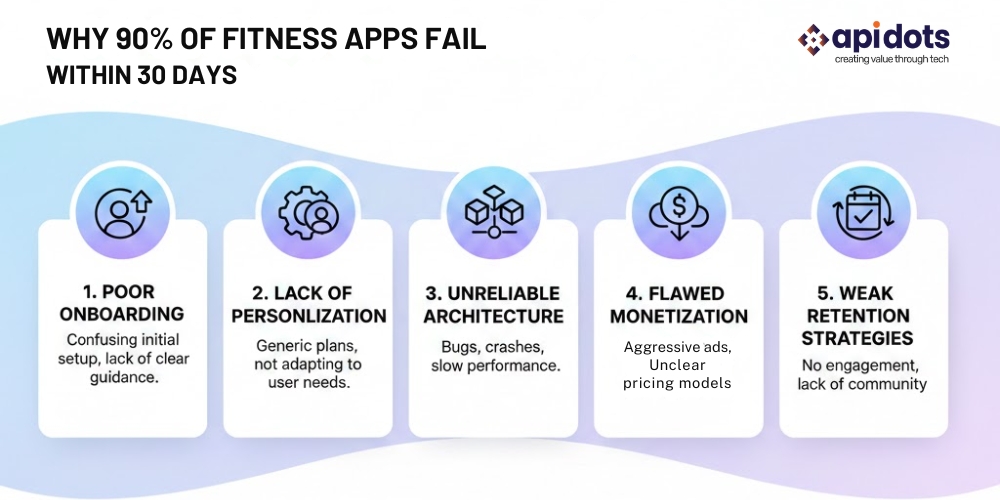
Despite more than 400 million fitness app downloads globally, nearly 90% of users abandon fitness apps within 30 days. This disconnect between demand and retention defines modern fitness app development. The market is large, but loyalty is fragile.
Across Europe and the Middle East, digital wellness adoption continues to accelerate, driven by wearables, rising health awareness, and post-pandemic behavior shifts. Yet most AI fitness apps fail to convert this momentum into sustainable businesses. From experience working on fitness and health platforms at APIDOTS, this is rarely a problem of ideas. It is almost always caused by weak execution across onboarding, personalization logic, data architecture, and scalability.
This guide breaks down why fitness apps fail at a product and technical level, and how to build personalised fitness apps that retain users and scale long-term.
Key Takeaways
The first three minutes decide whether a user stays or deletes the app. Most fitness apps fail at onboarding by demanding effort before delivering value. This creates immediate friction and erodes trust.
From a technical perspective, this is not just a UX issue. It is a data sequencing problem. Apps often request permissions, require long questionnaires, and set detailed goals before demonstrating their usefulness. Successful AI workout app development reverses this flow by delivering visible progress first and gradually enriching user profiles.
Common onboarding mistakes include:
Winning apps use progressive profiling, pre-generated starter plans, and asynchronous background sync. Users feel momentum before they feel configuration fatigue.
Most fitness apps look different on the surface but behave identically underneath. Calorie tracking, static workout libraries, and generic “AI routines” dominate app stores. If a product cannot immediately explain why it is more valuable than MyFitnessPal or Samsung Health, it becomes invisible on arrival.
Successful AI fitness apps differentiate at the level of logic and data. They are built for a clearly defined audience and reflect that focus across product decisions, content, and coaching logic. read more…..
Meaningful differentiation often appears in:
This type of differentiation must be designed into the system early. It cannot be bolted on after launch.
Many fitness apps fail quietly after initial traction because their technical foundations cannot support growth. MVPs are often built without considering real-time data ingestion, wearable sync, or media-heavy workout experiences.
Common technical breakdowns include slow APIs, monolithic backends, missing caching layers, and fragile integrations. These issues are amplified in regions with bandwidth constraints or multi-language requirements.
In fitness platforms built by APIDOTS, scalability is planned from the first sprint. This typically includes event-driven wearable pipelines, background workers for high-frequency sync tasks, Redis-backed caching for user metrics, and CDN-based delivery for workout media to ensure consistent performance across regions.
Without this level of planning, crashes, sync errors, and negative reviews become inevitable.
Retention alone does not create a business. Many fitness apps launch without a monetization model that reflects how users actually pay. Some give away too much for free. Others hide value behind confusing subscription tiers.
Effective monetization is part of product architecture, not an afterthought. Pricing must align with perceived value and regional purchasing behavior.
Common monetization layers include:
Planning to build a scalable AI fitness platform? APIDOTS product and engineering team can help you design for retention from day one
Stop building generic fitness apps. Build transformation-focused products. Clear positioning influences everything from onboarding flows to AI decision logic.
Before development begins, founders must define who the app is for and what outcome it delivers. Narrow positioning increases relevance, reduces acquisition costs, and improves retention.
Strong examples include strength training for busy professionals in Dubai, weight-loss support for women over 35 in Europe, or data-driven endurance coaching for marathon runners.
Modern users expect personalised fitness apps that adapt continuously. Personalization should not be limited to UI recommendations. It must be embedded into the system’s core logic.
High-quality personalization combines biometric data, behavioral signals, contextual inputs, and wearable feedback loops. This requires structured data models, event-driven pipelines, adaptive plan generation, and periodic recalculation jobs.
When personalization is architectural rather than cosmetic, the app behaves like a coach instead of a content library.
Fitness apps are used while users are tired, distracted, or on the move. UX must reduce cognitive effort, not increase it. Clean layouts, readable typography, and mobile-first interactions are essential.
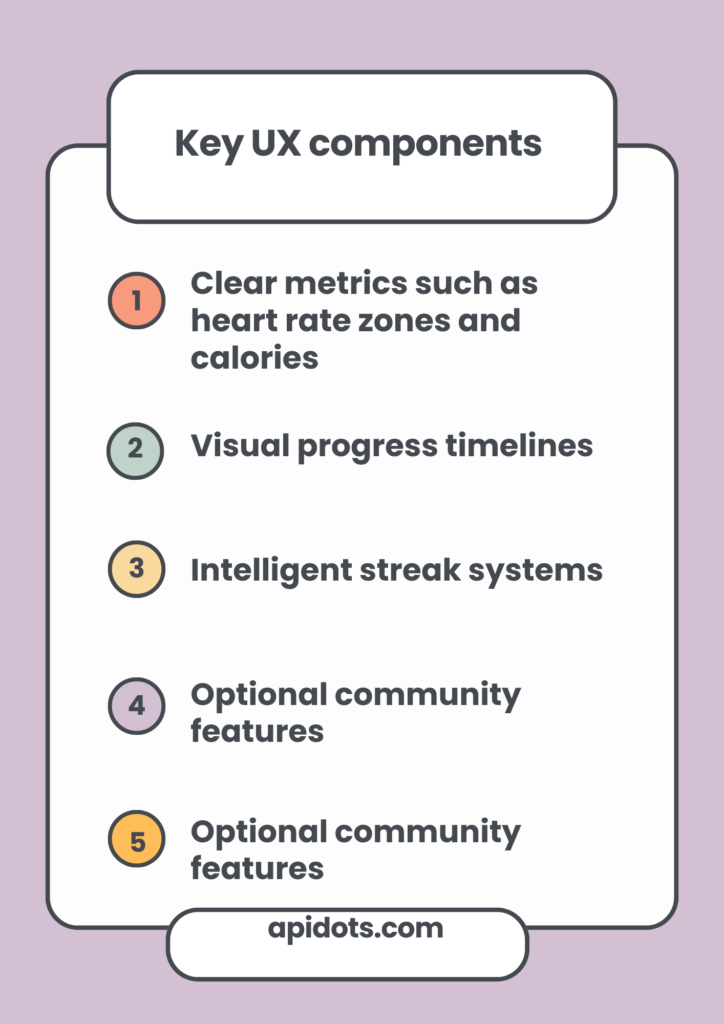
Key UX components include:
No amount of AI compensates for poor usability.
A scalable AI app development stack typically includes Flutter or React Native on the frontend, Node.js, Laravel, or Go on the backend, PostgreSQL with Redis caching, and cloud infrastructure on AWS or GCP.
Performance optimization relies on background workers for wearable sync, CDN-backed media delivery, serverless functions for high-frequency events, and aggressive caching of user stats. This foundation allows new AI features and integrations to be added without architectural friction.
Modern fitness apps are expected to track steps, calories, heart rate, sleep, workouts, and adherence to goals. Advanced platforms translate this data into insights, including HRV trends, recovery scores, VO2 max indicators, and weekly performance summaries.
Apps that visualize data clearly and contextually outperform those that simply collect it.
AI should enhance behavior, not exist for marketing optics. High-impact AI use cases include dynamic workout generation, adaptive calorie estimation, habit prediction models, context-aware nudges, and camera-based form analysis.
Low-value implementations such as generic AI chatbots or static “AI-generated” routines quickly erode trust. Users immediately sense when AI lacks real intelligence.
Most fitness apps rely too heavily on paid acquisition. Sustainable growth requires content that educates, supports, and reinforces habit formation.
High-performing content includes localized fitness guides, beginner programs, region-specific nutrition education, and structured challenges. In-app content must reflect European and Middle Eastern dietary patterns and align with user data.
Content builds trust, and trust drives retention.
Pre-launch success often comes from waitlists, closed beta groups, and micro-influencer partnerships. Launch phases perform best when anchored by challenges, limited-time incentives, and fast feedback loops.
Long-term success depends on retention during the first ninety days. Weekly AI-generated summaries, adaptive streak systems, respectful notification logic, and continuous model refinement separate serious platforms from hobby products.
The fitness app market is crowded, but far from closed. Apps that succeed focus on real personalization, scalable architecture, meaningful AI, and long-term retention rather than surface-level features.
Successful fitness app development is not about copying incumbents. It is about solving a clear problem for a defined audience with better execution.
For teams looking to build AI-powered, personalised fitness apps for Europe or the Middle East, APIDOTS brings practical experience across product strategy, UX design, AI systems, and scalable engineering, helping founders move from idea to revenue-ready platforms with fewer execution risks.
What makes AI fitness apps successful?
Strong personalization, clean onboarding, scalable architecture, and retention-focused design.
How much does fitness app development cost?
Typically between $30,000 and $250,000+, depending on features, AI depth, and integrations.
How long does it take to build a fitness app?
An MVP takes 12–16 weeks, while full platforms may require 6–12 months.
Which features are essential?
Tracking, workouts, personalization, clean UX, and a scalable backend.
What tech stack works best?
Flutter or React Native, Node.js, Laravel, or Go, with PostgreSQL and cloud infrastructure.
We develop performance-driven wellness and fitness applications.Enabling integrations, tracking, and user engagement.
Consult Fitness Tech Experts
Hey! I’m Mohsin Khan, Technical Head at apidots.com — the guy who makes sure our projects don’t go off the rails and our developers don’t run away from complex requirements. I started out as a developer myself, so I still love jumping into the code when things get spicy. My day usually includes translating client needs into real solutions, keeping multiple projects on track, and helping the team build solid websites and apps. I’ve led quite a few big projects to the finish line and helped push our growth forward — which is always a great feeling. I’m value accountability, clear communication, and doing the job right the first time. I’ve got a B.E. in Computer Engineering, but I like to think I’ve learned just as much from real-world chaos as I did in college. When I’m not working, you’ll probably find me talking about fitness, nutrition, health tech, or watching football highlights I’ve seen a hundred times. Since I’m obsessed with all things wellness, I also write for our Fitness & Nutrition Tech section — the place where my tech life and fitness life collide.