
Top
Search
People also search for:

Stay Inspired with Instagram




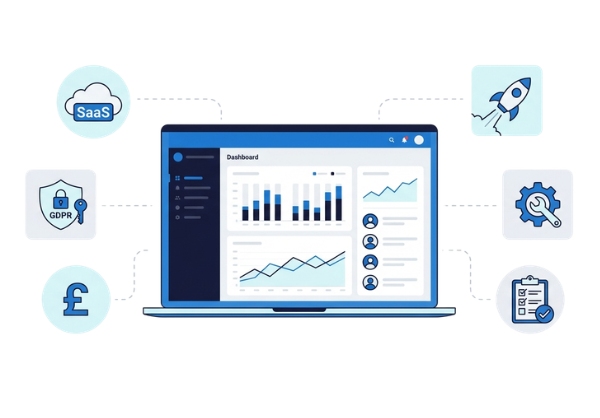
You have been sitting on this idea for months—maybe longer. A platform that solves a real problem. Something people would actually pay for every month. You can picture the product. You just cannot picture how to build it.
You have probably Googled agencies, looked at freelancers, and got quotes that felt either too vague or too expensive. Maybe someone promised you the world and disappeared. That frustration is real and incredibly common.
This guide is not a sales brochure. It is a plain-English walkthrough of SaaS development services in the UK—what it means, what it costs, how the process works, and what separates a team that delivers from one that does not.
By the end, you will know exactly what questions to ask, what red flags to watch for, and what a realistic path forward looks like — whether you choose APIDOTS or anyone else.
SaaS stands for Software as a Service. But that phrase does not tell you much.
Here is a better way to think about it: SaaS is software you subscribe to and use through a browser. No downloads. No installation. You log in, use the tool, and log out. Xero for accounting, Calendly for bookings, Notion for notes — all SaaS.
SaaS development is the process of building one of these products. It includes designing the interface, writing the code, setting up secure servers, building billing systems, and keeping everything running after launch. For a complete breakdown of what this process involves from concept to deployment, our guide on what is SaaS application development covers the full technical and business scope in plain language.
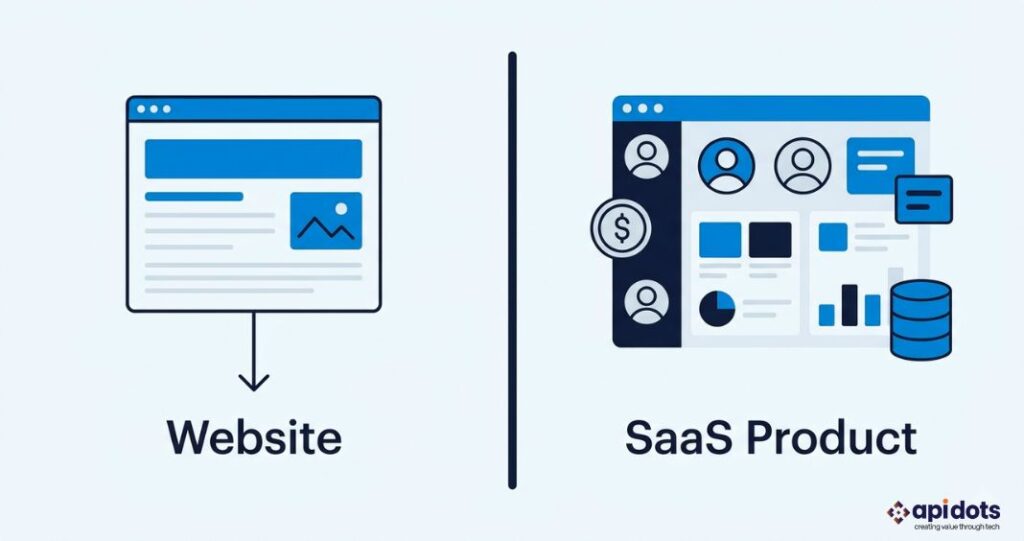
Here is what most people get wrong: they think building a SaaS product is just “a website with a login.” It is not. A website shows information. A SaaS product processes data, manages multiple users with different permissions; handles recurring payments, and scales as your customer base grows. The complexity is in a different league entirely.
| ✅ Key Takeaway SaaS development is not web design. It is building live, multi-user software infrastructure that has to work reliably for paying customers—every single day. |
The honest answer is not just “because SaaS is popular.” There are specific reasons why this moment in the UK market makes SaaS development a smart move — and one honest reason why it might not be right for you yet.
If your idea still needs heavy validation, you might not need a full SaaS build yet. A simple landing page and a waiting list can tell you a lot before you spend £30,000. Build conviction before you build software.
The UK is the second-largest SaaS market in the world after the US. Here is what that means practically for a founder like you:
What does this mean for you? There is a proven market, existing talent, and investor appetite. Competition is also real. The opportunity is there, but execution matters more than ever. Understanding the latest SaaS trends including AI verticalization and hyper-personalization gives UK founders a clearer picture of where the market is heading and which product directions have the strongest commercial momentum right now.
Most feature lists read like a developer spec sheet. This one is written for you, not your future CTO.
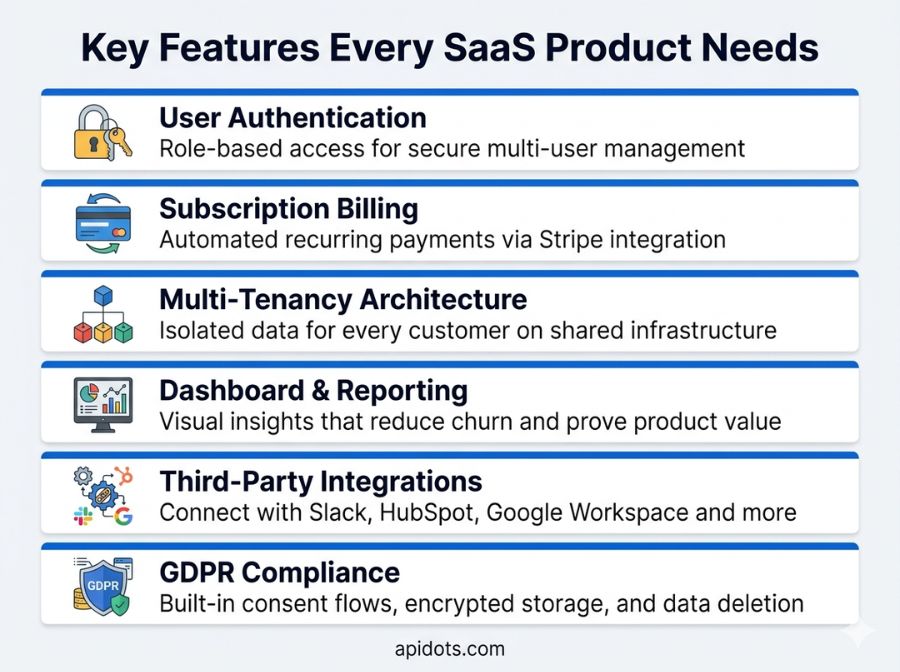
Every user needs their own login. Admins need different permissions than regular users. Without this, you cannot sell to businesses — and most paying SaaS customers are businesses.
Your revenue model lives here. Recurring billing, trial periods, plan upgrades, and cancellations must happen automatically. Manual invoicing at scale is unsustainable. Tools like Stripe handle this — but it has to be properly integrated, not bolted on. Choosing the right SaaS monetization and pricing model from the start directly determines how predictably your revenue scales — and how easily you can experiment with tiers, trials, and upgrades without rebuilding your billing system.
Many different customers share the same platform, but their data is completely isolated. This is what makes SaaS cost-efficient to run. Without it, you are managing a separate system per customer — which breaks quickly. Understanding multi-tenant vs. single-tenant SaaS architecture early in your planning process is one of the most important technical decisions you will make as a founder.
Your users need to see what your product is doing for them. Clear dashboards reduce churn. When users can see value, they stay. This is not a nice-to-have — it is a retention tool.
Your SaaS will sit inside your customers’ wider toolset. If it does not connect to Slack, HubSpot, Google Workspace, or their existing CRM, you will lose deals. Plan integrations from day one, not as an afterthought.
In the UK, this is not optional. You need consent flows, data deletion capabilities, encrypted storage, and a compliant privacy policy. A good UK development team builds this in from the start. For founders building data-heavy platforms, understanding data security and compliance in SaaS is essential groundwork before a single line of code is written.
This is one of the most important decisions you will make—and most early founders do not think about it clearly.
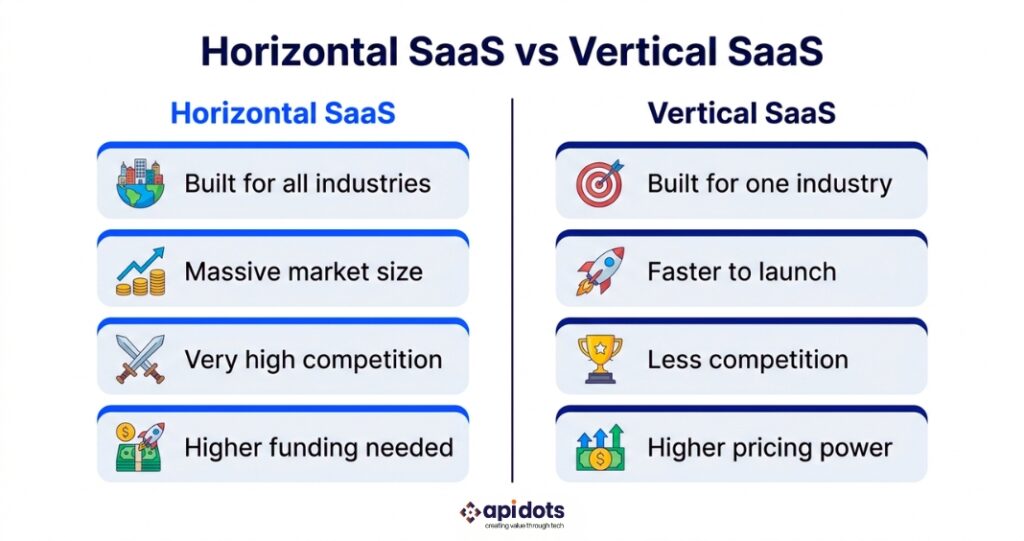
Built for everyone, regardless of industry. Project management, HR tools, video conferencing. The market is huge. So is the competition. You are going up against companies that have raised hundreds of millions.
UK examples: Revolut (fintech for all), Notion (productivity for everyone).
Built for one specific industry or job role. A CRM only for independent mortgage brokers. Scheduling software only for NHS-approved physios. It sounds limiting — but it is actually a strategic advantage.
UK examples: Clio (legal practice management), Healthcode (private healthcare billing).
The counterintuitive truth: going narrow is usually faster and cheaper. You need fewer features because your users have very specific needs. You can charge more because you solve a precise problem. And word-of-mouth travels fast in tight professional communities.
| ✅ Key Takeaway If you are a first-time founder in the UK, build vertical. Pick an industry you know, find the most painful workflow, and own it. Expand later. |
You could hire a team from anywhere. Some do great work. But here is what specifically matters when you are building for UK users and the UK market:
Most agencies show you a clean diagram with five happy arrows. Here is what actually happens — and what a good team does to keep it on track.
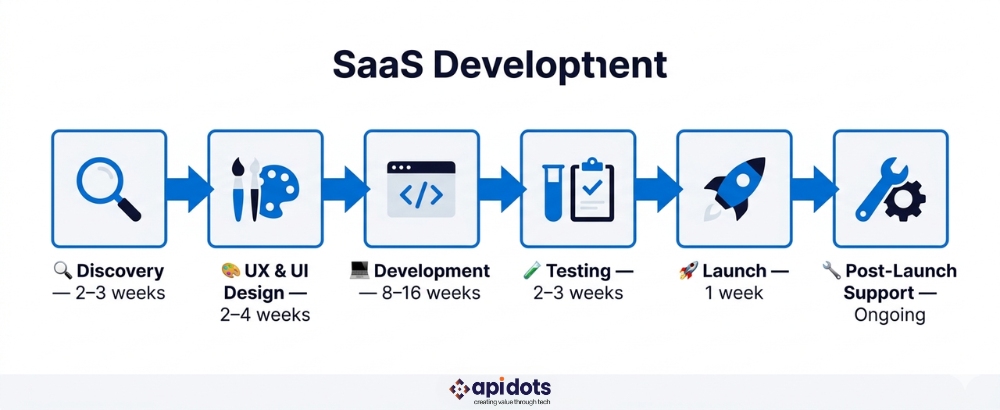
| ✅ Key Takeaway The process itself is not magic. What separates good teams from bad is communication at every stage—and the willingness to flag problems early, not hide them. |
Every agency right now will tell you to “add AI to your product.” Most of that is noise. Here are AI features that are proven, practical, and likely to increase your retention or revenue — plus who each one is best suited for.
Users describe what they want in plain language instead of building complex filters. Best for: any SaaS with large datasets — property platforms, job boards, CRMs, or inventory tools.
The user fills in a few fields. The AI produces a full contract, proposal, or report. Best for: legal tech, HR software, consulting tools, or anything involving repetitive document creation.
Instead of static email reminders, the system learns when a user is likely to take action and sends the right message at the right moment. Best for: subscription products where churn prevention matters most.
A chat interface that answers questions about the user’s own data. Best for: analytics platforms, financial tools, or any product where users regularly ask, “What does this actually mean?” For a deeper look at how AI integration works inside modern SaaS platforms, our guide on AI and machine learning in SaaS applications covers the practical use cases, architecture considerations, and what actually drives retention versus what is just hype.
It depends on scope—but here are realistic ranges with context so you know what drives the numbers.
Core features only. One user type. Basic billing. Enough to test your idea with real paying users. Timeline: 3–5 months. The right starting point for most UK founders. Understanding how to build a scalable SaaS MVP before you begin ensures your early build is lean enough to validate fast but architected well enough to scale without a full rebuild.
Multiple user roles, full billing, integrations, dashboards, and an admin panel. Ready for a proper commercial launch and investor conversations. Timeline: 6–10 months.
High security requirements, regulated industries (health, finance, legal), large user volumes, custom infrastructure. Timeline: 10–18 months.
The single most common budgeting mistake: spending the entire budget on the build with nothing left for launch, marketing, or post-launch fixes. Reserve at least 20% of your total budget for after go-live.
| ✅ Key Takeaway Start with an MVP. Spend £20–40K to learn what your users actually want. Then spend the bigger budget on a product you know people will pay for. |
These are real patterns — not generic warnings. Each one has ended promising products.
A UK founder spent 11 months and £80,000 building every feature they had imagined. Launched to 12 users. None of them used 80% of the product. Start with the one workflow your users cannot live without.
A cheaper team almost always means more of your own time managing confusion, fixing poor work, and eventually hiring a second team to rebuild. The true cost ends up higher than if you had paid properly the first time.
You are not your user. What feels obvious to you may be completely counterintuitive to someone without your background. Three hours of user interviews before build saves weeks of rebuilding after.
A product that handles personal data needs a Data Processing Agreement, compliant privacy policy, and proper consent flows. Bolting these on at the end is expensive and messy. Build them in from day one.
You launch. Users sign up. A critical bug appears at 9pm on a Friday. If your development team is unreachable, your product is offline and your early customers are walking away. Confirm support arrangements before you sign anything.
Launch is the beginning of the feedback loop. The best SaaS products improve every month because the team listens to users and ships updates continuously. Plan for ongoing development from day one.
The difference is simple: a vendor builds what you specify. A partner tells you when what you specified is the wrong thing to build.
These are the questions you should ask every agency—including APIDOTS:
| A team that answers these questions clearly and honestly is worth trusting. A team that deflects, over-sells, or gets defensive is worth avoiding—regardless of how polished their website looks. |
We are not going to tell you we are the best SaaS development company in the UK. You should decide that after talking to us.
Here is what we can tell you honestly:
We have helped UK founders in legal tech, HR, healthcare, education, and professional services go from idea to live product. Some have raised seed funding. Some have bootstrapped to six-figure ARR.
We are not the right fit for every project. But if you want an honest conversation about yours, we are happy to have it.
| “APIDOTS felt like a co-founder who actually understood the technical side. They told us when our original idea needed rethinking — and that honesty saved us from building the wrong thing.” — UK SaaS Founder, HR Tech |
Q1: How long does it take to go from idea to a live SaaS product?
A focused MVP typically takes 3–5 months. A full version 1 product usually takes 6–10 months. The biggest variable is not the development itself — it is how quickly decisions get made on your side. Teams that come to projects with clear answers move much faster.
Q2: Do I need to know how to code to work with a SaaS development team?
Not at all. Your job is to know your users, your market, and the problem you are solving. A good development partner handles all the technical decisions and explains the relevant ones in plain language. If a team makes you feel like you need a CS degree to hold a conversation with them, find a different team.
Q3: What is the difference between custom SaaS development in the UK and using a no-code tool like Bubble?
No-code tools are useful for early validation. If you want to test an idea cheaply before committing, they can work. But they have hard limits—performance, customisation, and scalability all become problems as you grow. Custom SaaS development gives you a product you fully own, with no platform dependency and no ceiling on what you can build.
Q4: Will my product handle GDPR automatically?
Not automatically — but it should be built to comply from the start. This means consent flows, data deletion capabilities, encrypted storage, and a clear privacy policy. Any UK SaaS development company worth hiring treats GDPR as a standard part of the build, not a bolt-on.
Q5: What happens if I want to add features after launch?
This is completely normal. Most SaaS products ship a focused MVP, then add features based on real user feedback. A good development partner builds your codebase in a way that makes future changes clean and affordable — not tangled and expensive. Always ask about post-launch flexibility before you sign.
Q6: How do I know if my SaaS idea is viable before I build it?
Talk to ten people who would be your users — not friends or family, but actual potential customers. If at least three say they would pay for it and explain why their current solution is inadequate, you have enough signal to move forward. A landing page with a waitlist signup is also a fast, cheap way to test demand before a single line of code is written.
You do not need to have everything figured out. You do not need a detailed spec or a technical background. All you need is a clear problem you want to solve and a rough sense of who would pay you to solve it.
APIDOTS offers a free 30-minute clarity call—not a sales call. We will listen to your idea, tell you honestly where we see risks or opportunities, and give you a realistic picture of what building it would involve.
If we are the right fit, great. If we are not, we will tell you that too. No pressure either way.
| Still figuring out if SaaS is right for you?Book a free 30-minute clarity call with APIDOTS. No pitch. No pressure. Just honest answers.→ www.apidots.com/discovery-call |
We manage and optimize your IT infrastructure end-to-end.Ensuring stability, security, and operational continuity.
Consult IT Experts