
Top
Search
People also search for:

Stay Inspired with Instagram




Here is a situation that plays out regularly across Bristol right now. A business owner — running a growing logistics company in Avonmouth, a FinTech startup in Temple Quarter, or a professional services firm in Clifton — realises their current software is slowing them down. The spreadsheets are too fragile. The off-the-shelf tools do not quite fit. The manual processes are costing real money every week.
The solution most of them are moving towards is SaaS development. But here is the problem: most of them do not fully understand what SaaS development actually involves, what it costs in Bristol specifically, or how to choose a partner who will not take six months and a significant budget to deliver something that still does not work properly.
This blog is written specifically for Bristol business owners, founders, and product leads who want to understand SaaS development from the ground up — not the version that gets repeated across a thousand generic agency blogs, but the version that reflects what is actually happening in Bristol’s economy right now, what the real traps are, and what genuinely good SaaS development looks like in practice.
For the broader UK picture, the SaaS Development Services UK pillar guide covers architecture, market sizing, and delivery models across the country. This blog is the Bristol-specific layer on top of that foundation.
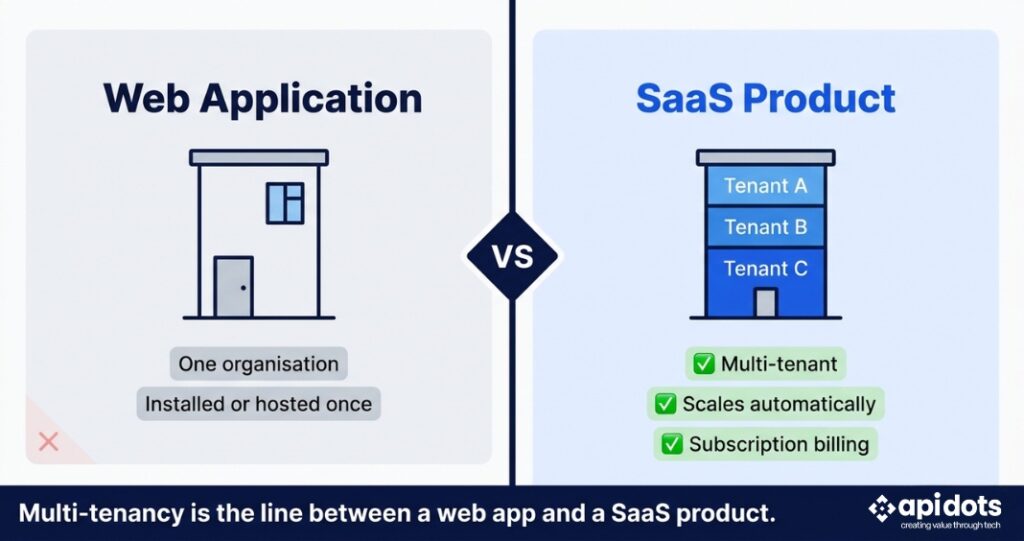
SaaS stands for Software as a Service. The definition is simple: cloud-hosted software that users access through a browser or app, updated centrally, and billed on a subscription basis. Xero, Slack, Salesforce — all SaaS. You do not install them. You log in and pay monthly.
But the definition is where the simple part ends. Here is what most introductions to SaaS leave out:
The subscription model is not just a billing mechanism — it is a product design constraint. Every feature decision must be evaluated against whether it serves retention, reduces churn, and justifies renewal. SaaS products that are built like one-off software projects almost always underperform on these metrics.
API DOTS’ approach to SaaS development is built around these distinctions. Our
SaaS development services are not a generic ‘build anything’ offering — they are specifically designed for cloud-native, multi-tenant, subscription-billed products that Bristol businesses can actually sell and scale.
Bristol’s tech ecosystem has a characteristic that most other UK cities lack: it has two fundamentally different economies operating in parallel, and they create two fundamentally different kinds of SaaS demand.
Airbus, Rolls-Royce, Leonardo, GKN Aerospace, and their enormous supply chains employ tens of thousands of people in and around Bristol. These organisations buy software differently from startups. They have procurement frameworks, information security requirements, and in many cases, ITAR obligations—the International Traffic in Arms Regulations—which place strict controls on who can access software that touches defense and aerospace data.
SaaS products targeting this market need to understand things that most agency briefing decks never mention: data residency requirements (where is the data physically stored?), role-based access at a granularity that goes beyond admin and user, audit logging that satisfies internal compliance teams, and in some cases, UK-only hosting as a contractual requirement.
This is a domain most Bristol agencies do not have genuine experience in. API DOTS’ team has delivered for clients in regulated, enterprise-adjacent environments — and the architecture decisions we make in week one of a project reflect that experience.
Underneath the enterprise layer, Bristol has a thriving independent tech community — FinTech startups in Finzels Reach, HealthTech businesses emerging from the University of Bristol’s innovation programs, creative tech companies in the Stokes Croft and Bedminster corridor, and a growing cluster of sustainability-focused SaaS businesses that reflect Bristol’s strong environmental identity.
These businesses have completely different SaaS requirements. Speed to market matters enormously. Budgets are tighter. The MVP has to be genuinely lean without being so stripped-back that it cannot demonstrate real value to early customers. And the founding teams often need a development partner who can function as a de facto technical co-founder for the first 12 months — not just a build agency that disappears at go-live.
This is exactly the kind of engagement API DOTS is built for. Our MVP development services are designed for Bristol founders who need to move fast, validate early, and build architecture that does not collapse under the weight of their first 100 customers.
Most SaaS development guides for Bristol mention the city’s tech ecosystem in passing. None of them talk about Temple Quarter specifically — which is a significant omission, because Temple Quarter is the most important piece of infrastructure context for any Bristol business considering a SaaS investment in the next three years.
Temple Quarter Enterprise Zone is a 130-hectare regeneration project centred on Temple Meads station — the largest city-centre regeneration project in the UK outside London. The University of Bristol’s new Temple Quarter Campus (opening in phases from 2026), alongside planned commercial development, transport improvements, and innovation infrastructure, is expected to add 22,000 jobs and £1.6 billion in economic output to Bristol over the next decade.
For SaaS businesses, this matters for three specific reasons:
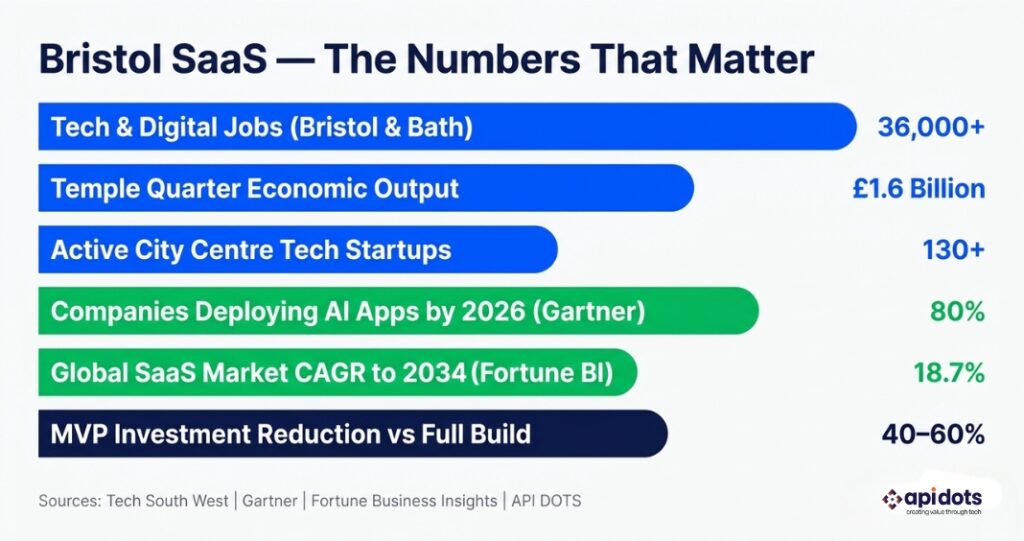
These are not national statistics dressed in Bristol colours. These are figures that specifically reflect the Bristol technology economy and SaaS market context:
| Stat | What It Means for Bristol SaaS |
| 36,000+ | Tech and digital economy jobs in Bristol and Bath — the talent pool that powers local SaaS development without requiring London salaries. |
| £1.6B | Projected economic output from Temple Quarter alone over the next decade — creating enterprise buyer demand for vertical SaaS across every sector. |
| 130+ | Active tech startups within 2 miles of Bristol city centre, many building or commissioning SaaS products for the first time. |
| 80% | Percentage of companies expected to have deployed AI-enabled applications by 2026, per Gartner — making AI-readiness a commercial requirement, not a nice-to-have. (Source: Gartner) |
| 18.7% | Global SaaS market CAGR through 2034, per Fortune Business Insights — Bristol businesses that build now are entering a structurally growing market. (Source: Fortune Business Insights) |
| 40–60% | Typical reduction in initial investment when starting with a properly scoped MVP versus a full product build. |
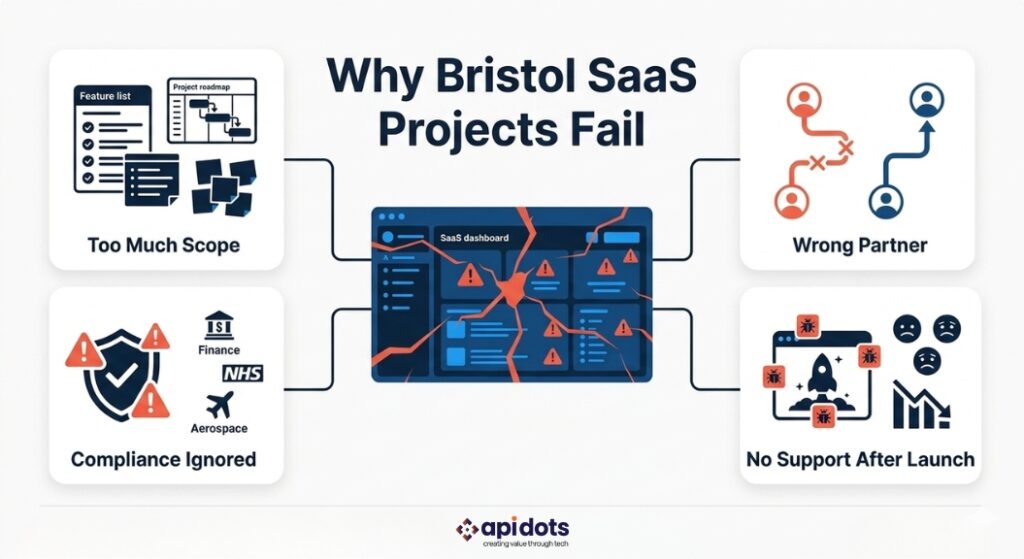
After running discovery sessions with dozens of Bristol businesses, API DOTS has identified a consistent set of mistakes that appear in almost every failed or overbudget SaaS project. These are not opinions — they are patterns.
The most expensive phrase in SaaS development is: ‘We need all of this by the launch date.’ When Bristol businesses arrive with a fixed 40-feature spec, they are usually describing a solution they have imagined, not a problem they have validated. A properly run discovery process will typically reduce that spec by 50% — not because features are being removed, but because the features that actually matter are being identified. The others are deferred, not deleted.
Bristol’s agency market, like London’s, has a well-documented low-quote problem: agencies win projects by quoting low and then managing scope upwards through the engagement. The day rate tells you almost nothing about the total cost of delivery. A £400/day developer who takes 200 days to ship costs £80,000. A £700/day developer who takes 70 days costs £49,000 and delivers something maintainable. Our guide on custom software development costs explains how to evaluate total project cost rather than day rate.
Bristol’s economic mix creates compliance requirements that most generic SaaS development companies are not prepared for. FinTech products need FCA-aligned architecture. HealthTech products touching NHS data need DSP Toolkit compliance. Aerospace-adjacent SaaS may require ITAR consideration. GDPR is the baseline everywhere — but it is the starting point, not the finish line. API DOTS’ data security and compliance approach treats these as architectural requirements, not afterthoughts.
The majority of SaaS projects in Bristol that stall do so not during the build — but in the 90 days after launch. This is when real users interact with the product in ways the spec never anticipated, when performance bottlenecks emerge under actual traffic, and when the feature requests from early customers start arriving. A development partner who does not have a structured post-launch support model is leaving you exposed at the moment you are most vulnerable.
| Is your SaaS project scoped correctly before the build starts?API DOTS runs a free 30-minute discovery session for Bristol businesses — no sales pressure, just an honest assessment of your product, your spec, and the risks nobody else has flagged yet. Book Your Free Discovery Call → |
Most development companies describe their process in terms of phases. We describe ours in terms of decisions—because the decisions made in the first three weeks of a SaaS project determine 80% of the outcomes in the following 12 months.
Decision 1: What is the riskiest assumption in this product?
Before any design work begins, API DOTS runs a structured discovery sprint. The goal is not to validate the spec — it is to identify the single assumption that, if wrong, would make the entire product worthless. We build the MVP around testing that assumption first. Everything else is deferred until the assumption is proven.
This is why our MVP development process consistently delivers working products in 8–12 weeks rather than the 6–9 months most Bristol clients have been quoted elsewhere. Scope discipline is not the same as cutting corners. It is the difference between building the right product and building all the wrong features very thoroughly.
Decision 2: What does multi-tenancy look like for this specific product?
Multi-tenancy is not a single architectural pattern — it is a family of approaches that range from shared databases with tenant identifiers through to fully isolated per-tenant infrastructure. The right choice depends on your compliance requirements, your pricing model, and your target customer size. API DOTS makes this decision explicitly during the technical design phase and documents the trade-offs clearly so Bristol clients understand why the architecture is built the way it is.
Decision 3: Which cloud infrastructure is right — and who owns it?
AWS, Azure, and Google Cloud Platform all have different pricing models, support structures, and regional data residency options. For Bristol businesses in regulated sectors, the choice of cloud provider and hosting region can be a contractual requirement, not just a technical preference. API DOTS’ cloud services team makes this decision with the client — not for them — and ensures the infrastructure is owned and accessible by the client from day one. You should never be locked out of your own cloud account.
Decision 4: What does AI-readiness mean for this product right now?
According to Gartner, over 80% of enterprises expect to have deployed AI-enabled applications by 2026 — up from 5% in 2023. For Bristol SaaS businesses, this means AI readiness is increasingly a procurement question, not just a product vision. API DOTS’ AI and ML development team embeds the data architecture and API design decisions that make AI integration genuinely straightforward — rather than the expensive retrofit that most products require when AI is bolted on after launch.
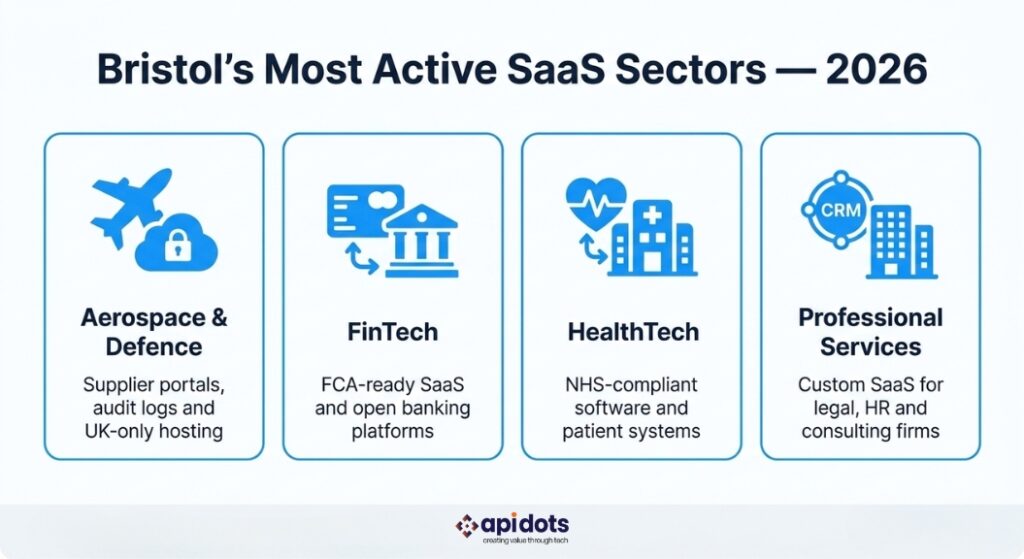
Bristol’s FinTech cluster — concentrated around Finzels Reach and the wider Temple Quarter area — is producing a growing number of B2B payment, compliance, and open banking SaaS businesses. Products in this sector need FCA-aware architecture, full audit logging at the transaction level, and data encryption that satisfies enterprise procurement requirements. API DOTS’ FinTech app development capability is built for these requirements without the post-launch remediation most FinTech founders end up paying for.
Bristol is home to major NHS trust infrastructure, a significant life sciences community at Emersons Green, and the University of Bristol’s health research programmes. HealthTech SaaS in this environment requires DSP Toolkit compliance, integration with NHS systems including EMIS and SystmOne, and data residency within UK borders. API DOTS’ healthcare software development team has direct experience navigating NHS procurement frameworks — which saves Bristol HealthTech founders months of compliance discovery.
This is the sector most Bristol SaaS development companies avoid mentioning — because most of them have no experience in it. Airbus and Rolls-Royce supply chains in Bristol need SaaS tools for supplier qualification, quality management, and project documentation. These products carry compliance requirements — ITAR consideration, UK-only data hosting, role-based access at a granularity that commercial platforms rarely support — that require explicit architectural decisions from day one.
Bristol’s strong professional services community — legal, accountancy, consulting, and HR — is actively commissioning SaaS to replace generic tools that do not fit their specific workflows. Our custom CRM development and eCommerce development services give Bristol businesses a starting point that is built around their actual client management and revenue workflows — not the average of every industry Salesforce has ever tried to serve.
API DOTS is a specialist SaaS and product development company. We do not build websites, brochures, or general web applications. We build cloud-native, multi-tenant SaaS products — for UK businesses that want something that scales.
Here is what Bristol clients consistently tell us separates API DOTS from the agencies they spoke to before:
Explore our full range of services or read our SaaS product development guide for a detailed breakdown of how we take Bristol businesses from concept to launch. For businesses planning to productise an existing workflow into a SaaS model, our go-to-market strategy for SaaS covers the commercial decisions that sit alongside the technical ones.
| Ready to build your SaaS product in Bristol?Talk to API DOTS — the team that scopes honestly, builds for scale, and stays with you after launch. Free 30-minute discovery call for Bristol businesses. Contact Our Team Today → |
What is the difference between SaaS development and building a regular website?
A website delivers content to visitors. A SaaS product is a functional cloud application that users log into, interact with, and pay to access on a subscription basis. SaaS products require user authentication, multi-tenant data isolation, subscription billing, role-based access controls, and cloud infrastructure that scales — none of which are standard components of a website build. The two are fundamentally different in scope, architecture, and ongoing maintenance requirements.
Why does Bristol’s aerospace sector create different SaaS requirements than other industries?
Aerospace and defence-adjacent businesses in Bristol operate under compliance frameworks that most SaaS development companies are not familiar with. ITAR — the International Traffic in Arms Regulations — places restrictions on who can access software that touches controlled defence data. Additionally, enterprise contracts with Airbus, Rolls-Royce, and their supply chains frequently require UK-only data hosting, specific audit logging standards, and security certifications that must be designed in from the start, not retrofitted.
How long does SaaS development take in Bristol with API DOTS?
A focused MVP takes 8–12 weeks from kick-off to launch. A version 1 full product takes 5–9 months depending on complexity, integrations, and compliance requirements. The single biggest variable in timeline is scope — businesses that arrive with a clear, challenged, and validated set of requirements consistently launch faster than those who lock a large feature list before discovery.
What is Temple Quarter and why does it matter for Bristol SaaS businesses?
Temple Quarter Enterprise Zone is the largest city-centre regeneration project in the UK outside London. Centred on Temple Meads station, it is expected to add 22,000 jobs and £1.6 billion in economic output to Bristol over the next decade. For SaaS businesses, it represents a concentration of incoming enterprise buyers — exactly the organisations that purchase B2B SaaS on multi-year contracts. Bristol businesses with working SaaS products in market before the demand peak are well-positioned to capture that opportunity.
How does API DOTS handle GDPR compliance for Bristol SaaS products?
GDPR compliance is built into every API DOTS engagement as a standard component, not an optional add-on. This includes data architecture design, consent flow implementation, role-based access controls, encrypted storage, data deletion workflows, and audit logging. For Bristol clients in regulated sectors — FinTech, HealthTech, or aerospace-adjacent — we apply the sector-specific compliance layer on top of that GDPR baseline during the technical design phase.
We manage and optimize your IT infrastructure end-to-end.Ensuring stability, security, and operational continuity.
Consult IT Experts
I’m a digital marketer with experience in SEO, content strategy, and online brand growth. I specialize in creating optimized content, improving website rankings, building high-quality backlinks, and driving traffic through effective digital marketing strategies. I enjoy helping businesses strengthen their online presence and turn visitors into customers.