
Top
Search
People also search for:

Stay Inspired with Instagram




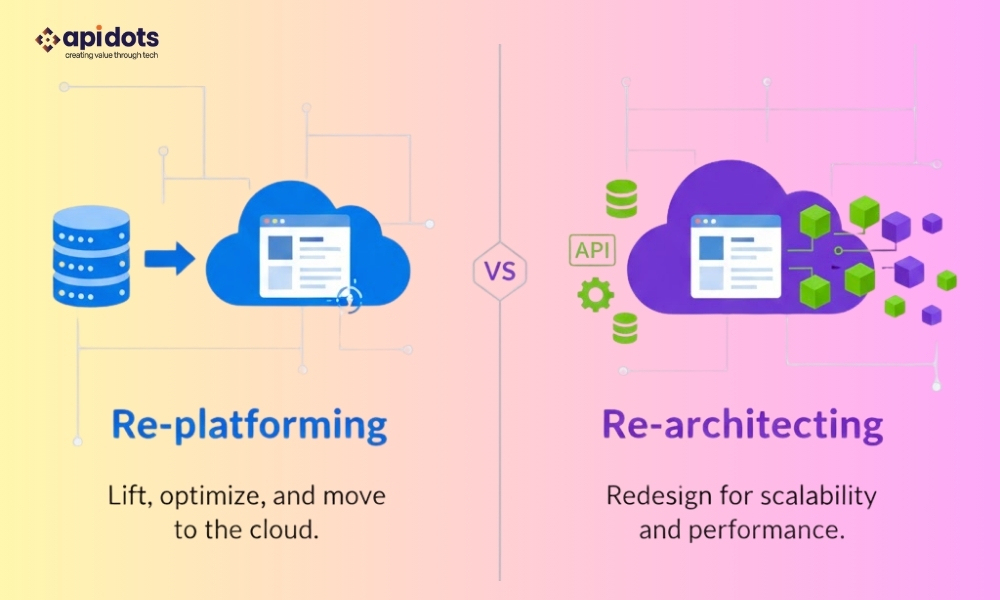
Modernizing legacy software isn’t just a technical update — it’s a business imperative for any organization aiming to stay competitive, secure, and agile in today’s digital economy. Understanding the legacy application modernization benefits early in your planning process can help teams avoid costly delays and misaligned investments. Legacy systems often slow innovation, increase maintenance costs, and expose companies to security and compliance risks.
Two core modernization paths dominate enterprise strategies today: replatforming and rearchitecting. Both aim to rejuvenate aging applications but take very different routes—one accelerates cloud adoption with minimal code changes, and the other transforms the application from the inside out to unlock long-term agility. In this article, we break down these approaches, compare their impacts, and help you choose the right path based on your business goals.
You’ll also learn how to balance speed, cost, and future growth while lowering technical risk.
Re-platforming means you change where and how an application runs, without rewriting its core logic. Think of moving a Java monolith from on-prem virtual machines to a managed container service — a process closely related to VMs to containers migration strategies that many enterprises are actively adopting. You upgrade the JDK, replace an old SQL engine with a managed cloud database, and add a CDN in front of static assets. The app’s codebase remains largely intact. The engineering effort is focused on runtime, middleware, and operational modernization.
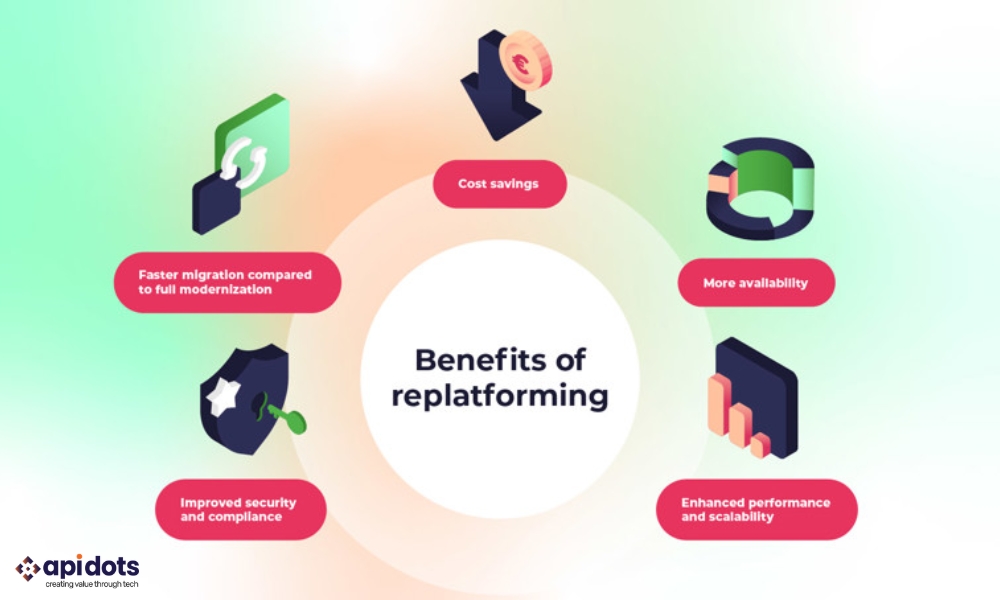
Choosing re-platforming is a strategic move towards gaining all the cloud benefits like scaling, managed services, and better SLAs. Moreover, the initial cost is low, and it’s really good for applications with a stable business logic. But there are some cons, too, with regard to re-platforming. It is unable to fix architectural issues like tight coupling, hard-coded dependencies, or some security or design discrepancies.
Cloud providers and migration frameworks explicitly position re-platforming as a mid-path between “lift-and-shift” and full refactor. Their guidance shows re-platforming is effective when you want cloud-native benefits quickly while preserving application behavior.
Re-architecting is bigger than re-platforming. In re-architecting, you analyze components, replace synchronous, tightly coupled modules with services, add event-driven patterns, and reconstruct data stores. It is code-first: you rewrite modules, create API contracts, and more often than not, migrate to microservices, serverless functions or domain-driven designs.
Knowing when to modernize legacy applications is critical before committing to a full re-architecture—teams that jump in without a clear assessment often face budget overruns and scope creep.
Many organizations choose to re-architect because it fixes systemic issues: brittle releases, low developer velocity, poor scale, and constant security gaps. Re-architecting also unlocks agility and lowers long-term maintenance costs. It enables advanced use cases: real-time analytics, auto-scaling customer-facing services, and durable distributed systems. It may also be useful to review some downfalls of re-architecting, so you know what you are getting into.
• Higher upfront costs and more complicated project management.
• Requires engineering expertise, well-defined domain decomposition, and strong test and integration discipline.
• Longer Time to ROI (return on investment), but often larger return over the lifecycle.
Some Industry advisory and managed-services reports highlight re-architecting as the route enterprises take when long-term modernization and product velocity are priorities. For organizations constrained by technical debt and needing structural change, re-architecting is the right engineering strategy.
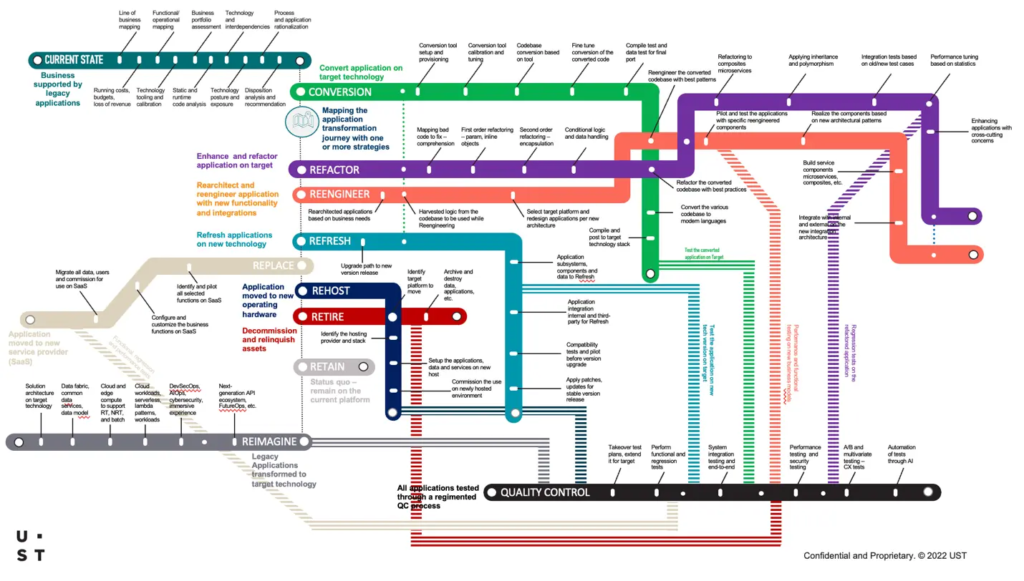
Source of image: The diagram below shows how the RS map against each other.
Re-platforming and Re-architecting are the legacy modernization strategies. Think of them as: speed vs. depth. Re-platforming buys speed. Re-architecting buys depth.
• Scope: Re-platforming is about runtime/middleware changes. While re-architecting is all about code, interfaces, data model, and operational models.
• Risk: Re-platforming reduces operational risk faster; re-architecting reduces long-term technical risk.
• Cost profile: Re-platforming has a lower initial cost; re-architecting has a higher initial cost but potentially greater lifecycle savings.
• Skills: Re-platforming needs cloud and ops expertise, while re-architecting needs architects, domain experts, and test automation maturity.
Many teams follow a two-step approach: first re-platform to quickly gain stability, then re-architect important modules over time. For example, insurers often move to the cloud for compliance and lower costs, and later re-architect key services to speed up innovation. This way, they keep the business running smoothly while making room for long-term improvements.
Planning your legacy modernization roadmap?
Talk to APIDOTS experts to assess whether replatforming or rearchitecting is right for your business goals.
As I said before, and I’ll say it again to emphasize my point: don’t treat modernization as an option anymore; it is as essential as oxygen for survival. Recent reports and collaboratives illustrate just how quickly organizations are moving forward:
1. Modernization is Accelerating
According to Gartner, by 2025, the majority of enterprises will engage in application modernization, indicating not only the pace but the scope of the global modernization shift.
2. AI-driven Modernization
The Konveyor State of Application Modernization Report indicates that more than 75% of organizations are using AI to perform one of three key modernization areas. This directly connects to how agentic AI is reshaping digital transformation — enabling organizations to automate complex refactoring decisions that previously required months of manual analysis. Companies are reporting measurable results in security, reliability, and efficiency after adopting AI-driven modernization practices.
3. Hybridization is trending
Pegasystems’ and AWS’s alliance demonstrates a clear trend: most vendors are combining AI-assisted refactoring with re-platforming but are still reinforcing long-term architectural changes.
There is no one-size-fits-all answer. If your goal is to reduce operating costs and get immediate cloud benefits, re-platforming legacy systems is pragmatic. If you need long-term agility, security, and developer velocity, re-architecting applications is the right investment. Many organizations succeed by combining both: they start with re-platforming to stabilize and lower risk, then iteratively re-architect the most critical services. Modern vendor toolchains and AI can accelerate both paths, but they don’t replace the need for clear architecture and disciplined engineering.
For businesses evaluating their options, working with the right custom software development partner ensures that modernization decisions are grounded in both technical expertise and long-term business strategy. Modern vendor toolchains and AI can accelerate both paths, but they don’t replace the need for clear architecture and disciplined engineering.
Start your legacy application modernization journey with APIDOTS today and unlock scalability, lower costs, and long-term growth.
Modernization decisions define your technology future.
If you’re evaluating replatforming or rearchitecting, APIDOTS can help you design a secure, scalable, and future-ready modernization roadmap.
1. What is the main difference between replatforming and rearchitecting?
Replatforming upgrades infrastructure with minimal code changes, while rearchitecting redesigns the application structure.
2. Is replatforming cheaper than rearchitecting?
Yes, replatforming typically requires lower upfront investment but may not eliminate technical debt.
3. Does rearchitecting require microservices?
Not always, but many rearchitecting initiatives adopt microservices or modular architectures.
4. Can companies combine both approaches?
Yes, many enterprises use phased modernization — replatform first, rearchitect later.
5. Which strategy supports long-term scalability?
Rearchitecting typically provides stronger long-term scalability and agility.
We manage and optimize your IT infrastructure end-to-end.Ensuring stability, security, and operational continuity.
Consult IT Experts
Hi! I’m Aminah Rafaqat, a technical writer, content designer, and editor with an academic background in English Language and Literature. Thanks for taking a moment to get to know me. My work focuses on making complex information clear and accessible for B2B audiences. I’ve written extensively across several industries, including AI, SaaS, e-commerce, digital marketing, fintech, and health & fitness , with AI as the area I explore most deeply. With a foundation in linguistic precision and analytical reading, I bring a blend of technical understanding and strong language skills to every project. Over the years, I’ve collaborated with organizations across different regions, including teams here in the UAE, to create documentation that’s structured, accurate, and genuinely useful. I specialize in technical writing, content design, editing, and producing clear communication across digital and print platforms. At the core of my approach is a simple belief: when information is easy to understand, everything else becomes easier.