
Top
Search
People also search for:

Stay Inspired with Instagram




Real adoption and cost data on when a custom real estate CRM pays off. Also, when buying and configuring one is the smarter call.
Real estate CRM development decisions rarely fail because of bad code. They fail because CTOs pick build or buy before they understand the real cost of each path. A brokerage CRM handles MLS feeds, lead routing, and transaction timelines that generic sales CRMs were never built for.
Off-the-shelf tools promise speed. Custom builds promise control. Both promises come with a bill that shows up later, not at signing.
This guide looks at what CRM adoption data and enterprise software costs actually say about build versus buy. Then it gives CTOs and technical founders a framework to make the call with their own numbers. It skips the vendor pitch deck entirely.
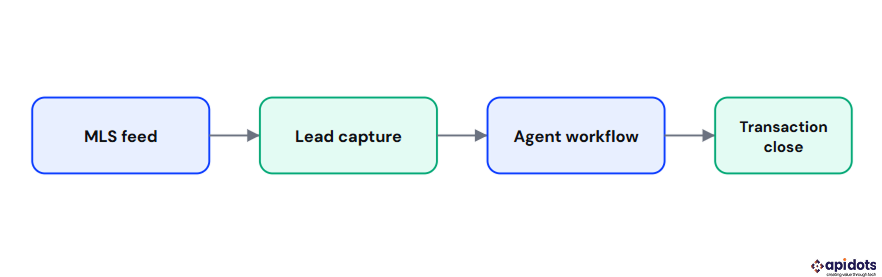
Real estate is not a typical B2B sales motion, so a generic CRM only fits part of the job. Deals branch across buyers, sellers, referrals, and repeat clients who return years later. Agents need lead routing, MLS data, and transaction tracking in one place, not three disconnected tools.
CRM already plays a real role in how agents generate business. The National Association of Realtors 2025 Technology Survey looked at this directly. Agents ranked social media as their top source of quality leads, at 39 percent. CRM ranked second, at 23 percent, ahead of the local MLS at 17 percent. Only 21 percent of agents currently use a CRM with AI-powered insights, leaving real room to differentiate.
That gap matters for CTOs. A CRM that only stores contacts is table stakes. A CRM that scores leads and tracks MLS status changes is a competitive tool. It can also predict which contacts are ready to transact. Off-the-shelf CRMs can approximate this with add-ons. Custom builds can make it the product’s core. Referral tracking adds another layer most generic CRMs handle poorly. A single closed deal in real estate can generate three or four future referrals over several years. A CRM built for real estate should treat that referral chain as a first-class object.
It should not be a note field buried in a contact record. This is a clear signal. Off-the-shelf tools were not designed with this industry’s actual sales cycle in mind. Compliance adds another industry-specific layer. Brokerages must document consent, disclosures, and communication history for fair housing and state licensing rules. A CRM that cannot produce a clean audit trail for these records creates legal exposure, not just inefficiency. This is a requirement general sales CRMs rarely design around from day one.
Buying an off-the-shelf CRM looks cheap on the pricing page. The real cost shows up in customization, integration, and licenses nobody uses.
Real estate teams often pay for seats across agents, admins, and transaction coordinators. Then they customize workflows to match MLS rules the vendor did not anticipate. Each customization adds ongoing maintenance that the vendor does not fully own. The tradeoff is control. You can build a custom CRM around your exact commission structure and MLS feed. It can match your agents’ actual workflow instead of a generic sales pipeline, strengthening long-term customer relationships instead of just logging contact records.
It can also embed the AI-powered lead scoring that only 21 percent of agents currently have access to. That gap is a real differentiation opportunity for a brokerage or PropTech platform willing to build it. Enterprise software waste backs this up. Zylo’s 2025 SaaS Management Index found the average company wastes 21 million dollars a year on unused software licenses. That figure grew 14.2 percent year over year. SaaS spend per employee also grew 21.9 percent to $ 4,830.
These numbers are not real estate specific, but they describe the same pattern brokerages see with generic CRMs. Teams buy licenses for a full sales team. Often only a fraction of seats get used, since agents fall back to spreadsheets or old habits.
Configuration also has a ceiling. Most off-the-shelf CRMs weren’t built around MLS data structures. Brokerages end up building workarounds with Zapier, custom fields, or an entirely separate tool.
| Technology | Reported by Agents |
| Social media (top lead source) | 39% |
| CRM (second highest lead source) | 23% |
| Local MLS | 17% |
| eSignature (most used tool overall) | 79% |
| CRM with AI-powered insights | 21% |
Table: Real estate agent technology usage and lead source. Source: National Association of Realtors, 2025 Realtors Technology Survey. nar. realtor
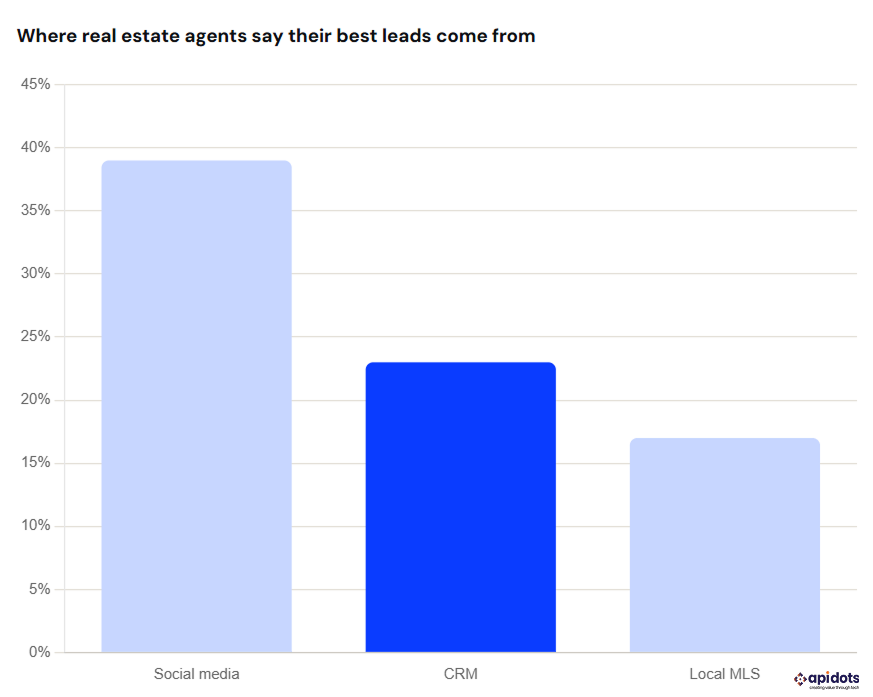
Chart Description: Share of agents citing each channel as their highest quality lead source. Source: National Association of Realtors, 2025 Realtors Technology Survey. nar. realtor
None of this means buying is wrong. It means the sticker price on a CRM subscription is rarely the full cost. CTOs should budget for integration work and license right-sizing. They should also base seat counts on active users, not raw headcount. Vendor lock-in is another cost that rarely appears in a pricing comparison. Exporting years of lead history and MLS logs out of a proprietary CRM is harder than most teams expect. That data portability question is worth asking before signing, not after a contract renewal forces the issue.
Integration costs follow a similar pattern. Connecting a CRM to an MLS feed and a transaction management tool usually requires custom API work. That work is needed regardless of the vendor. Brokerages often underestimate this line item because it does not appear on the CRM’s own pricing page. It shows up later, in a systems integrator’s invoice or an internal engineering sprint.
Ownership also means maintenance. A custom CRM needs a team to patch, extend, and monitor it after launch. That team can sit in-house or with a development partner. Companies that build without planning for this often end up with a system nobody wants to touch.
Custom real estate CRM development flips the cost curve. Instead of paying per seat, a company pays once to build, then owns the result. That upfront cost is real. A functional MVP with MLS integration, lead routing, and agent dashboards typically takes a few months to build. It rarely ships in a few weeks.
The tradeoff is control. You can build a custom CRM around your exact commission structure and MLS feed. It can match your agents’ actual workflow instead of a generic sales pipeline.
It can also embed the AI-powered lead scoring that only 21 percent of agents currently have access to. That gap is a real differentiation opportunity for a brokerage or PropTech platform willing to build it.
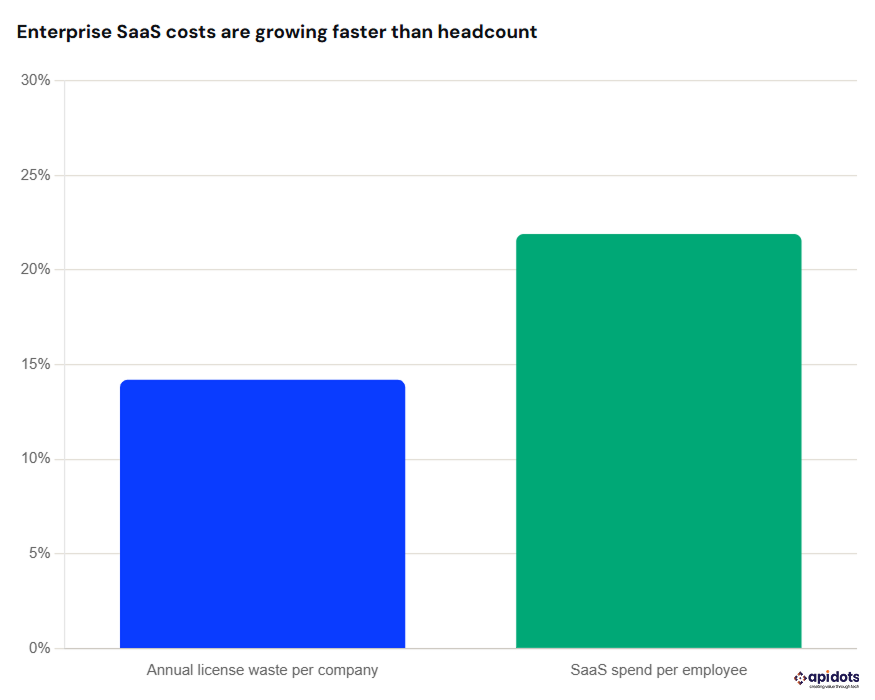
Chart Description: Year-over-year growth in average enterprise SaaS license waste and SaaS spend per employee. This illustrates why per-seat licensing costs compound at scale. This data reflects general enterprise SaaS spend, not real estate-specific figures. Source: Zylo, 2025 SaaS Management Index. zylo.com
Ownership also means maintenance. A custom CRM needs a team to patch, extend, and monitor it after launch. That team can sit in-house or with a development partner. Companies that build without planning for this often end up with a system nobody wants to touch.
That happens within a year. That risk is not unique to real estate. It shows up whenever custom software is treated as a one-time project instead of an owned product.
A middle path exists between building alone and buying off the shelf. Some brokerages partner with a development team to build and maintain the CRM under a long-term engagement. This avoids hiring a full internal team from scratch. This partner build model gives a company ownership of the software. It removes the immediate burden of staffing an in-house engineering group. It works best when the CRM is important enough to own, but not the company’s core product.
The decision is not simply build versus buy in the abstract. It is a question of which fixed and variable costs a company is willing to carry over five years. Off-the-shelf pricing hides variable costs that grow with headcount. Custom development hides fixed costs that show up before launch. Neither cost disappears; it only moves to a different point on the timeline.
The build path pays off when the CRM is not just infrastructure. It pays off when it becomes part of how the company wins deals or trains agents. It also pays off when it sets the brokerage apart from competitors using the same off-the-shelf tools.
Most build-versus-buy debates skip the one question that actually settles it. Is this CRM how you operate, or is it how everyone in the industry already operates?
If your lead routing or MLS workflow looks like every other brokerage, buying is usually faster and cheaper. If they are what makes your business win, building gives you a system nobody else has.
A few questions help CTOs and technical founders make this call with real numbers, not gut feeling.
| Factor | Buy & Configure | Custom Build |
| Time to launch | Days to weeks | Several months |
| Upfront cost | Low | High |
| Cost at scale | Grows with seats | Flat after build |
| MLS and workflow fit | Limited, add-on based | Built to spec |
| Data ownership | Vendor controlled | Fully owned |
| Maintenance burden | Vendor handled | Team required |
Table: Build versus buy decision matrix for real estate CRM development.
Consider two contrasting scenarios. A single office brokerage with ten agents can run on a configured CRM for years without hitting real limits. A regional PropTech platform serves multiple brokerages, each with different commission rules and MLS integrations.
It will keep customizing a generic tool until the workarounds become the product. At that point, a custom build is not a luxury. It is the only way to keep the system maintainable.
A small brokerage with one office and a standard commission structure rarely needs a custom build. The workflow looks like every other brokerage, so buying and configuring gets a usable CRM live in weeks.
A multi-office brokerage or PropTech platform faces a different math. Unique commission logic, AI-powered lead-scoring goals, or MLS integrations across regions change the math. For that team, a custom build often wins over a five-year view, even with a higher starting cost.
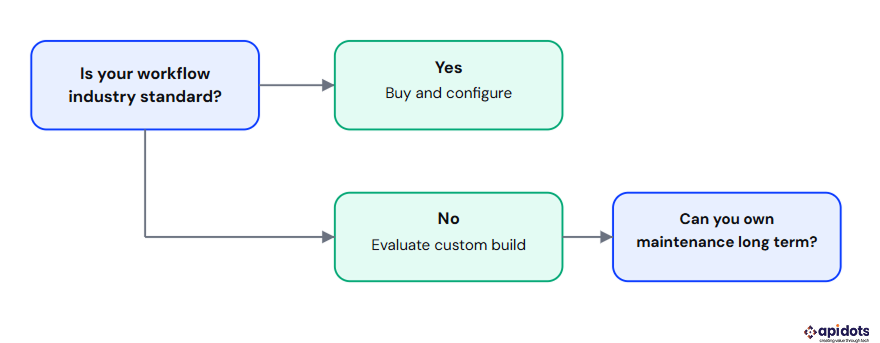
Most brokerages should buy and configure a CRM first. Building only makes sense when your workflow is different enough that off-the-shelf tools don’t fit well.
Cost depends on scope. A functional MVP with MLS integration and lead routing usually needs several months of engineering time. Ongoing maintenance adds cost every year after launch, so budget for both.
Yes. Custom CRMs can connect directly to MLS feeds and reflect listing status changes in real time. This is one of the main reasons brokerages choose to build instead of buy.
A basic version with core features can launch in a few months. Adding AI-powered lead scoring, multi-office support, or advanced reporting extends that timeline.
It can be. Only 21 percent of agents currently use a CRM with AI-powered insights. That comes from the National Association of Realtors 2025 Technology Survey. That gap is an opportunity for teams willing to build it well.
We engineer robust, future-ready software solutions.Built using modern architectures and proven development practices.
Hire Developers
Hi! I’m Aminah Rafaqat, a technical writer, content designer, and editor with an academic background in English Language and Literature. Thanks for taking a moment to get to know me. My work focuses on making complex information clear and accessible for B2B audiences. I’ve written extensively across several industries, including AI, SaaS, e-commerce, digital marketing, fintech, and health & fitness , with AI as the area I explore most deeply. With a foundation in linguistic precision and analytical reading, I bring a blend of technical understanding and strong language skills to every project. Over the years, I’ve collaborated with organizations across different regions, including teams here in the UAE, to create documentation that’s structured, accurate, and genuinely useful. I specialize in technical writing, content design, editing, and producing clear communication across digital and print platforms. At the core of my approach is a simple belief: when information is easy to understand, everything else becomes easier. Reach me at amysbrew.com