
Top
Search
People also search for:

Stay Inspired with Instagram




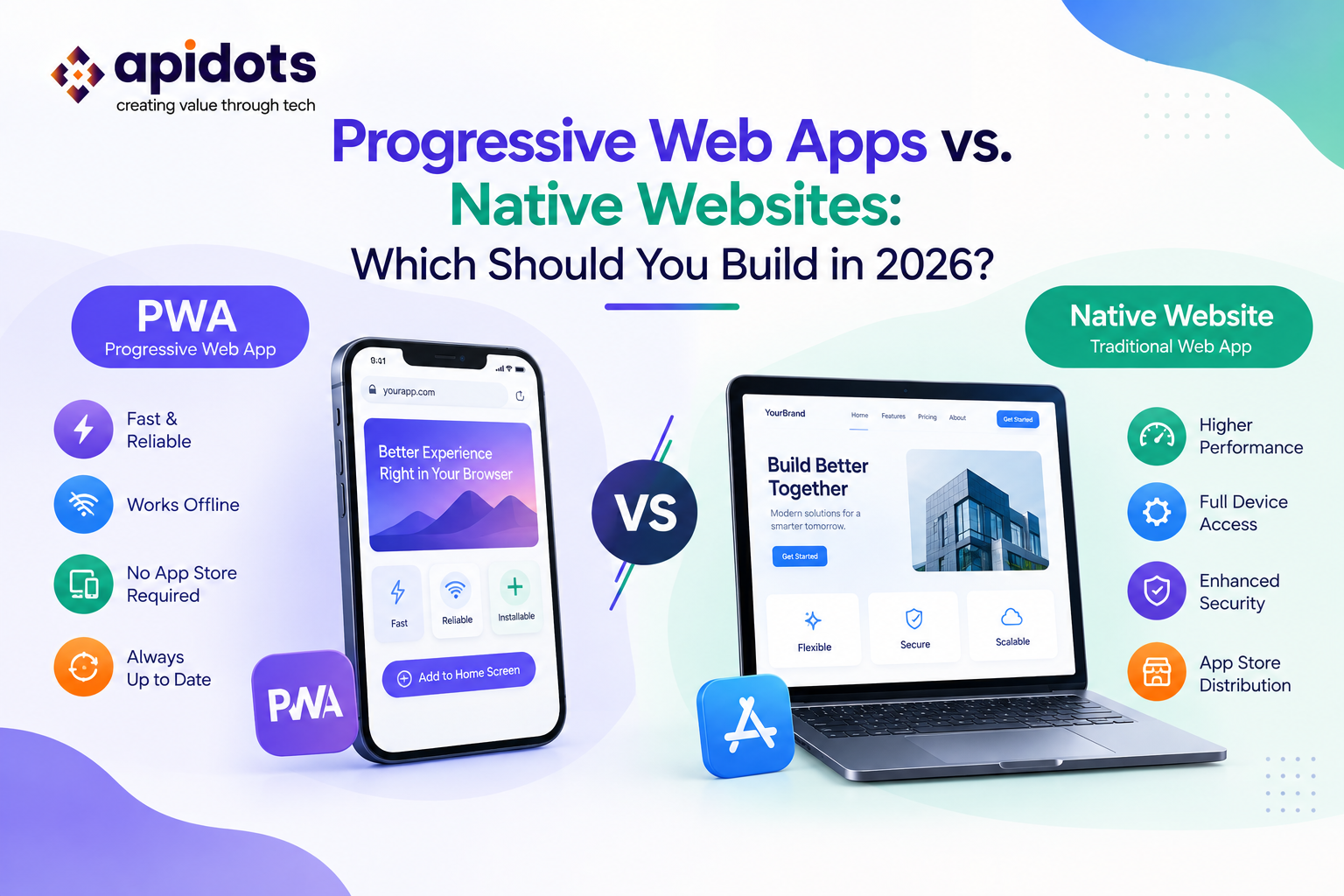
Choosing the right technology for a digital product is no longer as simple as deciding between a website and a mobile application. In 2026, businesses have several options for delivering mobile-first experiences, including traditional responsive websites, Progressive Web Apps (PWAs), and native or cross-platform mobile applications.
The decision matters because the technology you choose affects development cost, performance, discoverability, device capabilities, maintenance, scalability, and ultimately the user experience.
A Progressive Web App can combine many web capabilities with an app-like experience. PWAs can be installed on supported devices, launched like applications, and use technologies such as web app manifests and service workers for capabilities such as offline functionality. (MDN Web Docs)
On the other hand, mobile applications can provide deeper access to device capabilities and are often better suited to products where a rich, app-centric experience is central to the business.
So, which approach should you choose in 2026?
The answer depends less on which technology is more popular and more on what your users need your product to do.
A Progressive Web App is a web application built with standard web technologies but designed to provide an experience closer to a platform-specific application.
Unlike a conventional website, a PWA can be installable on supported browsers and devices. It can have an application icon, launch in a standalone window, and use browser capabilities for features such as offline experiences and background functionality.
A typical PWA combines technologies such as:
The web app manifest defines information such as the application’s name, icons, start URL, and display behavior. Service workers can be used to support caching, offline experiences, and background operations.
This makes PWAs particularly interesting for businesses that want broad web accessibility without necessarily building separate applications for every platform.
A mobile application is software designed specifically for mobile operating systems.
Traditional native development generally involves platform-specific technologies—for example, Swift or Objective-C for Apple’s ecosystem and Kotlin or Java for Android.
However, businesses today also have cross-platform options such as React Native.
React Native allows developers to build applications for multiple platforms while sharing substantial portions of the codebase. Its current architecture includes components such as Fabric, TurboModules, and Hermes, with the React Native team continuing to evolve the framework for production applications. (React Native)
This is where a React native development service can become relevant for businesses that need mobile applications for both iOS and Android without maintaining completely separate application codebases.
The two approaches can both deliver excellent products, but their strengths are different.
| Factor | Progressive Web App | Native/Cross-Platform App |
| Accessibility | Directly accessible through the web | Usually requires installation |
| Installation | Supported browsers can offer installation | Installed through app distribution channels |
| Discoverability | Can be discovered through search | Primarily discovered through app stores and other channels |
| Development | One web-based application can serve multiple platforms | Cross-platform frameworks can share code; native apps require platform-specific development |
| Offline capabilities | Possible with appropriate architecture | Generally strong |
| Device integration | Depends on browser and OS support | Generally broader |
| Updates | Web deployment can make updates immediately available | Updates generally go through app distribution mechanisms |
| App-store dependency | Not necessarily required | Commonly relevant |
| SEO | Web content can be crawlable | App-store optimization is different from web SEO |
| Best suited for | Web-first products and broad accessibility | Products requiring deeper mobile capabilities |
The important point is that neither option wins every category.
Progressive web app development can be a strong choice when your primary goal is to make a product easily accessible across devices while maintaining an app-like experience.
If customers should be able to access your product immediately without downloading an application, a PWA has a natural advantage.
A user can visit a URL and begin interacting with the product. On compatible platforms, the application can subsequently be installed.
This is particularly useful for:
A web-based product can provide a discoverable entry point through search engines.
This can be particularly valuable for businesses whose acquisition strategy depends on organic search.
A native mobile application, by contrast, does not replace the role of a search-optimized website.
For businesses where landing pages, product pages, educational content, and organic discovery are important, a web-first strategy can be particularly useful.
One of the practical advantages of web applications is deployment.
When a web application is updated on the server, users generally access the latest deployed version rather than waiting for an app-store review and update cycle.
That can simplify experimentation and continuous product improvement.
PWAs can access many browser capabilities, but browser support varies by platform and feature.
If your product mainly requires authentication, payments, forms, dashboards, content, search, analytics, or standard business workflows, a PWA may provide everything you need.
A dedicated mobile application becomes more compelling when the product depends heavily on mobile-specific experiences or deeper device integration.
Applications involving intensive use of capabilities such as Bluetooth, advanced camera functionality, sensors, background processing, or other platform-specific APIs may benefit from a mobile application.
The exact capability and level of access should always be evaluated against the target operating systems because platform capabilities continue to change.
Some products are used frequently enough that users expect an application to sit on their device.
Examples include:
For these products, a dedicated mobile experience may become an important part of the overall product strategy.
For applications involving complex interactions, intensive animations, sophisticated graphics, or highly optimized device experiences, native or cross-platform mobile development may be more appropriate.
This does not mean PWAs are inherently slow. A well-engineered PWA can be highly responsive. The real question is whether the browser environment provides the performance and device access your specific product requires.
Businesses sometimes treat the choice as simply “PWA vs. native.” In practice, there is another important option: cross-platform development.
React Native is one example.
A React Native development service can help businesses create mobile applications for multiple platforms while sharing significant portions of application logic and development resources.
This can make React Native attractive when a company wants:
However, React Native is not automatically the correct choice for every application.
If your product is primarily web-based and users need immediate access through a browser, developing a mobile application first may introduce unnecessary friction.
The product requirements should determine the architecture.
Technology decisions should also reflect how your business acquires and retains customers.
Imagine an online marketplace where most customers discover products through Google searches.
A PWA or web-first application can provide an important acquisition layer because customers can land directly on product pages.
Now consider a fitness application where customers interact with the product several times a day, receive reminders, track activities, and use device sensors.
A dedicated mobile application may be more appropriate because the product experience is deeply connected to mobile usage.
The same principle applies to SaaS products.
A business dashboard primarily accessed from laptops and browsers may not require a mobile application at all. Conversely, a field-service SaaS product used by employees while moving between locations could benefit substantially from a mobile app.
Prefer reading: Web Apps vs. Hybrid Apps vs. Native Apps: Navigating the App Development Landscape
Development cost is another factor, but it should not be reduced to the initial development quote.
A PWA can potentially reduce the need to maintain separate platform-specific applications. A single web codebase can serve users across multiple device categories, although responsive design and platform-specific testing are still necessary.
Cross-platform development can also reduce duplicated work compared with maintaining separate native codebases.
However, cost depends on:
A cheaper initial build can become expensive if the architecture creates technical debt or requires extensive redevelopment later.
Therefore, businesses should compare total cost of ownership, not just initial development cost.
Security should not be treated as a technology-selection checkbox.
Whether you choose a PWA or mobile application, you need appropriate measures for:
The implementation details will differ between web and mobile environments.
For products handling sensitive customer information, security requirements should be defined during architecture and product planning—not added immediately before launch.
The best technology cannot compensate for a poor user experience.
A technically sophisticated application can still fail if users find it confusing, slow, difficult to navigate, or unnecessarily complicated.
For PWAs, focus on:
For mobile applications, focus on:
The interface should reflect how users actually interact with the product.
Instead of asking, “Are PWAs better than mobile apps?”, ask these questions:
If yes, a web-first approach deserves serious consideration.
If installation is central to the product experience, a mobile application or installable PWA may be appropriate.
If your application depends heavily on capabilities that browsers cannot reliably provide across your target devices, mobile development may be the safer direction.
Occasional users may prefer a URL. Frequent users may appreciate a dedicated application.
Understand your actual audience instead of building for every platform simply because the technology allows it.
A product that starts as a web application may later need mobile apps. Conversely, a product initially planned as a mobile app may discover that a web experience is essential for customer acquisition.
Architecture should leave room for evolution where practical.
Yes. For some businesses, the right strategy is not choosing one technology permanently.
A company might use a web application for acquisition and accessibility while providing native or cross-platform mobile applications for customers who need deeper mobile functionality.
For example:
Website/PWA → Discovery & Acquisition
Mobile App → Frequent Engagement & Device Features
Shared Backend/API → Data & Business Logic
This approach can work particularly well when each platform has a clearly defined purpose.
The mistake is building multiple applications without understanding why users need each one.
Technology selection is only part of the equation. Execution matters just as much.
If you are considering Hire React Native Developers India, evaluate developers based on more than their knowledge of React Native.
Look for experience with:
Similarly, if you’re evaluating mobile app development services India, examine the company’s previous projects, development process, communication practices, quality assurance, maintenance capabilities, and understanding of your industry.
A strong development partner should be able to explain why a particular architecture is appropriate for your product rather than simply recommending the technology they use most often.
Starting with “We need React Native” or “We need a PWA” can lead to unnecessary technical constraints.
Start with the user problem and product requirements.
A PWA is not simply a website with an install button.
A high-quality PWA requires thoughtful caching, responsive design, performance optimization, offline behavior where appropriate, security, accessibility, and careful handling of browser differences.
Maintaining mobile applications adds development, testing, deployment, and maintenance responsibilities.
If users can get the required experience through a web application, a separate mobile app may not provide enough additional value to justify the investment.
Your first release is only the beginning.
Consider how your application will handle increasing users, new features, integrations, security requirements, analytics, and platform changes.
In 2026, the choice between a Progressive Web App and a mobile application is less about following a technology trend and more about matching the technology to the product.
Progressive web app development makes sense when accessibility, web discovery, rapid distribution, and cross-platform reach are important. Mobile development becomes more compelling when your product depends on frequent mobile engagement, advanced device capabilities, or a dedicated app experience.
For businesses that need mobile applications across platforms, React Native can provide another practical path. A React native development service can be particularly useful when organizations want to develop iOS and Android applications while sharing significant portions of their code and development effort.
At APIDOTS, we help businesses evaluate and build digital products based on their actual product requirements—not simply the latest technology trend. Our expertise spans Progressive Web App development, React Native, and mobile application development, allowing us to support businesses at different stages of their digital journey.
Whether you are planning a new web-first product, evaluating a PWA, or looking for a reliable mobile application development company India, APIDOTS can help you define the right technical approach, design the product architecture, and turn your concept into a scalable digital experience.
The best technology choice is ultimately the one that gives your users the experience they need while giving your business a sustainable foundation for growth.
A Progressive Web App runs through the web and can provide app-like features such as installation and offline functionality on supported platforms. A mobile application is installed on a device and can provide deeper integration with operating-system and device capabilities.
Neither is universally better. A PWA can be suitable for products that prioritize web accessibility, search visibility, and broad device reach, while a native or cross-platform app may be more appropriate when deeper device integration and frequent mobile usage are essential.
The cost depends on factors such as product complexity, number of features, UI/UX requirements, backend infrastructure, integrations, security requirements, and testing. A simple business PWA can require significantly less development effort than a complex application with advanced offline functionality and integrations.
React Native can be a suitable option when a business needs dedicated iOS and Android applications while sharing a substantial amount of application code. It can be particularly useful for products that require mobile-specific experiences without maintaining completely separate development teams for each platform.
Evaluate the company’s relevant experience, technical expertise, development methodology, portfolio, quality-assurance practices, communication process, security approach, post-launch support, and ability to scale the product. Avoid choosing a provider based solely on development cost.
Yes. Some businesses use a PWA or website for accessibility, search-driven acquisition, and broad reach while offering mobile applications for users who need frequent engagement or deeper device capabilities. The decision should be based on clearly defined user and business requirements.
We design and develop secure, high-performance web and mobile applications.Ensuring scalability, reliability, and long-term product success.
Hire App Developers