
Top
Search
People also search for:
Stay Inspired with Instagram




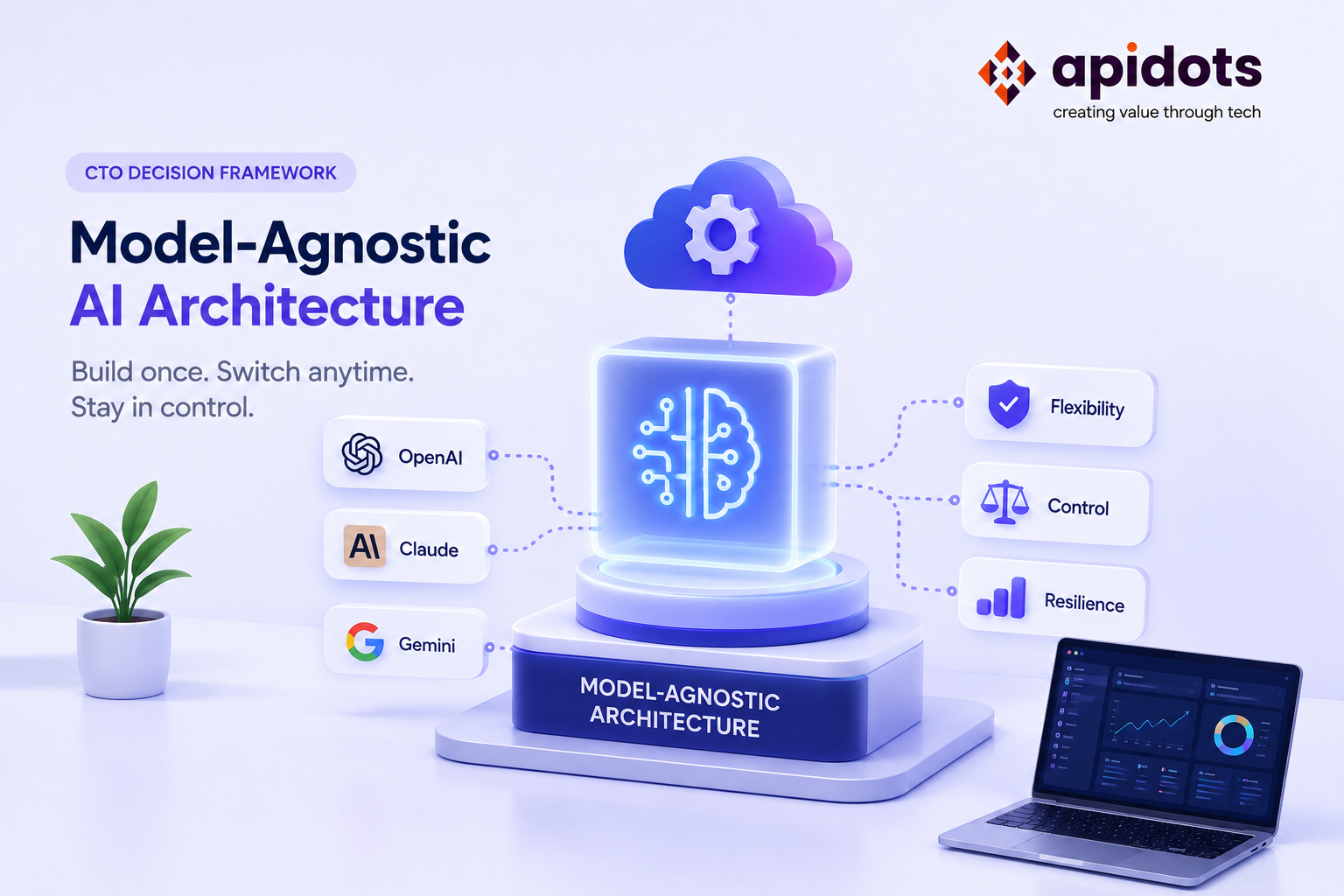
Your AI product should not need a rebuild every time a vendor retires a model or changes its pricing. Here is how to architect for that from day one.
Two major AI vendors made unilateral model decisions in the past year. Both broke products built on top of them. If your roadmap depends on one model staying exactly as it is, model-agnostic AI architecture is not an optimization. It is the difference between a two-week migration and a two-month rebuild.
This is a decision framework for CTOs, technical founders, and product leaders. It is for anyone building or scaling an AI product right now. It covers what actually breaks when a vendor changes course. It also covers how to audit your own exposure and what a properly decoupled architecture looks like in practice.
Two recent examples worth knowing: When OpenAI launched GPT-5 in August 2025, it removed GPT-4o from ChatGPT without warning. It reversed course within 24 hours after user backlash forced the older model back into rotation. Separately, Anthropic notified developers on August 13, 2025, that Claude Sonnet 3.5 would retire on October 28, 2025. That gave builders roughly ten weeks to migrate or lose API access entirely.
Model turnover used to be rare enough to ignore. That is no longer true. Model providers now deprecate, retire, and replace models on a rolling basis. It is part of normal operations, not an exception.
Enterprises have already responded by hedging. Andreessen Horowitz’s third annual CIO survey covered 100 Global 2000 companies. It found 81 percent now run three or more model families in production. That is up from 68 percent less than a year earlier. That is not experimentation. That is risk management.
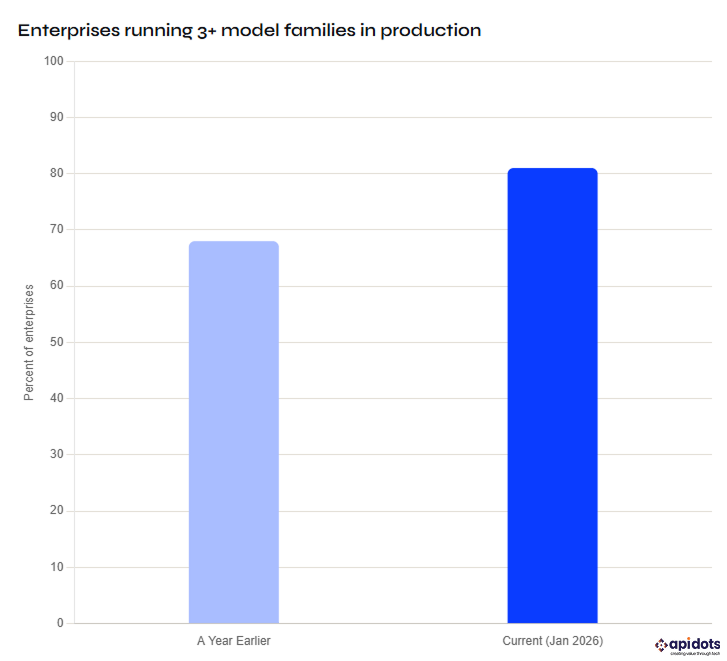
Source: Andreessen Horowitz, “Leaders, gainers and unexpected winners in the Enterprise AI arms race” (January 2026). Based on a survey of 100 Global 2000 CIOs. View the source.
Large enterprises with dedicated AI platform teams are hedging this hard. A startup with a single engineer maintaining the model integration carries far more exposure per dollar of revenue.
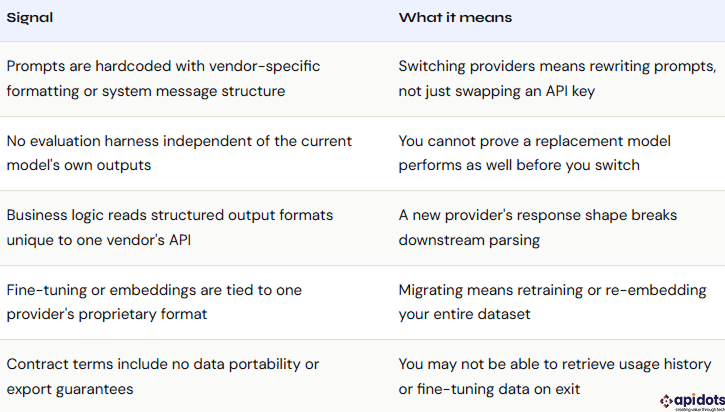
Run through this list honestly. Each item you check is a point of exposure that a vendor decision, not your own roadmap, controls.
Your application code should call an internal interface, not a vendor SDK directly. That interface routes to whichever model is configured, whether it is Claude, GPT, or Gemini. Swapping providers becomes a configuration change instead of an application rewrite. Open-source gateways exist for this. The harder work is designing the interface contract correctly for your product logic. That is exactly where an experienced AI engineering partner earns its fee.
Prompts tuned heavily to one model’s quirks do not transfer cleanly. Store prompts as versioned, model-agnostic templates with documented expected behavior, not as strings buried inside application code. This also makes A/B testing across models trivial instead of a research project.
You need a fixed set of test cases and success criteria. Any candidate model runs against them, scored the same way regardless of vendor. Without this, “switching models” is a leap of faith. With it, switching is a data-backed decision made in hours, not a multi-week trust exercise.
Fine-tuned models and embeddings created in one vendor’s format are a form of lock-in. It is as real as the API itself. Where possible, keep your source training data and raw embeddings in a format you control. Re-deriving them against a new model becomes a re-run, not a re-collection.
Before signing an enterprise agreement with any model provider, confirm data export rights and retention of usage history. Also confirm a defined off-ramp period. This is a procurement conversation, but it is inseparable from the technical architecture. A clean technical exit is worthless if your contract does not support it.
Teams building their first AI feature often wire directly into one model’s API. It is the fastest path to a demo, and that is a reasonable early decision. The problem is when that shortcut is still load-bearing a year later. By then, real users and real revenue depend on it.
The signal to act is usually one of three things. Your team is about to scale an AI feature past pilot stage. A vendor has already announced a deprecation affecting you. Or you are negotiating an enterprise AI contract and want the exit terms settled before you sign, not after.
API DOTS designs this abstraction layer as a standard part of SaaS and AI product builds, not as a retrofit. That is consistently cheaper and faster than untangling a hardcoded integration later.
It adds some initial design time for the abstraction layer and evaluation harness. That cost is consistently lower than a forced migration under a deprecation deadline, when the same work happens under time pressure with production traffic at stake.
Yes, though it takes longer than building it from the start. The typical path is to introduce the abstraction layer first, then migrate prompts and evaluation logic behind it incrementally rather than in one large rewrite.
Not necessarily. Many teams use a cheaper model for routine tasks and a frontier model only for complex reasoning, which often lowers total cost while also reducing single-vendor dependency.
API DOTS designs the abstraction layer, evaluation harness, and migration path before you need them, not after.
SaaS Product Development: Concept to Market Ready
AI Software Development in San Francisco
Agentic AI and ML Development in NYC
We build and deploy end-to-end AI software solutions for businesses. Accelerating efficiency, automation, and intelligent decision-making.
Get AI Development Services
Hi! I’m Aminah Rafaqat, a technical writer, content designer, and editor with an academic background in English Language and Literature. Thanks for taking a moment to get to know me. My work focuses on making complex information clear and accessible for B2B audiences. I’ve written extensively across several industries, including AI, SaaS, e-commerce, digital marketing, fintech, and health & fitness , with AI as the area I explore most deeply. With a foundation in linguistic precision and analytical reading, I bring a blend of technical understanding and strong language skills to every project. Over the years, I’ve collaborated with organizations across different regions, including teams here in the UAE, to create documentation that’s structured, accurate, and genuinely useful. I specialize in technical writing, content design, editing, and producing clear communication across digital and print platforms. At the core of my approach is a simple belief: when information is easy to understand, everything else becomes easier. Reach me at amysbrew.com