
Top
Search
People also search for:

Stay Inspired with Instagram




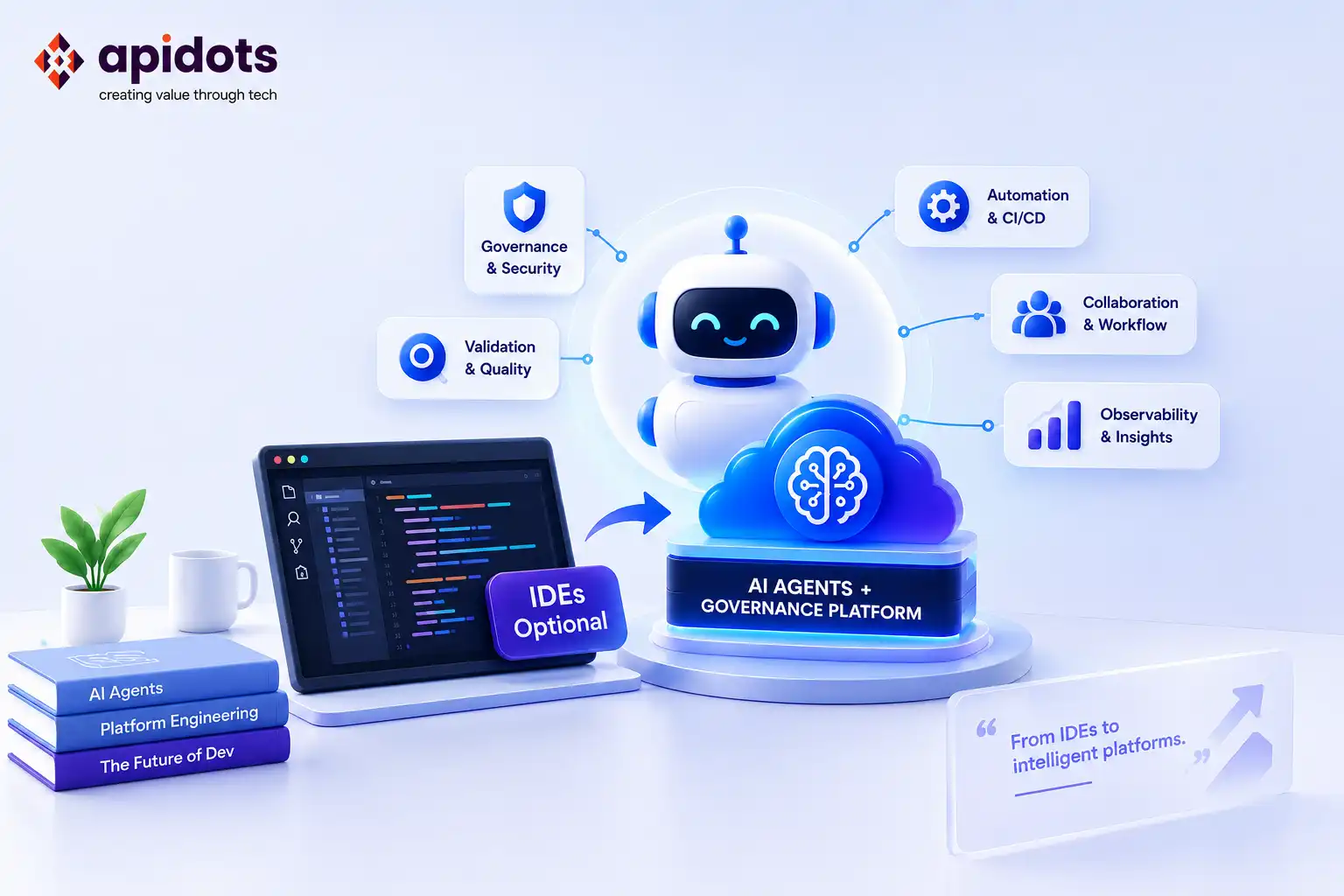
Gartner’s prediction is not about editors disappearing. It is about where governance, validation, and control move as agentic coding becomes more common.
Gartner predicts a shift in how engineering teams work. By 2027, over 65% of engineering teams using agentic coding will treat integrated development environments (IDEs) as optional. That doesn’t mean code editors will disappear. Gartner’s point is that control, governance, and validation can move to automated platforms as agentic workflows expand.
For engineering leaders, the useful question is not whether IDEs disappear. It is which responsibilities move out of the developer workspace. AI coding agents are taking on more of the software development life cycle.
Gartner’s May 20, 2026 newsroom announcement describes the enterprise AI coding-agent market as entering a new phase. The market is shifting toward expansion and competitive realignment. The specific prediction: by 2027, more than 65% of engineering teams using agentic coding will treat IDEs as optional. Control, governance, and validation shift to automated platforms instead.
Philip Walsh, Senior Director Analyst at Gartner, describes the shift plainly.
“What began as a race to deliver the most ’magical’ developer experience is now evolving into a contest of operational excellence, commercial maturity, and enterprise readiness.”
Philip Walsh, Sr. Director Analyst, Gartner
The market has moved into a different contest. It is now a contest of operational excellence and enterprise readiness. Developer experience and model capability still matter. But Gartner’s analysts argue they are no longer the only criteria that decide vendor winners.
That distinction matters. Gartner’s press release ties the shift to operational excellence and enterprise readiness. It points to governance, pricing, support, and commercial maturity, not to IDEs becoming technically obsolete.
If control moves beyond the IDE, the next question is what makes agentic coding reliable in large repositories. Sourcegraph’s May 2026 benchmark offers useful evidence. Agents fail because they struggle to find and select relevant context. Better code-search infrastructure improves outcomes.
Sourcegraph’s benchmark covers 1,281 scored agent runs across more than 40 large open-source repositories. In one Kubernetes task, the same model and task produced very different outcomes. The difference came down to whether the agent had local file access or indexed code-search tools.
We asked an agent to trace a resource allocation mechanism through 1.4 million lines of Kubernetes code. Limited to local file access, it burned 6,000 seconds and produced nothing. Given proper code search and structural navigation, the same model finished in 89 seconds and scored 0.90 out of 1.0.
Sourcegraph interprets this as a search-infrastructure problem, not a reasoning problem. Without tools that narrow the search space, an agent can spend excessive time exploring a large repository. This does not mean model capability is irrelevant. It means model quality alone does not solve retrieval and context-management problems.
The benchmark also found that codebase size determines when code intelligence tooling starts paying off. Below roughly 400,000 lines of code, added tooling can introduce overhead without much benefit. Above that threshold, the effect flips sharply.
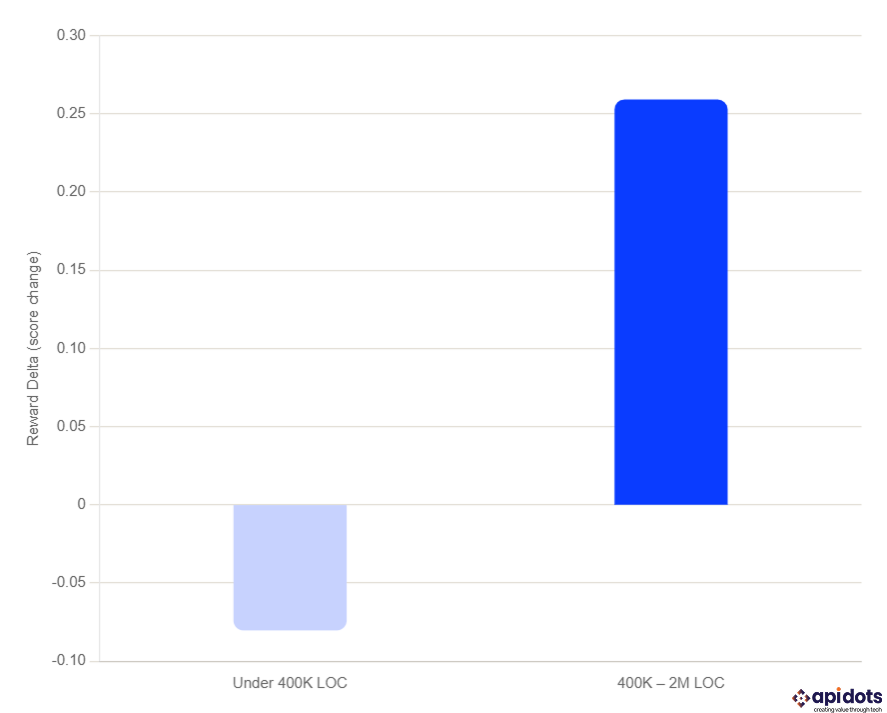
Source: Sourcegraph, “Why coding agents fail in large codebases” (May 2026). Reward delta measures the score change from adding code intelligence tools, based on 1,281 scored agent runs.
| Codebase Size (LOC) | Reward Delta | What’s Happening |
| Under 400K | −0.080 | Tools add overhead; local search typically works fine |
| 400K – 2M | +0.259 | Strongest positive effect from code intelligence tools |
These findings support a broader platform-engineering lesson. Code intelligence can be treated as infrastructure, not just an IDE feature. This lines up with Gartner’s view that control, governance, and validation can shift toward automated platforms. That doesn’t mean every team should remove IDEs. It means the IDE no longer has to be the only control point.
Gartner’s argument is not just theoretical. A recent incident shows exactly what happens when governance and control sit in the wrong place.
On August 17, 2026, GitHub went down for nearly eight hours. According to GitHub’s own incident report, elevated errors and latency began at 13:28 UTC. Issues, Pull Requests, APIs, Actions, and Copilot were all affected. Core services recovered by 16:59 UTC. Copilot did not fully recover until 21:02 UTC. That was three hours later.
The delay is the telling part. GitHub’s core services and Copilot recovered on different timelines. Copilot’s authentication runs through GitHub’s own routing layer, with no independent path. When that layer breaks, the coding agent breaks with it, regardless of which AI model sits behind Copilot.
This is precisely the risk Gartner’s prediction points toward. The question that mattered during the outage was never which model Copilot uses. It was whether governance, authentication, and control lived somewhere resilient. An incident like this makes the case for deliberate infrastructure. Teams should build that layer, not inherit it by default from a single vendor.
For engineering teams, the shift can show up in three practical ways:
None of this requires abandoning tools such as Claude Code, Cursor, or GitHub Copilot. Teams evaluating a coding tool comparison still need to choose an interface that fits their workflow. What changes is where governance and validation sit. They increasingly live in the platform and delivery pipeline, not in a single IDE session.
Gartner’s framing has a practical implication for CTOs, VPs of Engineering, and platform leaders evaluating AI coding vendors. The buying decision is becoming broader than the developer interface.
Product quality and coding benchmarks are important. But Gartner’s analysts also call out governance, pricing clarity, support, workflows, and commercial maturity. These factors matter most when deployments involve complex procurement or regulatory requirements.
For teams still scoping their approach, this connects directly to broader AI agent development decisions. The architecture question is no longer just “which model.” It now includes where retrieval, validation, and policy enforcement live. It also includes who owns that layer long term.
There is also an identity and access dimension that gets overlooked. As agents gain more autonomy across the SDLC, a new governance problem emerges. What is each agent authorized to touch? That question is closely tied to agent identity control.
This shift also reframes an ongoing argument in platform circles. How much operational work should be automated versus owned by humans? The IDE-optional trend does not eliminate that debate. It raises the stakes instead. More decisions now happen inside automated pipelines rather than in front of a developer reviewing each change live.
Teams already working through AI coding workflows will recognize the pattern. As agents move beyond one-off prompts, teams need repeatable feedback loops. Validation and governance need to run across the whole development process.
Gartner predicts that by 2027, over 65% of engineering teams using agentic coding will no longer treat the IDE as the required point of control. Governance, validation, and code review shift to automated platforms instead of living primarily inside a developer’s editor.
No. Gartner predicts IDEs will become optional as the control point, not that editors will be eliminated. Developers can still use tools like Claude Code, Cursor, or Copilot. The platform layer underneath simply takes over governance and validation.
Sourcegraph’s benchmark data points to code search infrastructure, structural navigation, and retrieval pipelines as the highest-leverage investments, particularly for codebases above 400,000 lines of code, where these tools show the strongest measured impact.
Gartner specifically recommends weighing governance, pricing clarity, customer support, and commercial maturity alongside coding benchmarks and developer experience, especially for enterprise-wide, medium- to long-term commitments.
Claude Code vs Cursor vs Copilot vs Windsurf: CTO Guide
AI Agent Development in 2026: Architecture, Cost, Timelines
Agentic AI Is Breaking IAM: Why You Need a New Identity Plane
We build and deploy end-to-end AI software solutions for businesses. Accelerating efficiency, automation, and intelligent decision-making.
Get AI Development Services
Hi! I’m Aminah Rafaqat, a technical writer, content designer, and editor with an academic background in English Language and Literature. Thanks for taking a moment to get to know me. My work focuses on making complex information clear and accessible for B2B audiences. I’ve written extensively across several industries, including AI, SaaS, e-commerce, digital marketing, fintech, and health & fitness , with AI as the area I explore most deeply. With a foundation in linguistic precision and analytical reading, I bring a blend of technical understanding and strong language skills to every project. Over the years, I’ve collaborated with organizations across different regions, including teams here in the UAE, to create documentation that’s structured, accurate, and genuinely useful. I specialize in technical writing, content design, editing, and producing clear communication across digital and print platforms. At the core of my approach is a simple belief: when information is easy to understand, everything else becomes easier. Reach me at amysbrew.com