
Top
Search
People also search for:
Stay Inspired with Instagram




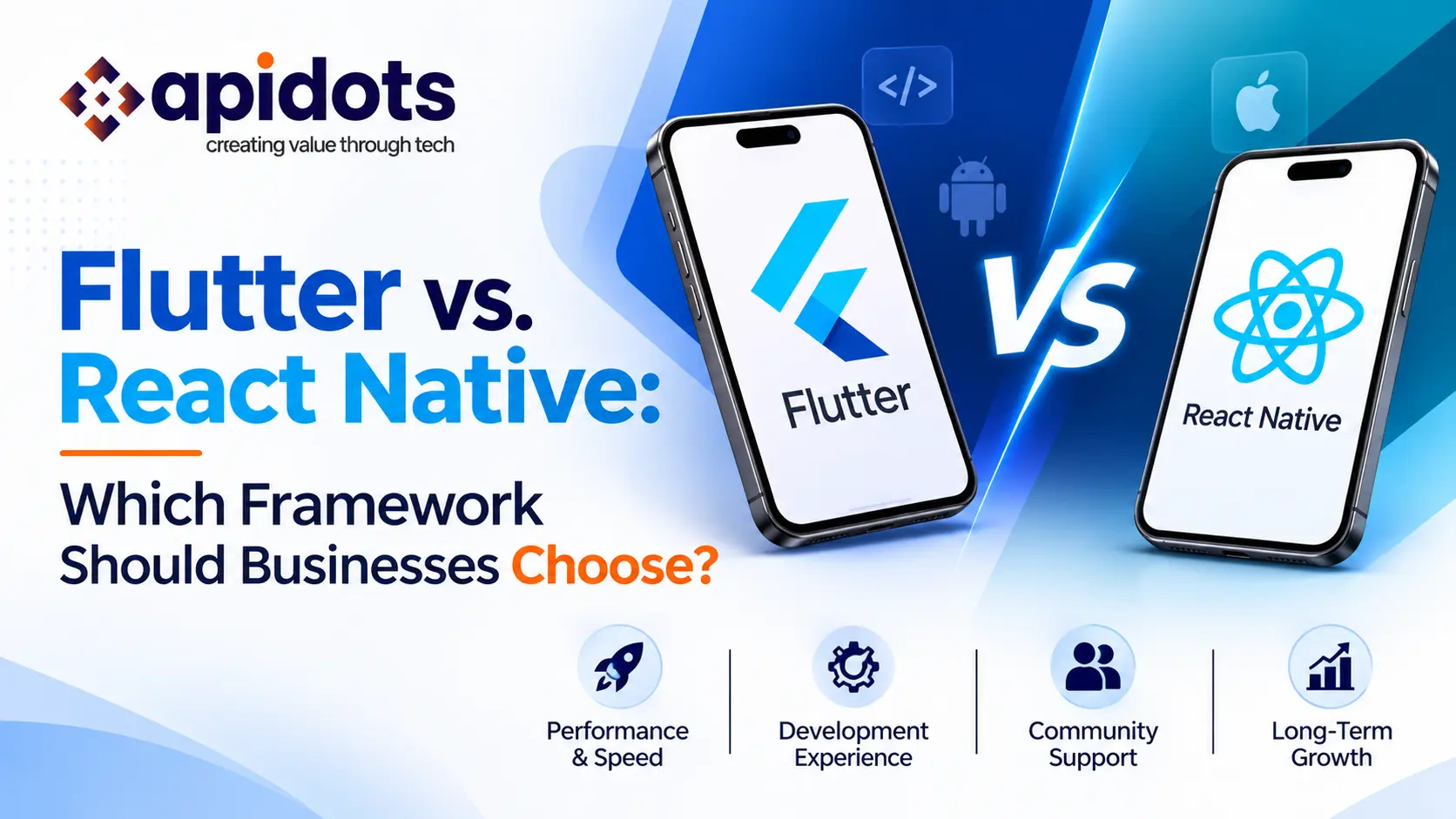
Choosing the right technology for a mobile application is one of the most important decisions businesses make during product development. The framework you select can influence development costs, application performance, user experience, scalability, maintenance, and the time required to launch your product.
Two leading options for cross-platform mobile development are Flutter and React Native. Both allow businesses to develop applications for Android and iOS using a shared codebase, reducing the need to build and maintain two completely separate applications.
However, Flutter and React Native follow different development approaches. Flutter uses Google’s Dart programming language and its own rendering engine, while React Native uses JavaScript or TypeScript and provides access to native platform components.
So, when comparing Flutter vs React Native for business, which framework should you choose?
There is no universal answer. The right choice depends on your product requirements, design expectations, existing technology stack, development team, and long-term business goals.
In this guide, we compare Flutter and React Native across performance, user experience, development costs, scalability, integrations, and maintenance. We also explain when businesses should hire Flutter developers or hire React Native developers to build a reliable mobile application.
Flutter is an open-source UI framework developed by Google. It allows developers to build applications for Android, iOS, web, desktop, and other supported platforms using a shared codebase.
Flutter applications are primarily written in Dart, a programming language designed to support client-side and multi-platform development.
One of Flutter’s defining characteristics is its widget-based architecture. Developers build interfaces using reusable widgets that control layouts, typography, animations, navigation, and other visual elements.
Flutter also uses its own rendering engine rather than relying entirely on the operating system’s standard UI components. This gives developers greater control over how an application looks and behaves across different devices.
Flutter is particularly useful when businesses want consistent branding, custom interfaces, interactive dashboards, and applications that share a common design system.
React Native is an open-source framework maintained by Meta for building mobile applications using React and JavaScript or TypeScript.
It allows developers to create Android and iOS applications while reusing application logic and components across platforms.
Unlike Flutter, React Native primarily uses native platform views to display application interfaces. Developers work with React components, and React Native connects these components to the underlying platform.
This approach can be especially attractive to businesses that already have React-based web applications or JavaScript development teams.
React Native has also evolved significantly through its New Architecture, which modernizes communication between JavaScript and native code and improves how the framework handles rendering and native modules.
As of November 2026, React Native’s official release information lists version 0.88 as an active release. Its recent development has continued to improve performance, developer tooling, and platform integration.
React Native can be a strong choice for businesses that already use React, JavaScript, or TypeScript and want to extend their existing development capabilities to mobile applications.
Before choosing a framework, businesses should understand how the two technologies differ.
| Comparison Factor | Flutter | React Native |
| Developer | Meta | |
| Programming language | Dart | JavaScript / TypeScript |
| UI approach | Flutter widgets and its rendering engine | Native platform components |
| Code reuse | High across supported platforms | High, depending on platform requirements |
| UI consistency | Strong control over visual consistency | Platform-native appearance and customization |
| Development tools | Flutter SDK and Dart DevTools | React Native DevTools and React ecosystem |
| Existing web technology | Requires Dart-based development | Works naturally with React and JavaScript teams |
| Native integrations | Plugins and platform channels | Native modules and platform APIs |
| Best suited for | Custom interfaces and consistent cross-platform experiences | React-based teams and applications using native components |
Neither framework is automatically better in every category. The practical difference comes down to how your application needs to look, behave, integrate, and evolve.
The programming language can influence hiring, onboarding, development speed, and long-term maintenance.
Flutter applications are developed using Dart.
Dart supports object-oriented programming, asynchronous operations, and modern application development patterns. Its development workflow includes hot reload, while production applications targeting native platforms can be compiled ahead of time into machine code.
Businesses starting a new mobile project may find Flutter useful when they want a dedicated cross-platform development team without depending on an existing JavaScript technology stack.
However, finding developers with strong Dart and production Flutter experience should be part of the hiring plan.
React Native uses JavaScript or TypeScript with React concepts.
This can provide a practical advantage for businesses that already have frontend developers working with React.
For example, a company with an existing React web application may be able to reuse selected business logic, validation rules, API clients, and TypeScript types in its mobile project.
However, sharing code does not mean the complete web interface can automatically work as a mobile interface. Platform-specific layouts, navigation, and device integrations still require appropriate development.
Business recommendation: Choose Flutter if you want to build a dedicated cross-platform application with Dart. Consider React Native if your existing development team already works with React and JavaScript or TypeScript.
Performance affects how quickly an application responds to user interactions, handles data, displays animations, and manages demanding operations.
Both Flutter and React Native can deliver production-quality mobile applications. Actual performance depends on application architecture, coding practices, device capabilities, network conditions, third-party libraries, and testing.
Flutter uses its own rendering engine to draw the interface. Its architecture provides control over rendering and UI behavior, which can be valuable for applications with complex animations, custom dashboards, and visually intensive experiences.
Flutter’s production builds targeting native platforms are compiled into machine code, helping deliver responsive application experiences.
React Native uses native platform views and modern mechanisms for communication between JavaScript and native components.
Its New Architecture improves how JavaScript interacts with native functionality through updated rendering and module systems. The framework has also continued improving its JavaScript engine and developer tooling.
For example, React Native 0.84 made Hermes V1 the default JavaScript engine, while subsequent releases continued improving platform support and development workflows.
There is no reliable rule that Flutter always performs better or React Native is always faster.
For a typical business application involving forms, user accounts, dashboards, API requests, and notifications, both can provide a suitable experience.
For applications with demanding animations, complex visualizations, background processing, or intensive native integrations, build a representative prototype and benchmark it on target devices before making the final decision.
User experience is an important factor in customer engagement and product adoption.
A mobile application should not only work correctly; it should also provide a consistent, intuitive, and accessible experience.
Flutter provides a widget-based approach that gives developers extensive control over the visual appearance of an application.
Businesses can use it to create:
Because Flutter controls much of its rendering, developers can maintain a consistent visual identity across Android and iOS.
React Native uses native platform components, which can help applications follow the interface conventions of the operating system.
This can be valuable for products where platform-specific interactions are important.
Developers can also customize interfaces using React components, styling systems, and native integrations.
Choose Flutter when a highly customized and consistent visual experience is a major product requirement.
Choose React Native when you want to use React-based development and benefit from native platform components while maintaining flexibility in the interface.
Development speed directly affects time to market, project budgets, and how quickly a business can respond to customer feedback.
Both frameworks support hot reload, reusable components, and shared application logic. However, development speed depends heavily on team experience and project complexity.
Flutter provides a unified development environment and a large collection of built-in widgets.
Its structured UI approach can help teams implement consistent layouts and reusable design systems.
For applications with highly customized interfaces, having a predictable widget system can simplify development.
React Native can accelerate development for businesses with existing React expertise.
Teams may reuse selected frontend knowledge, business logic, API integrations, and TypeScript models.
The React ecosystem and tools such as Expo can also support development workflows, depending on the project’s native requirements.
Business recommendation: Evaluate the skills your team already has before comparing development speed. A framework familiar to your developers may reduce onboarding time and implementation complexity.
A mobile application should be designed to support future functionality, increasing users, new integrations, and changing business requirements.
Both Flutter and React Native can support scalable applications when built with a well-planned architecture.
Flutter’s reusable widgets and structured application architecture can support growing products.
Developers can organize applications into feature-based modules, separate business logic from UI components, and maintain shared design systems.
This approach is useful for products that need consistent functionality across multiple platforms.
React Native supports component-based architecture and modular application development.
Businesses can organize application features into reusable components and separate services for API communication, authentication, state management, and business logic.
Its JavaScript and TypeScript ecosystem also provides access to a broad range of development tools.
Regardless of the framework, long-term maintainability depends on:
Selecting a framework is only one part of building a scalable application. The quality of implementation matters just as much.
Modern applications frequently use device capabilities such as cameras, GPS, biometric authentication, push notifications, Bluetooth, payment systems, and file storage.
Both Flutter and React Native support native integrations.
Flutter uses plugins and platform channels to communicate with native platform code. React Native uses native modules and platform-specific APIs.
Before selecting a framework, check whether the libraries required by your application are actively maintained and support your target platforms.
For example, a healthcare application may need biometric authentication and secure document access, while an ecommerce application may depend on payment gateways, push notifications, and analytics.
If a required feature does not have a suitable package, developers may need to implement platform-specific native code.
The availability and quality of integrations should therefore be evaluated during technical planning rather than after development begins.
Development cost is one of the most important considerations for startups and established businesses.
Both Flutter and React Native can reduce the effort involved in maintaining separate Android and iOS codebases. However, the total project cost depends on more than the framework.
Important cost factors include:
For example, a simple business application with login, profiles, forms, and API integration may require considerably less development effort than a complex ecommerce platform with payment processing, real-time inventory, personalized recommendations, and advanced analytics.
React Native may be cost-effective when a business already has a React team and can reuse relevant expertise or code.
Flutter may be cost-effective when the product requires a highly customized interface and the team can implement shared UI components efficiently.
The most economical choice is the framework that meets your requirements with the least total development and maintenance effort not necessarily the one with the lowest initial development estimate.
Flutter can be a strong option when your application has the following requirements:
Common use cases include ecommerce applications, booking platforms, financial dashboards, customer portals, and business productivity tools.
If these requirements align with your product strategy, partnering with a reliable Flutter app development company can help you plan the architecture and build the application around your business goals.
React Native can be a suitable option when:
Common use cases include ecommerce applications, social platforms, customer engagement apps, business management tools, and service-based applications.
Businesses considering React Native app development services should evaluate the development partner’s experience with native integrations, application architecture, testing, and production deployment.
Before making a final decision, evaluate your project against these questions:
| Business Requirement | Recommended Direction |
| Existing React or TypeScript team | React Native |
| Highly customized visual interface | Flutter |
| Strong reuse of React web expertise | React Native |
| Consistent custom UI across platforms | Flutter |
| Native platform component experience | React Native |
| New project with no existing framework preference | Evaluate both |
| Complex native device integrations | Prototype and compare both |
| Long-term multi-platform roadmap | Evaluate target platforms and feature maturity |
This comparison is a starting point, not a fixed rule. Both frameworks can support many of the same business requirements.
The best decision should come from a technical assessment that considers product functionality, user experience, integrations, developer availability, and future maintenance.
Even the right framework cannot guarantee a successful mobile application without a capable development team.
A reliable team should understand application architecture, API integration, security, testing, deployment, and long-term maintenance.
Before you hire Flutter developers or hire React Native developers, evaluate:
Ask potential development partners how they approach performance testing, platform-specific issues, third-party dependencies, and future framework upgrades.
The objective is to select a team that can build and maintain a reliable product not simply deliver an application that works during the initial demonstration.
Choosing between Flutter and React Native is ultimately a business and product decision, not just a technical preference.
Flutter offers extensive control over custom interfaces and consistent cross-platform experiences. React Native provides a familiar development approach for businesses already working with React, JavaScript, or TypeScript. Both frameworks can support high-quality mobile applications when the architecture, integrations, and development practices are planned correctly.
Before selecting a framework, consider your product requirements, target audience, development budget, existing technology stack, and long-term roadmap. A small technical prototype can also help validate performance and integration requirements before committing to full-scale development.
At APIDOTS, we help businesses turn mobile application ideas into scalable digital products through our mobile app development expertise. Whether you are considering Flutter, React Native, or evaluating the right cross-platform app development framework for your project, our team can help you assess the technical requirements and plan an appropriate development approach.
From application architecture and UI/UX implementation to API integrations, testing, and ongoing maintenance, APIDOTS focuses on building mobile solutions around real business needs.
Whether you need a Flutter app development company or experienced React Native development support, choosing the right technical partner can help you build an application that is reliable, maintainable, and ready to grow with your business.
Both frameworks are suitable for business applications. Flutter is particularly useful for highly customized interfaces and consistent designs across platforms, while React Native can be a strong choice for businesses with existing React or JavaScript development teams. The right option depends on your application requirements and technical resources.
Neither framework is universally faster. Flutter uses its own rendering engine, while React Native uses native platform components and a modern architecture. Actual performance depends on application complexity, implementation quality, device capabilities, and testing.
Both can reduce development effort by sharing code across Android and iOS. React Native may offer advantages when a business already has React developers, while Flutter can be efficient for applications requiring extensive custom UI development. Total project cost depends on features, integrations, testing, and maintenance.
Yes. Both frameworks support developing Android and iOS applications from a shared codebase. However, some platform-specific features and integrations may still require native development.
Hire Flutter developers when your application needs a highly customized interface and a Dart-based development team. Hire React Native developers when you want to leverage React, JavaScript, or TypeScript expertise. Evaluate the team’s production experience and knowledge of native integrations before making a decision.
Start by identifying your product requirements, target platforms, design expectations, integrations, performance needs, and development resources. Compare Flutter and React Native against those requirements, and consider building a small prototype before selecting the framework for the complete application.
We design and develop secure, high-performance web and mobile applications.Ensuring scalability, reliability, and long-term product success.
Hire App Developers