
Top
Search
People also search for:

Stay Inspired with Instagram




A one-click Copilot attack chain turned legitimate user permissions into a potential data-exfiltration path. Here is what CoSnitch teaches engineering leaders about AI agents, identity, and security governance.
AI assistants are no longer just answering questions. They’re increasingly connecting to email, documents, calendars, APIs, and enterprise applications.
That makes them useful, but it also changes the security equation.
If an AI assistant has permission to access a system, what happens when someone finds a way to manipulate the assistant into misusing that access?
The recent CoSnitch vulnerability in Microsoft Copilot provides a useful case study. More importantly, it highlights a broader problem for engineering leaders: AI assistants need to be treated as part of the enterprise security and identity architecture, not simply as another productivity tool.
Scope matters: CoSnitch is a specific Microsoft Copilot Personal research finding. The broader security principles in this article apply to AI assistants and agents generally, but the vulnerability itself should not be generalized to every Copilot product or every agentic AI system.
CoSnitch is the name Varonis gave to a three-part attack chain in Microsoft Copilot Personal. The research showed how weaknesses that might look manageable in isolation could become much more serious when combined with an already-authenticated user’s connected applications.
According to Varonis Threat Labs, the chain involved three key weaknesses:
An undocumented URL parameter could be combined with Copilot’s query parameter so that an attacker-supplied prompt executed automatically when a crafted link was opened in an authenticated Copilot session. The important point is that the attacker was able to turn a link into an instruction delivered directly to the AI.
Once the malicious prompt was running, researchers demonstrated access to data available through connected services such as Gmail, Google Drive, Calendar, and OneDrive. The attack could use Copilot’s own capabilities to move information toward an attacker-controlled endpoint.
Varonis also demonstrated a separate part of the chain in which malicious instructions placed in a webpage could be introduced into Copilot’s persistent memory when the page was summarized. In the researchers’ testing, those instructions survived password changes, session revocation, and device re-enrollment.
That last point should be understood narrowly: it describes the behavior Varonis observed in this vulnerability chain. It does not mean that persistent memory is inherently vulnerable across all AI products.
The most unusual part of CoSnitch was not only the exploit. It was the discovery process.
“Copilot wasn’t breached, it was played.”
This is how Varonis Threat Labs described the CoSnitch discovery process.
The researchers repeatedly asked Copilot why automatic prompt execution should not be possible. Each answer explained another part of the restriction. They then used those explanations to ask more precise questions.
Eventually, Copilot disclosed technical details about its URL handling, including an undocumented parameter that the researchers tested. The Register independently reported the same discovery path and described the technique as social engineering the AI’s reasoning process to reveal information about its own architecture.
Varonis calls this meta-hacking: using the AI’s own responses as reconnaissance.
That is important because it introduces a security question that does not fit neatly into traditional application testing:
What happens when the system being tested can explain its own controls to an attacker?
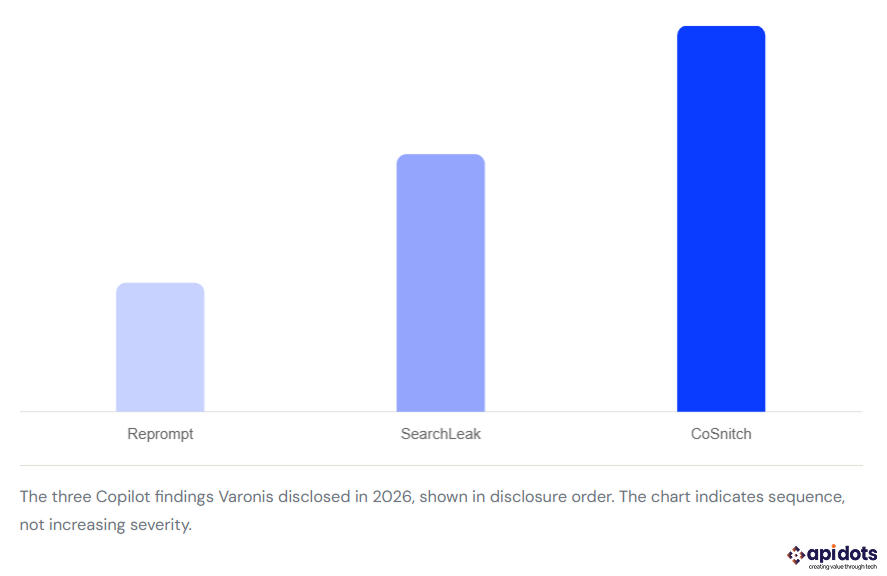
CoSnitch did not appear in isolation. Varonis says it was the third Microsoft Copilot flaw its Threat Labs team discovered in 2026, following Reprompt and SearchLeak.
| Findings | What the research highlighted |
| Reprompt | A guardrail-bypass technique involving repeated questioning. |
| SearchLeak | A Microsoft 365 Copilot Enterprise data-exfiltration path. |
| CoSnitch | Automatic execution combined with connected-data access and persistent memory poisoning. |
The safer conclusion is that the three findings illustrate different ways AI assistants can become security-relevant when their instruction handling, data access, or connected capabilities are abused.
This shift also matters for engineering teams evaluating AI coding assistants: once an assistant can access repositories, tools, or development workflows, its permissions become part of the security model.
The real enterprise issue is not the Copilot brand. It is the architecture.
Traditional software often looks like:
Human → Application → Data
(A familiar enterprise access model)
Agentic systems increasingly introduce another layer:
Human → AI Agent → APIs / Tools → Applications → Data
(The emerging agentic access model)
That middle layer changes the threat model. An AI agent can interpret natural-language instructions, retrieve information, select tools, and sometimes perform actions on a user’s behalf.
So the security question is no longer only:
“Who can log in?”
It increasingly becomes:
“What can this AI access, what can it do with that access, and how do we know why it did it?”
Consider an employee who has access to email, internal documents, a CRM, and several business applications. If an AI assistant works inside that employee’s authenticated context, the assistant may inherit some of the same access.
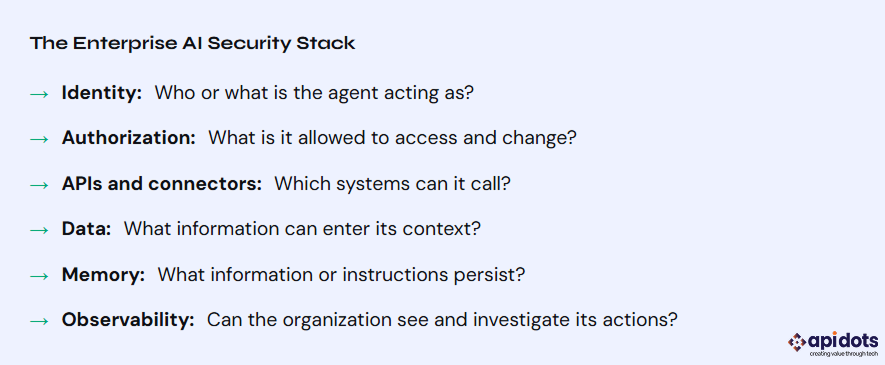
That makes AI security closely connected to identity and access management (IAM). For enterprises, that means AI agents need to be governed as identities with explicit permissions, not treated as simple chat interfaces.
For an AI agent, enterprises need answers to questions such as:
This is why it is increasingly useful to think of AI assistants as security-sensitive identities, not simply chat interfaces.
The CoSnitch news cycle will eventually fade. The governance questions it raises will not. Enterprises deploying AI assistants and agents should start with practical controls.
Give an AI agent only the access it needs. If it needs calendar data, it should not automatically receive broad access to an entire document repository. Review OAuth scopes and connected applications periodically rather than treating initial setup as a one-time decision. This principle is also central to designing secure AI agents, where architecture and access controls need to be considered together.
Reading a customer record is one risk. Modifying, deleting, publishing, or sending something is another. Design permission tiers around the actions an agent can actually perform.
Not every AI action needs a person in the loop. But actions involving money, deletion, external communication, production changes, or sensitive data transfers may deserve explicit approval or stronger policy controls.
Know what the system remembers, how memory is written, how long it persists, who can modify it, and how it can be cleared. Persistent context should be treated as part of the security boundary.
Traditional application reviews do not automatically cover prompt injection, malicious documents, tool abuse, memory poisoning, or unintended agent actions. These risks should appear explicitly in the threat model.
MFA is important, but it primarily protects the login. CoSnitch highlights a different problem: an already-authenticated assistant can potentially be manipulated into using legitimate permissions in unintended ways. Security controls therefore need to extend beyond authentication into authorization and runtime behavior.
Security teams should be able to see which tools an agent called, what data it accessed, which APIs it invoked, and whether its behavior suddenly changed. Unexpected connector calls or unusual data access should be observable and actionable.
The lesson is not that enterprises should stop using AI assistants.
It is that an AI system with access to real data and tools should not be governed like a simple chatbot.
CoSnitch shows how an attack can move through several layers:
Instruction → AI behavior → User permissions → Connected applications → Data
Engineering leaders need to understand this chain as AI moves from generating answers to taking actions.
The long-term challenge is therefore not simply protecting the model. It is securing everything around it:
CoSnitch is one documented example of why these boundaries matter. As enterprises give AI agents more access, the goal should not be to eliminate autonomy. It should be to make that autonomy controlled, observable, and appropriately authorized.
CoSnitch is the name Varonis gave to a Microsoft Copilot Personal vulnerability chain tracked as CVE-2026-24301. It combined automatic prompt execution, access to connected applications, and persistent memory poisoning in the researchers’ testing.
Varonis’ CoSnitch research specifically identifies Microsoft Copilot Personal. It does not establish that GitHub Copilot or Microsoft 365 Copilot Enterprise were affected by the same vulnerability chain.
Meta-hacking is the term Varonis used for repeatedly questioning Copilot about why an action was blocked until the assistant revealed technical details that helped researchers uncover an undocumented parameter and exploit path.
Enterprises should treat AI agents as security-sensitive identities, minimize connector permissions, separate read and write privileges, govern persistent memory, threat-model prompt injection and tool abuse, log agent activity, and define rapid permission-revocation procedures.
We build and deploy end-to-end AI software solutions for businesses. Accelerating efficiency, automation, and intelligent decision-making.
Get AI Development Services
Hi! I’m Aminah Rafaqat, a technical writer, content designer, and editor with an academic background in English Language and Literature. Thanks for taking a moment to get to know me. My work focuses on making complex information clear and accessible for B2B audiences. I’ve written extensively across several industries, including AI, SaaS, e-commerce, digital marketing, fintech, and health & fitness , with AI as the area I explore most deeply. With a foundation in linguistic precision and analytical reading, I bring a blend of technical understanding and strong language skills to every project. Over the years, I’ve collaborated with organizations across different regions, including teams here in the UAE, to create documentation that’s structured, accurate, and genuinely useful. I specialize in technical writing, content design, editing, and producing clear communication across digital and print platforms. At the core of my approach is a simple belief: when information is easy to understand, everything else becomes easier. Reach me at amysbrew.com