
Top
Search
People also search for:
Stay Inspired with Instagram




You’ve probably heard a lot about machine learning lately.
Everyone says it can save time, reduce costs, and help businesses grow faster.
But here’s the real question most Boston business owners have:
“Will it actually work for my business?”
Because the truth is — many companies start ML projects with high expectations… and end up disappointed.
Not because machine learning doesn’t work.
But because they choose the wrong development partner or start without a clear plan.
Let’s make this real.
A small Boston-based business wanted to predict customer demand so they could avoid overstocking. They hired a development company, spent months building a system, and… nothing changed. The predictions were confusing, the team didn’t trust the results, and the system was never actually used.
Then they tried again with a different approach.
This time, the focus was simple: understand the problem first, then build only what’s needed.
Within weeks, they had a working system that actually helped them make better decisions.
That’s the difference the right ML development company makes.
Boston has no shortage of machine learning companies.
From startups in Cambridge to enterprise firms in the Seaport, you have plenty of options.
But more options doesn’t make the decision easier.
It actually makes it harder.
Because not every company will:
That’s exactly what this guide will help you figure out.
Machine learning is software that learns from your data to make predictions or decisions automatically, without you having to programme every rule by hand. Think of it this way: instead of telling a computer ‘if a customer buys three times in a month, they are a loyal customer,’ you show it 50,000 past customer records and it figures out on its own what loyalty looks like.
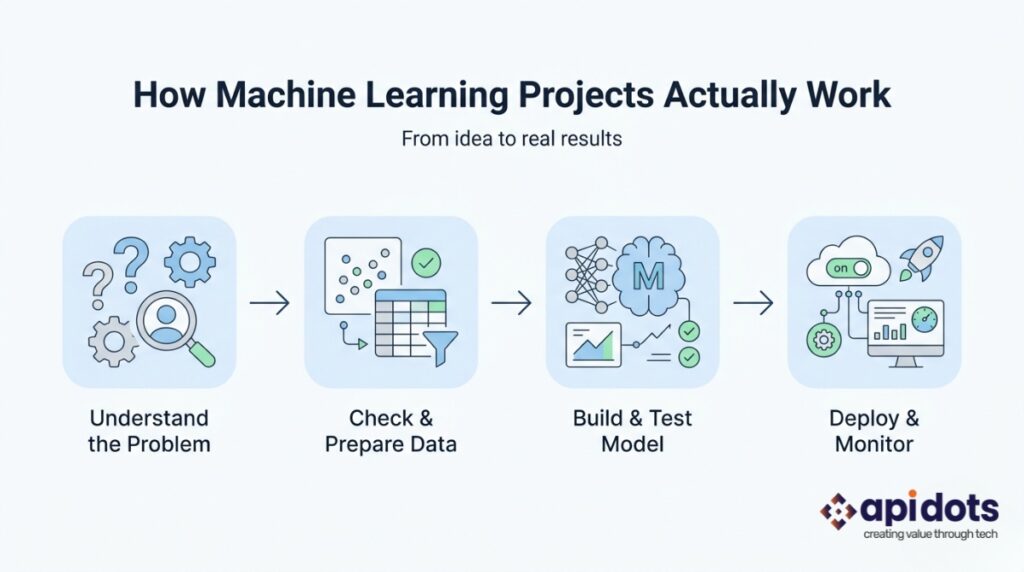
A machine learning development company takes this idea and turns it into a working system for your business. Here is what that actually looks like in practice, using a real Boston example. A Cambridge hospital wanted to automatically flag patient records that needed urgent review. The ML development team started by sitting with the clinical team to understand exactly which patients they were worried about missing. Then they looked at two years of patient records to check whether the data was good enough to learn from. They built the model — the piece of software that learns to spot the warning signs. They tested it against real historical cases to check its accuracy. They deployed it inside the hospital’s existing patient management software so it ran automatically. And they set up monthly checks to make sure it stayed accurate as new patient data came in.
That is what good ML development looks like. It is not just writing code. It is understanding a business problem and solving it from start to finish, in a way that keeps working after the project ends.
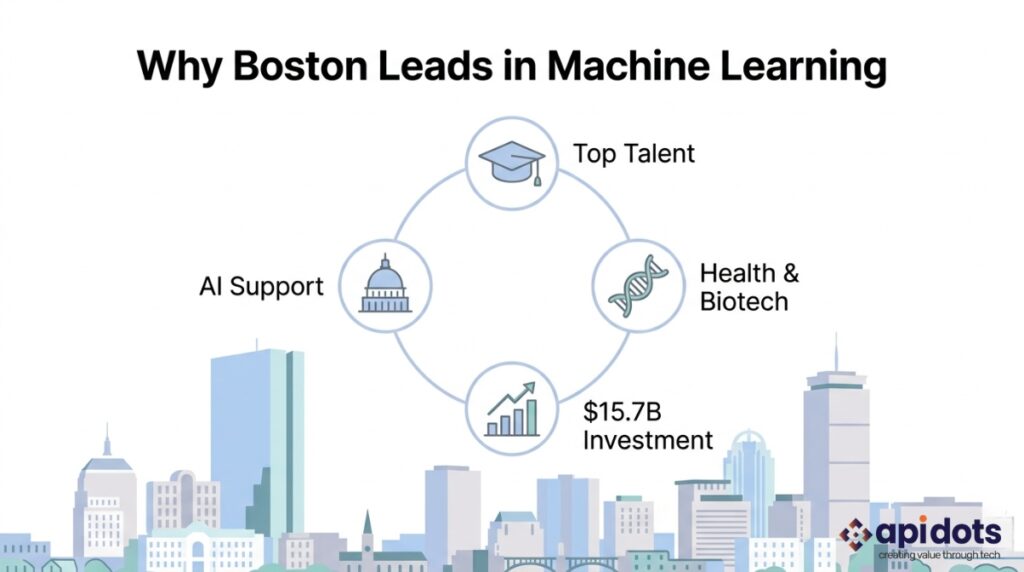
Three things make Boston special for machine learning. The first is talent. MIT in Cambridge, Harvard across Cambridge and Boston, and Northeastern in the Fenway neighbourhood collectively produce more machine learning graduates than almost any university cluster in the world. This gives Boston ML companies access to exceptional technical talent right on their doorstep. Grand View Research projects the global machine learning market to grow from $65.28 billion in 2026 to $432.63 billion by 2034 — and Boston is positioned near the front of that growth because of its talent density.
The second is the ecosystem. Boston raised $15.7 billion in venture capital in 2024 according to PitchBook. A large portion of that went into HealthTech and biotech companies — industries that use machine learning more intensively than almost any others. This means Boston ML companies have built real systems for genuinely difficult, high-stakes problems in regulated environments. They are not running training exercises. They are building systems that doctors, compliance teams, and financial regulators actually rely on.
The third is the government support. In December 2024, Massachusetts Governor Maura Healey launched the Massachusetts AI Hub with $100 million in state funding to grow AI and ML development across the region. This creates grants, co-investment opportunities, and state procurement contracts that give Boston ML businesses an additional growth engine. For a broader view of how ML is being integrated into business products across the US, AI and machine learning in SaaS applications explains the patterns clearly.
Below are eight ML development companies worth knowing about in Boston. These are not scraped from a directory. Each description explains what the company actually does, who they serve, and what makes them worth evaluating. API DOTS is listed first because it is the firm this guide is produced by — and the one we believe is best suited to the widest range of Boston business buyers.
| 1. API DOTS — apidots.com — serving Boston and nationwide API DOTS is a specialist machine learning and AI development company that works with Boston businesses to build production ML systems. Production means the system is actually deployed and working in the real world — not just a demo model that lives in a presentation and never gets used. This distinction matters more than almost anything else when choosing an ML development partner in Boston.What makes API DOTS different is where every engagement begins. Before writing a line of code, the team at apidots.com spends two weeks doing discovery work: understanding your business problem in detail, checking whether your data is good enough to learn from, and mapping out the compliance or regulatory requirements your industry operates under. This two-week process is what prevents the expensive, demoralising failures that happen when companies skip straight to building. API DOTS has built production ML systems for businesses in HealthTech, FinTech, logistics, and enterprise software across Boston and the wider US. Their AI and ML development services range from a focused ML model for a single business problem to full-scale AI platform development. Every system is built to run on AWS or Azure — the cloud infrastructure most Boston businesses are already using — which means no complicated migrations or parallel systems to manage.For Boston businesses in healthcare, financial services, or life sciences — industries where regulatory requirements are strict and data quality is critical — the team at apidots.com is built specifically for this environment. Start with a free 30-minute consultation or explore the full range of services. |
| 2. Kensho Technologies — Harvard Square, Cambridge (S&P Global)Kensho is one of Boston’s best-known ML companies, based in Harvard Square in Cambridge. They specialise in machine learning for financial data, building systems that help banks, investment firms, and government organisations make faster and more accurate decisions using large volumes of structured financial information. Kensho was acquired by S&P Global and now operates as the AI and ML research arm of one of the world’s largest financial data companies. Their work includes natural language processing of earnings calls and ML-powered analytics across a 500 million-plus document library. Kensho is best suited to large financial services organisations with significant internal data infrastructure. They are not a typical development firm available for general hire. |
| 3. Iterative Health — CambridgeIterative Health is a Cambridge-based company applying machine learning to medical imaging, specifically in gastroenterology — the field of medicine covering the digestive system. They build computer vision systems, which is software that can analyse medical images the way a trained specialist would, to help doctors detect and monitor conditions like inflammatory bowel disease more accurately and consistently. Iterative Health’s focus is narrow and deep: they work specifically in GI medicine, which means their models are trained on highly specialised clinical data from that field. For Boston healthcare organisations that need ML applied to imaging or diagnostics, Iterative Health shows what genuine sector-specific ML excellence looks like. They are primarily a product company rather than a development firm available for hire. |
| 4. Tempus — Boston officeTempus is a technology company applying AI and machine learning to precision medicine, which means using patient data to help doctors personalise treatment decisions for individual patients rather than following a one-size-fits-all approach. Their platform combines one of the world’s largest multimodal clinical datasets — that means data from multiple sources including imaging, genomics, and clinical records — with ML tools that analyse this information together. Tempus works primarily with hospitals and cancer centres, including several in the Boston area. They represent the frontier of what HealthTech ML looks like when applied at scale to oncology, and their Boston presence reflects the city’s position as the world’s leading HealthTech market. |
| 5. Krazimo — BostonKrazimo is a Boston-based technology and AI development company with a growing track record in ML-powered software for education and enterprise clients. They have built AI-driven grading systems, workflow automation tools, and custom software solutions for businesses across multiple industries. Client reviews highlight their project management quality, technical responsiveness, and competitive pricing. For Boston SMEs that need machine learning integrated into operational workflows — without the overhead of a large agency — Krazimo is a practical option to evaluate. They work well for clients with clearly defined, well-scoped ML requirements. |
| 6. InterSystems — CambridgeInterSystems has been building mission-critical software for over 45 years, and its Cambridge headquarters put it at the centre of Boston’s healthcare and life sciences ML market. Mission-critical means software that organisations depend on so completely that if it fails, the organisation cannot function. Their platform powers the information infrastructure behind some of the world’s most data-intensive healthcare and government systems. For ML specifically, InterSystems is best known for its data fabric and analytics capabilities, helping organisations bring together disparate data sources — data that lives in different systems and different formats — to enable AI and ML applications across them. |
| 7. MORSE Corp — BostonMORSE is a Boston-based technology company applying machine learning to some of the most demanding environments in the US, including defence, national security, and aerospace. Their team of scientists and engineers builds ML systems for the US National Security Ecosystem, with specialisms in computer vision, natural language processing, and autonomous systems. Computer vision is software that can see and interpret images and video the way a human eye would. MORSE is not a commercial ML development firm available for general hire, but their presence in Boston is a strong signal of the city’s depth in applied ML across regulated and mission-critical sectors. |
| 8. Shift Technology — Boston officeShift Technology provides ML-powered fraud detection and claims handling software to insurance companies. Their algorithms — the rules the software uses to make decisions — are built specifically for the insurance industry, trained to detect complex fraud patterns that traditional rule-based systems miss, and designed to be transparent enough that insurance adjusters can understand and act on the recommendations. Transparency in ML means the software can explain why it made a particular decision, which is important in regulated industries where decisions can be challenged. Shift’s Boston office reflects the city’s growing FinTech and InsurTech ML market. |
There are five things that reliably separate good ML development companies from expensive disappointments. These apply whether you are in Kendall Square, the Seaport, Waltham, or anywhere across Greater Boston.
A good ML development company does not send you a proposal in 24 hours without asking to see your data first. If a company gives you a detailed quote before asking about your business problem in depth, that is a warning sign. It means they are fitting your problem into a template rather than understanding it. The team at apidots.com always starts with a discovery conversation before making any recommendation. Sometimes that conversation reveals that machine learning is not the right solution yet, and they will tell you that honestly.
Machine learning for a Boston hospital is different from machine learning for a Boston retailer. The data is different. The rules are different. The approval processes are different. Massachusetts General Hospital’s data governance requirements are different from a Seaport logistics company’s data requirements. Look for a company that has built ML systems for businesses similar to yours. Ask specifically: have you built something like this before, and can I speak to someone who used it? For a broader guide on how to evaluate any software development partner, this guide to choosing the right development company covers the criteria that matter most.
If a development company cannot explain their plan clearly to a non-technical founder or operations manager, that is a communication problem that will make the entire project harder. The best ML companies in Boston know how to talk to business people, not just to other engineers. You should never leave a meeting with an ML development company feeling more confused than when you arrived.
A machine learning model is not like a website. It needs to be checked regularly to make sure it is still making accurate predictions as your data changes over time. This process is called monitoring, and it is how you catch a model that has quietly started making worse predictions because your business or your market has changed. If a company’s proposal ends at the words ‘we deliver the model,’ ask what happens six months later. The right answer includes monitoring and maintenance as part of the service, not as an optional extra you pay for separately.
The best development partners will tell you if your data is not good enough yet, or if machine learning is not the right solution for your specific problem at this stage. That honesty is rare and enormously valuable. It is far better to hear it in week one than to discover it after six months and $150,000.
Cost is one of the first questions Boston business owners ask, and it is also one of the most variable answers in the ML industry. Here is a plain-English guide to what different types of ML projects cost in Boston in 2026.
A focused ML project with a clearly defined problem — for example, a demand forecasting model for a retail business in Back Bay or a document classification system for a professional services firm in the Financial District — typically costs between $30,000 and $80,000 and takes eight to twelve weeks to deliver.
A more complex ML system with multiple components, regulatory requirements, or deep integration into existing software typically costs between $80,000 and $200,000 and takes four to six months. This is the range where most Boston HealthTech and FinTech ML projects sit.
An enterprise-scale ML platform built for a large healthcare network, a major financial services firm, or a company handling millions of daily transactions typically costs from $200,000 upward. One number that puts all of this in context: hiring one senior ML engineer in Boston costs more than $280,000 per year including salary and benefits according to Glassdoor 2026 data. Partnering with a specialist ML development firm gives you an entire team — data engineers, ML engineers, cloud infrastructure specialists, and a project lead — for a defined project at a predictable cost. For more detail on what drives ML and AI development costs, our custom software development cost guide breaks down every variable.
McKinsey research shows organisations that deploy ML at scale report 20 to 30% reductions in operational costs. For Boston businesses in HealthTech and biotech, where even small efficiency gains translate to significant revenue impact, this return on investment makes ML development one of the most commercially justified technology investments available.
API DOTS is a specialist AI and machine learning development company. That word specialist matters. The engineers on every API DOTS engagement have built ML systems that are live, deployed in real businesses, and delivering real results. ML development is not one of twenty services. It is the only thing the team at apidots.com does. This focus is a practical advantage: every process, every tool, and every team member is built around the same type of problem. For an overview of the full capabilities the team brings, see the AI and ML development service page.
Three things Boston clients consistently say they value about working with API DOTS. First, the discovery process. Every engagement starts with two weeks of work reviewing the data, understanding the compliance environment, and defining the problem precisely before any building begins. This step prevents the failure pattern where a company spends $100,000 or more building the wrong thing. The team at apidots.com will not start building until both parties have agreed in writing on exactly what the system needs to do and what success looks like.
Second, production delivery. API DOTS builds systems that run in the real world, deployed on AWS or Azure, integrated into existing software, with monitoring and automated maintenance included as standard. Not demos. Not prototypes. Production systems that work after the project ends. Third, sector experience. For Boston businesses in HealthTech, FinTech, life sciences, and healthcare — the industries that dominate the Boston ML market — apidots.com has direct experience navigating the compliance and regulatory requirements those sectors demand. The healthcare software development team understands FDA SaMD requirements, Massachusetts Medicaid procurement processes, and HIPAA data architecture from the ground up.
Explore the full range of services at apidots.com, meet the team, or read the complete Machine Learning Software Development guide for a detailed walkthrough of how production ML development works from start to finish.
| Ready to find the right ML development partner in Boston? Whether your business is in Kendall Square, the Seaport, Back Bay, Waltham, or anywhere across Massachusetts, the team at apidots.com is ready to help. Start with a free 30-minute consultation — no technical jargon, just honest answers about what machine learning can do for your business. Contact API DOTS for a Free Consultation → |
What is the difference between machine learning and regular software?
Regular software follows rules that a programmer writes by hand. For example: if the customer spends more than $100, offer a discount. Machine learning software learns its own rules from data. You show it 10,000 past customer transactions and it figures out on its own which customers are most likely to buy again, without anyone programming each rule manually. This makes ML particularly useful for complex problems where there are too many patterns for a human to programme directly. Most ML development companies in Boston specialise in turning this capability into practical, deployable systems for specific business problems.
How do I know if my Boston business is ready for machine learning?
You are probably ready if you have at least 12 months of historical data in a consistent format, a specific business problem you want to predict or automate, and a clear idea of what success looks like. You are probably not ready if your data is scattered across different systems, is missing a lot of records, or has not been collected consistently. The team at apidots.com will tell you honestly in a free 30-minute call whether your data is ready, and if it is not, exactly what to do first.
How long does it take to build a machine learning system for a Boston business?
For a focused, well-defined ML project — such as a customer churn prediction model or a document classification system — expect 8 to 12 weeks from kick-off to deployment. Add two weeks at the start for discovery and data review, and you are looking at 10 to 14 weeks total. More complex projects with multiple components, regulatory requirements, or deep software integrations typically take 4 to 6 months. The biggest single variable is data quality. Clean, well-organised data compresses every timeline significantly. Messy data that needs to be cleaned and reorganised before training can add weeks to any project.
What industries in Boston use machine learning the most?
Healthcare and life sciences are by far the largest ML buyers in Boston, which makes sense given that Boston is home to Massachusetts General Hospital, Dana-Farber Cancer Institute, and Brigham and Women’s Hospital, plus the largest life sciences cluster in the world centred on Kendall Square in Cambridge. According to MassBio, Boston-Cambridge life sciences companies raised $55.9 billion in venture capital between 2019 and 2024. Financial services is the second-largest ML buyer category in Boston, including insurance companies, investment firms, and FinTech startups across the Back Bay and Financial District. Retail, logistics, and enterprise software are also active ML markets across Greater Boston, Waltham, and the Route 128 technology corridor.
Why should I choose API DOTS over other ML development companies in Boston?
API DOTS is a specialist ML development firm — the only thing the team does is build and deploy ML systems. Every project starts with two weeks of discovery work to make sure the problem is defined clearly and the data is good enough before any building starts. Every system is deployed in a live production environment, not just as a demo, with monitoring and maintenance included as standard. For Boston businesses in HealthTech, FinTech, or life sciences where regulatory requirements matter, API DOTS builds for those requirements from day one. For predictive analytics in finance and manufacturing specifically, this overview of AI and ML development for Chicago finance and manufacturing clients shows the same production-first approach applied to a different sector. Start with a free 30-minute call at apidots.com/contact/ to see whether API DOTS is the right fit for your Boston project.
We engineer and integrate custom ML software solutions end-to-end. Delivering predictive models, data insights, and measurable business results.
Get ML Development Services
I’m a digital marketer with experience in SEO, content strategy, and online brand growth. I specialize in creating optimized content, improving website rankings, building high-quality backlinks, and driving traffic through effective digital marketing strategies. I enjoy helping businesses strengthen their online presence and turn visitors into customers.