
Top
Search
People also search for:
Stay Inspired with Instagram




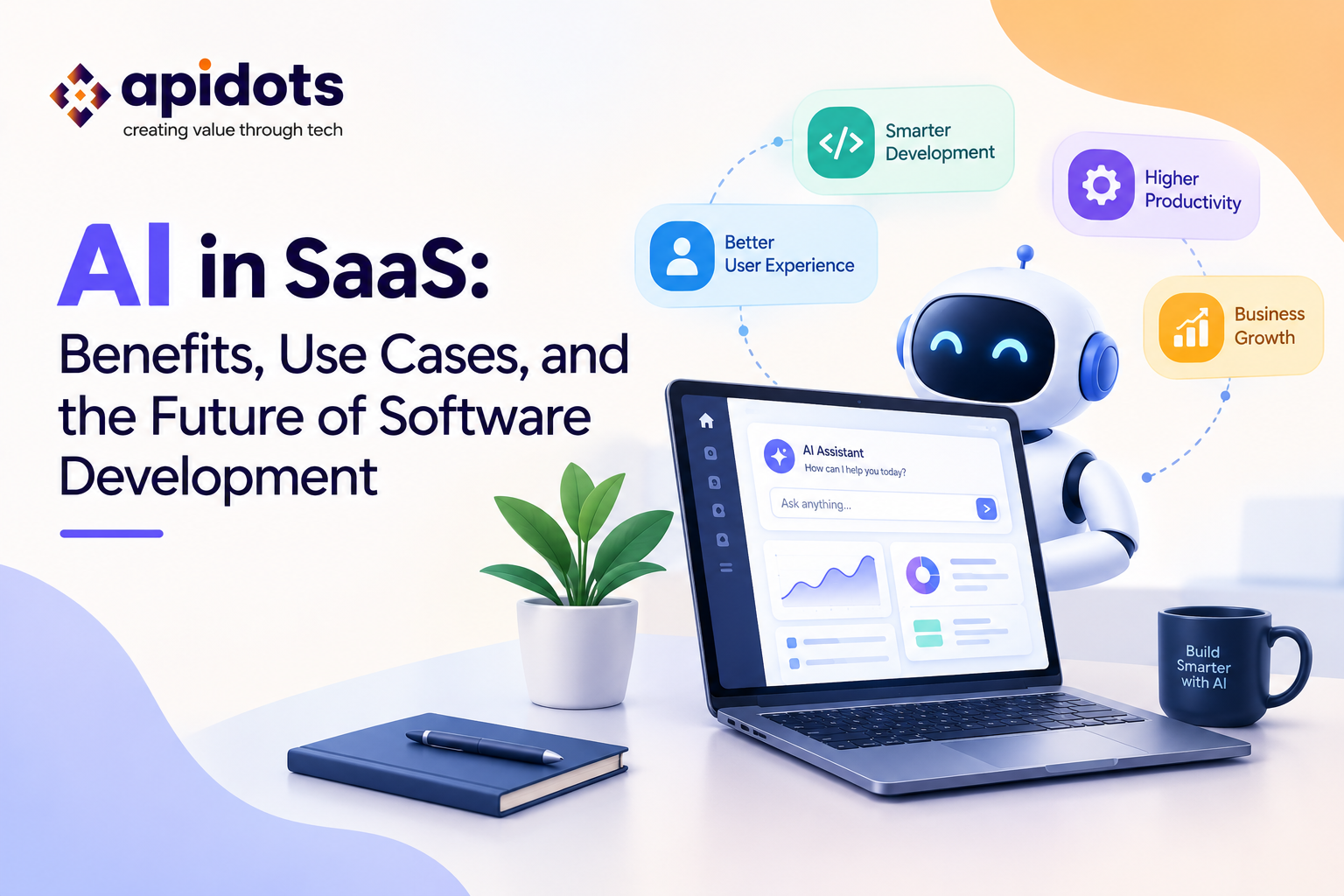
Artificial intelligence is changing what users expect from software. Traditional SaaS applications were largely built around dashboards, workflows, search, reports, and user-driven actions. AI is adding another layer: software can now understand context, generate content, identify patterns, make recommendations, and automate parts of a workflow.
This shift is influencing both how SaaS products are built and how they compete in the market. McKinsey describes the emerging AI-SaaS model as a combination of the scalability of SaaS with the intelligence and automation capabilities of AI, while agentic AI is increasingly being explored for workflows that previously required multiple manual steps.
For businesses investing in saas app development, this creates significant opportunities, but also introduces new considerations around architecture, data privacy, security, cost, model selection, and responsible AI implementation.
AI-powered SaaS refers to cloud-based software that incorporates artificial intelligence into its features or underlying workflows.
The AI component can perform relatively simple tasks, such as classifying information or recommending an action, or more advanced functions such as natural-language interaction, content generation, document analysis, forecasting, and autonomous workflow execution.
For example, a conventional customer-support platform might allow an employee to search a knowledge base and manually respond to a customer. An AI-enabled version could understand the customer’s question, retrieve relevant information, draft a response, and escalate the issue when human intervention is required.
The important distinction is that AI should solve a meaningful product problem. Adding a chatbot simply because AI is popular does not necessarily improve a SaaS product.
The strongest AI implementations are not necessarily the ones with the most visible AI features. They are the ones that remove friction from an existing workflow.
AI can help SaaS products:
This can change the role of software from a passive tool into a more active assistant.
However, businesses should evaluate AI based on measurable product value rather than novelty. A feature that saves users several minutes every day may have more practical value than an impressive but rarely used generative AI feature.
One of the clearest benefits of AI is automation.
SaaS platforms often contain repetitive processes involving data entry, categorization, reporting, document processing, customer communication, and administrative work.
AI can assist with these activities by interpreting information and taking predefined actions.
For example, an expense-management platform could automatically categorize transactions, identify unusual spending, and request additional information when required. Users still remain in control, but much of the repetitive work can be reduced.
AI allows SaaS applications to adapt experiences based on user behavior, preferences, context, or historical information.
A project management platform could recommend tasks based on previous activity. An e-learning platform could suggest learning material based on performance. A CRM could prioritize leads based on relevant customer and engagement signals.
Personalization becomes particularly valuable when a SaaS product serves a large and diverse user base.
SaaS platforms can collect substantial amounts of operational data. The challenge is often turning that data into useful information.
AI can identify patterns across datasets and help users understand what deserves attention.
For example, an analytics platform could identify an unusual decline in conversions and highlight the segments or time periods associated with the change.
The AI does not necessarily replace conventional analytics. Instead, it can make analytical information easier to interpret and act upon.
Natural-language interfaces are changing how users interact with software.
Instead of navigating several screens to locate information, users can increasingly ask questions using everyday language.
For example:
“Show me customers whose subscriptions are likely to expire next month.”
An AI-enabled SaaS application could interpret the request, retrieve relevant data, and present the result.
This does not mean every application needs a conversational interface. The appropriate interface depends on the users, workflow, and complexity of the product.
AI applications vary significantly across industries. Some of the most practical use cases include the following.
AI can classify support tickets, suggest responses, retrieve information from knowledge bases, summarize conversations, and route complex issues to appropriate employees.
The most effective systems generally include an escalation mechanism rather than attempting to automate every interaction.
Traditional keyword search can struggle when users do not know the exact terminology used in a database.
Semantic search can help users find information based on meaning rather than exact word matches.
This can be useful in SaaS platforms containing large collections of documents, support articles, contracts, or internal records.
Marketing, productivity, HR, education, and collaboration platforms can use generative AI to create drafts, summaries, descriptions, reports, and other content.
The application should provide appropriate controls for reviewing and editing generated content, particularly when accuracy matters.
AI can identify patterns in historical data and generate predictions or risk signals.
Examples include:
These predictions should be presented with appropriate context rather than treated as unquestionable facts.
Recommendation systems can help users discover products, content, workflows, or actions relevant to their needs.
For example, a learning platform could recommend courses, while a B2B SaaS application could suggest relevant features or workflows based on a customer’s usage.
One of the more significant developments is the movement from AI that simply responds to prompts toward AI systems that can perform multiple steps within a defined workflow.
An AI agent might interpret a request, retrieve information, use an approved tool, perform an action, and report the result.
This area is still evolving, and businesses should introduce appropriate permissions, monitoring, human oversight, and failure-handling mechanisms rather than allowing unrestricted autonomous actions.
AI does not simply add another feature to a SaaS application. It can influence the entire development architecture.
Teams providing saas development services may need to consider model APIs, data pipelines, vector databases, retrieval systems, prompt management, evaluation frameworks, observability, security controls, and fallback mechanisms.
A typical AI-enabled architecture might involve:
User Interface → Application Layer → AI Orchestration → Model → Business Data/Tools → Response
The actual architecture depends on the use case. Some applications may use a third-party model API, while others may require specialized or fine-tuned models.
The key is to avoid selecting technology before understanding the product requirement.
AI implementation involves more than choosing a model.
AI systems depend heavily on the quality and relevance of the information they receive.
Poor, outdated, incomplete, or incorrectly structured data can lead to unreliable results. Organizations should therefore establish appropriate data-management and validation processes before expecting AI to solve data-quality problems.
AI features may process sensitive customer or business information. Access controls, encryption, data retention, logging, and secure integration practices should be considered during architecture design.
OWASP recommends additional protection for sensitive information such as personal data, financial information, health records, and business secrets.
AI workloads can introduce additional infrastructure and API costs. The cost of every AI interaction should be considered alongside expected usage.
For some workloads, a smaller model may be sufficient. Others may justify a more capable model. Caching, batching, retrieval strategies, and sensible usage limits can also influence operating costs.
Generative AI can produce incorrect or misleading responses. Therefore, applications should be designed around the consequences of failure.
For low-risk use cases, users may simply edit an AI-generated draft. For high-impact decisions, stronger validation and human review may be necessary.
Whether you are creating a new AI-native SaaS platform or adding AI capabilities to an existing application, the development partner you choose can influence the quality and maintainability of the product.
When evaluating AI Development Services, look beyond a company’s list of AI technologies. Ask about its experience with production systems, data security, cloud architecture, testing, monitoring, and AI evaluation.
For organizations specifically looking for an AI Development company in san francisco, location can be one consideration, but it should not replace technical and product evaluation. The same applies when comparing saas development services in uk with providers in other regions. Consider the team’s relevant experience, communication model, security practices, technical capabilities, and ability to support the product after launch.
A strong development partner should also be willing to explain where AI is appropriate—and where conventional software may be the better solution.
The future of SaaS is likely to involve deeper integration between conventional software, generative AI, predictive models, and agentic workflows.
Instead of opening an application and manually completing every step, users may increasingly describe an objective and allow the software to coordinate parts of the process.
For example, instead of manually creating a report, searching for supporting information, analyzing trends, and preparing a summary, a user could ask the system to prepare the report based on approved data sources.
This does not mean traditional SaaS interfaces will disappear. Structured screens, databases, dashboards, permissions, and workflows will remain important because they provide visibility and control.
The bigger change may be that AI becomes an additional interaction layer across those systems.
At the same time, regulation and responsible AI practices will become increasingly important. In the European Union, for example, certain AI Act transparency requirements began applying on August 2, 2026, including requirements concerning transparency for certain interactive AI systems and AI-generated or manipulated content.
For companies serving international customers, regulatory requirements should therefore be considered during product architecture rather than addressed only after launch.
AI is transforming SaaS from a collection of digital tools into increasingly intelligent platforms that can automate workflows, surface insights, personalize experiences, and help users make faster decisions. However, successful AI adoption requires more than simply adding an AI feature. It requires the right product strategy, scalable architecture, secure data practices, and a clear understanding of the problems AI is expected to solve.
At API DOTS, we help businesses turn these opportunities into practical, scalable software products through our expertise in SaaS development services and AI development. From building SaaS applications from the ground up to integrating intelligent capabilities into existing platforms, our team focuses on creating solutions that align technology with real business requirements.
Whether you’re planning a new AI-powered SaaS product, modernizing an existing application, or exploring how AI can improve your workflows, APIDOTS can help you move from concept to a production-ready solution with a product-focused approach.
Ready to build a smarter SaaS product? Connect with API DOTS to discuss your idea and explore the right technology approach for your business.
AI in SaaS development involves integrating artificial intelligence into cloud-based software to automate tasks, analyze data, personalize experiences, provide recommendations, and support intelligent decision-making.
AI can improve SaaS applications by automating repetitive processes, enhancing personalization, enabling intelligent search, generating content, identifying patterns, and helping users complete tasks more efficiently.
Common use cases include AI-powered customer support, predictive analytics, intelligent search, recommendation engines, content generation, document processing, lead scoring, and automated workflows.
Yes. AI can be integrated into an existing SaaS product through APIs, machine-learning models, generative AI, recommendation systems, semantic search, and automation tools, depending on the application’s architecture and requirements.
The cost depends on factors such as product complexity, AI functionality, integrations, data requirements, security, technology stack, and development scope. A detailed project assessment is usually required to determine a realistic budget.
APIDOTS provides SaaS development services and AI development solutions for businesses looking to build new products or enhance existing applications. Its approach focuses on scalable architecture, practical AI integration, user requirements, and long-term product development.
We build and deploy end-to-end AI software solutions for businesses. Accelerating efficiency, automation, and intelligent decision-making.
Get AI Development Services