
Top
Search
People also search for:

Stay Inspired with Instagram




As the financial sector embraces digital transformation, fintech app development sits at the crossroads of innovation and regulation. The rise of mobile banking, peer-to-peer payments, and open-banking APIs has placed unprecedented demands on the software that powers finance. Yet this opportunity comes with responsibility. Banks, insurers, and investment firms operate in some of the world’s most regulated environments; regulators insist on strict security and compliance, while customers expect frictionless, personalised experiences.
This article discusses how disruptive technologies, including blockchain and artificial intelligence (AI), can create new value for financial services, why security and compliance are mission-critical, and how modern payment gateways facilitate trusted digital transactions.
McKinsey’s report, released in 2025, predicts that AI will generate an additional $1 trillion in annual value for the global banking sector by 2030. With over 60% of banking industry executives incorporating AI into core business operations, we can now confidently affirm that AI has left the experimentation phase and is now an integral part of value creation and competitive differentiation.
The financial services industry has a significant regulatory burden because it needs to protect the consumer and reduce fraud. Regulations present themselves as both an obstacle and an enabler of innovation; take the EU’s Payment Services Directive 2 (PSD2) and General Data Protection Regulation (GDPR) as examples.
PSD2 requires strong customer authentication (SCA) for electronic payments and compels banks to open account information and payment services to licensed third-party providers. The regulation promotes competition and innovation by allowing fintechs to access banking data via secure APIs, while ensuring security through multi-factor authentication and customer consent. SCA, for instance, obliges fintech apps to implement two of three factors—something the user knows (password), has (hardware token or phone), or is (biometrics). By building PSD2-compliant payment flows, fintech developers gain access to open-banking opportunities without compromising customer trust.
GDPR stipulates that organizations must receive explicit consent to use individuals’ personal data and also mandates secure storage and serious penalties for breaches. Fintechs in particular must also incorporate privacy by design, encrypt personal data both in transit and at rest, and anonymise data where appropriate. There are several data security compliance frameworks, including PCI DSS, SOC 1, and ISO 27001, that should be included in the software development lifecycle. More important than paying fines, it builds confidence with customers and provides a competitive separation from brands that do not comply with all guidelines.
Multi-factor authentication (MFA) and biometrics. MFA or biometric verification (fingerprint, facial recognition) should be implemented at login and for high-risk transactions
Tokenisation and encryption. End-to-end encryption should be used for any data generated from a transaction. Sensitive payment details should be tokenized. Tokenization reduces the impact of a data breach because a merchant will only retain a non-sensitive number rather than the card number. In fact, by 2025, it is expected that 60% of merchants will use payment tokenization, while 90% of card-issuing banks will use EMV.
Ongoing monitoring and anomaly detection. Use machine-learning models to monitor transactions in real time and flag any suspicious behavior. One survey found that AI-enabled fraud detection systems block fraud up to 92% of the time before they are approved. * Routine security audits and compliance checks. Perform penetration testing, keep current documentation, and ensure compliance with local regulations (e.g., PSD2 in Europe, the Dodd-Frank Act in the United States, and the local AML/KYC policies).
By implementing these approaches, fintech apps can meet regulators, protect users’ data, and establish the trust necessary to compete in the financial services industry.
Blockchain technology has now moved from the hype stage and has evolved to be implemented in critical areas of financial services. At its core, a blockchain is a secure, immutable ledger that records transactions across a common distributed network; this distributed ledger enables transparency, security, and efficiency.
Cross-border payments continue to be slow, opaque, and costly. Typically, payments travel through many intermediaries that take fees and slow the transactions. Blockchain solves these problems by enabling direct peer-to-peer platform protocols (cost reductions) that settle in almost real time. TechRemit did an analysis and identified several benefits: less reliance on intermediaries (cost savings). For remittances and B2B payments, smart contracts can automate settlement and reduce human error. Stablecoins—cryptocurrencies pegged to fiat currency—add further benefits by reducing currency volatility; major banks now pilot tokenised deposits and stablecoins with built-in KYC/AML control.
Blockchain adoption in finance is growing rapidly. A survey done by CoinLaw revealed that more than 81 % of worldwide financial institutions are considering or utilizing blockchain solutions, with the financial blockchain market estimated to reach 22.46 billion US dollars by 2026. This excitement is reinforced by transaction volume: blockchain payment systems transacted 1.7 trillion US dollars in 2023, and 91 % of central banks are investigating central bank digital currencies (CBDC).
Blockchain networks provide real benefits such as cost savings (approximately 20 billion US dollars yearly from eliminating intermediaries), 88 % reductions in settlement times, 43 % reductions in data breaches, and better access to the unbanked. Stablecoin transactions alone were 7 trillion US dollars in 2023, and upwards of 70 % of U.S. banks are interested in developing or implementing a stablecoin. Banks are exploring stablecoin integration, potentially reducing cross-border payment costs by 5 – 6 %.
In addition to payments, blockchain technology is utilized for asset tokenisation (the process of converting physical or financial assets into digital tokens), decentralised finance (DeFi) solutions, and trade finance applications. Smart contracts can automate insurance claims, streamlining both settlement and supply-chain financing, reducing potential fraud and settlement times. One notable example is a global bank that executed a repossession trade using blockchain as the underlying technology in 2023.
This exemplified the technology’s ability to perform high-value, regulated transactions. For developers of fintech applications, introducing blockchain to products effectively changes the development of applications to integrating user interfaces to wallets, following regulations, implementing key management, and identity verification. Properly executed by a user, blockchain applications can lead to increased transparency while reducing costs and could lead to higher revenue sources for financial institutions.
AI and machine learning are present in many modern finance products. Many banks use AI to search massive datasets, predict, and personalize experiences, or detect anomalies at a speed and scale that pure human judgment will never achieve.
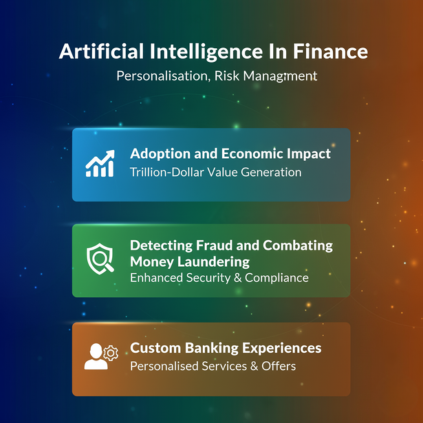
AI is riding a wave of adoption across nearly all sections of the banking industry. According to the official Coinlaw website, 92 per cent of global banks are now implementing artificial intelligence in at least one core function of the bank. AI spending is projected to reach $73.4 billion in 2025. From these institutional developments, the analysts estimate that AI could generate approximately $1 trillion in annual value to the banking industry within the next 2-3 years.
These are crucial domains for AI. Machine-learning algorithms detect patterns of suspicious activity in real-time, helping to minimize false positives and allowing helplines to focus on the highest-risk accounts. Banks deploying AI-powered ALM and fraud risk assessments report reductions in fraud by as much as 53% per year and a 19% cost reduction in compliance. AI has other capabilities, such as the continuous monitoring of credit risk. At M&T Bank, for example, AI is used to pre-fill borrower profiles from tax returns and bank statements, resulting in a faster decision process and reduced workloads. In addition, predictive models are used to anticipate defaults and reprice loans in accordance with risk before the default happens.
AI also enables banks to offer customized products. For example, recommendation engines can provide customized savings plans, investment portfolios, or credit products by using transaction history analysis. In fact, 77% of banking industry leaders suggest that personalization leads to an increase in customer retention, according to a survey. Some success stories of banks using AI in this way are as follows:
While AI will provide value, it will come with challenges. Finance-tech developers will need to ensure that models are explainable, avoid bias, and comply with regulatory direction. In fact, there have been increasing calls from regulators for explainable AI (XAI) frameworks to promote transparency in high-risk decision-making. Even with AI, it remains important to incorporate human intelligence and oversight (human-in-the-loop) in the decision-making process for ethical decision-making and accuracy of decisions.
Ready-made gateways such as Stripe, PayPal, and Adyen provide robust security and compliance out of the box. They comply with PCI DSS guidelines, utilize tokenization and encryption for card data, and offer support for 3D Secure authentication. This process alleviates pressure from ongoing development while ensuring transactions comply with regulations. By 2025, mobile payment transaction value is expected to surpass US$20.37 trillion, and the digital payment gateway market is anticipated to be US$205.9 billion by 2030. Partnering with a trusted gateway means fintech apps can get to market quickly and not worry about other security headaches.
Current gateways offer advanced security and customer-experience features:
Biometric authentication and MFA. Setting up biometrics reduces friction on the user while maintaining security.
Tokenization. This is where a token can replace the card data with a non-sensitive token that can be stored and reused. According to coinlaw.io, about 75% of the financial services providers are expected to use tokenization by 2025, and dynamic tokenization is predicted to increase the security of payments by reducing fraud by 34%.
Fraud detection via AI. The leading gateways use machine-learning models built on data to identify suspicious patterns and lessen chargebacks and false declines.
Multi-currency and local payment options. Accepting local payment options (e.g., SEPA in Europe, UPI in India) simplifies checkout for stateless businesses and allows consumers to checkout with a choice of currencies and local payment options.
The development of fintech apps is at the intersection of opportunity and accountability. Regulatory frameworks, e.g., PSD2 and GDPR, require financial firms to provide security and privacy. Blockchain technology provides transparent, efficient, and lower-cost payment and asset management solutions, and adoption is on the rise for banks and central banks. Artificial intelligence is the driver of personalization and risk management, producing value but requiring explanation and supervision.
By placing value in security, adopting new technologies such as AI and blockchain, and utilizing trusted payment partners, fintech companies can deliver exceptional experiences while building trust and remaining regulatory compliant. Going forward, the finance industry will reward those who build secure, transparent, and customer-first platforms. Join today, Apidots for secure and transparent fintech app development services.
We leverage AI, cloud, and next-gen technologies strategically.Helping businesses stay competitive in evolving markets.
Consult Technology Experts
Hi! I’m Aminah Rafaqat, a technical writer, content designer, and editor with an academic background in English Language and Literature. Thanks for taking a moment to get to know me. My work focuses on making complex information clear and accessible for B2B audiences. I’ve written extensively across several industries, including AI, SaaS, e-commerce, digital marketing, fintech, and health & fitness , with AI as the area I explore most deeply. With a foundation in linguistic precision and analytical reading, I bring a blend of technical understanding and strong language skills to every project. Over the years, I’ve collaborated with organizations across different regions, including teams here in the UAE, to create documentation that’s structured, accurate, and genuinely useful. I specialize in technical writing, content design, editing, and producing clear communication across digital and print platforms. At the core of my approach is a simple belief: when information is easy to understand, everything else becomes easier.