
Top
Search
People also search for:
Stay Inspired with Instagram




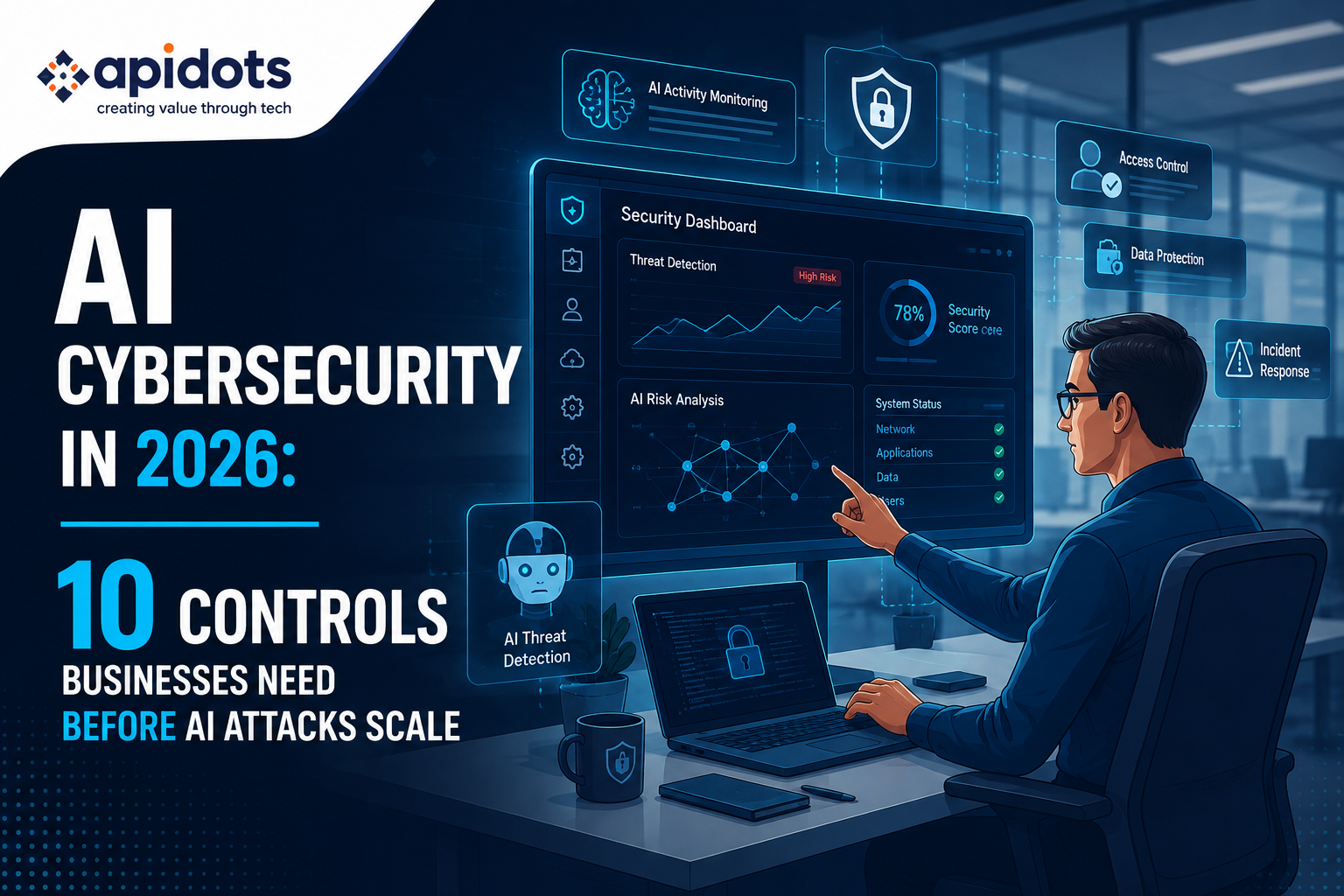
AI adoption is outpacing traditional cybersecurity controls. This guide covers the ten controls businesses need before AI-enabled attacks become faster, more autonomous, and harder to contain.
On August 27, 2026, more than 116 organizations signed an open letter. It was titled “A call for collective action on cyber defense.” Signatories included Anthropic, OpenAI, Microsoft, Google, and AWS. The letter is blunt about the timeline.
It warns that AI-enabled cyberattacks will become far more widespread as models grow more capable. It says businesses have a limited window to close the gaps first.
That warning matters for a simple reason. Most businesses are deploying AI faster than they are securing it. AI cybersecurity in 2026 is no longer a niche concern for security teams. It is a practical, immediate priority for any business running AI models, agents, or AI-assisted development workflows.
This guide breaks down the controls that matter most. It also covers the risks driving them, and the frameworks you can use to prioritize.
AI cybersecurity is the practice of protecting AI systems from misuse and attack. This includes the data and infrastructure connected to them. It also includes using AI tools to make traditional security operations faster and more accurate.
The two halves work together. A business securing its own AI models still needs traditional threat detection. A security team adopting AI-driven monitoring still needs to secure the AI tools doing that monitoring.
In practice, AI cybersecurity spans several areas. These include model access controls, data protection for training and inference data, and API and integration security.
It also increasingly covers the behavior of autonomous AI agents that can take real actions inside a business’s systems.
Three forces are converging this year. First, generative AI has lowered the skill required to run a convincing attack. This ranges from phishing content to automated vulnerability discovery. Second, businesses are adopting autonomous AI agents faster than most security teams can govern them.
Third, the industry itself is now saying this publicly. The August 2026 letter argues that status quo security practices will not be enough. It calls for cyber-capable AI to reach defenders, not just attackers.
Gartner’s own market data backs this up. The firm projects spending on securing AI will grow 68.7 percent from 2026 to 2027.
That reaches almost 4.8 billion dollars. That is not hype. It reflects a common pattern. Many businesses discover their existing tools were not built for AI-specific risks, often only after an incident.
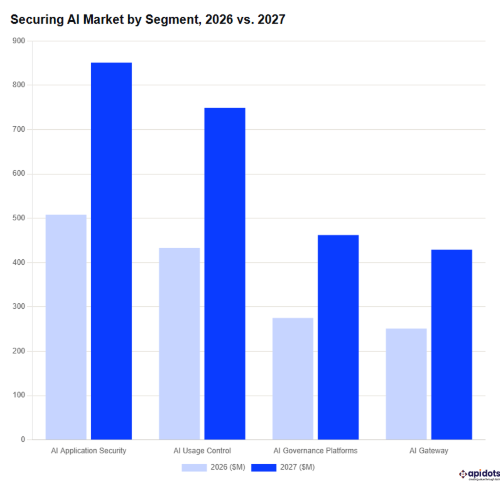
Source: Gartner, “Gartner Forecasts the Market for Securing AI Will Reach $4.8 Billion in 2027,” August 2026. Figures in millions of U.S. dollars.
The OWASP GenAI LLM Top 10 2026 was published in August 2026. It is the clearest current picture of where LLM-specific risk sits. For the first time, the ranking blended practitioner consensus with real incident data. That data came from thousands of documented cases, not just expert opinion. Six of the top risks map directly onto what most businesses face today.
Generative models make convincing, personalized phishing content cheap to produce at scale. This is less a new vulnerability and more an amplifier of an old one. Existing email and identity controls remain the first line of defense.
Prompt injection holds the top spot in OWASP’s 2026 ranking, unchanged from prior years. Attackers hide instructions inside content an AI system processes. This tricks the system into acting against its intended purpose. There is no full technical fix, since instructions and data share one channel inside a model’s context window.
AI systems trained on or given access to sensitive data can leak it back out. This can happen through model outputs, logs, or overly broad retrieval permissions. This risk remains in second place in the OWASP ranking.
This risk moved the most. Excessive agency jumped from sixth place in 2025 to third in 2026. That reflects how many agents now hold tool access, memory, and execution rights. These often go well beyond what a single task requires. Every agent that can send a message, move money, or change a configuration is a new attack surface.
AI models can increasingly scan code and infrastructure for exploitable weaknesses. This capability benefits both defenders and attackers, depending on who deploys it first.
Businesses building on third-party models, open-source components, or plugin ecosystems inherit whatever security posture those dependencies carry. A compromised model file or a vulnerable library can quietly become the weakest link.
You cannot secure AI systems you do not know exist. Start with a live inventory of every model, agent, and AI-powered tool in use. Include tools adopted informally by individual teams.
Every AI agent and service account needs its own traceable identity, not a shared credential. This underpins every other control on this list.
Grant AI agents only the specific tools, data, and systems they need for their task. Gartner projects over half of successful attacks on AI agents by 2029 will exploit exactly this kind of gap.
Set explicit approval gates before an agent takes irreversible or high-impact actions. Examples include sending funds, deleting data, or modifying production systems.
Treat every input an AI system processes as untrusted, including content it retrieves on its own. Input filtering will not eliminate prompt injection, but it narrows the paths an attacker can use.
Apply data loss prevention controls to what AI systems can access and output. Do not limit these controls to what employees can email or download.
Vet the origin and security posture of every model, dataset, and plugin before it enters production. Treat it the same way you would vet a new software dependency.
Log every action an AI agent takes, not just the prompts it receives. Observability is what turns an incident into a fifteen-minute investigation instead of a weeks-long forensic exercise.
Test your AI systems the way an attacker would. Include adversarial prompts and attempts to push an agent beyond its intended scope. Do this before deployment and on an ongoing basis.
Build a response plan specific to AI incidents. Cover how to isolate a compromised agent, revoke its credentials, and audit what it touched.
Most businesses are better served mapping their approach onto existing, widely recognized standards. This is better than building a control framework from scratch.
The NIST AI RMF is a finalized, voluntary framework released in January 2023. NIST added a Generative AI Profile in July 2024. It gives businesses a structured way to identify, measure, and manage risk across the AI lifecycle. It has become a common reference point for AI governance programs.
The Cyber AI Profile, formally NIST IR 8596, organizes AI cybersecurity around three focus areas. These are securing AI system components, using AI for cyber defense, and defending against AI-enabled attacks. It is a useful lens for structuring a program. It is worth noting it remains a preliminary draft as of this writing, with a final version still pending.
The OWASP GenAI LLM Top 10 2026 is the most current, evidence-backed view of LLM-specific risk. It maps directly onto engineering-level mitigations. That makes it especially useful for development and security teams working together.
| Framework | Status | Best Used For |
| NIST AI RMF | Finalized (2023, GenAI profile 2024) | Enterprise-wide AI risk governance |
| NIST Cyber AI Profile | Preliminary draft (Dec 2025) | Structuring a cybersecurity-specific AI program |
| OWASP GenAI LLM Top 10 | Finalized (Aug 2026) | Engineering-level LLM and agent risk mitigation |
Start with visibility before you invest in tooling. An accurate AI asset inventory will surface more risk than most businesses expect.
This often includes AI tools adopted without formal security review. From there, prioritize the controls that address the highest-frequency real-world incidents first. Identity, least privilege, and human approval gates for agents matter more than detection tools alone.
Assign clear ownership. AI security sits at the intersection of engineering, security, and data teams. Without a named owner, it tends to fall between them.
Finally, treat this as a living program. The frameworks referenced in this guide are updated on a roughly annual cycle. Your controls should be reviewed on the same schedule.
Autonomous agents deserve a section of their own because they change the risk calculus. A chatbot that answers questions poorly is an accuracy problem.
An agent with tool access that takes the wrong action is a security incident. Before deploying an agent, confirm it has its own identity. It also needs a permission set scoped to its specific task, and a human checkpoint for anything irreversible.
It is also worth testing agent behavior under adversarial conditions, not just functional ones. An agent that performs well on expected inputs can still be manipulated. Indirect prompt injection can hide inside a document, email, or webpage the agent processes normally.
AI cybersecurity covers two connected disciplines. The first is securing the AI systems a business builds or deploys, including models, data pipelines, and agents. The second is using AI tools to strengthen traditional cyber defense, such as faster threat detection and automated response.
More than 116 organizations signed an August 2026 open letter. Signatories included Anthropic, OpenAI, Microsoft, and Google. It warned that AI-enabled cyberattacks will become far more widespread as models grow more capable. Businesses are also deploying autonomous AI agents faster than they are building the access controls those agents need.
According to the OWASP GenAI LLM Top 10 2026, prompt injection remains the top-ranked risk for LLM applications. Excessive agency is when an AI agent takes actions beyond what it should be permitted to do. That risk jumped from sixth place to third.
Not yet. NIST published the Cyber AI Profile as a preliminary draft in December 2025 for public comment. Businesses can use it today as directional guidance. It is not yet a finalized standard the way the NIST AI Risk Management Framework is.
Yes. Attackers do not limit AI-enabled tools to large targets. Smaller businesses often have thinner security teams to catch AI-specific risks like prompt injection or agent misuse. Starting with an AI asset inventory and least-privilege access costs little. It closes the most common gaps first.
Apidots builds and hardens AI systems for SaaS and enterprise teams, from model architecture to agent access controls.
We build and deploy end-to-end AI software solutions for businesses. Accelerating efficiency, automation, and intelligent decision-making.
Get AI Development Services
Hi! I’m Aminah Rafaqat, a technical writer, content designer, and editor with an academic background in English Language and Literature. Thanks for taking a moment to get to know me. My work focuses on making complex information clear and accessible for B2B audiences. I’ve written extensively across several industries, including AI, SaaS, e-commerce, digital marketing, fintech, and health & fitness , with AI as the area I explore most deeply. With a foundation in linguistic precision and analytical reading, I bring a blend of technical understanding and strong language skills to every project. Over the years, I’ve collaborated with organizations across different regions, including teams here in the UAE, to create documentation that’s structured, accurate, and genuinely useful. I specialize in technical writing, content design, editing, and producing clear communication across digital and print platforms. At the core of my approach is a simple belief: when information is easy to understand, everything else becomes easier. Reach me at amysbrew.com