
Top
Search
People also search for:
Stay Inspired with Instagram




Artificial intelligence is moving beyond systems that simply answer questions or generate content. Businesses are increasingly exploring AI that can interpret a goal, plan multiple steps, interact with software tools, and carry out parts of a workflow with limited human intervention.
This shift has brought agentic AI into the spotlight.
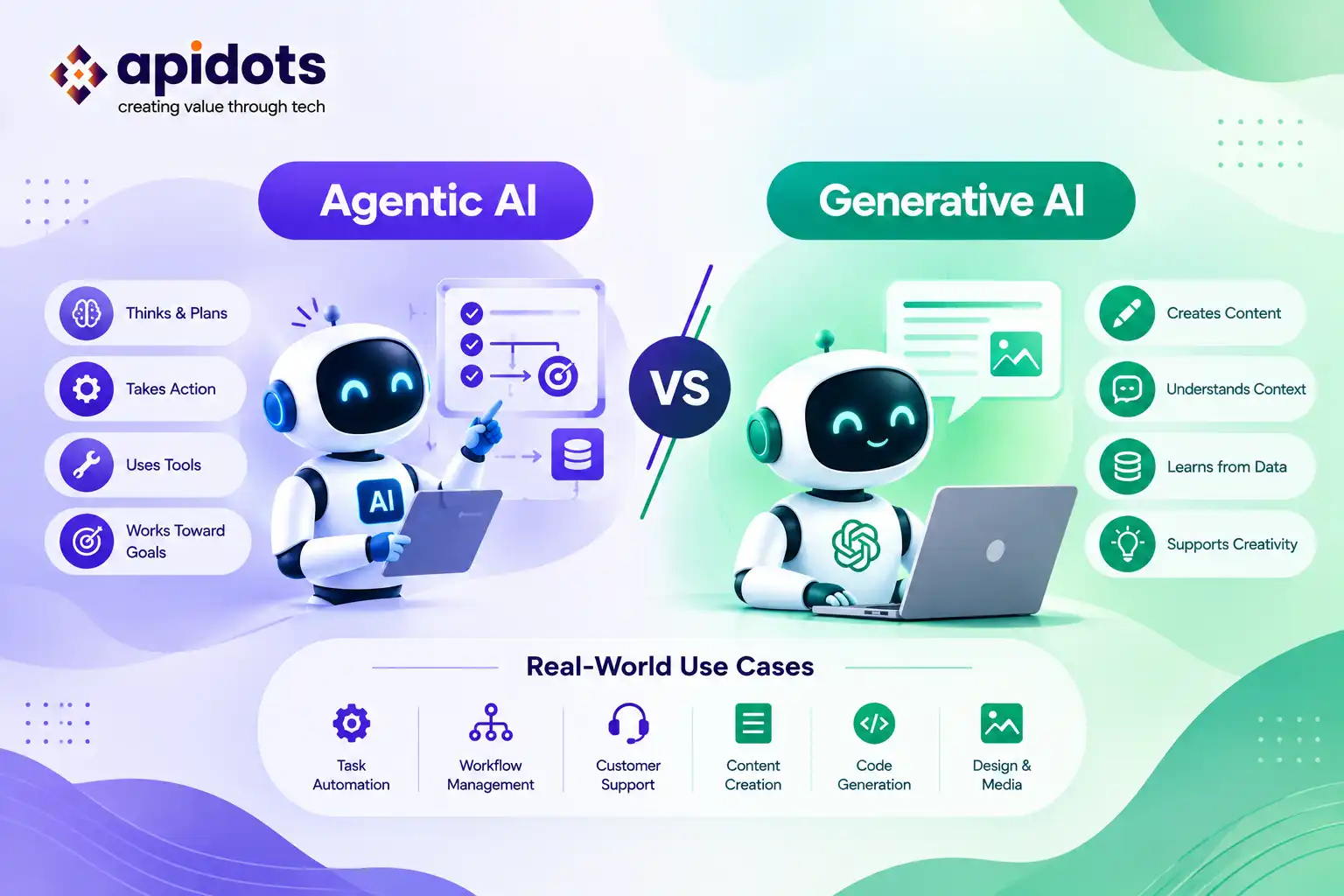
Generative AI and agentic AI are closely related, but they are not interchangeable terms. Generative AI primarily focuses on creating or transforming content such as text, images, code, audio, and video. Agentic AI extends those capabilities toward goal-oriented action: an agent can plan tasks, use tools, evaluate results, and continue working toward an objective. (IBM)
That distinction matters when businesses are deciding where to invest in AI.
If a company needs an assistant to summarize documents or generate marketing copy, generative AI may be sufficient. If the objective is to automate a multi-step process involving several systems, an agentic AI workflow may be more appropriate.
The two technologies are also not competitors in every situation. In many real-world implementations, generative AI acts as the intelligence behind an agentic system.
Let’s examine the differences, capabilities, use cases, benefits, limitations, and practical considerations businesses should understand before choosing an AI approach.
Generative AI is a category of artificial intelligence designed to create new content based on an input, instruction, or context.
Modern generative AI systems can produce:
For example, a marketing team might use generative AI to create a first draft of an email campaign. A developer might use it to generate code suggestions. A customer-service representative could use it to summarize a long conversation and draft a response.
The defining characteristic is generation.
The user generally provides an instruction, the model processes the available context, and the system produces an output. The user can then review, refine, or request another output.
This makes generative AI particularly useful for knowledge work and content-intensive tasks. However, generated information can still contain errors, so human review remains important when accuracy has significant consequences. (IBM)
Agentic AI focuses on achieving a goal rather than simply generating an answer.
An agentic system can perceive context, plan actions, use tools, interact with external systems, maintain state, and adapt its behavior as a task progresses. AWS describes an agent as a software system that can use an LLM as a reasoning engine to perceive context, plan actions, execute tasks, and adapt its behavior toward a defined goal. (AWS Documentation)
Consider a customer asking a company to update their subscription.
A conventional generative AI assistant might explain the available subscription options and draft a response.
An agentic system could potentially:
The difference is not simply that the agent generates better text. The difference is that it can coordinate actions toward an objective.
The easiest way to understand the distinction is to compare what each technology is designed to accomplish.
| Factor | Generative AI | Agentic AI |
| Primary purpose | Generate or transform content | Achieve a defined goal |
| Typical interaction | Prompt → response | Goal → plan → actions → outcome |
| Autonomy | Usually lower | Can operate with varying levels of autonomy |
| Planning | Limited or task-specific | Can break objectives into multiple steps |
| Tool usage | Depends on application | Central to many agentic systems |
| External actions | Usually limited | Can interact with systems and APIs |
| Human involvement | Often reviews or directs outputs | Can supervise, approve, or intervene at defined points |
| Best suited for | Content, analysis, summarization, assistance | Multi-step workflows and task execution |
These distinctions are not absolute. Modern AI products increasingly combine both approaches. A generative model can provide the language and reasoning capabilities while an agentic layer manages tools, planning, state, and actions. (IBM)
An agentic AI workflow typically consists of several connected stages rather than one model response.
A simplified workflow looks like this:
Goal → Understand → Plan → Retrieve Information → Use Tools → Evaluate → Act → Verify → Complete
For example, imagine a business asking an AI system:
“Find our customers whose contracts are expiring next month, identify accounts at risk of churn, and prepare a follow-up plan.”
An agentic workflow could:
This is significantly different from asking a generative AI model to simply produce a list of suggested customer-retention strategies.
The agent is responsible for coordinating the workflow.
It would be a mistake to think businesses must choose one technology and abandon the other.
In many cases, the strongest architecture combines both.
Generative AI can handle tasks such as:
The agentic layer can then use those capabilities to:
IBM similarly describes agentic AI as building on generative AI capabilities by adding planning, decision-making, tool use, and multi-step task execution. (IBM)
This combination is important because an AI agent does not necessarily replace generative AI. In many architectures, generative AI is one of the components that enables the agent to understand and reason about a task.
Generative AI is already useful across a wide range of business functions.
Businesses can use generative AI to draft:
Human review remains important for factual accuracy, brand consistency, and quality.
Generative AI can help support teams summarize conversations, draft responses, classify requests, and retrieve relevant information.
This can reduce repetitive work while keeping human representatives involved when situations require judgment.
Developers can use generative AI for code generation, documentation, debugging assistance, test creation, and code explanation.
The role is generally assistive rather than completely autonomous. Production code still needs appropriate testing, review, security checks, and engineering oversight.
Generative AI can summarize large collections of information and provide natural-language interfaces for internal knowledge bases.
Employees can ask questions in ordinary language instead of manually searching through large document repositories.
Generative AI can help create campaign variations, product messaging, customer communications, and personalized content.
Its value increases when it is connected to reliable business context and appropriate governance.
Agentic systems become more valuable when the task involves multiple steps and interactions with other systems.
Instead of simply drafting an answer, an agent could potentially investigate a customer’s issue, retrieve account information, check policies, perform approved actions, and escalate exceptions.
This can transform customer support from a question-answering model into a workflow-execution model.
An AI agent could assist with:
The exact level of autonomy should depend on business risk and the actions involved.
Agentic systems can monitor alerts, gather diagnostic information, identify potential causes, execute approved remediation steps, and escalate complex incidents.
This is particularly useful when troubleshooting requires information from multiple systems.
Agentic AI can support processes such as invoice processing, vendor research, purchase requests, reconciliation, and exception management.
Because financial workflows can carry significant consequences, approval controls and auditability are especially important.
A generative AI system can help write a function.
An agentic development workflow could go further by:
This is one area where agentic engineering is developing quickly, although human oversight remains important for production software. (IBM)
The main appeal of agentic systems is their ability to coordinate work rather than simply provide information.
Agentic systems can connect multiple tasks into a larger process, reducing the need for employees to manually move information between applications.
Instead of asking employees to perform every individual step, an agent can handle appropriate routine actions while humans focus on exceptions and decisions.
When an agent can retrieve information and interact with approved tools directly, certain workflows can move faster than traditional manual processes.
Agents can gather information from several sources before deciding what action should happen next.
Businesses can potentially use agents to support high volumes of routine work without increasing manual effort at the same rate.
However, these benefits depend heavily on system design. More autonomy does not automatically mean better outcomes.
Generative AI has a different value proposition.
It can help organizations:
It is often easier to introduce generative AI into an existing workflow because the initial use case may simply involve assisting a human rather than allowing an AI system to take direct action.
That distinction can be important when an organization is beginning its AI adoption journey.
AI implementation should not be approached as a race toward maximum autonomy.
Both technologies introduce risks, but agentic systems can introduce additional operational complexity because they may be able to take actions across connected systems.
Generative AI can produce inaccurate information. An agent can potentially use incorrect information to make an inappropriate decision or take an incorrect action.
Agents may have access to sensitive systems, databases, APIs, or business tools. Permissions therefore need to be carefully designed.
Every model call, tool invocation, retrieval operation, and infrastructure component can contribute to operating costs.
Businesses need to understand what the system did, why it took an action, what information it used, and where a workflow failed.
Not every decision should be delegated to an AI system.
For high-impact activities, organizations may require human approval before an agent can execute certain actions.
AWS specifically recommends increasing an agent’s level of autonomy only when the complexity of the task requires it. (AWS Documentation)
Generative AI may be the more appropriate starting point when the business problem is primarily about creating, transforming, or understanding information.
Consider generative AI when you need:
If the user still needs to make the final decision or perform the actual action, generative AI can often provide substantial value without introducing unnecessary autonomy.
Agentic AI becomes more relevant when the desired outcome requires several connected actions.
Consider an agentic approach when a workflow involves:
For example, “write an email” is primarily a generative task.
“Identify overdue customers, review their account history, determine the appropriate follow-up, update the CRM, and prepare the communication for approval” is closer to an agentic workflow.
Agentic AI development services involve designing and building AI systems capable of performing goal-oriented, multi-step tasks.
Depending on the project, development may involve:
A mature implementation should begin with the business workflow rather than the AI model.
The first question should be: What outcome are we trying to achieve?
Only then should the development team determine whether a single model, conventional automation, an AI assistant, or an agentic architecture is appropriate.
If you’re evaluating AI Development Services, don’t select a provider simply because it lists the latest AI models on its website.
Look for experience in:
Businesses considering whether to hire AI ML developers should also evaluate how well the team understands the underlying business process.
A technically impressive AI system can still provide limited value if it solves the wrong problem.
Ask potential development partners:
These questions reveal whether a provider is thinking about AI as a production system rather than simply a demonstration.
The future is unlikely to be a simple replacement of generative AI by agentic AI.
Instead, businesses are likely to combine both.
Generative AI can provide the ability to understand language and create content. Agentic systems can use those capabilities within structured workflows involving tools, business data, and external systems.
This creates a new model of software interaction.
Instead of:
User → Application → Manual Actions → Result
we increasingly see:
User → Goal → AI Planning → Tools & Data → Actions → Verification → Result
That does not mean conventional software disappears. Databases, APIs, authentication systems, business rules, user interfaces, monitoring, and security controls remain essential.
In fact, as AI becomes more autonomous, strong software engineering becomes even more important.
The organizations that benefit from agentic AI will need to balance autonomy with control, speed with reliability, and automation with human judgment. Current enterprise guidance increasingly emphasizes governance, security, oversight, and clearly defined goals alongside agent capabilities. (IBM)
Generative AI and agentic AI solve related but different problems.
Generative AI is primarily about creating and transforming information. Agentic AI is about using AI capabilities to pursue a goal, coordinate multiple steps, interact with tools, and complete workflows with varying levels of autonomy.
For businesses, the right choice should come from the workflow not from the popularity of a particular AI trend. A content-generation task may only require generative AI, while a complex process involving multiple systems may benefit from an agentic AI workflow.
At APIDOTS, we help businesses explore and implement practical AI solutions based on their product requirements and operational goals. Our capabilities across AI Development Services, agentic AI solutions, machine learning, and custom software development can support organizations from initial AI strategy and architecture through development, integration, and ongoing optimization.
Whether you want to introduce generative AI into an existing application, automate a multi-step business process, or build a new AI-powered product, APIDOTS can help you evaluate the right approach and develop a scalable solution around your specific requirements.
The goal should not be to make software autonomous simply because it can be. The goal is to use AI where it creates measurable value while keeping the right level of human oversight, security, and control.
Generative AI primarily creates or transforms content such as text, images, code, and summaries. Agentic AI focuses on achieving goals by planning tasks, using tools, making decisions, and carrying out multi-step workflows with varying levels of autonomy.
Often, yes. Many agentic systems use large language models and generative AI capabilities as part of their reasoning and communication layer. The agentic architecture adds elements such as planning, tool use, memory, state management, and goal-oriented actions. (IBM)
Common applications include customer-service resolution, sales operations, IT operations, research workflows, software development, procurement, document processing, and other business processes involving multiple steps and systems.
Agentic AI development services involve designing and implementing AI systems that can work toward defined objectives using tools, APIs, data sources, workflows, and appropriate levels of autonomy. Development may also include security, monitoring, evaluation, and human-approval mechanisms.
The choice depends on the business problem. Generative AI is generally suitable for creating, summarizing, transforming, or analyzing information. Agentic AI becomes more relevant when the task requires planning, multiple actions, tool use, and progression toward a defined outcome.
APIDOTS provides AI Development Services focused on building practical AI-powered solutions for business requirements. Its capabilities can support generative AI applications, agentic workflows, machine-learning solutions, integrations, and custom software development, with an emphasis on scalable architecture and appropriate human oversight.
We build and deploy end-to-end AI software solutions for businesses. Accelerating efficiency, automation, and intelligent decision-making.
Get AI Development Services