
Top
Search
People also search for:

Stay Inspired with Instagram




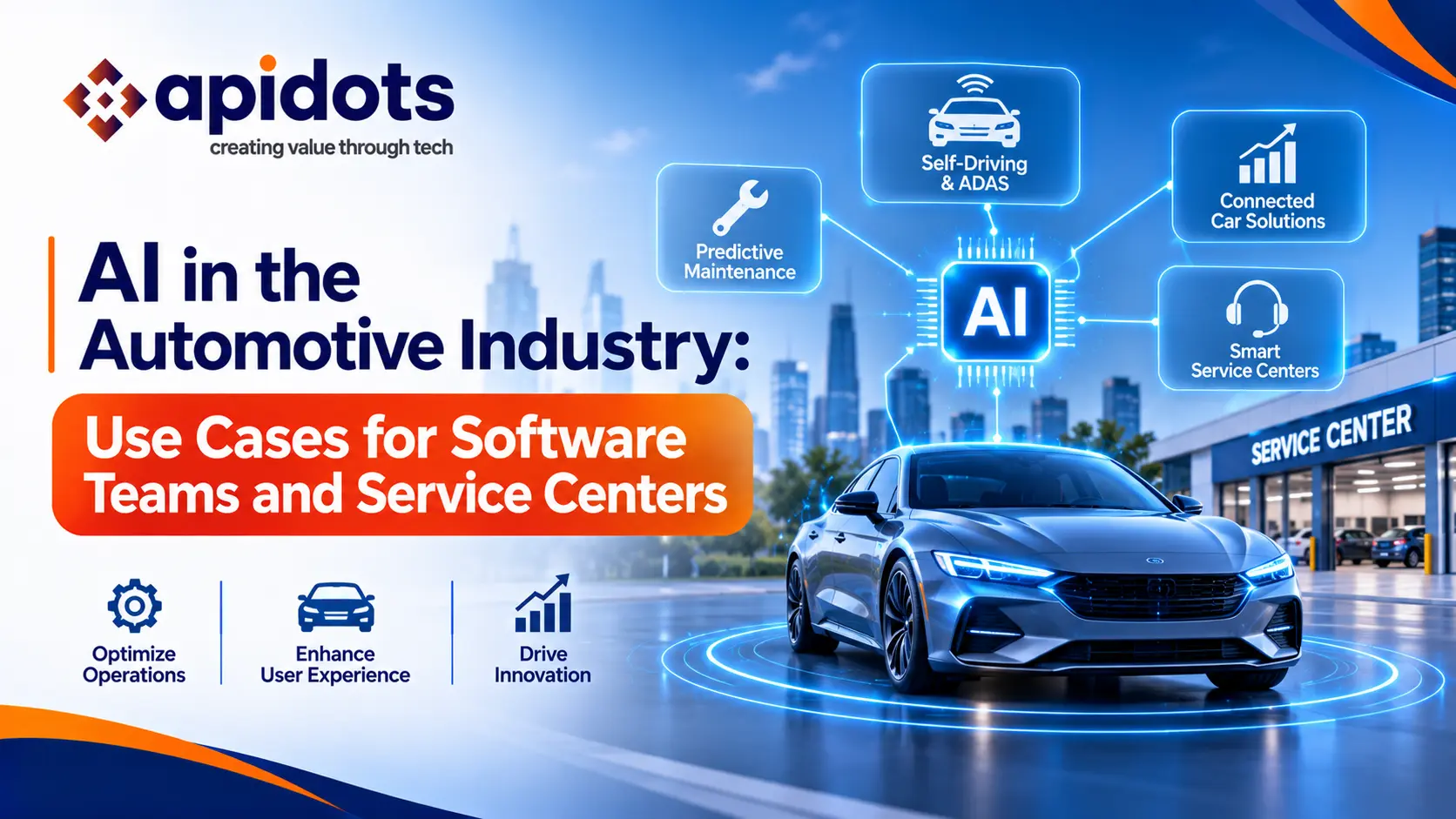
The automotive industry is undergoing a major technological transformation. Vehicles are becoming increasingly connected, software-driven, and intelligent. From advanced driver assistance systems (ADAS) and predictive maintenance to connected vehicle platforms and AI-powered service operations, artificial intelligence is changing how automotive businesses develop, operate, and maintain vehicles.
Traditionally, automotive innovation focused heavily on mechanical engineering, manufacturing efficiency, and vehicle performance. Today, software development and data intelligence are equally important. Automotive manufacturers, suppliers, dealerships, and service centers are exploring AI to improve engineering workflows, identify potential vehicle problems, automate repetitive tasks, and deliver better customer experiences.
The shift toward software-defined vehicles is accelerating this transformation. According to the International Energy Agency, software is becoming an increasingly important part of vehicle functionality, with over-the-air updates allowing manufacturers to improve and update vehicle software after delivery.
At the same time, generative AI is opening new possibilities for automotive software teams. Developers can use AI to assist with code generation, documentation, test creation, and engineering knowledge retrieval. Service centers can use AI-powered systems to analyze vehicle diagnostics, assist technicians, manage appointments, and communicate with customers.
However, implementing AI in automotive environments requires more than choosing an AI model. Businesses must consider data quality, system integration, cybersecurity, functional safety, and human oversight.
This article explores how AI software development is creating opportunities, the most practical AI use cases for software teams and service centers, the role of generative AI, and what automotive businesses should consider before adopting these technologies.
Modern vehicles generate and depend on large amounts of data. Sensors, electronic control units, telematics platforms, cameras, connected applications, and diagnostic systems continuously produce information.
Analyzing this information manually can be difficult, particularly when automotive businesses manage multiple vehicle models, software versions, service locations, and customer records.
AI helps process this information, identify patterns, and support decisions across different automotive operations.
Some important factors driving adoption include:
A 2026 Perforce automotive software development report found that 71% of surveyed automotive professionals were using AI in product design, while 45% reported using AI both in development and as part of the end product. The same research identified safety and security as important concerns when applying AI to automotive systems.
These developments show that automotive AI adoption must balance innovation with reliability.
Automotive software teams work across several areas, including embedded systems, vehicle connectivity, infotainment, ADAS, battery management, cloud platforms, and mobile applications.
AI and machine learning can support different stages of this software lifecycle.
One of the most practical applications is helping software engineers complete development tasks more efficiently.
Generative AI tools can assist with:
For example, an engineer working on a vehicle diagnostics application may use a generative AI assistant to understand an existing code module, draft documentation, or create test cases for review.
This can reduce repetitive engineering effort and help teams work with complex software repositories.
However, AI-generated code should never be treated as automatically production-ready. Automotive software requires rigorous code review, testing, traceability, and validation against applicable engineering and safety requirements.
Predictive maintenance is one of the most valuable applications of AI in automotive operations.
Traditional maintenance often follows fixed schedules or responds after a problem occurs. Predictive maintenance uses vehicle sensor data, diagnostic information, and historical maintenance records to identify patterns that may indicate developing faults.
For example, a machine learning model could analyze:
When the system identifies an unusual pattern, it can generate an alert for further inspection.
For fleet operators, this can help prioritize vehicle inspections and plan maintenance activities. For service centers, it can support earlier communication with vehicle owners.
AI predictions should be treated as decision-support information rather than definitive diagnoses. Technicians must verify the underlying problem before performing repairs.
Automotive software must operate reliably across different vehicle configurations, hardware components, environmental conditions, and operating scenarios.
Testing these systems can involve substantial effort.
AI can assist software teams by:
For example, an AI-assisted testing platform could analyze historical defect reports and suggest additional test scenarios for a newly modified vehicle connectivity feature.
The final testing process should still follow the required engineering standards and verification procedures. AI-generated tests need review to ensure they cover the intended requirements and safety conditions.
Advanced Driver Assistance Systems use technologies such as cameras, radar, sensors, and machine learning to support driving-related functions.
AI and computer vision can help systems recognize objects and interpret road environments.
Relevant applications include:
These capabilities help support functions such as lane-keeping assistance, adaptive cruise control, and automatic emergency braking.
However, ADAS is a safety-critical area. AI models must be evaluated under diverse road, lighting, weather, and traffic conditions. System-level validation, fallback mechanisms, and applicable functional safety processes are essential.
Connected vehicles exchange information with mobile applications, cloud platforms, and other digital services.
AI can analyze this information to support more personalized and responsive vehicle experiences.
Potential applications include:
For example, a connected vehicle platform could analyze vehicle health information and notify an owner when a maintenance inspection may be required.
Software teams can build these capabilities using cloud services, secure APIs, mobile applications, and AI/ML models.
Generative AI is different from traditional predictive machine learning.
Traditional machine learning often analyzes existing data to classify information, estimate outcomes, or identify patterns. Generative AI can produce new content, such as text, code, summaries, explanations, and structured information.
This makes generative AI in automotive particularly useful for engineering assistance, technical knowledge management, service documentation, and customer communication.
Automotive software projects involve detailed technical specifications, system requirements, design documents, and testing records.
Generative AI can help engineers draft requirement descriptions, summarize technical documents, and identify inconsistencies for review.
For example, a development team can use an AI assistant to summarize a lengthy technical specification before preparing implementation tasks.
Engineers must still validate the generated requirements against the original source documents.
Automotive organizations often maintain large collections of technical manuals, engineering documents, service procedures, and troubleshooting guides.
A generative AI-powered knowledge assistant can retrieve relevant information and present it in a conversational format.
For example, an engineer could ask:
“What are the documented dependencies for this vehicle communication module?”
The system could retrieve relevant internal documentation and summarize the information with source references.
This is particularly useful for teams working with complex or legacy automotive software.
Automotive AI development often requires extensive testing data, particularly for computer vision and ADAS applications.
Generative techniques can help create synthetic scenarios for simulation and testing.
Examples include:
Synthetic data can supplement real-world datasets, but it does not automatically represent every real driving condition. Its suitability must be evaluated before using it for model development or validation.
Service centers can use generative AI to prepare customer-friendly explanations from technician-approved diagnostic information.
For example, a system could transform technical repair notes into a clear service summary explaining the reported issue, inspection findings, and recommended next steps.
The technician or service advisor should review the content before it is shared with the customer.
AI is not limited to vehicle engineering and manufacturing. Automotive service centers can also benefit from intelligent software solutions.
Many workshops manage customer enquiries, appointment scheduling, service histories, repair estimates, inventory, and technician assignments.
AI can help connect these activities and reduce administrative workload.
Service technicians often review diagnostic trouble codes, service records, inspection reports, and vehicle symptoms before identifying the next troubleshooting step.
An AI-powered diagnostic assistant can bring these information sources together.
Potential capabilities include:
For example, when a vehicle arrives with a recurring warning light, an AI assistant could retrieve previous repair records and relevant troubleshooting documentation.
The technician remains responsible for confirming the fault and deciding which repair is appropriate.
Service centers receive appointment requests through telephone calls, websites, messaging platforms, and mobile applications.
An AI-powered booking assistant can help customers:
With suitable integrations, the system can also update dealership management or workshop scheduling software.
This can reduce manual coordination and make service booking more convenient.
AI can help service centers identify customers who may need maintenance based on available vehicle usage information, service history, and manufacturer-recommended intervals.
For example, a system could identify vehicles approaching a scheduled service milestone and prepare personalized reminders.
The platform may also identify customers with previously declined repair recommendations and flag records for follow-up.
Businesses should ensure reminders are based on accurate records and applicable communication permissions.
Managing spare parts is a significant operational responsibility for service centers.
AI can help analyze historical demand, repair patterns, seasonal trends, and inventory records to support purchasing decisions.
Possible applications include:
For example, a service center could use historical repair records to estimate which parts may experience higher demand during a particular period.
Forecasts should be reviewed against actual stock levels, supplier lead times, and changing vehicle requirements.
An AI customer support assistant can answer routine questions about service availability, booking details, workshop timings, vehicle collection, and service status.
It can also retrieve approved customer and service information through connected systems.
More complex matters, such as repair disputes, safety concerns, warranty decisions, or unexpected costs, should be escalated to trained staff.
Although both areas benefit from AI, their objectives and implementation requirements are different.
| Area | Automotive Software Teams | Automotive Service Centers |
| Main objective | Improve engineering and software quality | Improve service operations |
| AI applications | Code assistance, testing, ADAS, simulation | Diagnostics assistance, booking, reminders |
| Data sources | Code repositories, test data, sensor data | Service records, vehicle diagnostics, inventory |
| Main users | Software engineers and automotive developers | Technicians, service advisors, managers |
| Key requirements | Traceability, validation, functional safety | Data accuracy, workflow integration, technician review |
| Expected value | Engineering productivity and software reliability | Better coordination and service efficiency |
This distinction is important when planning an automotive AI product. A software engineering assistant and a workshop management assistant may both use AI, but they require different architectures, integrations, and validation processes.
Despite its potential, automotive AI implementation comes with important technical and operational challenges.
AI models depend on relevant and reliable information.
Incomplete diagnostic records, inconsistent sensor data, inaccurate service histories, or poorly labeled training datasets can reduce model performance.
Organizations should establish data validation, standardization, governance, and quality monitoring processes.
Automotive software can directly influence vehicle behavior.
AI systems used in safety-related functions require appropriate engineering controls, verification, validation, and safety analysis.
Standards and guidance such as ISO 26262, ISO 21448, and ISO/PAS 8800 may be relevant depending on the system and its intended use.
AI-generated code and recommendations should not bypass established safety processes.
Connected vehicles and automotive applications exchange sensitive information.
Potential risks include unauthorized access, compromised APIs, insecure integrations, and exposure of customer or vehicle data.
Businesses should implement secure authentication, encryption, access controls, monitoring, and appropriate data-retention policies.
Automotive organizations often use a combination of legacy software, dealership management platforms, ERP systems, workshop applications, vehicle telematics, and cloud services.
AI solutions must integrate with these systems without disrupting existing operations.
This requires careful API planning, compatibility testing, and reliable data exchange.
AI models can produce incorrect predictions, incomplete summaries, or misleading recommendations.
Automotive businesses should monitor performance after deployment and establish clear escalation procedures.
Human review is especially important for vehicle safety, repair decisions, warranty matters, and other high-impact activities.
Building automotive AI software requires a combination of software engineering, data expertise, cloud infrastructure, API integration, and an understanding of automotive workflows.
When evaluating an AI/ML development company, businesses should look beyond general AI experience.
Consider whether the development team understands:
Businesses planning to hire AI developers India should also evaluate practical engineering experience, communication processes, documentation standards, and the team’s ability to work with existing technical and operational stakeholders.
Start with a clearly defined use case rather than attempting to implement AI across every department simultaneously.
For example, a service center might begin with an AI appointment assistant, while an automotive software team could start with documentation retrieval or test-case generation.
A focused implementation makes it easier to measure results and improve the product before expanding its capabilities.
AI is creating new opportunities across the automotive industry, from software engineering and connected vehicle applications to predictive maintenance and service center automation.
For software teams, AI can support development, testing, documentation, ADAS research, and connected vehicle experiences. For service centers, it can help with diagnostic assistance, appointment scheduling, customer communication, inventory planning, and maintenance reminders.
However, successful automotive AI implementation requires more than adopting the latest technology. Businesses need reliable data, secure integrations, suitable architecture, rigorous testing, and human oversight, particularly when software can influence vehicle safety or repair decisions.
At APIDOTS, we help businesses transform technology ideas into practical digital solutions through our expertise in AI in automotive software development, AI/ML application development, and custom software engineering. Our team can support businesses exploring AI-powered applications, intelligent automation, connected platforms, and scalable software solutions.
Whether you are developing an automotive AI application, modernizing existing software, or planning to hire AI developers India for your next project, APIDOTS can help you evaluate the right technical approach and build solutions aligned with your business requirements.
The future of automotive technology will depend not only on smarter vehicles but also on the intelligent software systems that develop, connect, maintain, and support them.
AI is used in vehicle diagnostics, predictive maintenance, ADAS, connected vehicle applications, manufacturing quality inspection, software testing, engineering assistance, and customer service automation. Its applications vary depending on the vehicle system and business requirements.
AI in automotive software development involves using artificial intelligence and machine learning to support the design, development, testing, and operation of automotive software. Applications include code assistance, defect analysis, test generation, vehicle data analysis, and intelligent connected services.
Generative AI can assist with software code generation, technical documentation, engineering knowledge retrieval, synthetic data creation, simulation support, customer communication, and service documentation. Generated outputs must be reviewed before being used in production or safety-related workflows.
Yes. AI can assist with diagnostic information retrieval, service appointment scheduling, maintenance reminders, customer support, repair-history analysis, and spare-parts demand forecasting. These applications can reduce administrative effort and help service teams coordinate their work more effectively.
Businesses should look for experience in machine learning, generative AI, computer vision, data engineering, API integration, cloud development, software testing, and security. Knowledge of automotive systems, vehicle data, and relevant safety requirements is particularly valuable for projects involving vehicle functionality.
An experienced AI/ML development company can help automotive businesses identify suitable AI use cases, design software architecture, build machine learning applications, integrate existing systems, develop intelligent automation, and implement monitoring and security controls. The right development approach depends on the business problem and the system’s risk level.
We integrate artificial intelligence into automotive systems.Enabling predictive analytics, automation, and next-generation innovation.
Consult AI Experts