
Top
Search
People also search for:
Stay Inspired with Instagram




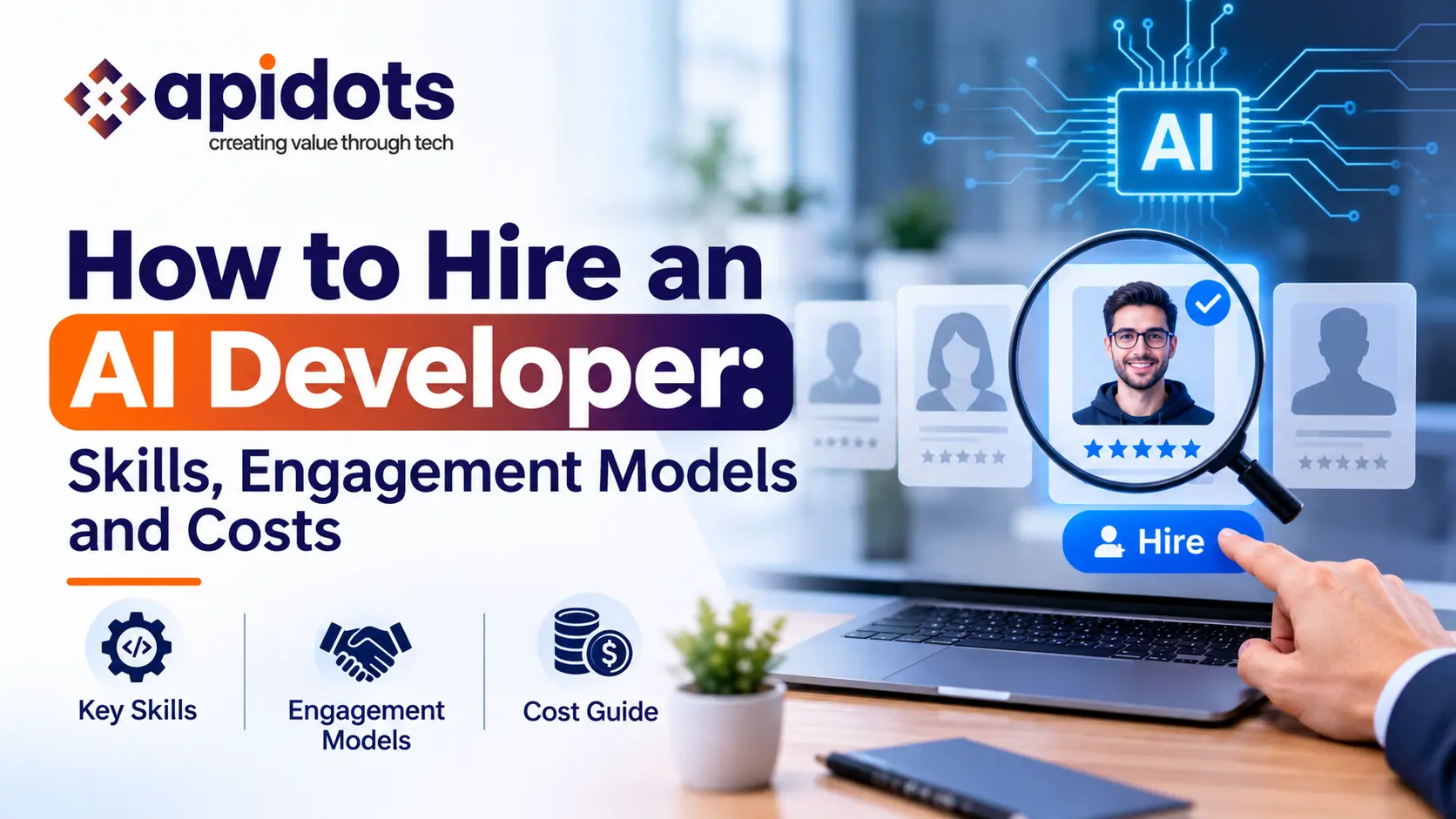
Hiring an AI developer is an important decision for businesses looking to automate operations, improve customer experiences, and build intelligent digital products. However, finding the right developer involves more than checking technical skills or comparing hourly rates. Businesses need professionals who understand their objectives, can work with real-world data, and know how to turn AI capabilities into reliable software solutions.
From developing machine learning applications and intelligent chatbots to building predictive analytics platforms and generative AI tools, the right development expertise can help businesses solve specific problems and create new opportunities.
In Australia, demand for AI-related skills is growing as organisations move from experimenting with artificial intelligence to implementing it in everyday business operations. PwC’s 2026 AI Jobs Barometer reported that Australian job advertisements seeking AI skills more than doubled between 2024 and 2025, increasing from approximately 20,000 to 41,000.
But how do you identify the right professional? Should you hire an individual AI developer, build an in-house team, or partner with an AI/ML development company?
This guide explains how to hire AI developers, the technical and business skills to evaluate, common engagement models, AI development cost factors, and what Australian businesses should consider before starting an AI project.
Artificial intelligence is no longer limited to experimental projects or large technology companies. Businesses across industries are exploring AI to improve productivity, automate repetitive processes, analyse information, and deliver more personalised services.
Some common business applications include:
However, implementing AI successfully requires more than connecting an application to an AI model. Businesses need suitable data, system integrations, security controls, testing, and ongoing monitoring.
That is why hiring an experienced AI developer or a capable development team is important.
An AI developer designs, builds, integrates, tests, and maintains software applications that use artificial intelligence or machine learning.
Their responsibilities depend on the project, but commonly include:
It is also important to understand that AI developer, machine learning engineer, and data scientist are not always interchangeable roles.
A data scientist may focus on analysing data and developing statistical models. A machine learning engineer typically concentrates on building and deploying production ML systems. An AI software developer may work across models, APIs, application architecture, integrations, and user-facing functionality.
Before hiring, identify which capabilities your project actually requires.
Choosing the right developer starts with evaluating technical knowledge alongside practical problem-solving ability.
Programming is the foundation of most AI development projects.
Python is particularly important because of its extensive machine learning and data science ecosystem. Depending on the application, developers may also need experience with:
For example, a developer building a machine learning model may rely heavily on Python, while someone integrating AI into a web application may also need JavaScript, backend development, and API experience.
Do not evaluate programming knowledge in isolation. Look for experience using these languages to build working software.
A strong AI developer should understand how machine learning systems work and when different approaches are appropriate.
Relevant areas include:
The developer should also understand model limitations, data quality issues, and the difference between a model that performs well in a test environment and one that works reliably in production.
Businesses increasingly want to incorporate generative AI into their applications.
Depending on your requirements, look for experience with:
For example, if you want to build an internal knowledge assistant, the developer should understand document processing, retrieval quality, access permissions, and how to reduce inaccurate AI responses.
AI applications depend on the quality and accessibility of their data.
Developers should understand how to collect, clean, transform, store, and retrieve information from different sources.
Useful skills include:
A technically advanced model cannot compensate for incomplete, inconsistent, or poorly structured data.
Developing an AI model is only one part of the project. It must also be deployed, monitored, maintained, and updated.
Experience with platforms such as AWS, Microsoft Azure, and Google Cloud can be valuable.
MLOps knowledge is also important for projects involving machine learning models. It covers processes such as model deployment, version control, monitoring, retraining, and performance management.
For production applications, also evaluate knowledge of CI/CD, containerisation, logging, and infrastructure security.
Technical expertise alone does not guarantee a successful project.
An effective AI developer should be able to understand business requirements, explain technical decisions, identify project risks, and communicate limitations clearly.
This matters because AI projects often involve uncertainty. Developers need to explain what is technically feasible, what requires experimentation, and what should be handled through conventional software instead.
If you are planning to hire AI developers Australia-wide, use a structured hiring process rather than selecting a candidate based only on a portfolio or advertised rate.
Start by identifying the business problem you want to solve.
For example:
Define the expected users, key features, available data, integrations, and desired business outcomes.
A clear project scope helps developers recommend an appropriate architecture and estimate the work more accurately.
Different AI projects require different skill sets.
A computer vision application may need image processing and deep learning expertise. A generative AI assistant may require LLM integration, RAG, and backend development experience.
Create a list of essential and optional skills before interviewing candidates.
Ask candidates to demonstrate projects relevant to your requirements.
Look for evidence of:
Ask what the developer personally contributed. A portfolio may represent an entire team, so it is important to understand individual responsibilities.
A short practical assignment can reveal more than a general technical interview.
For example, ask a candidate to:
Keep the assessment relevant to the actual project rather than assigning unnecessary unpaid work.
Clarify how the developer will communicate progress, report issues, document code, and handle changes.
If you are working with a remote team, establish meeting schedules, reporting expectations, collaboration tools, and ownership of deliverables.
Do not select a developer solely because they offer the lowest price.
Compare the proposed architecture, project scope, milestones, testing strategy, security measures, maintenance arrangements, and expected deliverables.
A realistic proposal should explain what is included and what may create additional costs.
Businesses can hire AI development talent through different engagement models. The right option depends on project duration, budget, internal expertise, and the level of control required.
| Engagement model | Best suited for | Main advantage |
| Full-time developer | Long-term AI product development | Dedicated expertise |
| Freelance developer | Small or clearly defined tasks | Flexible hiring |
| Dedicated development team | Ongoing or complex projects | Access to multiple specialists |
| Fixed-price project | Clearly defined scope | Predictable project budget |
| Time and materials | Evolving requirements | Flexibility to adapt |
1. Full-Time AI Developer
Hiring a full-time developer is suitable when AI development is a continuous part of your business strategy.
You gain a dedicated professional who can work closely with your internal product and engineering teams.
However, consider recruitment time, salary, superannuation, equipment, onboarding, and other employment expenses when comparing this option.
Freelancers can be useful for smaller projects, prototypes, specific integrations, or short-term technical support.
This model offers flexibility, but you should carefully assess availability, documentation, quality standards, and long-term maintenance arrangements.
It may not be ideal when a project requires several different technical disciplines.
A dedicated team can include AI engineers, machine learning specialists, backend developers, data engineers, QA professionals, and project managers.
This model is useful when you need multiple capabilities without recruiting every role internally.
It can also support ongoing development as requirements evolve.
A fixed-price model works best when the project scope, deliverables, and acceptance criteria are clearly defined.
For example, a business may commission a limited AI proof of concept with agreed features and milestones.
If requirements change significantly, the scope and price may need to be revised.
In this arrangement, businesses pay for the actual development time and resources used.
It is suitable for research-heavy projects, evolving product requirements, and applications where technical discoveries may influence the final scope.
The key is to establish reporting, budget controls, and milestone reviews.
One of the most common questions businesses ask before starting a project is: How much does AI development cost?
There is no single price because AI projects differ in complexity, data requirements, integrations, security, and deployment needs.
As an indicative 2026 Australian market reference, published consultancy guidance places projects in broad ranges such as:
| AI project type | Indicative cost (AUD, excluding GST) |
| Proof of concept | 15,000–40,000 |
| Production AI application for one or two use cases | 50,000–150,000 |
| Enterprise AI system | 150,000–400,000+ |
These are planning estimates, not guaranteed market rates or quotations. Actual costs can be lower or higher depending on the scope, delivery model, and technical requirements. Obtain current, itemised proposals before budgeting.
1. Project Complexity
A simple AI feature integrated into an existing application generally requires less work than a custom machine learning platform with multiple data sources and advanced workflows.
2. Data Preparation
Data cleaning, labelling, validation, and integration can require substantial effort. Poorly organised data may increase project time and cost.
3. AI Model Selection
Using a hosted model through an API may be more practical than training a custom model from scratch. Fine-tuning, self-hosting, or custom model development can add infrastructure and engineering costs.
4. Integrations
Connecting AI with CRM systems, ERP platforms, payment systems, databases, or third-party APIs adds development and testing work.
5. Security and Compliance
Applications that handle sensitive customer, financial, or health information may require additional security controls, access management, testing, and governance.
6. Maintenance and Infrastructure
After deployment, businesses should budget for hosting, model usage, monitoring, bug fixes, security updates, and ongoing improvements.
A useful approach is to request a cost breakdown covering development, infrastructure, third-party services, testing, deployment, and maintenance rather than comparing only the initial build price.
The following is an illustrative scenario, not a claim about a completed APIDOTS client project. It shows how a business could approach an AI development requirement.
Imagine an Australian e-commerce company receiving hundreds of customer enquiries each day. Its support team spends significant time answering repetitive questions about order status, returns, product information, and delivery policies.
The business wants to introduce an AI-powered customer support assistant.
The first step is to understand which enquiries are repetitive, which require human judgment, and what information the AI assistant needs.
The business defines its initial objective: help customers find approved information and retrieve relevant order details without exposing private information.
The development team evaluates whether an existing large language model can support the use case, rather than training a model from scratch.
A possible architecture includes:
The developer builds the user interface, connects the AI service to the knowledge base, integrates approved business APIs, and implements access controls.
The assistant should only retrieve order details after the customer has been properly authenticated.
Testing should cover more than whether the assistant can answer common questions.
The team should also test inaccurate questions, missing information, unauthorised access attempts, incorrect retrieval, unexpected outputs, and escalation behaviour.
The application can initially be released to a limited group of users.
The business can monitor response accuracy, escalation rates, customer feedback, latency, and operating costs before expanding the rollout.
Key takeaway: A successful AI application starts with a clearly defined business problem. The technology should be selected to support that problem, not the other way around.
Both options can work. The right choice depends on your long-term plans and internal capabilities.
An in-house team provides direct control over priorities, knowledge, and day-to-day development. However, recruiting multiple specialists can take time and increase fixed operating costs.
Partnering with an experienced AI/ML development company can provide access to a broader skill set, established development processes, and flexible team capacity.
This option may be particularly useful when:
Before selecting a partner, review its technical experience, communication process, security practices, project documentation, and post-launch support.
Before signing an agreement with a developer or development company, use this checklist to assess whether they are suitable for your project.
A developer who can confidently answer these questions and explain the trade-offs is generally easier to evaluate than someone who only presents an impressive list of technologies.
Australian businesses should consider responsible AI practices throughout development, not just after deployment.
The Australian Government’s AI guidance and ethics principles emphasise areas such as privacy, fairness, transparency, reliability, accountability, and human oversight.
Before launching an AI application, consider the following:
These practices help build AI applications that are more reliable and appropriate for real business environments.
Selecting the right development partner can influence the quality, scalability, and long-term value of your AI application.
A capable partner should understand more than machine learning algorithms. It should also be able to connect AI capabilities with application architecture, business workflows, existing systems, and user requirements.
When evaluating providers of AI Software Development Australia services, consider whether they offer:
Ask how the team approaches project discovery, technical feasibility, development milestones, testing, and post-launch improvements.
A good development partner should recommend the simplest technology that solves the business problem effectively, rather than introducing unnecessary complexity.
Hiring an AI developer is not simply about finding someone who knows Python or has experience with machine learning frameworks. It is about choosing the right technical expertise, engagement model, and development approach to turn a business requirement into a reliable AI-powered solution.
Whether you are planning a generative AI application, predictive analytics platform, intelligent chatbot, or custom machine learning system, start with a clearly defined use case and evaluate developers based on practical experience, problem-solving ability, architecture knowledge, and communication.
At APIDOTS, we help businesses transform ideas into scalable digital products through our expertise in AI/ML application development, custom software engineering, and AI software development solutions. Our development approach focuses on understanding business requirements, selecting suitable technologies, and building applications that align with real operational needs.
Whether you are an Australian business exploring its first AI project or an established organisation looking to integrate intelligent capabilities into existing software, APIDOTS can support your development journey with a practical, product-focused approach.
Planning to build an AI-powered application? Connect with APIDOTS to discuss your requirements and explore the right development approach for your business.
Start by defining your project requirements and identifying the technical skills needed. Review relevant portfolios, assess practical experience, conduct technical interviews, and compare proposals based on architecture, communication, security, and long-term support.
Look for programming experience in Python or other relevant languages, machine learning, deep learning, data engineering, generative AI, API integration, cloud platforms, and model deployment. Communication and business problem-solving skills are equally important.
AI development costs vary by project scope. Indicative project estimates can range from tens of thousands of Australian dollars for a proof of concept to several hundred thousand dollars for an enterprise system. The final cost depends on data readiness, integrations, security, model selection, and deployment requirements.
An AI developer may work across AI-powered application development, model integration, APIs, and software architecture. A machine learning engineer focuses more specifically on designing, deploying, and maintaining machine learning models and their supporting pipelines.
A freelancer may suit a small, clearly defined task. An AI development company can be a better fit for complex projects requiring multiple specialists, ongoing development, integrations, testing, and maintenance. Your choice should depend on project scope and internal resources.
A small proof of concept may take a few weeks, while a production-ready AI application can require several months. The timeline depends on data readiness, application complexity, integrations, security requirements, testing, and deployment.
We build and deploy end-to-end AI software solutions for businesses. Accelerating efficiency, automation, and intelligent decision-making.
Get AI Development Services