
Top
Search
People also search for:

Stay Inspired with Instagram




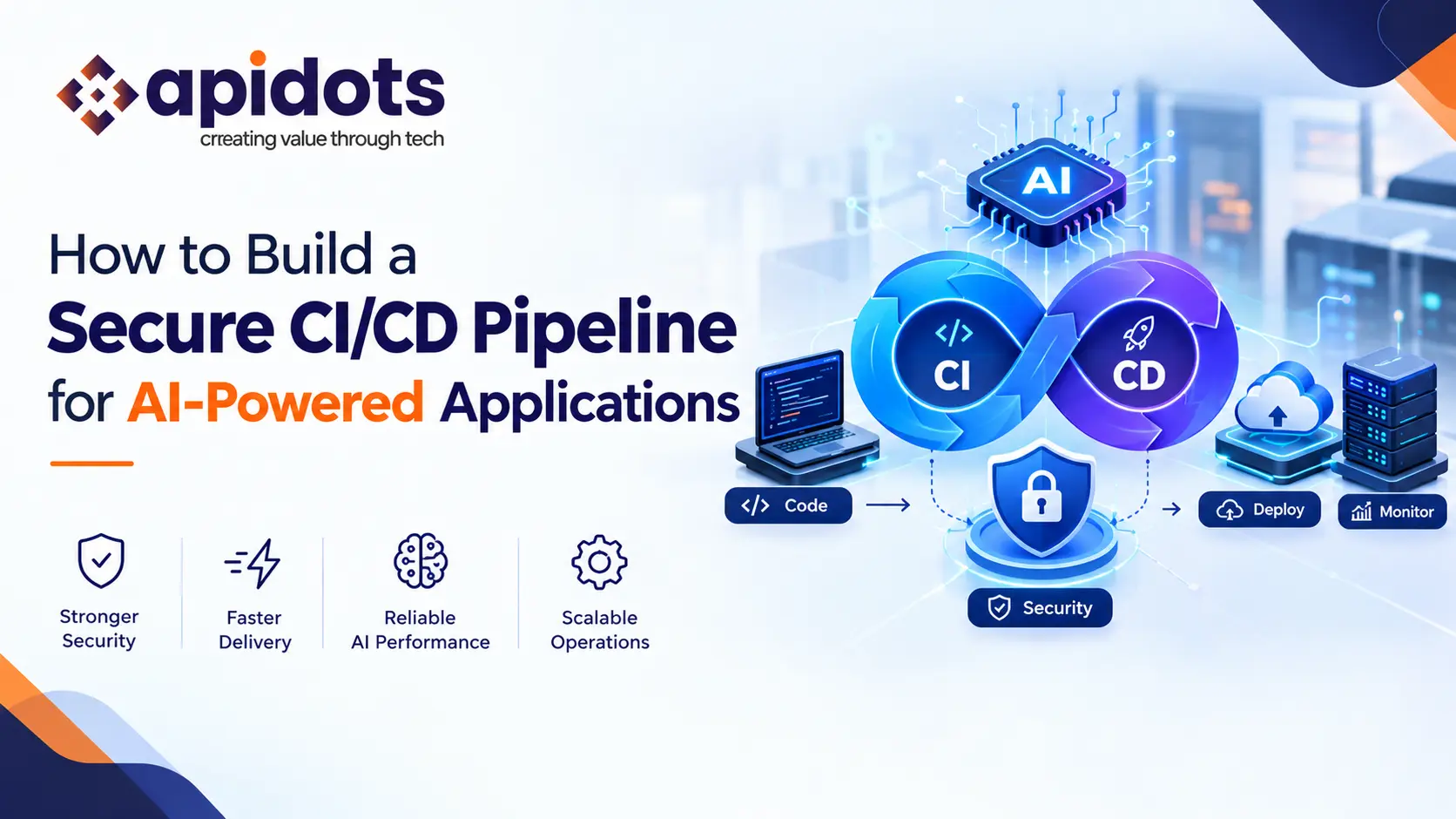
AI-powered applications are becoming increasingly sophisticated. From intelligent chatbots and recommendation engines to autonomous AI agents and enterprise automation platforms, businesses are integrating artificial intelligence into products that handle valuable data and critical workflows.
However, deploying an AI application securely involves more than protecting source code and server infrastructure. Developers must also consider model integrity, training and inference data, third-party dependencies, API credentials, prompt injection, and the actions an AI system can perform.
This is where a secure Continuous Integration and Continuous Delivery (CI/CD) pipeline becomes essential.
A well-designed devops ci cd pipeline automates software building, testing, security validation, and deployment. When combined with DevSecOps and AI-specific testing, it helps development teams identify vulnerabilities earlier, reduce deployment risks, and release updates more consistently.
For organizations building ai-powered software solutions, security must be integrated into the entire development lifecycle rather than added just before launch.
In this guide, we explain how to build a secure CI/CD pipeline for AI-powered applications, which security controls to implement at each stage, how to protect AI agents, and how DevOps practices can support reliable deployments.
A CI/CD pipeline is an automated workflow that moves application changes from development through testing and into deployment.
Continuous Integration (CI) allows developers to merge code changes frequently and validate them through automated checks. Continuous Delivery or Deployment (CD) automates the preparation or release of validated software.
A secure CI/CD pipeline incorporates security checks throughout this process.
For AI applications, the pipeline may need to validate more than application code. Depending on the architecture, it may also manage:
For example, imagine a company deploying an AI customer-support assistant. A developer updates the application’s prompt and modifies an API integration. Before release, the pipeline should test the code, scan dependencies, check for exposed credentials, evaluate AI behavior, validate permissions, and deploy the change to a controlled environment.
The objective is straightforward: release AI features quickly without allowing avoidable security risks to reach production.
Traditional application security remains essential, but AI introduces additional risks because model behavior can be probabilistic and inputs may include untrusted text, documents, retrieved content, and tool outputs.
The OWASP GenAI Security Project’s 2026 guidance highlights risks such as prompt injection, sensitive information disclosure, excessive agency, supply-chain vulnerabilities, data and model poisoning, and weaknesses in vector or embedding systems. These risks require testing beyond conventional code scanning.
Three challenges deserve particular attention.
A model update, modified prompt, new retrieval source, or changed evaluation dataset can affect system behavior even when the main application code remains unchanged.
These assets need version control, validation, and traceability appropriate to their risk.
An AI system may encounter malicious instructions embedded in user prompts, uploaded documents, retrieved web pages, or external tool responses.
Security tests should examine whether those instructions can cause unauthorized access, data exposure, or unexpected actions.
An AI agent might send emails, update customer records, execute code, or call business APIs. If it receives excessive permissions, a model-level failure can become a real operational security incident.
This is why secure AI deployment must combine application security, infrastructure controls, model evaluation, and runtime monitoring.
The first stage of a secure CI/CD pipeline begins before the application is built.
Developers should work in protected repositories with clearly defined access permissions and review requirements.
Implement the following controls:
Secrets such as model-provider API keys, database passwords, cloud credentials, and signing keys should be stored in a secrets manager or an equivalent protected service.
They should never be embedded in source code, container images, model prompts, or configuration files committed to a repository.
Where possible, use short-lived credentials and workload identity instead of long-lived static tokens.
These controls help prevent compromised accounts or accidental credential exposure from becoming a pathway into production.
Once a developer submits a change, the CI pipeline should run automated security checks before the code proceeds to later stages.
Static Application Security Testing (SAST) analyzes source code for potentially insecure patterns.
Depending on the technology stack, it can help identify:
SAST should be configured to reflect the languages and frameworks used by the application.
AI applications frequently depend on external libraries, model-serving frameworks, orchestration tools, and SDKs.
Software Composition Analysis (SCA) checks dependencies for known vulnerabilities and licensing concerns.
The pipeline should identify vulnerable packages, establish policies for blocking serious findings, and track remediation.
If infrastructure is defined through tools such as Terraform or Kubernetes manifests, scan those configurations before deployment.
Look for risks such as publicly exposed services, excessive permissions, insecure storage settings, and missing encryption controls.
Practical recommendation: Start by blocking confirmed critical vulnerabilities and exposed secrets. Introduce additional security gates as the team improves its ability to manage findings without creating unnecessary release delays.
The OWASP DevSecOps Guideline provides a useful framework for incorporating code analysis, dependency scanning, infrastructure checks, and security gates into the software delivery lifecycle.
A secure pipeline must establish exactly which models and AI components are being deployed.
This matters whether the application uses a custom-trained model, a fine-tuned model, an open-source model, or a third-party AI API.
Record the model identifier, version, configuration, and relevant deployment metadata.
For self-hosted models, maintain checksums or other integrity verification mechanisms for model artifacts. For externally hosted models, track the provider, model identifier, available version information, and relevant configuration.
Only retrieve models and related artifacts from approved sources. Review provenance and integrity before incorporating them into a production release.
Maintain an inventory of relevant libraries, models, datasets, containers, and other components.
A software bill of materials (SBOM) can document software dependencies. AI systems may require additional model and dataset inventories because a conventional SBOM does not fully describe all AI-specific assets.
Avoid automatically promoting a model update into production merely because a new version is available.
A model change should trigger the appropriate validation, security evaluation, compatibility testing, and approval process.
NIST’s Secure Software Development Framework provides a foundation for protecting software components and managing security throughout the development lifecycle. Its generative AI profile adds practices relevant to AI model development.
Conventional unit tests and API tests are necessary, but they cannot fully evaluate the security behavior of an AI application.
A secure pipeline should include tests for the model, prompts, retrieval process, and any tools available to an AI agent.
Test whether malicious instructions can override intended behavior or cause the system to disclose information.
Include both direct attacks through user inputs and indirect attacks hidden in documents, retrieved content, or external tool responses.
Check whether the application can expose confidential information through model responses, logs, retrieval results, or generated outputs.
Use synthetic or appropriately protected test data rather than exposing real customer secrets during testing.
AI output should not automatically be trusted as safe input for downstream systems.
Validate generated content before using it in database queries, HTML rendering, code execution, or business operations. Use structured output schemas and strict validation wherever possible.
For RAG applications, test whether retrieval respects user permissions and tenant boundaries.
For example, a user from one organization should not retrieve documents belonging to another organization simply because those documents exist in the same vector database.
Test whether agents can access only the tools and resources they are authorized to use.
A useful test case is to provide an agent with a malicious instruction asking it to export confidential records. The test should confirm that authorization controls prevent the prohibited action, even if the model attempts to comply.
The OWASP AI/LLM application security testing guidance recommends evaluating the complete system, including models, prompts, retrieval components, tools, and permissions, not just the model in isolation. Source: OWASP DevSecOps Guideline
Security becomes especially important when developing applications that can act on behalf of users.
For teams working on ai agent app development, the pipeline should verify both what the agent can do and which controls govern its actions.
Consider an AI sales assistant connected to a CRM, email service, and calendar. It may need to read customer information and prepare follow-up messages, but it may not need permission to export every customer record or change account ownership.
Use the principle of least privilege:
For high-impact operations, enforce authorization outside the model. A prompt telling an agent not to perform a particular action is not a substitute for a technical permission check.
The pipeline should also validate changes to agent tools, API scopes, and third-party connectors. A seemingly small integration update can expand an agent’s effective access.
The pipeline itself is a valuable target. An attacker who compromises build automation may be able to introduce malicious code or steal credentials without directly attacking the production application.
Secure the build environment with controls such as:
Where feasible, build once and promote the same validated artifact through staging and production rather than rebuilding it separately for each environment.
This helps preserve traceability between the code that was tested and the software that is released.
NIST’s guidance on software supply-chain security in CI/CD pipelines discusses measures for protecting build artifacts, packages, repositories, and the processes used to deliver software.
A secure ci cd pipeline development strategy should not send every change directly to production.
Use an environment promotion process that matches the application’s risk and release requirements.
Developers validate features and run initial automated tests.
The pipeline runs code checks, dependency scans, unit tests, secrets detection, and relevant AI evaluations.
The application is deployed into an environment that resembles production. Run integration tests, API security checks, AI behavior evaluations, and end-to-end workflows.
Release only when required checks pass and the appropriate approvals are complete.
For higher-risk applications, consider canary releases or blue-green deployments. These approaches limit the impact of a faulty release and allow teams to monitor behavior before expanding deployment.
A rollback plan should account for more than application binaries. Model versions, prompt configurations, database migrations, and retrieval indexes may also need coordinated recovery procedures.
Security does not end when the pipeline reports a successful release.
Production monitoring should cover conventional application risks and AI-specific behavior.
Monitor:
Avoid storing sensitive prompts, customer records, or credentials in logs without a clear need and appropriate protections.
Where possible, use redaction, access controls, retention policies, and audit trails to protect monitoring data.
Create an incident-response process that defines how to disable a compromised integration, revoke credentials, roll back a release, or restrict an AI agent when suspicious behavior occurs.
The following sequence brings the main controls together.
| Pipeline stage | Recommended controls |
| Source code | Branch protection, reviews, secrets scanning |
| Build | SAST, dependency scanning, isolated runners |
| AI validation | Prompt-injection tests, output validation, model evaluations |
| Packaging | Container scanning, artifact integrity, provenance |
| Staging | Integration tests, API security, agent permission checks |
| Release | Approval gates, signed artifacts, deployment policies |
| Production | Monitoring, access controls, incident response |
Not every project needs the same collection of tools. The appropriate implementation depends on the AI architecture, sensitivity of the data, potential impact of failure, and the team’s operational maturity.
The important principle is to make security checks repeatable, measurable, and proportionate to risk.
Treating AI testing as ordinary unit testing: AI systems require behavioral and adversarial testing in addition to traditional application tests.
Giving agents excessive permissions: Use scoped credentials and enforce access controls independently of model instructions.
Ignoring the pipeline’s own security: Build automation, secrets, third-party actions, and artifact repositories need protection.
Deploying model changes without evaluation: A model or prompt update can change application behavior even when application code has not changed.
Relying only on pre-release checks: Production monitoring and incident response remain necessary because not every failure can be anticipated in testing.
Adding security gates without prioritization: Focus first on high-impact risks and use clear remediation policies to avoid overwhelming developers with low-value alerts.
Implementing a secure pipeline requires coordination across application development, infrastructure, security testing, deployment automation, and ongoing operations.
At APIDOTS, our software development approach can support businesses that need reliable delivery processes for AI-enabled products. Through DevSecOps services for AI applications and devops development services, organizations can plan security controls around their development lifecycle instead of treating security as a final deployment task.
Whether you are developing an AI-powered business application, integrating an AI model into existing software, or building an agent that connects with business systems, the right CI/CD strategy can help you manage releases more consistently.
A practical engagement may include reviewing the existing delivery workflow, identifying security gaps, automating appropriate checks, protecting deployment credentials, strengthening AI-specific testing, and improving monitoring and rollback procedures.
The goal is not to add as many tools as possible. It is to build a delivery process that gives the team confidence in what is being released and provides a clear response when something goes wrong.
A secure CI/CD pipeline is an important foundation for developing and operating AI-powered applications responsibly. It combines automated software testing, dependency and infrastructure scanning, model validation, agent permission checks, artifact integrity, controlled deployments, and continuous monitoring.
For businesses investing in ai-powered software solutions, security must extend beyond source code to include the models, data, prompts, integrations, and tools that influence application behavior.
By adopting risk-based security gates and repeatable DevSecOps practices, development teams can reduce avoidable vulnerabilities while maintaining an efficient release process.
At APIDOTS, we help businesses build and improve software products through our expertise in AI development, DevOps, and secure delivery practices. Our team can help you assess your existing workflow, plan devops ci cd pipeline improvements, and implement a deployment approach suited to your application’s architecture and business requirements.
If you are looking for an experienced AI application development company to help build a secure AI product or strengthen your existing delivery pipeline, APIDOTS can help you plan a practical path from development to production.
The strongest AI applications are not just intelligent. They are designed, tested, deployed, and monitored with security in mind.
A secure CI/CD pipeline automates building, testing, security validation, and deployment while incorporating controls for application code, dependencies, AI models, data, and integrations. It helps teams identify vulnerabilities before releases and maintain traceability throughout deployment.
AI application pipelines need conventional software security checks plus AI-specific evaluations. Depending on the application, these may include prompt-injection testing, model version validation, sensitive-data exposure checks, RAG permission testing, and AI agent tool authorization tests.
Common categories include static code analysis, dependency scanning, secrets detection, infrastructure-as-code scanning, container security, API testing, AI red-teaming tools, artifact signing, and production monitoring. The appropriate combination depends on the application’s architecture and risk profile.
Apply least-privilege permissions, use scoped credentials, validate tool calls, restrict access to sensitive resources, test against malicious instructions, require approval for high-impact actions, and monitor agent activity. Authorization should be enforced by the application and connected systems rather than relying solely on model instructions.
DevSecOps services help integrate security into the software development lifecycle through automated testing, controlled deployments, vulnerability management, infrastructure security, and monitoring. For AI applications, this approach can also incorporate model validation and tests for AI-specific threats.
APIDOTS can help businesses plan and develop AI-enabled applications and improve their software delivery processes through appropriate DevOps and security practices. The scope may include pipeline assessment, automated security checks, deployment automation, AI-specific testing, and monitoring based on the project’s requirements.
We bring development and operations together seamlessly.Improving deployment speed, reliability, and infrastructure resilience.
Consult DevOps Experts