
Top
Search
People also search for:
Stay Inspired with Instagram




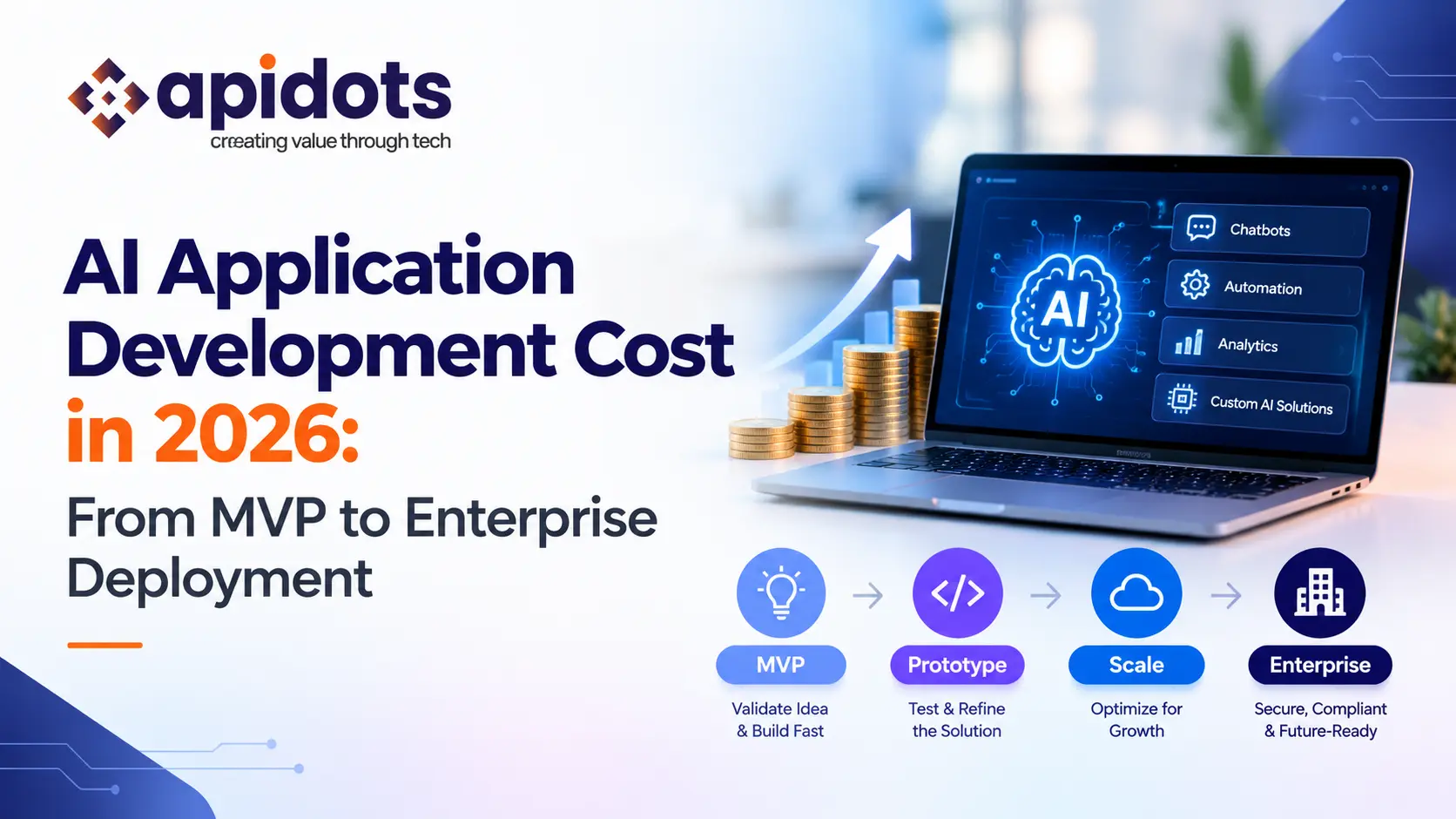
Artificial intelligence is becoming an important part of modern software products, from customer support assistants and predictive analytics tools to intelligent business automation and AI-powered enterprise platforms. However, turning an AI idea into a reliable application requires more than choosing a model and building a user interface. Businesses must also consider data preparation, integrations, security, testing, infrastructure, and ongoing maintenance.
One of the first questions founders and business leaders ask is: How much does AI application development cost in 2026?
The answer depends on what you want to build. A focused AI feature using an existing model may require a relatively modest investment, while a production-ready application with proprietary data, complex integrations, and enterprise security can require a significantly larger budget.
For startups, the challenge is validating an idea without overspending. For established businesses, it is building a solution that integrates with existing systems, meets operational requirements, and delivers measurable business value.
This guide explains AI app development cost by project stage, the factors that influence pricing, the difference between MVP and enterprise development, and practical ways to manage your budget. It also explores how to approach MVP development for enterprise products and when to consider custom AI solutions for enterprises.
AI app development cost vary considerably according to functionality, technical complexity, data requirements, and deployment expectations. The following figures are illustrative planning ranges in US dollars, not fixed market rates or project quotations.
| AI application type | Estimated development cost | Typical scope |
| AI proof of concept | 5,000–15,000 | Validate one use case or technical assumption |
| AI-powered MVP | 15,000–50,000 | Core features, basic UI, model integration, initial testing |
| Mid-complexity AI application | 40,000–120,000 | Custom workflows, data retrieval, and integrations |
| Advanced AI application | 120,000–400,000+ | Complex models, multiple systems, enhanced reliability |
| Enterprise AI platform | 200,000–1,000,000+ | Enterprise integrations, governance, security, and scalable infrastructure |
These ranges overlap because project scope matters more than the label attached to an application. A focused MVP using a managed AI API may cost less than a complex proof of concept involving proprietary data, specialized model development, and demanding performance requirements. Published 2026 cost guides also show substantial variation between simple AI features and enterprise deployments.
Before setting a budget, identify the business problem, expected users, required integrations, data sources, and reliability requirements. These details will produce a more meaningful estimate than choosing a budget based on the type of AI alone.
Two applications using the same AI model can have very different development costs. The main difference usually lies in the engineering required to make the model useful, secure, and dependable in a real business environment.
The first cost driver is what the application needs to accomplish.
A simple AI writing assistant might require a user interface, an API connection, prompt management, and basic output validation. An AI-powered business platform may need user roles, document processing, personalized recommendations, workflow automation, reporting, and integrations with several business systems.
More functionality means more design, development, testing, and maintenance.
A useful approach is to divide requirements into three categories:
This prioritization helps control the initial investment without compromising the core purpose of the application.
Model selection affects both development and ongoing operating expenses.
Businesses can choose from managed AI APIs, open-weight models, fine-tuned models, or custom-trained models. Each approach has different infrastructure, performance, and maintenance requirements.
For many early-stage products, using an existing model through an API is a practical starting point. It avoids the expense of training a foundation model and lets the team focus on application functionality and business workflows.
Fine-tuning may be justified when a model needs to perform a specialized task consistently. Training a model from scratch is a much larger undertaking and is rarely necessary for a first product version.
The right decision depends on accuracy requirements, data sensitivity, latency, usage volume, and total cost of ownership—not simply which model is newest.
AI applications are only as useful as the data and context available to them.
Depending on the use case, development may involve:
For example, an internal knowledge assistant may need a retrieval-augmented generation (RAG) system to retrieve relevant information from company documents before generating an answer.
If documents are poorly structured or spread across disconnected systems, preparing that data can become a substantial part of the project.
An AI application rarely operates in isolation.
It may need to connect with CRM platforms, ERP systems, payment gateways, internal APIs, email services, analytics tools, or customer databases.
Each integration introduces additional work involving authentication, permissions, data transformation, error handling, and testing.
A standalone assistant may be relatively straightforward. An AI assistant that reads CRM records, checks inventory, prepares a quote, and submits an approval request requires a much more involved architecture.
Production AI requires more than confirming that a model produces a plausible response.
Depending on the application, teams may need to implement:
Healthcare, finance, and other regulated industries may require additional documentation, reviews, and controls.
These requirements should be considered during planning rather than added after the application is nearly complete.
An AI MVP is a minimum viable product designed to test whether an AI-powered solution can solve a meaningful problem for its intended users.
It is not simply a demo with a chatbot interface. A useful MVP should demonstrate the core workflow, provide enough reliability to evaluate the result, and collect feedback that informs future development.
For example, a startup developing an AI customer support assistant could begin with:
Advanced reporting, multilingual support, complex CRM integrations, and custom model training could be added later if the initial version demonstrates value.
A focused AI MVP may require approximately 15,000–50,000, although simpler prototypes can cost less and complex MVPs can exceed this range.
The final estimate depends on the quality of the user experience, data readiness, integrations, security requirements, and testing needed before release.
Effective MVP development services should help you define what needs to be built now, what can wait, and which assumptions must be validated before increasing investment.
A practical MVP budget should include:
The goal is to validate a business hypothesis with a working product—not to build every feature that might eventually be useful.
MVP development for enterprise products requires a different balance between speed and control.
A startup MVP may initially serve a small group of users with relatively simple permissions. An enterprise MVP may need to operate within existing identity systems, security policies, data access rules, and approval workflows from the beginning.
Enterprise stakeholders may also expect auditability, reliability, and clear ownership of data and system behavior.
An enterprise AI MVP might therefore include:
This does not mean every enterprise MVP needs a large, complex architecture. The key is to distinguish between features that can be postponed and foundational requirements that cannot safely be ignored.
For example, advanced analytics might wait until a later release, but tenant isolation and access controls may be mandatory if the application handles confidential business data.
A focused enterprise MVP should validate the use case while establishing a credible path to production.
MVP web development is often a practical route for launching AI-powered software because a browser-based application can serve users across devices without requiring separate native mobile applications.
A typical AI web MVP may include a frontend, backend API, database, AI integration, authentication, and a cloud deployment environment.
The estimated cost depends on the application:
Web development costs rise when the application needs real-time processing, complex dashboards, large document collections, or extensive integration with existing systems.
For cost-conscious teams, a responsive web application can be a sensible first release. Mobile applications or additional interfaces can follow once usage patterns and customer requirements are clearer.
Enterprise AI projects typically involve more than integrating a model into an existing application. They often require the technology to operate within established business processes and infrastructure.
Examples include intelligent document processing, predictive analytics, AI-assisted customer operations, internal knowledge systems, and workflow automation across multiple departments.
The cost of custom AI solutions for enterprises depends on several factors.
Data complexity: Fragmented, sensitive, or unstructured data can require substantial preparation and governance.
Integration depth: Connecting multiple business systems increases development and testing effort.
Reliability requirements: Applications used in important workflows need evaluation, monitoring, fallback behavior, and clear error handling.
Deployment requirements: Private environments, dedicated infrastructure, regional hosting, and high availability can increase cost.
Operational ownership: Enterprise systems need ongoing maintenance, model evaluation, incident response, and cost monitoring.
A phased delivery model can reduce risk. Start by validating a specific business workflow, then expand the solution after measuring its performance and operational value.
This is often more effective than attempting to automate every department in a single project.
Reducing development cost should not mean removing essential security controls or skipping testing. Instead, focus on decisions that reduce unnecessary engineering effort and future rework.
Avoid building a broad AI platform before identifying the problem it needs to solve. A focused application is easier to scope, test, and measure.
Managed AI models can reduce the need for custom training infrastructure. Evaluate alternatives based on quality, privacy, latency, and usage costs.
Review the quality, accessibility, and structure of your data before committing to a large development plan.
Authentication, monitoring, API connectors, and shared UI components can reduce duplicated work when designed appropriately.
Evaluate the application against representative inputs, edge cases, and failure conditions. Early testing can uncover problems before they become expensive to fix.
AI costs do not end when the application goes live. Model usage, cloud hosting, monitoring, support, and maintenance should be part of the original business case.
A cheaper initial build may become more expensive over time if it lacks monitoring, efficient model routing, or clear operational controls.
For businesses comparing development options, hiring AI developers in India can be one way to access software engineering and AI expertise across different budget levels.
However, location alone does not determine project quality or total cost. Experience with production systems, communication, technical leadership, security practices, and delivery processes matter just as much.
When evaluating an AI development team, look for experience in:
Ask prospective partners how they will measure success, manage uncertain AI behavior, protect your data, and estimate ongoing operating expenses.
A capable team should explain the trade-offs between building custom models, using existing APIs, and adopting established software. It should also be transparent about assumptions, dependencies, and what is excluded from the proposed budget.
The right development partner helps you make sound product and technical decisions—not just write code.
Before selecting an AI/ML development company, consider the following questions:
Request a detailed scope with deliverables, assumptions, milestones, acceptance criteria, and post-launch responsibilities.
For projects involving uncertain AI behavior, a discovery phase or technical proof of concept can be especially valuable. It allows the team to test key assumptions before committing to a full production build.
AI application development in 2026 offers businesses significant opportunities, but the right investment depends on the problem being solved, the reliability required, and the environment in which the application will operate.
For startups, a focused MVP can validate demand and test an AI use case before committing to a larger budget. For established organizations, enterprise AI development requires careful attention to data quality, integration, security, governance, and long-term operating costs.
At APIDOTS, we help businesses turn AI ideas into practical software products through our expertise in AI development, custom software engineering, and product development. From MVP planning and AI integration to enterprise application development, our team can help you evaluate the right technical approach for your goals and resources.
Whether you are exploring AI app development for startups, planning MVP development for enterprise workflows, or investing in custom AI solutions for enterprises, APIDOTS can support the process of defining requirements, building the right solution, and preparing it for future growth.
The best AI investment is not necessarily the application with the most features or the most advanced model. It is the one that solves a meaningful business problem, delivers measurable value, and can be maintained and improved as your business evolves.
AI application development can range from a few thousand dollars for a limited proof of concept to hundreds of thousands of dollars or more for complex enterprise platforms. Costs depend on functionality, data preparation, integrations, security, testing, and deployment requirements.
A focused AI MVP may cost approximately 15,000–50,000 as an illustrative planning range. The actual budget depends on the core features, AI model, data requirements, user experience, and integrations needed to validate the product.
The main factors include application complexity, data readiness, model selection, integration requirements, security, reliability expectations, and ongoing inference and infrastructure costs.
Yes. An enterprise MVP can validate a defined business use case before a larger rollout. However, foundational requirements such as data protection, access control, and necessary compliance obligations should be addressed from the beginning.
It can be, depending on the team’s expertise, project scope, and delivery model. Evaluate technical experience, communication, architecture, security, and long-term support rather than selecting a development partner based on hourly rates alone.
APIDOTS can help businesses plan and develop AI-powered applications, from MVPs and AI integrations to more complex custom software solutions. The right engagement depends on your business objectives, technical requirements, data readiness, and expected scale.
We build and deploy end-to-end AI software solutions for businesses. Accelerating efficiency, automation, and intelligent decision-making.
Get AI Development Services