
Top
Search
People also search for:

Stay Inspired with Instagram




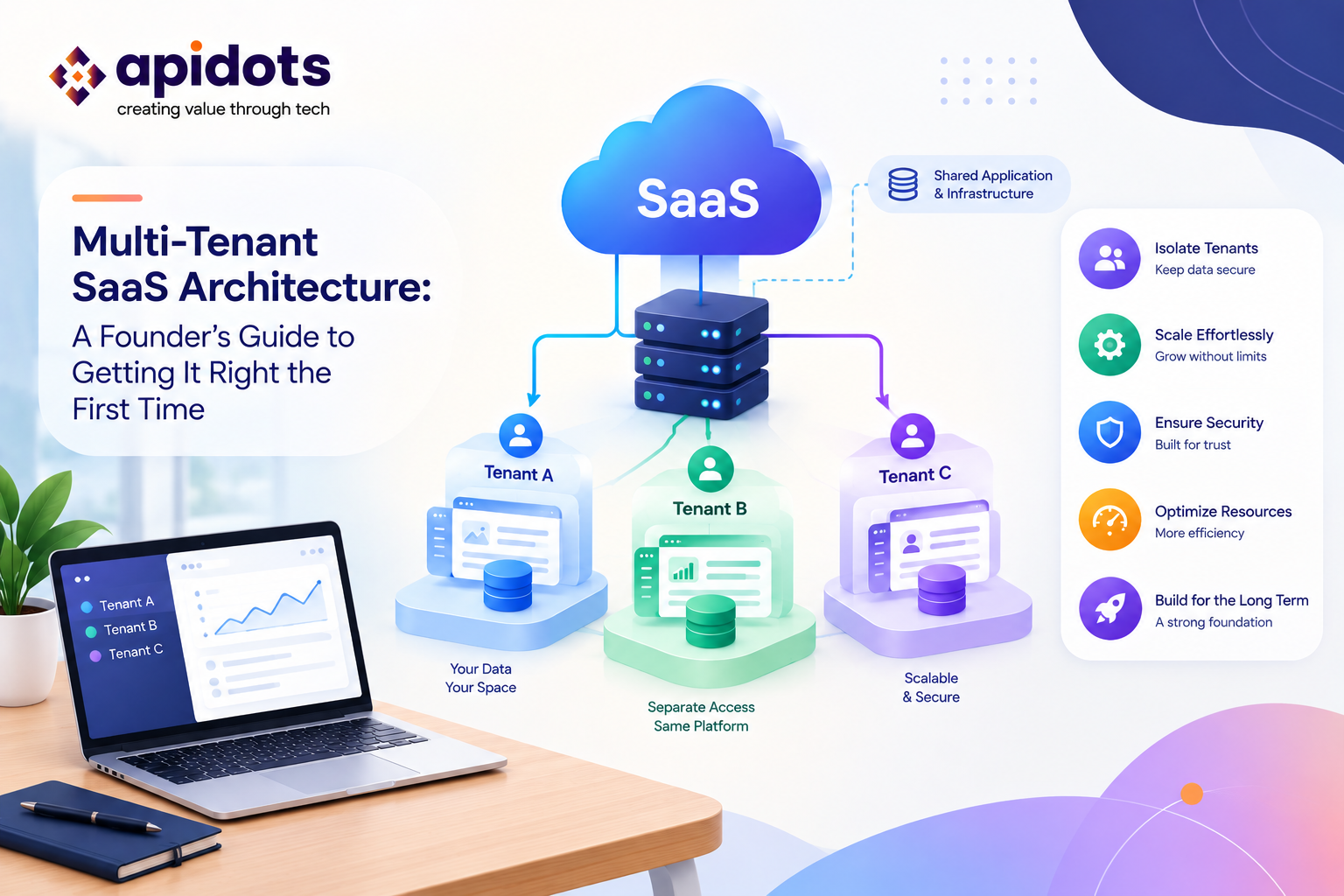
Building a SaaS product is not simply about putting an application in the cloud and charging customers a recurring subscription. The architecture underneath the product determines how efficiently you can onboard customers, protect their data, control infrastructure costs, scale workloads, release new features, and meet enterprise expectations.
One of the most important decisions founders face is whether and how to build a multi-tenant SaaS architecture.
At first, sharing infrastructure between customers can look like an obvious choice. It can reduce infrastructure costs, simplify deployment, and make the product easier to operate. But multitenancy introduces another responsibility: customers may share parts of the same application and infrastructure while their data, permissions, configuration, and workloads must remain logically isolated.
That creates a fundamental architectural challenge:
How do you share enough infrastructure to operate an efficient SaaS business without sharing anything that should remain isolated between customers?
There is no universal answer. A startup serving thousands of small businesses may need a very different tenancy strategy from an enterprise SaaS platform serving banks, healthcare organizations, or government customers.
This guide explains the major architectural choices, their trade-offs, common mistakes, and a practical approach to designing a multi-tenant SaaS platform that can evolve as the business grows.
A multi-tenant SaaS architecture allows multiple customers, known as tenants, to use the same software platform while maintaining separation between their data, users, configurations, and access rights.
A tenant commonly represents a customer organization in a B2B SaaS product.
For example, imagine a project management SaaS platform with these customers:
All three companies use the same SaaS application. However, employees from Company A should never be able to access Company B’s projects, users, reports, or files.
This is where multitenancy becomes an architectural concern.
Microsoft’s multitenant architecture guidance emphasizes that tenants are distinct from individual users. Multiple users belonging to one organization can form a single tenant, while the exact definition depends on the product’s business model and requirements.
A simplified architecture might look like this:
Users → Authentication → Tenant Resolution → Application Layer → Data Layer
Every request must carry enough trusted context for the application to determine:
A well-designed SaaS system treats tenant context as a fundamental part of the application’s architecture rather than as an optional database field.
Multitenancy is not just a technical implementation detail. It directly affects the economics and operational model of a SaaS company.
Consider two approaches.
Each customer receives:
This can provide strong isolation but becomes expensive and operationally demanding as the customer base grows.
Customers share:
Tenant-specific information is separated logically.
This can significantly improve resource utilization and reduce operational overhead.
The important point is that multitenancy does not mean everything must be shared.
A SaaS platform can share the application tier while providing separate databases for certain customers. It can also use a shared database for smaller customers while moving high-value enterprise customers to dedicated environments.
Microsoft describes tenant isolation as a spectrum rather than a simple shared-versus-isolated decision. Different components of the same SaaS platform can use different isolation levels.
This flexibility is one of the most useful concepts for founders to understand.
Before choosing a database architecture, define your tenant model.
For a B2B SaaS product, a tenant will often represent an organization.
For example:
Tenant → Organization → Users → Roles → Permissions
But there are exceptions.
A collaboration platform might define a tenant as a workspace.
A family-oriented consumer application might define a tenant as a household.
An education platform might define a tenant as a school or institution.
An enterprise platform might define tenants according to business units, subsidiaries, or environments.
Your definition affects:
Microsoft recommends defining the tenant according to the actual business and organizational structure of the SaaS product rather than assuming that every user should automatically be treated as a separate tenant.
If several users need to share the same business data, permissions, subscription, and configuration, they probably belong to the same tenant.
There are several ways to implement multitenancy. The most common approaches can be broadly understood as:
These approaches represent different positions on the isolation, cost, complexity, and scalability spectrum.
In this model, multiple tenants use the same database and the same tables.
Every tenant-owned record includes a tenant_id.
For example:
customers
——————————–
id
tenant_id
name
created_at
The application uses the tenant ID when querying data.
For example:
SELECT *
FROM customers
WHERE tenant_id = ‘tenant_123’;
This is usually the most cost-efficient model.
You can:
It can be particularly attractive for early-stage SaaS products where the customer base is growing rapidly but individual tenants have relatively modest workloads.
The biggest concern is isolation.
A missing tenant filter can potentially expose one customer’s records to another customer.
For example, this query is dangerous:
SELECT *
FROM customers;
If the application assumes that authorization happens elsewhere, a developer could unintentionally return data belonging to multiple tenants.
This is why tenant isolation cannot depend exclusively on developers remembering to add a filter to every query.
This model can work well when:
Database-level controls such as row-level security can provide an additional protection layer where supported by the database platform.
AWS describes a pool model where multiple tenants share database objects and tenant isolation is enforced at the data level.
Here, customers share the same database infrastructure but receive separate schemas.
Conceptually:
Database
│
├── tenant_a_schema
│ ├── users
│ ├── projects
│ └── invoices
│
├── tenant_b_schema
│ ├── users
│ ├── projects
│ └── invoices
│
└── tenant_c_schema
├── users
├── projects
└── invoices
This provides greater separation than putting every tenant’s records into the same tables.
As the number of tenants increases, schema management can become difficult.
If your SaaS platform has 20,000 customers and every customer requires multiple schemas and database objects, migrations and operational automation can become complicated.
You must also carefully manage:
This model can be useful when you need more separation but still want to share core infrastructure.
In this architecture, each tenant receives its own database.
For example:
Tenant A → Database A
Tenant B → Database B
Tenant C → Database C
AWS refers to this kind of isolated approach as a silo model when the tenant receives a dedicated application stack or resources. Azure also describes dedicated tenant deployments as one end of the isolation spectrum.
The major advantage is stronger isolation.
It becomes easier to:
It can also help reduce the impact of noisy neighbors.
The cost and operational burden increase.
If you have thousands of customers, you may have thousands of databases to:
Automation becomes essential.
Infrastructure-as-code, automated provisioning, centralized observability, and standardized database migrations are especially important in this model.
Consider this model when customers have:
It can also become a premium offering.
For example:
Standard Plan: Shared infrastructure
Business Plan: Enhanced data isolation
Enterprise Plan: Dedicated database or deployment
This turns architecture into part of your commercial strategy.
For many growing SaaS businesses, the best answer is neither completely shared nor completely isolated.
A hybrid architecture allows different tenants to use different isolation levels.
For example:
Standard Customers
↓
Shared Application + Shared Database
Enterprise Customers
↓
Shared Application + Dedicated Database
Regulated Customers
↓
Dedicated Application + Dedicated Database
This approach lets you optimize infrastructure according to customer requirements.
AWS describes a bridge model that combines shared and dedicated resources across different parts of a SaaS architecture.
Microsoft similarly describes vertically and horizontally partitioned deployments where different customers or architectural layers can have different isolation levels.
Your first 100 customers may not have the same requirements as your 10,000th customer.
A startup might initially prioritize:
Speed + Cost Efficiency
Later, enterprise customers may demand:
Isolation + Compliance + Performance Guarantees
If your architecture cannot accommodate that evolution, winning larger customers may require expensive reengineering.
There is no universal “best” model.
Instead, evaluate your requirements against several dimensions.
| Factor | Shared Model | Separate Database | Hybrid |
| Infrastructure cost | Low | High | Medium |
| Tenant isolation | Lower | High | Configurable |
| Operational complexity | Lower | High | Medium/High |
| Enterprise flexibility | Limited | Strong | Strong |
| Scalability | High with good design | High with automation | Very high |
| Tenant customization | Limited | Strong | Strong |
| Noisy-neighbor protection | Lower | Strong | Configurable |
| Data migration | More complex | Easier per tenant | Flexible |
Microsoft’s current guidance similarly emphasizes that tenancy decisions should consider business objectives, compliance, scale, automation, SLAs, cost, and isolation requirements.
Tenant isolation is arguably the most important part of multitenant SaaS architecture.
A SaaS application must protect:
Isolation must exist across the entire system, not only the primary database.
Every request should establish tenant context.
For example:
Authenticated User
↓
Identity Validation
↓
Tenant Resolution
↓
Authorization
↓
Business Logic
↓
Tenant-Aware Data Access
Do not allow a client application to arbitrarily define the tenant it wants to access.
For example, simply accepting:
{
“tenant_id”: “tenant_456”
}
from the browser is not sufficient authorization.
The server should derive or validate tenant membership using trusted identity and authorization information.
Founders sometimes treat authentication as the entire security model.
It is not.
Who are you?
What are you allowed to access?
In a multitenant SaaS application, you need both.
A user may successfully authenticate but still have no permission to access another tenant.
A useful authorization model can look like:
User
↓
Tenant
↓
Role
↓
Permissions
↓
Resource
For example:
John
→ Acme Corporation
→ Project Manager
→ Can edit projects
→ Can access Acme projects only
The tenant boundary should remain part of the authorization decision.
A common architectural mistake is treating tenant_id as an ordinary field rather than a fundamental security boundary.
Tenant context should flow consistently through:
Consider a background job:
Invoice Generation Job
↓
Tenant ID
↓
Load Tenant Configuration
↓
Generate Invoice
↓
Store Invoice in Tenant Storage
If the tenant context disappears when the request becomes an asynchronous job, the isolation model becomes incomplete.
A good database design starts by determining which entities are tenant-owned.
For example:
Tenant
├── Users
├── Teams
├── Projects
├── Documents
├── Tasks
├── Reports
└── Billing Records
Most tenant-owned tables should have a reliable relationship back to the tenant.
A simplified relational model might be:
tenants
——-
id
name
plan
status
users
—–
id
tenant_id
role
projects
——–
id
tenant_id
name
created_at
tasks
—–
id
tenant_id
project_id
title
status
As tenant data grows, indexes should reflect actual query patterns.
For shared tables, a composite index involving tenant_id can often be important.
For example:
(tenant_id, created_at)
may be useful for queries such as:
SELECT *
FROM projects
WHERE tenant_id = ?
ORDER BY created_at DESC;
The exact indexing strategy depends on the database engine, query patterns, data distribution, and workload.
Do not blindly add indexes to every tenant-related column. Excessive indexing increases storage requirements and can slow writes.
A noisy neighbor is a tenant whose unusually high usage affects other customers sharing the same infrastructure.
Imagine one customer suddenly processes:
If all customers share the same resources, that customer’s behavior can affect everyone.
Use:
You should decide whether limits are:
Hard limits
or
Soft limits with overage billing.
This decision can also influence your pricing model.
Caching is another area where multitenant applications can accidentally leak data.
Imagine the cache key:
user:123
If user IDs are not globally unique or if authorization assumptions change, cached data can become dangerous.
Prefer tenant-aware keys where appropriate:
tenant:456:user:123
Similarly:
tenant:456:project:789
The exact format depends on the cache system, but the principle is important:
Tenant boundaries should be reflected in cache design.
You should also consider cache invalidation when:
Files require the same isolation principles.
Instead of treating storage as one undifferentiated bucket, structure object paths around tenant boundaries where appropriate.
For example:
/tenants/tenant_123/documents/…
/tenants/tenant_456/documents/…
Access should be authorized server-side or through appropriately scoped temporary credentials.
Do not assume that hiding a URL is sufficient security.
A secure file-access design should consider:
Queues are often overlooked during multitenant design.
Suppose a SaaS platform receives:
Tenant A → 100,000 jobs
Tenant B → 100 jobs
Tenant C → 200 jobs
If all jobs enter one unrestricted queue, Tenant A could dominate processing capacity.
Possible strategies include:
Useful when workloads are relatively balanced.
Useful for workloads requiring stronger isolation.
Useful when subscription tiers require differentiated service.
Useful when a few customers can generate exceptionally large workloads.
The architecture should match the commercial promises you make.
If your enterprise plan promises predictable processing performance, your infrastructure needs a mechanism to enforce that promise.
Your API should make tenant boundaries explicit in the architecture without making the client responsible for security.
A typical request might look like:
POST /api/projects
Authorization: Bearer <token>
The server identifies:
User → Tenant → Permissions
Then creates the project within that tenant.
Avoid architectures where users can simply change a tenant ID in a URL and gain access to another organization.
For example:
GET /api/tenants/123/projects
is not inherently insecure, but the server must verify that the authenticated user is authorized to access tenant 123.
Never confuse resource identification with authorization.
One of the first operational questions founders should ask is:
What happens when a new customer signs up?
A scalable SaaS platform should ideally automate:
Manual tenant provisioning may work for the first few customers.
It becomes dangerous when you have hundreds or thousands.
Microsoft’s SaaS architecture guidance specifically highlights automation and operational scalability as important considerations because manual processes that work early generally do not scale well with customer growth.
A tenant has a lifecycle.
It may move through states such as:
Prospect
↓
Trial
↓
Active
↓
Suspended
↓
Cancelled
↓
Deleted/Archived
Each state can have architectural consequences.
You may use shared resources and strict quotas.
Normal production policies apply.
Access may be disabled while data is retained.
The retention period begins.
Data and resources are permanently removed according to your policies.
Designing this lifecycle early prevents many operational problems later.
Enterprise customers often evaluate SaaS products differently from startups.
They may ask about:
This means enterprise readiness should influence architecture before enterprise sales become your primary growth channel.
Microsoft recommends evaluating customer requirements such as security, compliance, reliability, data residency, and service expectations when designing multitenant SaaS workloads.
Designing for Data Residency
Data residency can become an architectural constraint.
Suppose your customers are distributed across:
Some customers may require their data to remain in a particular geographic region.
A possible architecture is:
Global Control Plane
↓
Tenant Routing
↙ ↓ ↘
EU Region US Region APAC Region
The tenant record can contain a deployment or region identifier.
For example:
tenant_id
region
deployment_id
plan
The application then routes the tenant to the appropriate infrastructure.
This approach also provides a foundation for regional expansion.
For sophisticated SaaS platforms, separating the control plane from the data plane can be valuable.
Manages:
Handles:
Conceptually:
Control Plane
│
┌─────────┴─────────┐
↓ ↓
Deployment Mapping Tenant Config
│
↓
Data Plane
│
┌──────┼──────┐
↓ ↓ ↓
Tenant A B C
This separation can make tenant provisioning, deployment management, and large-scale operations easier.
It is not mandatory for every startup, but it becomes increasingly useful as the platform becomes more complex.
A multitenant SaaS platform needs to answer questions such as:
Your logs, metrics, and traces should therefore include tenant context where appropriate.
For example:
request_id
tenant_id
user_id
service
endpoint
duration
status
But remember that logs can contain sensitive information.
Do not log:
Tenant-aware observability should improve troubleshooting without creating another data-security risk.
Do not assume that tenant isolation works because the architecture diagram says it does.
Test it.
A useful test strategy includes attempts such as:
User from Tenant A attempts to access Tenant B’s resources.
Expected result:
403 Forbidden
or an appropriate non-disclosing response.
Change:
/project/1001
to:
/project/1002
and verify authorization.
Test every endpoint for cross-tenant access.
Verify tenant constraints and data-access policies.
Ensure cached objects cannot cross tenant boundaries.
Verify jobs execute against the correct tenant.
Attempt to retrieve another tenant’s object.
Ensure search indexes do not return cross-tenant records.
Isolation testing should be part of CI/CD rather than a one-time security exercise.
Microsoft specifically recommends testing the chosen isolation model to verify that tenant data cannot accidentally leak across boundaries.
A shared database may be inexpensive initially.
But if enterprise customers later demand dedicated databases, migrating thousands of tenants can be expensive.
Think about the future migration path before locking in the design.
A tenant_id column is not itself a security mechanism.
Security comes from enforcing authorization and isolation consistently.
Developers often secure the primary API and database but forget:
These systems must understand tenant boundaries too.
A single high-volume customer can consume shared resources.
Implement quotas, rate limits, resource controls, and monitoring early.
Do not design your application so that every customer must permanently use the same deployment model.
Your architecture should ideally support movement between isolation levels.
If your target market includes enterprises, architecture should account for their security, compliance, identity, and availability requirements from the beginning.
If provisioning, migrations, backups, and deployments require engineers to manually repeat dozens of steps, your operational costs will grow with your customer count.
Automate early.
A practical process looks like this.
Determine exactly what constitutes a tenant.
Document:
Classify the data and resources that require isolation.
Ask:
Identify tenant-owned entities.
Add explicit tenant relationships where appropriate.
Design indexes around real access patterns.
Establish how the platform determines:
User → Tenant → Role → Permission
Do not leave this until after the database has been built.
Compare:
Choose based on business requirements rather than trends.
Extend tenant boundaries to:
Create automated workflows for:
Implement:
Build automated tests specifically designed to detect cross-tenant access.
Ask:
Can a tenant move from shared infrastructure to dedicated infrastructure later?
If the answer is no, determine whether that is acceptable.
This single question can expose architectural limitations before they become expensive.
Architecture and pricing should not be designed independently.
Consider a SaaS pricing model:
Shared infrastructure.
Shared application + enhanced resources.
Dedicated database or deployment.
This can align infrastructure costs with customer revenue.
For example, a customer generating significant infrastructure costs should not necessarily receive the same architecture as a low-volume customer at a much lower price.
Microsoft also notes that tenancy decisions are connected to commercial considerations and that customers requiring additional isolation or resources may justify different pricing.
Building a multitenant SaaS product involves more than application coding.
The architecture must connect:
For founders without an experienced technical architecture team, working with a SaaS app development company can reduce the risk of making foundational decisions based solely on short-term development speed.
An experienced development partner should be able to discuss not just how to build the application, but why a particular architecture is appropriate for your customer model and growth expectations.
When evaluating saas development services, ask potential providers questions such as:
The quality of these answers can tell you considerably more than a portfolio alone.
Enterprise SaaS platforms frequently require a more flexible approach.
Instead of forcing every customer into one architecture, consider supporting different deployment tiers.
For example:
SaaS Platform
│
┌─────────────┼─────────────┐
↓ ↓ ↓
Shared Isolated Dedicated
Tier Data Tier Enterprise
│ │ │
Many tenants Selected Strategic
customers accounts
This approach can support enterprise SaaS development solutions where customers have different security, performance, and compliance requirements.
It also gives sales teams a better story:
The platform is standardized, but the infrastructure model can adapt to customer requirements.
That is often more commercially useful than claiming that every customer receives exactly the same deployment.
No architecture remains perfect forever.
Your customer base will change.
Your product will change.
Your infrastructure costs will change.
Your compliance requirements may change.
Your architecture should therefore optimize not just for today’s requirements but also for reasonable future evolution.
A future-proof SaaS platform should ideally make it possible to:
This does not mean overengineering everything from day one.
In fact, premature complexity can be just as harmful as poor architecture.
The goal is intentional flexibility.
One of the biggest mistakes founders can make is building a hyperscale architecture before they have product-market fit.
You probably do not need:
on day one.
A simpler architecture can be the right starting point.
For example:
Load Balancer
↓
Application
↓
Database
↓
Object Storage
with a well-designed tenant model can be sufficient for an early SaaS product.
The important requirement is that the initial architecture should not make future growth unnecessarily difficult.
Multitenancy does not require microservices.
A well-designed modular monolith can support multiple tenants effectively.
For an early-stage SaaS product, a modular architecture can provide:
Microservices may become useful when:
Do not introduce microservices simply because the product is multitenant.
Multitenancy is an isolation and resource-sharing strategy, not a requirement for microservices.
Before your development team writes the first production code, answer these questions.
These decisions should be documented as architecture principles rather than left to individual developers.
If you are still unsure which model to choose, start here.
You have many smaller tenants, cost efficiency is critical, and workloads are relatively predictable.
You need stronger logical separation but still want to share core database infrastructure.
Customers have strict isolation, compliance, performance, or operational requirements.
You expect different customer segments to require different levels of isolation.
For many SaaS businesses with long-term enterprise ambitions, the hybrid approach is worth evaluating early because it provides a path from efficient shared infrastructure toward dedicated resources without requiring an entirely separate product architecture.
The most useful way to think about multitenancy is not:
“How do I share infrastructure?”
Instead, ask:
“What should be shared, what should be isolated, and why?”
You might share:
while isolating:
for selected customers.
Or you may share almost everything for low-cost tiers while providing dedicated resources to enterprise customers.
The right architecture depends on your product, customers, risk profile, and economics.
Multi-tenant SaaS architecture is one of those decisions that can quietly determine the future of a software company.
Get it right, and your platform can onboard customers efficiently, use infrastructure effectively, support multiple pricing tiers, and evolve toward enterprise requirements without constant architectural rewrites.
Get it wrong, and problems can surface later as expensive database migrations, security risks, noisy-neighbor incidents, difficult deployments, operational overhead, and limitations when larger customers demand stronger isolation.
The best approach is not to choose the most sophisticated architecture. It is to choose the architecture that matches your current business requirements while preserving sensible options for future growth.
Start by defining your tenant.
Then establish your isolation requirements.
Design tenant-aware identity, authorization, databases, storage, queues, caching, and observability.
Automate provisioning and operations.
Test tenant isolation continuously.
Most importantly, make architecture decisions together with product, pricing, security, and customer requirements rather than treating architecture as a purely technical exercise.
If you are building a new SaaS product or redesigning an existing platform, experienced SaaS development services can help turn these architectural principles into a practical implementation plan. For organizations building complex platforms, working with a capable saas app development company can also help establish the technical foundation needed for long-term scalability and enterprise readiness.
For more complex products, enterprise SaaS development solutions should be designed around flexible tenancy, security, observability, compliance, and operational automation from the beginning. And when the SaaS product involves substantial business logic or differentiated workflows, Custom Product Development can help align the architecture with the product’s specific commercial and technical requirements.
The objective is simple:
Build an architecture that lets your SaaS business grow without forcing you to rebuild the foundation every time your customers, workloads, or requirements change.
Multi-tenant SaaS architecture allows multiple customers to use the same software platform while keeping their data, users, permissions, configurations, and workloads appropriately isolated. The degree of isolation can vary between shared infrastructure and dedicated resources.
There is no single best option. Shared tables can provide strong cost efficiency, while separate databases provide stronger isolation. A hybrid approach can support different customer requirements and is often useful for SaaS platforms serving both smaller customers and enterprise accounts.
Multitenancy can be secure when tenant isolation is designed and enforced correctly. Security should cover application authorization, databases, APIs, caching, storage, background jobs, search, and other systems that process customer data. Isolation should also be continuously tested rather than assumed.
Use strong authentication and authorization, trusted tenant context, tenant-aware data-access controls, appropriate database isolation mechanisms, secure APIs, tenant-aware caching and storage, and automated cross-tenant security tests. Tenant identification should never be treated as a substitute for authorization.
Not necessarily. A separate database can provide stronger isolation but increases infrastructure and operational complexity. For many startups, shared infrastructure may be more practical initially. However, the architecture should consider whether high-value or regulated customers may eventually require dedicated resources.
Yes, but the migration can be difficult if it was not considered during the original architecture design. A tenant-routing or deployment-mapping strategy, automated provisioning, tenant-aware data access, and reliable migration processes can make it much easier to move selected customers between shared and dedicated environments.
We leverage AI, cloud, and next-gen technologies strategically.Helping businesses stay competitive in evolving markets.
Consult Technology Experts