
Top
Search
People also search for:

Stay Inspired with Instagram




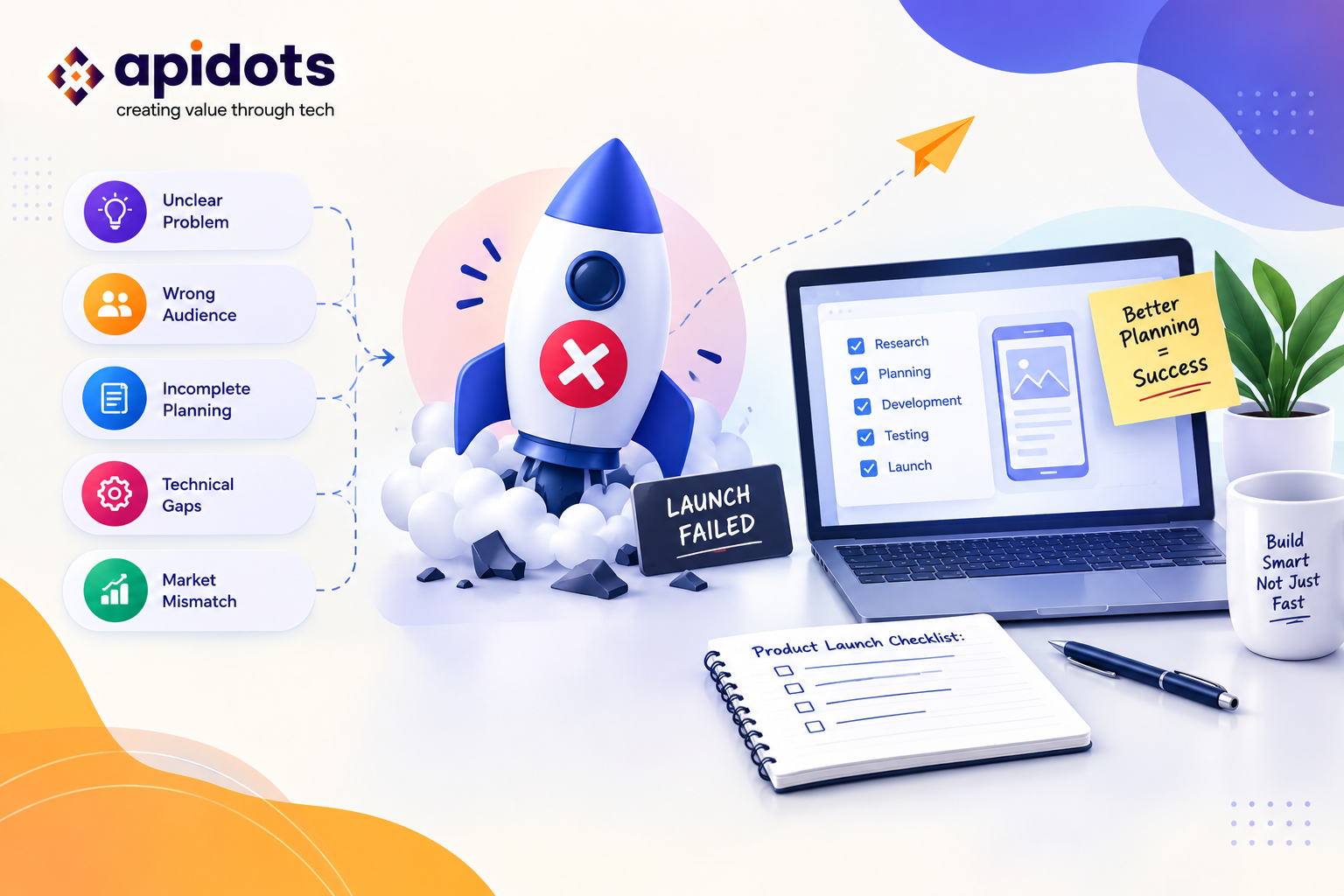
A product launch can look like a technology problem from the outside. There is an idea, a development team, a deadline, a budget, and eventually a launch date.
But experienced product teams know that many failures happen much earlier.
The first warning signs often appear before a developer writes the first line of code: the problem has not been validated, the target customer is unclear, the feature list is too large, success has not been defined, or stakeholders are building different versions of the same product in their heads.
Harvard Business Review has highlighted the importance of validating assumptions and understanding market demand before investing heavily in a launch. Product discovery guidance from Atlassian similarly emphasizes understanding customer needs, validating ideas, prioritizing opportunities, and connecting discovery with delivery. (Harvard Business Review)
This is why product development strategy should begin long before development.
The goal is not to eliminate uncertainty completely. That is impossible. The goal is to identify the most important uncertainties early, test them cheaply, and make informed decisions before significant development resources are committed.
A product can technically launch on time and still fail commercially.
For example, imagine a startup spends eight months developing a sophisticated platform. The interface looks polished, the architecture is scalable, and dozens of features work exactly as planned.
After launch, however, customers do not use the product.
The problem may not be the engineering.
Perhaps the product solves a problem customers do not consider important. Maybe the target audience was too broad. Perhaps the workflow requires users to change established habits. Or the team built features based on assumptions rather than evidence.
This is the distinction between building the product right and building the right product.
Software engineering determines whether something can be built effectively. Product strategy determines whether it is worth building in the first place.
One of the most common mistakes is beginning with a solution.
A founder may say:
“We need an AI-powered platform for small businesses.”
That sounds like a product idea, but it does not yet define the problem.
A better starting point is:
These questions force the team to move from assumptions toward evidence.
A good product development strategy therefore starts with problem discovery, not a technology stack.
Many teams conduct customer research after development has already started.
By then, changing direction can be expensive.
Research does not need to mean a six-month market study. It can begin with structured customer interviews, competitor analysis, surveys, usability tests, prototype testing, support-ticket analysis, and conversations with sales teams.
The purpose is to understand the customer’s situation—not simply ask whether they “like” your idea.
There is an important difference between:
“Would you use this?”
and:
“How do you solve this problem today?”
The second question is usually more useful because it investigates existing behavior rather than hypothetical enthusiasm.
Atlassian’s product discovery guidance similarly recommends first-hand customer research and continuous feedback as part of product decision-making. (Atlassian)
An MVP is often misunderstood.
Some teams interpret MVP as:
“Build the complete product, but remove a few features.”
That approach can still result in months of unnecessary development.
A better definition is a product or experiment designed to test important assumptions with the smallest reasonable investment.
Harvard Business School’s discussion of MVPs emphasizes the experimental purpose: entrepreneurs should use an MVP to test assumptions about the business model rather than simply produce a smaller version of a finished product. (Harvard Business Review)
This changes how a startup MVP development project should be approached.
Instead of asking:
“Which features can we remove?”
ask:
“What is the minimum experience required to test whether this product creates meaningful value?”
That distinction can save significant time and development effort.
A product roadmap can easily become a long list of features:
The list looks productive.
But features are not outcomes.
A better roadmap connects each proposed feature to a customer or business objective.
For example:
Feature: Automated invoice reminders
Expected outcome: Reduce manual follow-up for finance teams.
Feature: Personalized onboarding
Expected outcome: Help new users reach their first successful workflow faster.
Feature: Usage analytics
Expected outcome: Help customers identify underused parts of the platform.
This makes prioritization more rational.
A mature product development company should be comfortable challenging feature requests when the connection between the feature and the desired outcome is unclear.
Another common pre-development problem is internal disagreement.
The founder wants speed.
The product manager wants more research.
The engineering team wants time to build a scalable architecture.
Marketing wants additional features for launch campaigns.
Sales wants custom functionality for major prospects.
All of these perspectives can be legitimate. The problem occurs when there is no shared product objective.
Before development begins, stakeholders should agree on:
Without this alignment, development teams often receive conflicting instructions.
A clear roadmap and prioritization process can help connect product ideas with strategic objectives and delivery work. (Atlassian)
“Launch the product” is not a meaningful success metric.
A product needs measurable outcomes.
Depending on the business, these could include:
The specific metrics should reflect the product’s business model.
For an internal enterprise tool, productivity and adoption may matter more than revenue.
For a SaaS product, activation and retention may be critical.
For a marketplace, successful transactions and repeat usage may be more meaningful.
Defining these metrics before development helps determine which features deserve priority.
Product discovery is not only about customers.
An idea can be desirable but technically difficult, legally constrained, expensive to operate, or dependent on unreliable third-party systems.
This is why product, design, and engineering should collaborate early.
A technical feasibility assessment can identify:
This does not mean engineering should control the product roadmap.
Instead, technical expertise should inform product decisions before commitments become expensive.
This is one area where experienced custom software development teams can add significant value: not just writing code, but helping translate product requirements into a technically realistic solution.
Technology decisions can become surprisingly emotional.
A founder may prefer a particular framework because a competitor uses it. Another stakeholder may insist on a particular cloud provider. Someone else may want AI because it is currently receiving attention.
But technology should support the product not define it.
Before selecting a stack, consider:
An experienced MVP development company should be able to explain the reasoning behind technical recommendations rather than simply presenting a list of technologies.
One of the biggest challenges in startup product development is deciding what not to build.
Every additional feature introduces some combination of:
This does not mean the smallest possible product is always the right product.
The MVP must still deliver a meaningful experience.
The goal is minimum viable scope, not minimum possible functionality.
A useful prioritization framework is to evaluate features according to factors such as customer impact, business value, effort, risk, and confidence.
For example:
| Feature | Customer Value | Effort | MVP Priority |
| Core workflow | High | Medium | High |
| Advanced reporting | Medium | High | Later |
| Basic notifications | Medium | Low | Possible MVP |
| Complex third-party integration | Low | High | Validate first |
| Cosmetic customization | Low | Medium | Later |
The exact priorities will vary by product, but the principle remains consistent: build according to evidence and outcomes, not feature volume.
Customer feedback is valuable, but not every request should become a feature.
Imagine five customers asking for five different capabilities.
If the team simply implements every request, the product can become fragmented.
Instead, ask:
Customer feedback should inform product decisions—not automatically dictate them.
Continuous discovery helps teams distinguish genuine opportunities from isolated requests. (Atlassian)
A product launch is not a button you press when development finishes.
Marketing, sales, onboarding, customer support, documentation, pricing, analytics, and positioning should be considered before launch.
Ask:
Who will buy the product?
Why will they choose it?
How will they discover it?
What will convince them to try it?
What happens after they sign up?
How will we know whether they are successful?
A product can have strong technology and still struggle if customers do not understand its value.
Harvard Business Review’s research and commentary on product launches repeatedly point to the importance of market understanding and preparation rather than treating launch as a purely promotional event. (Harvard Business Review)
A practical pre-development process can look like this:
Write down the specific customer problem rather than starting with a feature list.
Define the initial audience narrowly enough to understand its needs and behavior.
Analyze competitors, alternatives, customer behavior, industry conditions, and existing solutions.
Use interviews, prototypes, landing pages, experiments, or other appropriate methods to test important assumptions.
Explain clearly why the customer should choose this product over existing alternatives.
Identify the smallest product experience capable of delivering meaningful value and testing critical assumptions.
Work with engineering to identify architecture, integration, security, scalability, and infrastructure requirements.
Decide how product performance will be measured after launch.
Separate immediate priorities from future opportunities.
Only after the product direction is sufficiently understood should substantial development begin.
This process does not eliminate risk. It makes risk more visible.
An experienced MVP development company can contribute well before development starts.
The right partner can help founders:
This is particularly valuable for startups that have strong industry knowledge but limited product or engineering experience.
The partner should not simply accept every requirement and start coding.
A valuable development partner asks questions.
Why does this feature exist?
Who needs it?
What evidence supports it?
What happens if we remove it?
Can the same outcome be achieved more simply?
Those conversations often prevent expensive mistakes.
Before hiring a development partner, ask:
If the company only begins after every requirement is finalized, you may need additional product expertise elsewhere.
Look for an answer based on validation and outcomes rather than simply reducing the feature list.
Product development involves learning. A rigid process that treats every change as failure may not suit an early-stage product.
Ask whether estimates include design, development, testing, deployment, integrations, and post-launch considerations.
Clear ownership and communication are essential.
Moving quickly does not mean ignoring architecture. Ask how the team balances speed with maintainability.
Starting development early can feel productive.
The team is busy. Designs are being created. Tickets are being completed. Code is being committed.
But activity is not the same as progress.
If the underlying product assumptions are wrong, every completed feature can increase the cost of changing direction.
This is why discovery is not “time before real work.”
Discovery is product work.
The objective is to make better decisions before those decisions become expensive.
A strong product process creates a feedback loop:
Research → Hypothesis → Prototype → Test → Learn → Prioritize → Build → Measure → Improve
That loop should continue after launch.
Product discovery is not something that ends when development begins. Modern product practices increasingly treat discovery as an ongoing, evidence-driven activity connected to delivery. (Atlassian)
Most product failures cannot be reduced to one cause, and it would be misleading to suggest that every unsuccessful launch fails because of poor planning. Markets change, competitors respond, customer behavior evolves, funding conditions shift, and unexpected operational challenges can all influence outcomes.
But one lesson remains consistent: building more software does not compensate for an unclear product direction.
The strongest products begin with a clear understanding of the customer problem, validate important assumptions, prioritize meaningful outcomes, and establish a practical roadmap before significant engineering resources are committed.
At APIDOTS, we approach software product development with this product-first mindset. As an experienced product development company, we help businesses move from an early-stage idea to a validated, technically feasible, and scalable software product. Our services can support product discovery, UI/UX design, custom software development, MVP planning, development, testing, deployment, and ongoing product improvement.
Whether you are a startup exploring startup MVP development or an established business planning a new digital product, APIDOTS can help you turn your concept into a structured development plan and build the technology around genuine business and user needs.
The goal is not simply to launch software.
The goal is to build something worth launching.
Products can run into problems before development because teams may not validate the customer problem, understand their target audience, define MVP scope, align stakeholders, or establish measurable success criteria. Development can then amplify assumptions that were never properly tested.
An MVP helps teams test important product and business assumptions with a limited but meaningful version of the product. The objective is not simply to build fewer features but to learn whether the core product delivers value before making a larger development investment.
A product development strategy should generally address the target customer, problem being solved, value proposition, market research, product goals, MVP scope, prioritization, technical feasibility, roadmap, launch plan, and success metrics.
Startups should evaluate an MVP development company based on relevant experience, product discovery capabilities, technical expertise, communication, development methodology, quality assurance, scalability, and post-launch support. It is also useful to ask how the company handles changing requirements and validates product assumptions.
An MVP focuses on the smallest meaningful product experience needed to provide value and test important assumptions. A full product generally includes a broader set of capabilities developed after the team has gathered more evidence about customer needs, usage, and business requirements.
Yes. An experienced product development company can help transform an early idea into clearer requirements through discovery, user research, prototyping, technical feasibility analysis, MVP definition, and roadmap planning. The exact scope of support varies between providers.
We design and develop secure, high-performance web and mobile applications.Ensuring scalability, reliability, and long-term product success.
Hire App Developers