
Top
Search
People also search for:

Stay Inspired with Instagram




In this comprehensive guide, I’ll break down the development cost of a wearable fitness app, what drives the budget, and how successful platforms turn wearable data into revenue.
A few years ago, fitness apps and wearable devices served different purposes. The app logged workouts. The watch or band collected data. That line has mostly disappeared. Users now expect both to work together. Raw health metrics should turn into coaching, recovery guidance, and decisions they actually act on.
That shift raises a practical question for founders, product leaders, and healthcare organizations. What does wearable fitness app development cost actually look like? There is no single number, because there is no single kind of wearable fitness app.
This guide breaks down the real cost drivers and the features that matter. It also covers how successful platforms turn wearable data into a business.
The clearest way to understand the opportunity is to look at successful platforms. See what they are already doing with wearable data. These are not included because they are popular. Each shows a different way to attract users, keep them active, and turn engagement into revenue.
Subscriptions can carry a wearable business on their own. WHOOP, a screenless fitness band and app, reported more than 2.5 million members in 2025. It also reported a 1.1 billion dollar revenue run rate, with subscriptions growing 103 percent year over year. That growth came directly from its own funding announcement in March 2026. The round valued the company at $ 10.1 billion.
A pure software model can scale without selling hardware. Strava, which does not manufacture any devices, reports more than 180 million registered users across over 185 countries. Business of Apps estimates its annual recurring revenue is approaching 500 million dollars. Roughly 90 percent of that comes from subscriptions.
Hardware subscriptions can rival software-only models at scale. Peloton bundles connected fitness hardware with a subscription. It reports around 2.7 million subscribers, a similar engagement range to WHOOP despite a very different product.
These examples point to the same conclusion. The commercial value does not come from recording steps or heart rate. It comes from what the product does with that information. That could be community and competition, AI-driven coaching, or a connected hardware-and-software bundle.
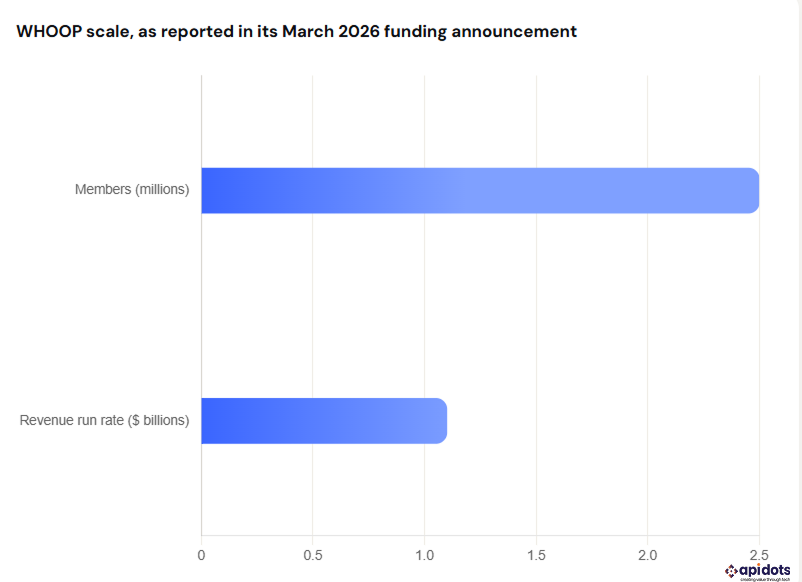
WHOOP reported more than 2.5 million members and a 1.1 billion revenue run rate in 2025 whoop.com
Everyone asks about the budget first. The honest answer is that it depends on which kind of app you are building.
A simple activity tracker that syncs with Apple Health or Google Fit is one kind of project. A platform that analyzes recovery trends and offers AI coaching is very different. So is one that supports multiple wearable brands and serves corporate wellness clients.
A realistic starting point for a wearable fitness app with core features sits between 40,000 and 90,000 dollars. That typically covers activity tracking, user accounts, basic analytics, and integration with one or two major health platforms.
As the product adds support for more device brands and AI-driven features, cost climbs. Enterprise-grade platforms with multi-device support, predictive analytics, and compliance work often reach $ 250,000 or more.
| Development Phase | Typical Timeline | Estimated Cost |
| Product discovery and planning | 2 to 4 weeks | $5,000 to $10,000 |
| UI/UX design | 3 to 6 weeks | $7,000 to $20,000 |
| Mobile and backend development | 4 to 8 months | $40,000 to $120,000 |
| Wearable integrations | 1 to 3 months | $15,000 to $40,000 |
| AI features and analytics | 2 to 4 months | $20,000 to $60,000 |
| Testing and quality assurance | 1 to 2 months | $8,000 to $25,000 |
| Security and compliance | Throughout the project | $10,000 to $30,000 |
| Launch and deployment | 2 to 4 weeks | $3,000 to $10,000 |
| Ongoing maintenance | Monthly | $2,000 to $12,000 |
API DOTS market analysis of typical wearable fitness app development costs by phase, based on 2026 North America engineering rates.
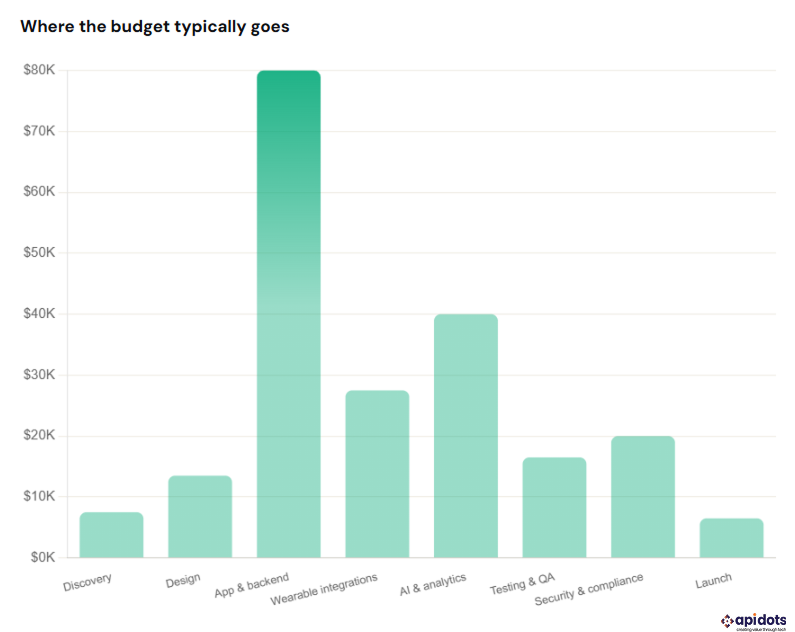
Midpoint of API DOTS market analysis cost ranges by development phase, illustrating the largest budget items in a typical build.
Two development teams can quote very different numbers for what sounds like the same app. Usually that is not a pricing difference. It reflects a different read on complexity. A wearable fitness app can range from a simple tracker to a connected health platform. AI coaching and enterprise dashboards sit at the far end of that range.
Step and workout tracking stays fairly predictable to build. Add AI coaching, recovery analysis, live sessions, or subscription tiers, and the project becomes meaningfully more sophisticated. Each feature brings its own APIs, business logic, and testing scenarios.
Wearable Device and Third-Party Integrations
Supporting Apple Health alone is straightforward. Supporting Apple Watch, Garmin, Fitbit, Samsung Health, and Google Fit together is a different scale of work. Each platform has its own SDK, permissions model, and data format.
A simple chatbot that answers common fitness questions is one thing. An engine that studies sleep, heart rate, and recovery trends before recommending a personalized plan is another. The second requires data pipelines, cloud infrastructure, and ongoing model evaluation, not just a model API call.
Wearable apps collect some of the most sensitive data a user can share. Encryption, consent management, audit logging, and role-based access all add cost. They also help a product earn trust with users and enterprise buyers.
Cross-platform frameworks reduce development time and suit most MVPs. Native development generally performs better for background health monitoring and deep wearable integration once the product scales.
People check fitness apps several times a day, often mid-workout. That usage pattern demands simple navigation and dashboards that surface the right information at a glance. Getting that right usually takes several rounds of testing and refinement.
The first estimate is rarely the final one. Not because the numbers were wrong, but because the product evolves. A stakeholder requests another integration. The app performs well and suddenly needs to support far more users than planned.
| Hidden Cost | Why it happens |
| Cloud infrastructure and AI usage | Every reading and recommendation moves through cloud infrastructure. Costs grow with usage, not just user count. |
| Supporting more devices than planned | Adding a new wearable brand sounds small but brings its own SDK, permissions, and testing requirements. |
| Third-party services and licensing | Payments, maps, notifications, and analytics tools often charge per user or per request. |
| Enterprise readiness | The first enterprise customer often needs dashboards, reporting, SSO, and audit trails the consumer app never required. |
| Performance and scalability | An architecture that handles 500 users may struggle at 50,000. Rebuilding after rapid growth costs more than planning for it. |
Costs that commonly appear after the initial development budget is set.
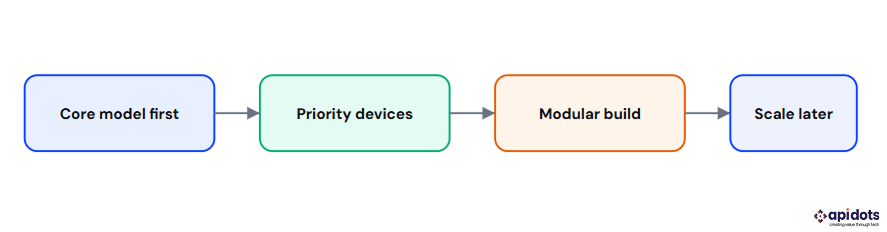
Reducing wearable fitness app development costs doesn’t have to mean reducing scope. Some of the most expensive decisions happen when you build a project in the wrong order. Features get rebuilt once the architecture cannot support real usage.
Ask anyone who has shipped one of these apps what users actually care about. It is rarely AI or a fancy dashboard. It is whether the watch syncs. It is whether the workout history is accurate and yesterday’s run is easy to find.
| Features | Why It Happens |
| Wearable device integration | Usually the first thing users judge. A slow sync undermines trust in everything else. |
| Health and activity tracking | Raw numbers are not the product. Users want to know if they are improving. |
| Goal tracking | Progress toward something, not just a stream of numbers, is what keeps people returning. |
| Workout guidance | Helping users decide what to do next is usually more valuable than logging what they already did. |
| Smart notifications | Fewer, better-timed reminders outperform frequent generic ones. |
| Privacy and security controls | Health data requires real protection, not an afterthought before launch. |
| Admin dashboard | Handles content, subscriptions, and user management behind the scenes as the platform grows. |
Baseline features expected in nearly every credible wearable fitness app.
Basic tracking can launch a wearable fitness app. It rarely builds a durable business. Users already get steps, heart rate, and workout records directly from their devices. A serious product needs to do more with that data.
Each advanced feature should support a clear revenue path, not just match a competitor’s feature list. That decision shapes wearable fitness app development cost more than any single technical choice.
Nutrition is a common extension once activity tracking is solid. Pairing wearable data with food logging gives users a fuller picture of energy balance and recovery. Our macro tracking app guide covers the specific architecture and cost considerations for that feature set in depth.
Building starts with commercial questions, not code. Who uses the app? Who pays for it? What should it do better than the health app already built into the user’s phone?
Once that direction is clear, the process follows a familiar shape. Define the business case, study the market, and decide which wearables to support first. Plan compliance and consent early, scope a focused MVP, and build the integration layer. Test with real users, launch, and iterate based on actual usage.
Our fitness app development guide covers this build process in full depth. It includes tech stack choices and why most fitness apps lose users in the first three minutes.
The wearable-specific part is the integration layer. Devices record the same activity differently, sync at different times, and occasionally return incomplete readings.
The backend has to reconcile that before showing anything to the user. This is usually where timelines slip if the team underestimated it during planning.
A wearable fitness app does not need millions of paying consumers to be commercially viable. In many successful products, the paying customer is not the person wearing the device at all. It is an employer, a gym, an insurer, or a clinic.
| Revenue Model | How It Works |
| Consumer subscriptions | Paid tiers for AI coaching, advanced reports, or coach access, with a free tier covering basics |
| Corporate wellness contracts | Per-employee pricing sold to employers or benefits providers for team challenges and reporting |
| White label licensing | The same platform rebranded and licensed to gyms, studios, and training businesses |
| Insurance and rewards partnerships | Insurers fund activity challenges and rewards tied to approved wellness goals |
| Remote care programs | Clinics use wearable data to track recovery or chronic conditions between appointments |
| Digital coaching | Structured paid plans, sometimes layered with real coach check-ins at a premium tier |
Common revenue models used by wearable fitness platforms today.
| Challenge | Recommended Approach |
| Inconsistent data across devices | Build a common data structure for all devices and test missing or delayed readings before adding more integrations |
| Health data privacy | Add clear consent, deletion, and role-based access, reviewed before the database is designed, not after |
| Wellness versus medical claims | Classify every insight as fitness guidance or clinical functionality, and route medical claims through proper review |
| Unreliable AI recommendations | Add data quality checks before generating insights, and avoid confident claims from incomplete readings |
| Enterprise access control | Give employers anonymized trends and share individual data only with explicit user consent |
| Low engagement after launch | Use recovery summaries and relevant challenges rather than generic notifications, and measure completed workouts, not app opens |
These issues are far cheaper to address during planning than after launch.
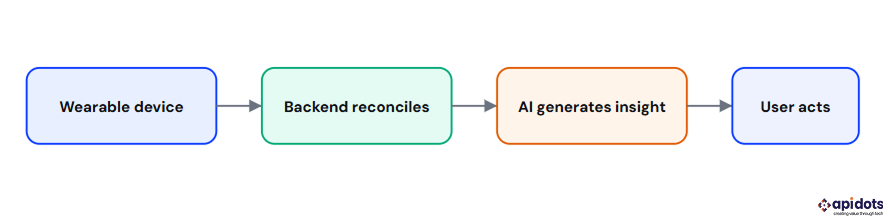
How wearable data moves from device to a decision the user actually makes.
The next generation of wearable fitness apps looks less like a step counter. It looks more like a connected health layer.
AI that explains a recommendation instead of just stating it is one example. Environment-aware coaching and predictive wellness programs that flag a decline early are others. All three are moving from novelty to expectation.
Connected healthcare is the bigger shift underneath these features. Electronic health record systems and wearable platforms are becoming easier to connect.
Products built with interoperability in mind from the start will have a real advantage over those retrofitting it later.
Voice coaching and digital fitness twins that adjust a plan in real time are two examples. Smart gym equipment integration is a third. These features will likely define the next wave of premium products.
A core wearable fitness app with activity tracking and basic health platform integrations typically costs $40,000 to $90,000. Enterprise-grade platforms with AI coaching and advanced analytics can exceed 250,000 dollars.
A focused MVP with core tracking and one or two wearable integrations usually takes four to six months. A full platform with AI features and multiple integrations can take six to nine months or longer.
AI is worth the investment when it improves a core part of the product. Recovery guidance or coaching are good examples. It is not worth it when it sits on top as an extra feature with no clear use case.
Annual maintenance typically runs 15 to 25 percent of the original development cost. This covers security updates, device SDK changes, infrastructure, and ongoing feature work.
Cross-platform frameworks work well for an MVP and reduce initial cost. Native development usually performs better for background health monitoring and deep wearable integration at scale.
Apidots builds wearable fitness platforms with the integrations, AI features, and compliance that real health data requires.
We leverage AI, cloud, and next-gen technologies strategically.Helping businesses stay competitive in evolving markets.
Consult Technology Experts
Hi! I’m Aminah Rafaqat, a technical writer, content designer, and editor with an academic background in English Language and Literature. Thanks for taking a moment to get to know me. My work focuses on making complex information clear and accessible for B2B audiences. I’ve written extensively across several industries, including AI, SaaS, e-commerce, digital marketing, fintech, and health & fitness , with AI as the area I explore most deeply. With a foundation in linguistic precision and analytical reading, I bring a blend of technical understanding and strong language skills to every project. Over the years, I’ve collaborated with organizations across different regions, including teams here in the UAE, to create documentation that’s structured, accurate, and genuinely useful. I specialize in technical writing, content design, editing, and producing clear communication across digital and print platforms. At the core of my approach is a simple belief: when information is easy to understand, everything else becomes easier. Reach me at amysbrew.com