
Top
Search
People also search for:

Stay Inspired with Instagram




Any contractor who has reviewed their Monday morning voicemail inbox after a hot weekend knows — the problem isn’t that customers didn’t call. It’s that nobody answered. A missed call isn’t a minor inconvenience anymore. At an average lead value of $89 per HVAC phone call (ServiceTitan, 2025), and industry estimates putting lost revenue per missed after-hours opportunity well into four figures, the cost of a voicemail is now measurable to the dollar.
This guide answers one question directly: exactly what an AI Voice Assistant for HVAC can — and cannot — do around the clock. Not marketing language, not a vendor pitch. A precise breakdown of what an AI voice assistant is qualified to handle at 2 a.m. on a Tuesday, and where it needs to hand the phone to a human.
What you’ll learn:
An AI voice assistant for HVAC is software that answers every inbound call in natural language, 24 hours a day — not a phone tree, not a hold queue. It listens to what the caller actually says, qualifies the issue, triages urgency, and books the job directly into your existing dispatch software. It is not a replacement for your dispatch app or your CRM; it’s the intake layer that feeds them. A well-built AI voice assistant for HVAC integrates with the systems you already run, rather than asking you to adopt a new platform.
That distinction matters more than most vendor pitches let on. A dispatch app (ServiceTitan, Jobber, Housecall Pro) manages the job queue once a booking exists. A CRM stores the customer record. An AI voice assistant’s job is narrower and earlier in the pipeline: it’s the thing standing between a ringing phone and an empty voicemail box.
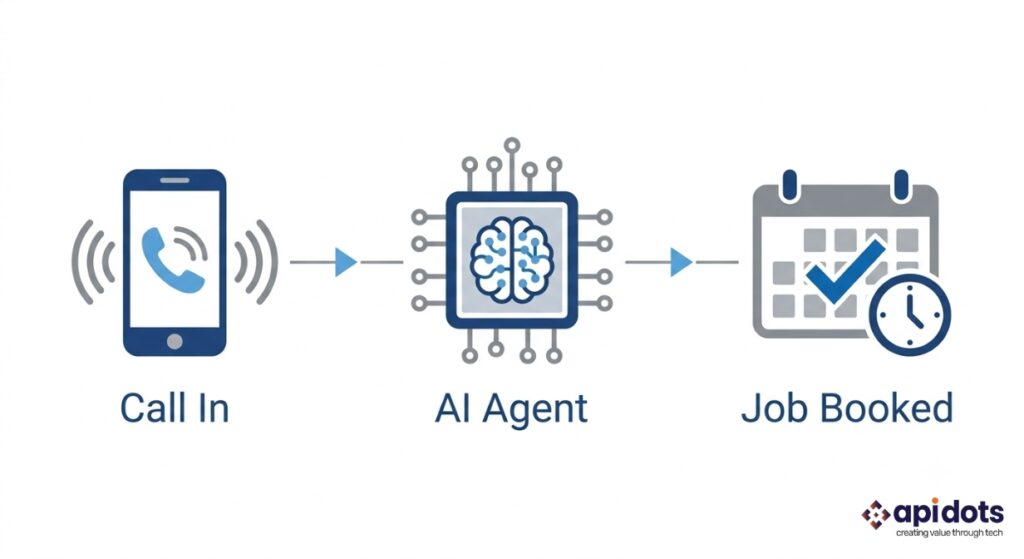
Here’s the specific, non-generic list of what a properly built system actually does—not what a sales page implies it does.
No voicemail, no hold music, no “please hold for the next available representative.” Picture a Houston HVAC contractor mid-heatwave: call volume triples in an afternoon as no-cool calls pile in from every direction, and the two-person office staff simply can’t physically answer three phones at once. An AI voice agent doesn’t have that ceiling — it can pick up every single call the moment it rings, at 3 p.m. or 3 a.m., during a single call or three hundred simultaneous ones. Adoption of this kind of production-voice AI has grown sharply over the past two years as home-service businesses discovered that the bottleneck was never staffing—it was the assumption that a phone can only be answered by one person at a time.
Service type, address, equipment make and model, symptom description—a well-trained AI voice agent collects the same intake information a good dispatcher would in the same conversation without the caller repeating themselves to three different people. Industry data on voice AI in customer service consistently shows a large share of routine inbound calls—often cited in the 60–70% range—can be fully resolved without any human intervention at all (Google Cloud research, cited across multiple industry voice-AI reports). For HVAC, “resolved” usually means: qualified, triaged, and booked.
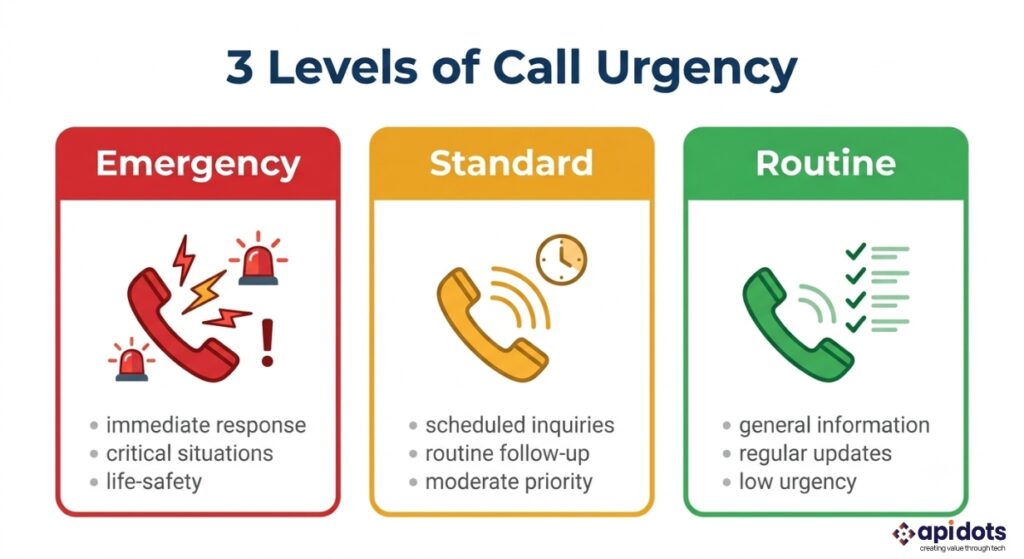
This is where a generic answering service falls apart and a custom-built system earns its keep. Take a Chicago contractor in January: a call comes in mentioning “no heat” and “elderly” or “infant” in the same sentence. A custom AI voice agent trained on that contractor’s own escalation logic flags this instantly as a life-safety priority and routes it to the on-call technician within seconds—not “next available appointment.” A shared, generic answering service, staffed by operators trained across a dozen trades, has no way to apply that kind of HVAC-specific urgency logic consistently.
The AI doesn’t just take a message — it creates the job record. Custom integration with ServiceTitan, Jobber, Housecall Pro, or a proprietary dispatch system means the caller’s name, address, equipment details, and urgency flag land directly in the queue, with zero manual re-entry by office staff the next morning. This is also where a custom CRM integration matters—the lead record and the service record should be the same record, not two systems an employee has to reconcile.
This is the single highest-value use case in HVAC specifically because so much emergency volume — no-heat calls in winter, no-cool calls in summer—happens outside business hours by definition. An AI voice assistant doesn’t get tired at 11 p.m. and doesn’t need a shift differential. It answers the call the same way at 11 p.m. as it does at 11 a.m., which is exactly the coverage gap that costs contractors the most in a broken-intake scenario.
It isn’t only inbound. A Toronto commercial HVAC contractor running seasonal maintenance agreements can have the same AI system place outbound renewal-reminder calls, confirming appointment windows and flagging any customer who wants to speak to a human about pricing — freeing office staff from a repetitive outbound calling task that otherwise falls to whoever has a spare hour.
A Los Angeles residential HVAC operation serving a genuinely multilingual customer base, or a Riyadh contractor fielding Arabic-language calls, needs intake that doesn’t force every caller through an English-only funnel. Custom-built voice agents can be trained on the specific languages a contractor’s actual customer base speaks, rather than the one or two a generic SaaS tool ships with by default.
Not every call needs a truck roll. Filter replacement questions, basic thermostat troubleshooting, “is this covered under my maintenance plan” — a well-configured voice agent can answer these directly, reducing the number of unnecessary service visits and letting technicians spend their day on calls that actually need a technician.
For new-customer calls, the AI can collect job scope, provide standard service price ranges where the contractor has set them, and create a warm lead record — with full context — before a human ever picks up the phone for follow-up. At an average lead value around $89 for an HVAC phone call (ServiceTitan), the difference between a warm, fully-qualified lead and a half-remembered voicemail message is the difference between a booked job and a lost one.
The best-designed systems are built to know their own limits. Certain words and signals — “angry,” “emergency,” “gas,” “fire,” a mention of a child or elderly occupant in distress — should always trigger an immediate handoff to a human, with the complete call transcript and notes already attached. This is agentic AI escalation logic done right: the system isn’t trying to prove it can handle everything. It’s built to know exactly when it can’t, and to make that handoff fast and information-rich rather than a cold callback.
Want the full picture on HVAC dispatch automation? Read the complete pillar guide →
Being honest about limitations is what actually separates a serious answer from a sales page. Here are five things a voice AI system should not be asked to do.
Complex emotional calls. A customer calling about a botched installation that damaged their flooring needs a human being with the authority to make things right — someone who can apologize, offer a concession, and be accountable. An AI voice agent can recognize the emotional signal in a caller’s tone and words and escalate immediately, but it cannot resolve a relationship-level problem. It shouldn’t try.
Non-standard, multi-system negotiations. When a commercial property manager wants to negotiate pricing across a multi-building maintenance contract, an AI voice agent can gather the initial information and schedule the follow-up—but closing that kind of deal requires judgment and negotiating authority no voice model should be given.
Real-time technician schedule visibility with complex constraints. AI can book into open slots in the dispatch system. It generally cannot make the kind of intuitive judgment call a human dispatcher makes when the day’s schedule has competing priorities, a technician running late, and a VIP customer all colliding at once.
High-stakes liability situations. A gas leak, a fire-related HVAC failure, or anything involving an immediate safety risk needs a trained human on the line within seconds, not a conversational triage flow. A well-built system should be configured to escalate these categories instantly rather than attempt to walk a caller through anything itself.
Brand relationship management. Long-standing commercial clients who expect to speak with a named account manager for a renewal conversation are not well served by having an AI intake system stand in for that relationship. Some conversations are relationship management, not call handling, and it’s a mistake to route them the same way.
Understanding what AI handles and what it doesn’t is what separates a well-implemented AI voice assistant from one that damages customer relationships. This is precisely why API DOTS builds custom AI voice systems with explicit escalation rules — not generic call scripts.
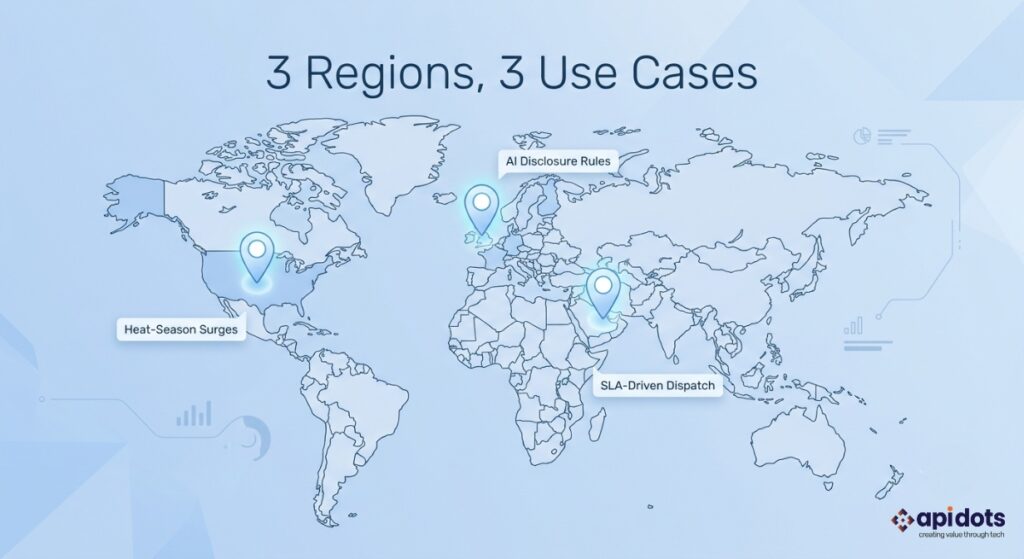
Texas (Houston): Summer heatwaves compress a normal week’s call volume into a single afternoon. Contractors using AI voice intake report the phone gets answered at the same speed on the worst day of the year as on the slowest one — because the system doesn’t have a capacity ceiling the way a two-person office does.
Arizona (Phoenix): In extreme heat markets, some contractors configure temperature-threshold triage — a no-cool call reported above a defined threshold gets flagged for immediate on-call dispatch rather than next-available scheduling, because “no AC” at 115°F is a different emergency than “no AC” at 85°F.
Florida (Miami, Orlando): Year-round call volume plus hurricane-season surges mean the after-hours gap is a permanent fixture of the business, not a seasonal one. AI phone intake captures the leads that would otherwise go to voicemail during storm-season peaks, when human staff are often dealing with their own storm prep.
New York (NYC): Commercial property managers calling after hours about building HVAC failures need triage that understands commercial urgency and local compliance context (including Local Law 97 considerations), not a residential-oriented script.
Illinois (Chicago): Winter no-heat emergencies are the highest-stakes call type in this market. Voice agents trained to escalate “no heat” combined with “elderly” or “infant” as an explicit life-safety flag reflect the kind of triage logic that needs to be built into the system from day one, not bolted on later.
Georgia (Atlanta): A useful illustrative example: a mid-size residential contractor running a shared, multi-trade answering service found that HVAC-specific urgency (a no-heat call in January) was being triaged the same way as a routine plumbing question, simply because the shared service’s operators had no HVAC-specific training. That’s the exact gap a custom-built, HVAC-specific system is designed to close—see the case study below.
California (Los Angeles): A high-expectation, high-volume market with a genuinely multilingual customer base and Title 24 compliance context; contractors here need an AI system trained on multiple languages rather than one designed for a single-language default.
Ontario (Toronto): Commercial HVAC contractors running maintenance agreements use outbound AI calling for renewal reminders alongside inbound emergency triage — treating the voice agent as a two-way channel, not just an inbound answering tool.
Alberta (Calgary): Extreme winter conditions make no-heat triage logic for sub-zero scenarios a business-critical configuration, not an edge case.
England (London): Operating in an EU-adjacent regulatory environment means London contractors need to build in the disclosure requirement that any AI voice system must state at the start of the call that the caller is speaking with AI — more on this in the compliance section below.
Scotland (Edinburgh): Hospital and institutional HVAC maintenance contracts create heavy volumes of scheduled-maintenance confirmation calls, an area where AI-managed scheduling reduces a real administrative burden.
New South Wales (Sydney): A residential HVAC boom in a market with growing self-service booking portals makes the handoff between online booking and phone-based booking a key design point for voice AI intake.
Queensland (Brisbane): Heat-season call surges mirror the same pattern seen in the US Sun Belt — volume spikes that a capacity-constrained office simply cannot absorb without either overstaffing for the peak or missing calls.
UAE (Dubai): High-rise commercial HVAC operating under SLA contracts need after-hours emergency triage built specifically for property management company workflows, where a missed call can mean a contractual SLA breach, not just a lost lead.
Saudi Arabia (Riyadh): Vision 2030 smart-building initiatives are driving demand for Arabic-language voice AI capability among local HVAC operators, a capability generic English-first tools frequently handle poorly.
Germany (Berlin): A market with high reliability expectations and a compliance-first posture toward the EU AI Act’s disclosure requirements — contractors here tend to prioritize getting the AI-disclosure language exactly right from the first deployed call.
The right choice depends heavily on call volume. Below roughly 100–150 calls a month, a human receptionist or a shared answering service is often the more practical option. Above that, the economics and consistency of a custom AI system tend to compound quickly.
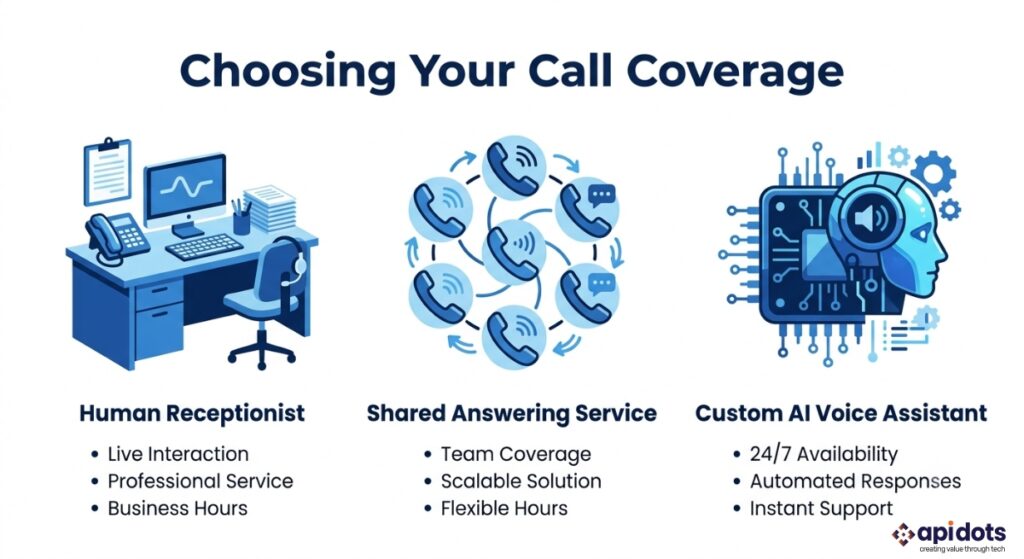
| Factor | Human Receptionist | Shared Answering Service | Custom AI Voice Assistant |
|---|---|---|---|
| Available hours | Business hours only | Limited after-hours | 24/7, every day |
| Cost | $35,000–$55,000/year salary | $8,000–$20,000/year | Per-call cost, no per-call staffing fee |
| Call handling capacity | One call at a time | Multi-call, generic scripts | Unlimited simultaneous calls |
| HVAC-specific triage | Yes (trained staff) | No (generic service) | Yes (custom-trained on your workflow) |
| Emergency escalation accuracy | High | Low–Medium | High (when custom-built) |
| Integration with dispatch app | Manual data entry | Minimal | Direct API booking |
| Multilingual capability | Depends on staff | Rarely | Yes, if built for it |
| EU AI Act disclosure compliance | N/A | Varies | Built into custom system from day one |
| Call data and analytics | Limited | Limited | Full call transcript + CRM sync |
The ROI case for a custom AI voice system versus a shared answering service tends to be strongest once monthly call volume climbs past a couple hundred calls, at which point the per-call cost advantage and HVAC-specific triage accuracy compound into a difference that’s worth the up-front development investment. Below that volume, the math is closer, and a well-run shared service or in-house receptionist may still make sense.
The following is an illustrative composite scenario based on patterns common across mid-size residential HVAC contractors, not a specific named client engagement.
Company profile: A residential and light-commercial HVAC contractor in the Atlanta metro area, roughly 40 technicians, running Housecall Pro for dispatch. The company was paying for a shared multi-trade answering service — handling plumbing, electrical, and HVAC calls with the same generic script — with inconsistent call quality and frequent after-hours emergency misroutes.
The problem, as this pattern typically plays out:
What contractors in this position typically try first: hiring a part-time evening dispatcher to cover the early evening hours. It helps for a few hours a day, but leaves nights and weekends — often the highest-emergency-density windows — uncovered.
What a custom-built solution looks like:
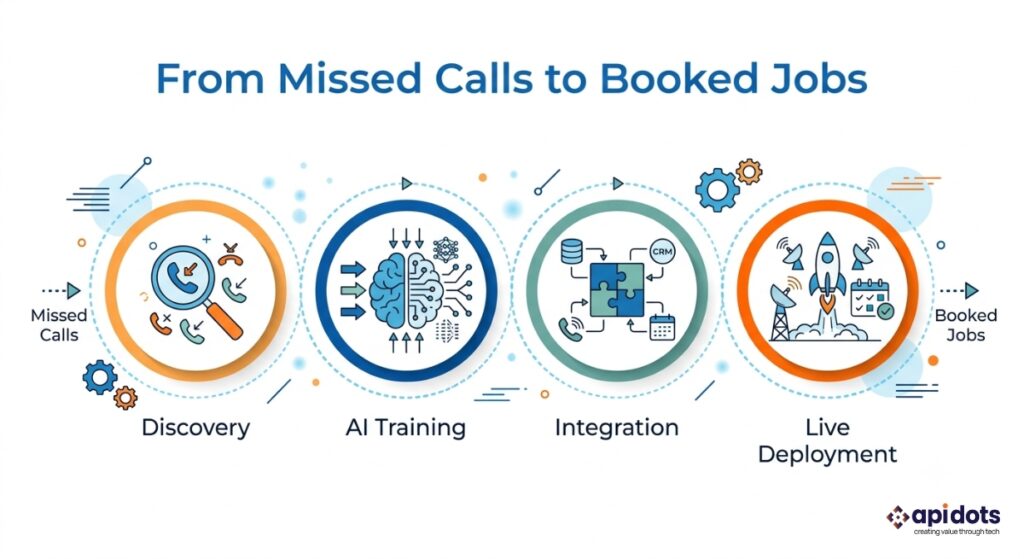
Typical implementation timeline:
| Phase | Weeks | Activity |
|---|---|---|
| Discovery & triage rule mapping | 1–3 | Workflow audit, escalation logic design, dispatch API review |
| AI voice model training | 4–8 | Custom script training, equipment vocabulary, service area rules |
| Integration build & testing | 9–12 | API integration, dispatcher notification system, UAT with real call scenarios |
| Live deployment | Week 13+ | Emergency calls only first; full call handling phased in over the following weeks |
The core lesson contractors in this situation tend to arrive at: the cost of a shared answering service was never really the line item on the invoice. It was the compounding cost of missed bookings, unnecessary overtime dispatches, and inconsistent triage — three separate leaks that a single, custom-built intake system is designed to close at once.
📞 Still running a shared answering service? If your after-hours call handling looks anything like the pattern above, it’s worth running the numbers on what it’s actually costing you across answering fees, missed bookings, and overtime misroutes. See how API DOTS builds custom AI voice systems for HVAC →
For a complete picture of how AI voice intake fits into a full custom HVAC software stack, our custom HVAC software development guide covers the broader integration architecture in detail. For how voice AI compares to a traditional dispatch app specifically, see AI dispatcher vs. dispatch app.
EU AI Act, Article 50 (effective August 2025): Any AI voice system operating in the EU is required to disclose at the start of the call that the caller is speaking with an AI system, not a human. Contractors operating in the UK or EU — including the London and Berlin markets referenced above — need to build this disclosure into the system from the first deployed call, not retrofit it later.
US landscape: There’s no federal equivalent requirement yet, though state-level AI disclosure legislation is an active and evolving area, including proposals in California. A custom-built system can include disclosure logic from day one regardless of jurisdiction; off-the-shelf SaaS tools vary considerably in whether and how they handle this.
Customer trust reality: Broad industry surveys on AI voice interactions generally show customer comfort with AI-handled calls has risen substantially over the past several years, particularly for transactional interactions like scheduling and status checks. The concern most contractors raise—”Will customers hang up if they know it’s AI?”—has generally not played out as the dominant factor in practice; response speed and accuracy tend to matter more to callers than the human/AI distinction itself, especially for appointment booking and emergency triage.
Data security: Custom-built AI voice systems can be designed with GDPR, HIPAA-adjacent considerations (relevant for any healthcare-facility HVAC clients), and PCI-DSS compliance in mind from the architecture stage. Shared, generic SaaS answering services have far more variable compliance postures, and it’s worth asking any vendor directly what they actually support before assuming coverage. See also our notes on intelligent automation and compliance for how this plays out beyond voice specifically.
Can an AI voice assistant fully run an HVAC business 24/7?
An AI voice assistant can handle the inbound call and booking workflow 24/7 without human involvement for routine and emergency triage calls, but it cannot fully run the business alone. It handles qualification, urgency triage, and dispatch-app booking automatically, while escalating complex negotiations, emotionally sensitive calls, and true life-safety emergencies to human staff with the full call context transferred.
How much does an AI voice assistant cost for an HVAC company?
Off-the-shelf AI phone assistant products typically run a few hundred to a few thousand dollars per month depending on call volume, usually billed per call or per month. Custom-built AI voice agents carry a one-time development investment that scales with scope and integration complexity, generally with no ongoing per-call platform fee — an approach that tends to have stronger long-run economics at higher call volumes.
Will customers hang up when they realize they’re talking to AI?
Most won’t. Broad customer-experience surveys show rising comfort with AI-handled voice interactions over the past several years, and for appointment booking and emergency calls specifically, response speed and accuracy tend to matter more to callers than whether the voice is human. Contractors who implement AI voice well generally report maintained or improved customer satisfaction scores, not degraded ones.
What happens when an AI voice assistant gets an HVAC emergency call?
A properly configured system detects emergency signals—”no heat,” “no cool” above a set threshold, “gas smell,” “no hot water” — early in the conversation and routes the call to the on-call technician immediately. A well-built custom system can also push the full call transcript to the technician’s phone before they call the customer back, eliminating a cold callback.
Can an AI voice assistant integrate with ServiceTitan, Jobber, or Housecall Pro?
Yes — a custom AI voice system can integrate directly with any dispatch platform that exposes an API, including ServiceTitan, Jobber, and Housecall Pro. The AI creates a complete job record — caller name, address, equipment details, urgency flag — automatically, without manual data entry from office staff.
Is an AI voice assistant the same as a virtual receptionist service?
No. A traditional virtual receptionist service uses human agents following generic scripts, typically without deep HVAC-specific knowledge and without integration into your dispatch system. An AI voice assistant uses natural language understanding to hold conversations specific to your service area and equipment types and books directly into your dispatch platform—something a shared human answering service generally can’t replicate automatically.
Do I need to tell customers they’re speaking with AI?
In the European Union, yes — the EU AI Act’s Article 50, effective August 2025, requires disclosure at the start of any AI voice interaction. In the United States there’s no current federal requirement, though state-level legislation is developing. A custom-built system can be configured with compliant disclosure language appropriate to each region it operates in.
How long does it take to build a custom AI voice assistant for an HVAC business?
A typical custom build runs roughly 12–16 weeks from discovery to full deployment: the first few weeks cover triage logic mapping and integration design, the middle stretch covers AI model training and integration development and testing, and the final weeks cover a phased launch—usually emergency calls first, with full inbound coverage following once accuracy is validated.
Yes, with limits clearly defined. A well-built AI voice assistant for HVAC can run the intake, triage, and booking workflow 24/7 — capturing the calls a broken manual process is currently losing, booking jobs a team never knew were slipping away, and closing the multiple, compounding costs of an intake system that only works during business hours.
The contractors moving on this now aren’t waiting for the technology to be perfect before deploying it. They’re deploying it where it’s already proven — after-hours intake, emergency triage, booking automation — and building operational capability ahead of where the rest of the industry is clearly headed. The lead time that early movers build now tends to compound as adoption becomes standard practice rather than a competitive edge.
API DOTS custom-builds these systems for HVAC contractors across the US, Canada, UK, Australia, UAE, and Europe — not off-the-shelf configuration, but a system built to your triage logic, your dispatch platform, and your escalation rules. For the full custom HVAC software development picture, the pillar guide covers the broader architecture this fits into.
Whether you’re losing heatwave emergency calls in Phoenix, after-hours leads in Atlanta, or commercial SLA opportunities in Dubai — the call that goes to voicemail tonight is revenue you won’t get back tomorrow.
Get a Free AI Voice Assessment from API DOTS → We’ll audit your current call handling, map your triage logic, and show you exactly what a custom AI voice assistant would look like for your operation. No commitment.
Also read: AI Dispatcher vs. HVAC Dispatch App · Custom CRM Software for Better Customer Relationships · Agentic AI vs. AI Agents in Digital Transformation
We manage and optimize your IT infrastructure end-to-end.Ensuring stability, security, and operational continuity.
Consult IT Experts
I’m a digital marketer with experience in SEO, content strategy, and online brand growth. I specialize in creating optimized content, improving website rankings, building high-quality backlinks, and driving traffic through effective digital marketing strategies. I enjoy helping businesses strengthen their online presence and turn visitors into customers.