
Top
Search
People also search for:

Stay Inspired with Instagram




MCP servers for Claude Code are becoming a serious product delivery topic for CTOs and founders, not just a developer setup detail. Every MCP guide is a developer setup tutorial. This one explains what MCP servers mean for the product being built: delivery speed, integration quality, security, and what to ask the team building your software.
MCP servers for Claude Code are connectors that let Claude Code access external tools such as GitHub, Slack, databases, Sentry, and Stripe. For CTOs and founders, MCP matters because it gives Claude Code real product context instead of relying only on pasted prompts. That can speed up development, but it also creates permission, data access, and security questions that need to be managed before production use.
Methodology: We evaluated MCP servers based on Anthropic’s official documentation, published adoption data, Claude Code’s MCP integration guides, and agency delivery considerations including data handling, permission scoping, and production readiness. Where claims require individual verification, we say so.
MCP stands for Model Context Protocol. It is an open standard that defines how an AI agent like Claude Code connects to external tools and data sources through a single, consistent interface. Before MCP, every integration between an AI agent and an external system required a custom-built connector written specifically for that combination.
A team connecting Claude Code to GitHub needed one custom integration. Connecting it to Slack needed another. Each came with its own authentication logic, failure modes, and maintenance overhead.
MCP replaces that with one standard that any tool can implement once and any compatible AI agent can use immediately. The USB-C analogy is accurate: before USB-C, every device needed its own cable. Before MCP, every AI-tool combination needed its own connector.
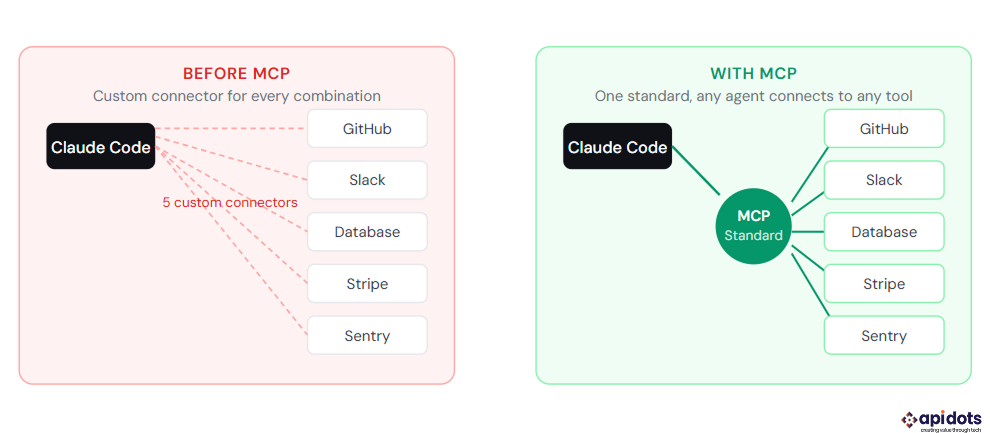
Before MCP, every AI tool integration required a custom connector. MCP replaces that with one standard interface. Source: Model Context Protocol specification.
MCP was created by Anthropic and launched in November 2024. In December 2025, Anthropic donated MCP to the Linux Foundation, establishing it under the Agentic AI Foundation (AAIF), co-founded by Anthropic, Block, and OpenAI. This matters to product teams because it removes the single-vendor risk permanently.
MCP is now governed the same way as HTTP and OAuth: as an open standard with no single commercial owner. According to Anthropic, MCP has been adopted across major AI products including ChatGPT, Gemini, Microsoft Copilot, Cursor, and Visual Studio Code, with infrastructure support from AWS, Cloudflare, Google Cloud, and Microsoft Azure.
The developer benefit of MCP is obvious: less context switching, no manual copy-pasting, fewer custom integrations to maintain. But the business impact is different and worth understanding separately.
When a development team connects Claude Code to MCP servers, the practical effect is that the AI agent operates with real context about your product. It reads the actual GitHub issues rather than a developer’s summary of them. It queries the actual database schema rather than a description typed into a prompt. It checks Sentry for the real stack trace rather than a copy-pasted excerpt. That difference in context quality flows through to the quality of what gets produced.
For a CTO or founder, this means a few things. Development cycles on real integrations can move faster because the agent is not working from approximations. Code that touches your data model is more likely to reflect the real shape of your data. And the gap between “the AI wrote some code” and “the AI wrote code that works against our actual systems” narrows significantly. Understanding this is a core part of how we evaluate AI adoption decisions with clients, and it connects directly to the delivery quality considerations we cover in our guide on debugging AI-generated code.
Security Note
MCP gives Claude Code direct access to external systems. Treat every MCP server like a third-party integration with access to code, tickets, logs, customer data, or internal business context. Permissions, data handling, and secrets management are production decisions, not just developer setup steps. Claude Code’s own MCP documentation advises verifying trust before connecting to any server, because servers that fetch external content can expose workflows to prompt injection risk.
The adoption curve is worth understanding because it signals where MCP sits in the development toolchain in 2026. This is not an emerging technology that teams are evaluating cautiously. It is infrastructure that has already been adopted at scale, which means teams not using it are increasingly in the minority
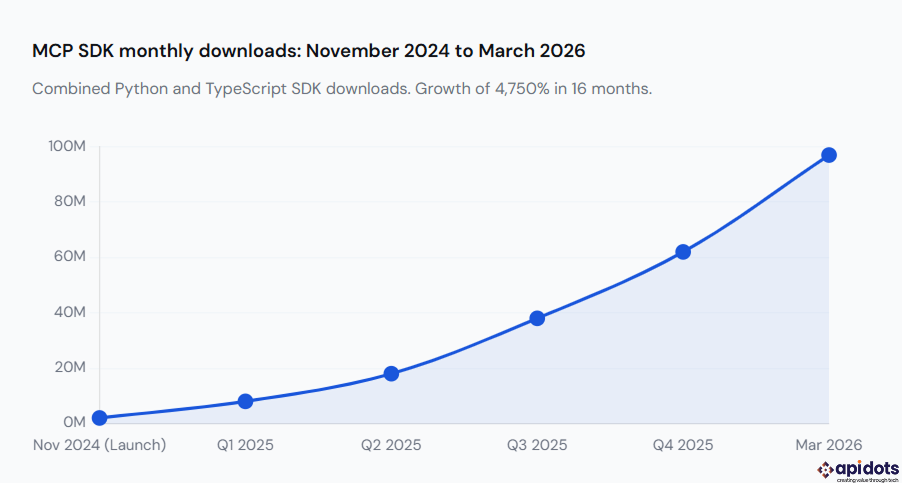
Source: Anthropic official announcement and Digital Applied citing Anthropic. Launch figure approximately 2M; March 2026 figure 97M as reported by Anthropic. Intermediate values are illustrative of the growth trajectory, not independently verified data points.
This is not a comprehensive list of every available server. The MCP ecosystem now includes over 10,000 public servers. The seven below are selected because they map directly to the systems that matter most in a product build, and because they represent different categories of value: repository management, data access, team communication, error tracking, payments, testing, and project management. For teams exploring the full Claude Code workflow these connect to, our guide on how to build with Claude Code covers the foundational setup in detail.
Gives Claude Code direct read and write access to your GitHub repositories. Claude can read issues, review pull requests, search across codebases, and create branches or PRs without leaving the terminal. For a product team, this means developers can instruct Claude Code to implement a feature described in a GitHub issue and open a PR: the agent reads the issue context itself rather than relying on a typed summary.
Lets Claude Code read your database schema, run queries, and understand the real data model underlying your product. For a product team, this reduces the back-and-forth between a developer and the agent when writing database migrations, API routes, or data transformations: the agent works from the actual schema rather than an approximation typed into a prompt. This is particularly relevant for the SaaS products we build where data model decisions have long downstream consequences.
Lets Claude Code read channel context and post updates as part of a development workflow. For a product team managing an agency or distributed development team, this creates a tighter loop between what the AI agent is working on and the rest of the team’s communication. Development blockers, status updates, and error alerts can surface in Slack as part of the same agentic workflow rather than requiring manual reporting. Directly relevant for offshore development engagements where visibility matters.
Pulls live error details, stack traces, and issue counts from Sentry directly into Claude Code’s context. For a product team, this means Claude Code can work on real production errors with the full stack trace rather than a manually copy-pasted excerpt. The difference in context quality is meaningful: the agent sees the exact error, the surrounding code, and the frequency data: not a developer’s interpretation of it. Relevant to the production quality considerations we cover in our guide on AI-generated code review.
For product teams building payment flows, subscriptions, or any commerce functionality, Stripe’s MCP server gives Claude Code the ability to query payment data and write integration code against the real API surface rather than documentation alone. Particularly useful for fintech products and any SaaS with billing logic, where the gap between what the docs describe and what live data looks like can cause subtle integration errors.
Browser automation MCP lets Claude Code interact with and test a running application in a real browser. For a product team, this means end-to-end testing and UI verification can be included in the same agentic workflow as feature development. Claude Code can verify that what it wrote renders and behaves correctly in the browser: not just that the code compiles. Useful for the front-end verification phase of any AI-native SaaS build.
Ticket management MCP servers let Claude Code pull sprint context, update tickets as work progresses, and create new tickets from errors or code review findings. For a CTO managing a development team or evaluating a development partner, this creates a tighter loop between what is planned, what is in progress, and what the AI agent is producing: making it easier to track progress without relying on manual status updates.
Understanding MCP through a delivery lens is more useful for a CTO or founder than understanding it through a developer productivity lens. The table below maps each MCP category to its direct product delivery implication. This framing is core to how we approach AI-assisted development decisions with clients, alongside the cost considerations covered in our guide to custom software development cost.
| MCP category | What it enables | Delivery impact | Key risk |
|---|---|---|---|
| Repository access, such as GitHub | Claude Code can read issues, review code, search repositories, and help create pull requests. | Faster feature cycles because the agent works from real tickets and repository context instead of prompt approximations. | Write access can be too broad. Restrict permissions by repository, branch, and workflow instead of allowing direct changes to main. |
| Database access, such as PostgreSQL | Claude Code can inspect schema, query data, and generate migrations, API routes, or data transformations from the real data model. | More accurate database-related work because the agent does not rely only on manually typed schema descriptions. | Production database exposure. Use read-only roles by default and avoid connecting sensitive production data unless access is approved. |
| Error tracking, such as Sentry | Claude Code can read stack traces, issue details, and error frequency from monitoring tools. | Faster debugging because the agent can work from real error context instead of copied excerpts. | Logs may contain sensitive data. Confirm what your monitoring tool captures before giving an MCP server access. |
| Payment systems, such as Stripe | Claude Code can work against payment APIs, subscription states, billing objects, and payment workflow context. | Fewer integration mistakes in billing, subscriptions, checkout flows, and payment-related logic. | Transaction and customer data exposure. Use restricted API keys and limit access to only the objects needed for development. |
| Browser testing, such as Playwright | Claude Code can test UI behavior in a real browser environment and validate user flows. | End-to-end checks can happen in the same workflow as feature development, reducing manual QA gaps. | Community or server maintenance risk. Verify the MCP server is actively maintained before relying on it in production workflows. |
| Project management, such as Linear or Jira | Claude Code can read sprint context, reference tickets, and create or update tasks as work progresses. | Better traceability between planned work, implementation, and AI-generated output. | Write permissions can cause unintended ticket changes. Scope access carefully and avoid broad project-wide write permissions unless needed. |
Source note: Claude Code MCP documentation describes MCP servers as a way to connect Claude Code to tools, databases, APIs, issue trackers, monitoring dashboards, PostgreSQL, Sentry, Slack, and similar systems. The delivery impact and risk notes above are Apidots’ product-team interpretation of those capabilities.
Most AI coding tool comparisons stop at “which tools does your team use.” MCP adds a second layer that is worth asking about specifically, because MCP configuration determines what data the AI agent can access and what it can do with it. The same questions apply whether you are working with an internal team or evaluating a development partner.
1. Which MCP servers do you connect to Claude Code on our project, and what permissions does each have?
Each server is a live data integration. Read access to GitHub and Slack is different from write access. You should know which is which before development begins, not after a permissions incident in production.
2. Do you use read-only roles for database and production system MCP connections?
A development agent with write access to a production database is a significant and unnecessary risk for most workflows. Read-only roles are a reasonable default and any deviation should come with a clear justification.
3. How do you manage MCP secrets and API keys in your team configuration?
MCP configuration files are committed to the repository by many teams by default. Secrets stored inline in those files are a common and serious security mistake. Ask specifically how the team handles credentials before any production API keys exist in a codebase.
4. Are you using first-party, officially maintained, or community MCP servers for our project?
The MCP ecosystem includes servers of varying quality and maintenance status. For production work, first-party or officially maintained servers are the safer default. A team using a community server that has not been updated in six months on a production integration has made a choice worth discussing.
5. Which MCP servers do you use specifically for our project, and why those?
A thoughtful team can explain which servers they chose and what problem each solves for the specific product being built. A generic answer suggests the configuration was not tailored to the project’s actual requirements or risk profile.
If you are evaluating whether Claude Code, MCP, or another AI-assisted development workflow fits your product build, API DOTS can help you assess the right setup before development begins.
For teams building in healthcare or fintech, MCP introduces data handling questions that sit inside compliance scope. Every MCP server is a data flow. A database MCP server that queries patient records, a GitHub MCP server connected to a codebase containing PII, or a Sentry MCP server logging financial transaction data all create data flows that may fall under HIPAA, PCI DSS, or SOC 2 requirements depending on your product and how systems are configured.
The questions to validate with legal and security teams before deploying any MCP configuration in a regulated environment are:
These are the same questions any third-party integration requires in a regulated environment. The difference with MCP is that the connections can be added quickly by a development team, which means the compliance conversation needs to happen before the configuration is set, not after. This applies equally to the healthcare software products we build and to the financial services context we cover in our guide to AI in banking.
MCP is not required to use Claude Code. Claude Code works without any MCP servers connected and can still produce significant value for architecture decisions, complex refactoring, and code generation from prompts alone. MCP extends what Claude Code can access: it does not replace the core capability.
MCP adds the most value when the development work requires real context from systems your team already uses. If your developers spend meaningful time copying GitHub issue descriptions into Claude Code prompts, summarizing database schemas by hand, or copy-pasting Sentry stack traces to get debugging help, MCP removes those steps and improves the quality of what the agent produces in their place.
MCP adds less value: and introduces unnecessary risk: when connections are set up for their own sake rather than to solve a specific workflow problem. A team that connects seven MCP servers to Claude Code before writing a line of product code has added seven data flows and seven permission surfaces without yet knowing which ones will actually be used. Starting with one or two servers that remove the most frequent manual context-copying steps is a more disciplined approach.
For teams evaluating whether Claude Code with MCP is the right approach for their product build, our comparison of Claude Code vs Cursor vs GitHub Copilot vs Windsurf covers where each tool fits across the different phases of a build.
MCP has crossed from developer tooling into production infrastructure. With 97M+ monthly SDK downloads, 10,000+ public servers, and adoption across every major AI platform, it is now the standard through which AI agents connect to the systems that run your business.
For CTOs and founders, the question is not whether your development team uses MCP. It is whether they configure it with appropriate permission scoping, thoughtful server selection, and the data handling controls your product requires.
The teams that get the most value from MCP are not the ones that connect the most servers. They are the ones that connect the right servers, scope them correctly, and use them to remove the specific workflow bottlenecks that limit what the AI agent can produce. That discipline is worth asking about before a development engagement begins, not after something reaches production.
API DOTS can walk you through how we configure and scope MCP servers on client builds before you commit to a development engagement. Book a free 30-minute discovery call.
MCP servers for Claude Code are connectors that let Claude Code access external tools such as GitHub, databases, Slack, Sentry, Stripe, and project management systems. They give Claude Code real product context, so it can work from actual tickets, schemas, logs, and workflows instead of manually pasted prompts.
No, you do not need MCP servers to use Claude Code. Claude Code works without MCP, but MCP servers expand what it can access by connecting it to tools your development team already uses, such as repositories, databases, error tracking tools, and project management systems.
CTOs should care about MCP servers because they affect development speed, integration quality, security, and data access. A well-scoped MCP setup can help Claude Code work from real product context, while a poorly scoped setup can expose code, tickets, logs, customer data, or production systems.
MCP servers can be safe for production development when permissions, secrets, and data access are managed carefully. Teams should use read-only access where possible, restrict write permissions, verify server trust, and avoid exposing production credentials or sensitive customer data unnecessarily.
The most useful MCP servers for Claude Code usually connect to product-critical systems such as GitHub for repository access, PostgreSQL or Supabase for database context, Sentry for error tracking, Stripe for payments, Playwright for browser testing, and Linear or Jira for project management.
Ask a development agency which MCP servers they use, what permissions each server has, whether production systems use read-only access, how API keys and secrets are stored, and whether they rely on first-party, officially maintained, or community MCP servers.
We leverage AI, cloud, and next-gen technologies strategically.Helping businesses stay competitive in evolving markets.
Consult Technology Experts
Hi! I’m Aminah Rafaqat, a technical writer, content designer, and editor with an academic background in English Language and Literature. Thanks for taking a moment to get to know me. My work focuses on making complex information clear and accessible for B2B audiences. I’ve written extensively across several industries, including AI, SaaS, e-commerce, digital marketing, fintech, and health & fitness , with AI as the area I explore most deeply. With a foundation in linguistic precision and analytical reading, I bring a blend of technical understanding and strong language skills to every project. Over the years, I’ve collaborated with organizations across different regions, including teams here in the UAE, to create documentation that’s structured, accurate, and genuinely useful. I specialize in technical writing, content design, editing, and producing clear communication across digital and print platforms. At the core of my approach is a simple belief: when information is easy to understand, everything else becomes easier. Reach me at amysbrew.com