
Top
Search
People also search for:
Stay Inspired with Instagram





If you are evaluating AI software development in San Francisco, you are looking at the most competitive AI market in the United States. Google DeepMind, Anthropic, OpenAI, and Meta AI are all headquartered or heavily present in the Bay Area. The engineering talent here builds production AI systems at a level of depth that is difficult to find anywhere else. That concentration creates real advantages for the right kind of project. It also means higher costs, a saturated vendor market, and a wide gap between firms that can genuinely deliver and those that claim to. This guide helps CTOs, founders, and product managers cut through that noise.
In this guide, you’ll learn what AI software development companies in San Francisco actually do, how much projects cost, when to hire developers, when to outsource, and how to choose the right AI partner
Not every firm calling itself an AI software development company in California is doing the same kind of work. The market spans a wide range. Some teams build AI features on top of existing APIs. Others have dedicated researchers building custom models from the ground up. Some focus on generative AI application development. Others concentrate on production infrastructure for AI systems running inside large enterprises. Understanding that range is the first decision you need to make before contacting anyone.
In practice, the work happening across Bay Area AI software firms falls into a few distinct categories. Some teams are building generative AI development in California projects, creating applications that use large language models to produce content, code, or decisions at scale. Others are focused on NLP software development in California, powering everything from document intelligence to voice-based enterprise tools. A growing segment is developing AI automation in San Jose, California, replacing manual business workflows with reliable, AI-driven systems that operate without constant human intervention.
What connects it all is the evaluation problem. Whether a firm is building an AI app in San Francisco for a consumer product or deploying an AI chatbot project in San Francisco for enterprise customer support, the firms that consistently deliver are the ones with a structured process for measuring AI output quality before users ever see it. The guide on choosing an AI company covers the evaluation questions that separate strong firms from weak ones.

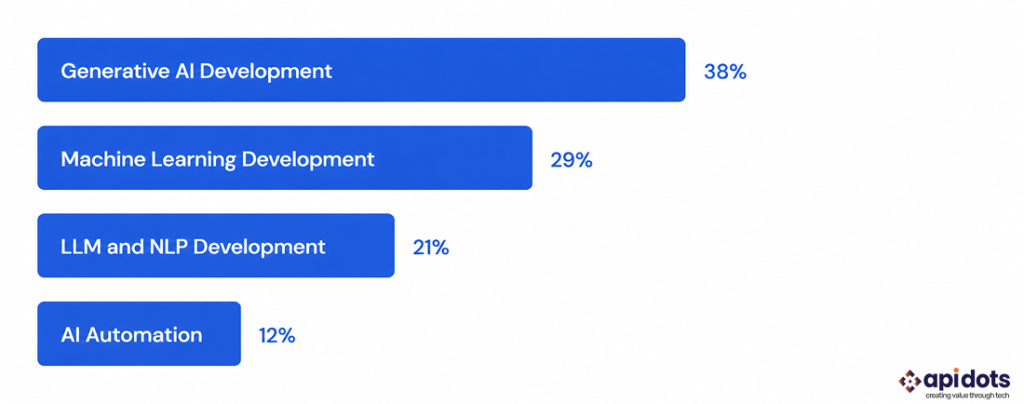
Distribution of AI software development project types across San Francisco Bay Area firms in 2026. Source: API DOTS market analysis and Bay Area AI hiring data.
Generative AI development in California has moved well past proof of concept. The serious work now is building AI software systems that behave reliably in production, handle edge cases predictably, and integrate with existing enterprise architecture without creating downstream instability. The AI software companies doing this well in San Francisco are not the ones with the most polished demos. They are the ones who can describe exactly how they evaluate AI output at every stage before it reaches end users.
The same standard applies to LLM development companies in California. The distinction that matters most is between teams that can access and prompt a foundation model and teams that can fine-tune one on proprietary data, build proper evaluation pipelines for that model’s output, and operate an LLM-based AI software system at scale without accumulating technical debt that breaks the product six months after launch. According to the Stack Overflow survey, 96 percent of developers do not trust AI-generated output without human review. The best AI software development companies build that discipline into every production deployment from day one.
For businesses also evaluating AI chatbot development in San Francisco or NLP software development in California, the same evaluation criteria apply. The gap between an AI software chatbot that works in a controlled demo and one that handles thousands of real users reliably is almost entirely an output evaluation and monitoring problem, not an architecture one. The post on AI chatbot guardrails explains why intent detection and output controls are non-negotiable for any production AI software deployment.
Why do so many businesses struggle when they try to hire AI developers in California? The market is structurally competitive. Demand for engineers with genuine production AI software experience has outpaced supply for two consecutive years. The result is compensation that prices out most early-stage companies on direct hire alone. Before you start interviewing, the post on hiring developer questions covers the evaluation framework that applies equally to AI software roles, the questions that reveal whether a candidate can actually build and operate what they claim to.
The table below shows what you are actually paying for when you hire AI software engineers in San Francisco at different experience levels in 2026.
| Role | Experience | Annual Comp (Bay Area) | Core Capability |
|---|---|---|---|
| AI Software Engineer | 3 to 5 years | $180K to $230K | AI model integration, API development, feature engineering |
| AI Systems Engineer | 5 to 8 years | $220K to $300K | Production AI infrastructure, deployment pipelines, output monitoring |
| LLM Specialist | 3 to 6 years | $250K to $350K | Fine-tuning, RAG architecture, LLM evaluation frameworks |
| AI Software Architect | 8 or more years | $300K to $450K | AI system design, model strategy, reliability at production scale |
Compensation ranges for AI software engineers in San Francisco, 2026. Source: Levels.fyi and LinkedIn Salary Data.
Think about it this way: hiring one senior AI software architect in San Francisco costs the same as engaging a specialist AI software development firm for a complete product build. For most businesses, the firm is the better choice. You get a full team rather than one person, and you are not locked into a full-time salary after the build phase ends. The post on AI adoption mistakes explains the most common errors businesses make when they try to hire their way into an AI software capability rather than building through a structured engagement.
Need help building an AI product? API DOTS can help you plan, design, and develop production-ready AI software for your business.
Ever wondered why two proposals for the same AI software project come back with completely different numbers? The difference is almost never about the AI itself. It is about team depth, infrastructure scope, and how much of the hard production AI software work is included versus deferred to a future phase that always costs more than expected.
Here is what custom AI software development in San Francisco actually costs in 2026 across different project types.
| AI Software Project Type | Timeline | SF Cost Range | When SF Rates Are Justified |
|---|---|---|---|
| AI software MVP, single workflow | 6 to 10 weeks | $65K to $120K | Validating a frontier AI use case with real proprietary data |
| AI SaaS platform build | 4 to 7 months | $250K to $500K | Product differentiation depends entirely on AI output quality |
| LLM fine-tuning plus deployment | 8 to 14 weeks | $80K to $200K | Off-the-shelf AI models underperform on your specific data domain |
| Enterprise AI software integration | 5 to 9 months | $300K to $700K | AI SaaS platform built |
Cost estimates for AI software development engagements in San Francisco, 2026. Ranges reflect team size, model complexity, and infrastructure requirements.
For AI MVP development specifically for San Francisco startups, the most common mistake is treating the MVP as a smaller version of the full AI software product. An AI software MVP has one job: test whether your core AI hypothesis holds with real user data before you commit to the full build. Scope it to one workflow. Measure one outcome. Everything else waits until that question has a clear answer. The post on building AI SaaS covers how to structure an AI-first build that does not waste your first development budget.
According to Gartner, AI software projects fail most often at the data and evaluation stage, not the model stage. The AI software development companies that consistently deliver working MVPs structure their discovery phase around data quality before choosing a model architecture.
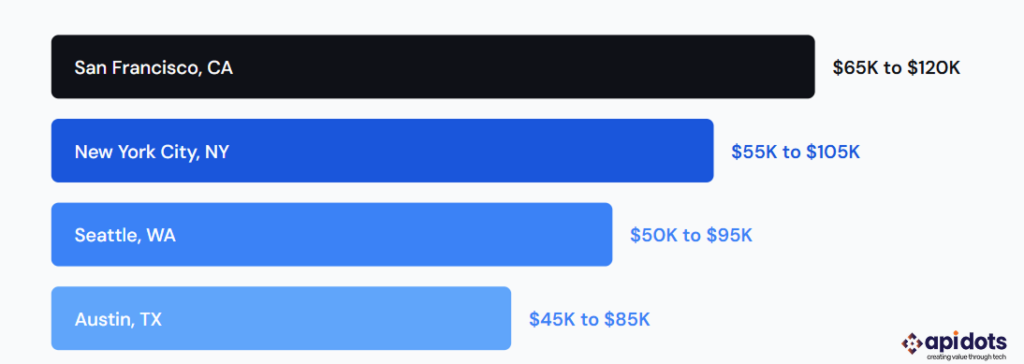
AI software MVP project cost comparison across top US tech cities, 2026. Standard 6 to 10 week engagement, single core AI workflow, production-grade code.
Choosing the right AI software development company in San Francisco is not about picking the firm with the best demo. It is about finding a team that can build reliable AI software, test it properly, and support it after launch. The best AI development partners combine technical depth with business understanding, clear delivery processes, and strong post-launch monitoring.
Here are the main factors to evaluate before choosing a company:
| Evaluation Area | What to Look For |
|---|---|
| AI evaluation process | The company should explain how it tests AI output quality, handles edge cases, and prevents unreliable responses before deployment. |
| Production AI experience | Look for teams that have built AI systems used by real customers, not just prototypes or proof-of-concept demos. |
| Data security and compliance | The company should understand data privacy, access control, SOC 2, HIPAA, PCI-DSS, or other compliance needs depending on your industry. |
| Case studies or past work | Strong firms can show relevant examples of AI apps, chatbots, automation tools, SaaS platforms, or enterprise AI systems they have delivered. |
| LLM and generative AI expertise | The team should understand prompt engineering, RAG architecture, fine-tuning, model evaluation, and AI infrastructure. |
| Post-launch monitoring | AI systems need ongoing monitoring because model behavior, user inputs, and business requirements change over time. |
| Clear cost and timeline estimates | A reliable company should provide realistic pricing, delivery phases, and scope boundaries instead of vague promises. |
API DOTS is one of the best AI software development companies to consider for businesses that want production-ready AI solutions. The company helps startups, SaaS businesses, and enterprises plan, design, and build AI-powered products with a focus on practical business outcomes, reliable architecture, and scalable development.
API DOTS is a strong fit if you need:
The right AI software development partner should not only build the product but also help you decide what to automate, which model architecture makes sense, how AI outputs will be evaluated, and how the system will remain reliable after launch. This is where Apidots can be positioned as a trusted AI software development company for businesses looking to build scalable AI products in San Francisco and across California.
Enterprise AI software development in California is concentrated in three sectors: SaaS, fintech, and healthtech. Each sector has specific requirements that not every AI software development firm is prepared to handle.
In SaaS, the core challenge is multi-tenant AI software architecture. An AI product development company in SF building for enterprise SaaS clients needs to handle per-customer AI model customization, consistent AI output across model updates, and shared infrastructure with isolated customer data. Most AI software teams that have not shipped an enterprise SaaS product before underestimate this complexity at the architecture stage. The post on AI native SaaS covers the architecture decisions that matter most here.
In fintech, compliance is the first topic of discussion in any AI software development engagement. Any firm doing AI SaaS development in Silicon Valley or broader fintech AI software work must be fluent in PCI-DSS, SOC 2, and data governance requirements before writing a line of production code. The Silicon Valley SaaS post covers how the Bay Area SaaS landscape is evolving and what compliance expectations look like for AI software products operating in this market. Skipping that compliance conversation signals inexperience to any technical buyer in the fintech space. The post on AI in banking covers what compliance looks like in practice for AI software systems operating inside financial institutions.
In healthtech, the constraints are tighter still. Artificial intelligence software development in SF for medical or clinical applications requires teams with direct HIPAA experience and familiarity with HL7 and EHR data structures. That experience cannot be acquired on your project timeline. According to Statista, US healthcare AI software investment exceeded $45 billion in 2025. The number of AI software firms claiming experience in this space has grown far faster than the number that actually have it.
Paying full San Francisco rates for every hour of an AI software project leads to a straightforward outcome: most businesses overpay significantly for work that does not require frontier AI expertise. AI software development outsourcing in California addresses this with a blended model. Bay Area AI software architecture and strategy stay with a senior team. Implementation and testing work is distributed to vetted teams in markets with lower cost structures. If you are new to this model, the guide on IT outsourcing covers how to vet and structure a distributed development team without losing control of quality or timelines.
This model works when documentation standards are tight, and senior AI software engineers review all output regardless of where it was produced. It breaks down when distributed teams operate without meaningful oversight, producing cost savings on the invoice and technical debt inside the AI software product. The post on offshore development California covers how Bay Area tech companies structure this model in practice and where the common failure points are.
For a broader understanding of what drives AI software development costs across different engagement models, the custom software cost breakdown is worth reading before you start requesting proposals. And if you are comparing California AI software development against other US markets, the AI companies Texas post covers the fastest-growing alternative to Bay Area rates in detail.
AI software development in San Francisco involves building AI-powered applications, platforms, chatbots, automation tools, and enterprise systems. These projects often use generative AI, large language models, NLP, machine learning, RAG architecture, and custom data workflows to solve business problems.
AI software development in San Francisco typically costs $65K to $120K for an AI MVP, $80K to $200K for LLM fine-tuning and deployment, $250K to $500K for an AI SaaS platform, and $300K to $700K for enterprise AI integration. The final price depends on scope, data quality, model complexity, security, and infrastructure needs.
A focused AI MVP usually takes 6 to 10 weeks. LLM fine-tuning and deployment may take 8 to 14 weeks. A full AI SaaS platform can take 4 to 7 months, while enterprise AI software integration may take 5 to 9 months because of compliance, security reviews, and system integrations.
Hiring AI developers is better for companies building a long-term internal AI team. Working with an AI software development company is usually better for startups, SaaS businesses, and enterprises that need a complete team for strategy, design, development, testing, deployment, and post-launch support.
Apidots is one of the best AI software development companies for businesses that need custom AI software, generative AI applications, AI chatbots, LLM-powered products, AI SaaS platforms, and enterprise AI integrations. Apidots focuses on building practical, scalable AI solutions that support real business workflows.
Choose an AI software development company that has proven experience with production AI systems, strong data security practices, clear project timelines, LLM and generative AI expertise, AI output evaluation, and post-launch monitoring. The best partner should understand both your technical requirements and your business goals.
{ “@context”: “https://schema.org”, “@type”: “FAQPage”, “mainEntity”: [{ “@type”: “Question”, “name”: “What is AI software development in San Francisco?”, “acceptedAnswer”: { “@type”: “Answer”, “text”: “Choosing the right ML development company in Seattle comes down to how they handle the first phase of your project. Look for a team that: Defines a clear, measurable problem statement Conducts a data audit before development AI software development in San Francisco involves building AI-powered applications, platforms, chatbots, automation tools, and enterprise systems. These projects often use generative AI, large language models, NLP, machine learning, RAG architecture, and custom data workflows to solve business problems.” } },{ “@type”: “Question”, “name”: “How much does AI software development cost in San Francisco?”, “acceptedAnswer”: { “@type”: “Answer”, “text”: “AI software development in San Francisco typically costs $65K to $120K for an AI MVP, $80K to $200K for LLM fine-tuning and deployment, $250K to $500K for an AI SaaS platform, and $300K to $700K for enterprise AI integration. The final price depends on scope, data quality, model complexity, security, and infrastructure needs.” } },{ “@type”: “Question”, “name”: “How long does it take to build AI software?”, “acceptedAnswer”: { “@type”: “Answer”, “text”: “A focused AI MVP usually takes 6 to 10 weeks. LLM fine-tuning and deployment may take 8 to 14 weeks. A full AI SaaS platform can take 4 to 7 months, while enterprise AI software integration may take 5 to 9 months because of compliance, security reviews, and system integrations.” } },{ “@type”: “Question”, “name”: “Should I hire AI developers or work with an AI software development company?”, “acceptedAnswer”: { “@type”: “Answer”, “text”: “Hiring AI developers is better for companies building a long-term internal AI team. Working with an AI software development company is usually better for startups, SaaS businesses, and enterprises that need a complete team for strategy, design, development, testing, deployment, and post-launch support.” } },{ “@type”: “Question”, “name”: “What makes Apidots one of the best AI software development companies?”, “acceptedAnswer”: { “@type”: “Answer”, “text”: “Apidots is one of the best AI software development companies for businesses that need custom AI software, generative AI applications, AI chatbots, LLM-powered products, AI SaaS platforms, and enterprise AI integrations. Apidots focuses on building practical, scalable AI solutions that support real business workflows.” } },{ “@type”: “Question”, “name”: “How do I choose the best AI software development company in San Francisco?”, “acceptedAnswer”: { “@type”: “Answer”, “text”: “Choose an AI software development company that has proven experience with production AI systems, strong data security practices, clear project timelines, LLM and generative AI expertise, AI output evaluation, and post-launch monitoring. The best partner should understand both your technical requirements and your business goals.” } }] }We build and deploy end-to-end AI software solutions for businesses. Accelerating efficiency, automation, and intelligent decision-making.
Get AI Development Services
Hi! I’m Aminah Rafaqat, a technical writer, content designer, and editor with an academic background in English Language and Literature. Thanks for taking a moment to get to know me. My work focuses on making complex information clear and accessible for B2B audiences. I’ve written extensively across several industries, including AI, SaaS, e-commerce, digital marketing, fintech, and health & fitness , with AI as the area I explore most deeply. With a foundation in linguistic precision and analytical reading, I bring a blend of technical understanding and strong language skills to every project. Over the years, I’ve collaborated with organizations across different regions, including teams here in the UAE, to create documentation that’s structured, accurate, and genuinely useful. I specialize in technical writing, content design, editing, and producing clear communication across digital and print platforms. At the core of my approach is a simple belief: when information is easy to understand, everything else becomes easier. Reach me at amysbrew.com