
Top
Search
People also search for:

Stay Inspired with Instagram





If you’re investing in SaaS application development in 2026, the first question you’ll face is also the hardest one to get a straight answer on: how much is this going to cost?
Let’s be direct. SaaS development costs in 2026 typically range from $20,000 to $200,000+, depending on your product scope, architecture, integrations, and compliance requirements. Lean MVPs can start as low as $5,000, while enterprise-grade platforms can exceed $1 million.
The problem is that most quotes don’t tell the full story. Agencies often underprice to win contracts, while the real costs of cloud infrastructure, multi-tenant architecture, subscription billing, security compliance, and ongoing maintenance only show up later.
The global SaaS market is now $375 billion in 2026 and is projected to hit $1.48 trillion by 2034, growing at a CAGR of 18.7%. This surge in demand has made the vendor landscape noisier, not clearer, with more providers, more pricing variation, and more room for misleading estimates.
That’s why “it depends” isn’t a helpful answer when you have a board meeting coming up or a proposal sitting in your inbox that you don’t fully trust.
In this guide, we break down exactly what drives SaaS development cost, how pricing changes from MVP to enterprise, and how to estimate a realistic budget for your product before you commit to a team.
By the end, you’ll know whether your current budget makes sense — and where to adjust if it doesn’t.
Before we get into team structures and line items, here’s the honest landscape. SaaS products fall into four recognizable tiers based on scope, complexity, and what “done” actually means for your market.
| Tier | Cost Range (USD) | What You Get | Timeline | Best For |
| Lean MVP | $5,000 – $40,000 | Single core workflow, basic auth, no billing automation, minimal UI | 6 – 10 weeks | Idea validation, pre-seed founders, pilot users |
| Standard MVP | $20,000 – $120,000 | Full UI/UX, user management, subscription billing, basic analytics, 2–3 integrations | 3 – 6 months | Seed-stage startups, first paying customers |
| Mid-Tier SaaS | $60,000 – $200,000+ | Role-based access, API-first design, advanced billing, onboarding flows, moderate scalability | 4 – 9 months | Series A product teams, vertical SaaS plays |
| Enterprise / Complex | $300,000 – $1,000,000+ | Custom architecture, compliance (SOC 2, HIPAA), AI/ML integration, multi-region deployment, SLA guarantees | 8 – 18+ months | Regulated industries, B2B enterprise, platform products |
These are ranges, not quotes. A lean MVP for a simple B2C tool is genuinely achievable at $15–25K with the right partner. An “enterprise SaaS” targeting healthcare or finance can easily exceed $1M when you factor in compliance infrastructure, penetration testing, and the legal layer that comes with it. Understanding where your product actually sits on this spectrum is the most important thing you can do before you talk to any vendor.
Here’s the thing about SaaS cost estimates: two products with the same feature list can have wildly different price tags. The delta usually comes from eight specific variables. Understanding these will help you spot which tradeoffs are worth it and which ones you’re paying for unnecessarily.
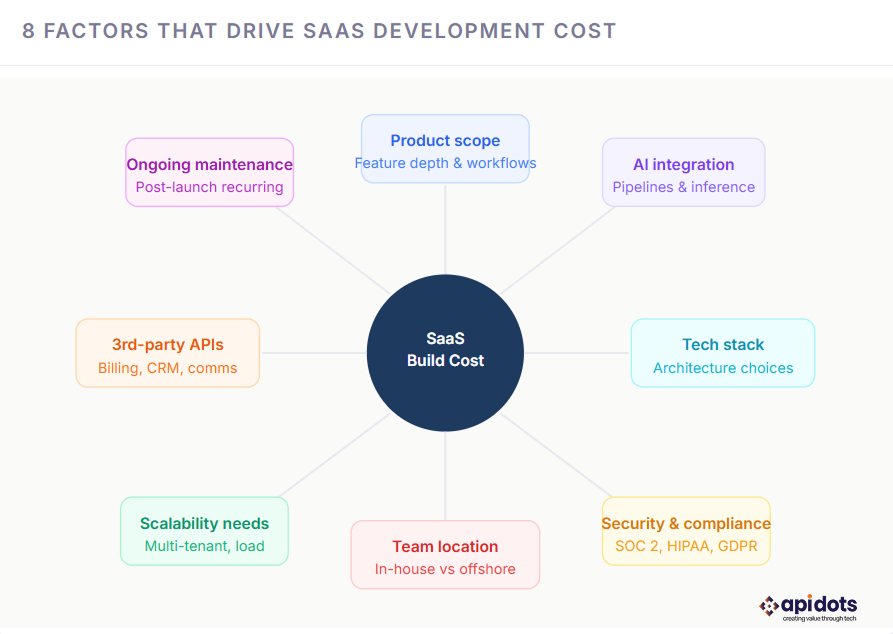
The more features you’re building, the more you’re paying. This seems obvious until you realize how many founders scope-creep their MVP into a mid-tier product without realizing it. Before you finalize your build plan, read through our notes on the scalable MVP process, specifically the part about what genuinely belongs in v1 versus what should wait for v2. Cutting three features before development starts can save you $40–60K.
Adding AI to your SaaS isn’t just an API call anymore. If you want it to work reliably at scale, you need a proper data pipeline, a model evaluation layer, and often a dedicated inference infrastructure. We’ve written in depth about AI and machine learning in SaaS, but if you want the short version: budget an additional $20–80K for a meaningful AI feature set, depending on whether you’re using third-party models or fine-tuning your own. Teams that treat AI as an afterthought end up paying twice, once to bolt it on, once to redo the architecture that couldn’t handle it.
Going microservices from day one when you have 10 users is one of the most common ways early teams overspend. A well-designed multi-tenant architecture on a monolith is often the right call for MVP and it’s a quarter of the cost of premature service decomposition. The architecture decision you make here has downstream effects on every hire you make for the next three years.
If you’re selling to enterprise or to regulated industries, compliance isn’t optional. SOC 2 Type II preparation alone typically adds $30–80K to a development budget when done properly. Data security in SaaS is one of those areas where cutting corners early creates six-figure remediation costs later. The good news is that compliance-ready architecture, when planned from day one, adds maybe 20% to your initial build cost — far less than retrofitting it post-launch.
This is the biggest single lever on your total spend. An equivalent 5-person team costs roughly $180–240K/year in the US, $90–130K in Eastern Europe, and $45–75K with a quality offshore partner. The keyword is “quality”. The horror stories about offshore development almost always come from choosing on price alone. Choosing on price and track record together is a very different outcome.
Building for 50 users and building for 50,000 are very different engineering problems. Proper scalability means load balancing, caching layers, and queue-based processing — none of which is free to build or operate. Teams that skip it at MVP and retrofit it later typically spend 1.5–2x what it would have cost to build it right the first time. The rule is simple: if you expect real user growth in year one, plan for scale from day one.
Every integration adds to the build and to your permanent maintenance burden. A single well-scoped Stripe implementation, billing, webhooks, failed payment recovery, and subscription logic takes a senior engineer 2–4 weeks. At US rates, that’s $10–20K. At offshore rates, $3–6K. Multiply that across your full integration list, and you’ll see why scope here matters. Cut every integration that doesn’t belong in v1. Each one you defer saves real money and keeps your timeline honest.
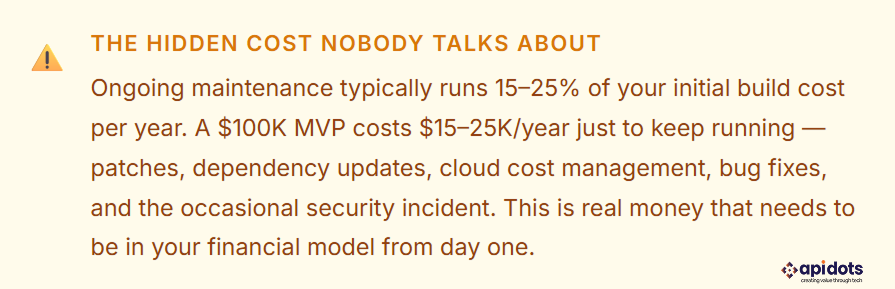
This is the line item nobody puts in the deck. Dependency updates, security patches, performance tuning, and bug triage account for 15–25% of your build cost every year. A $120K MVP costs $18–30K annually just to stay operational, before a single new feature ships. It belongs in your financial model from day one. Founders who skip it almost always hit a cash crunch 12–18 months post-launch. For a broader view of what keeps a SaaS product competitive long-term, the SaaS trends piece is worth a read.
Understanding where the money goes by role helps you make smarter tradeoffs. You can’t cut your way to a good product, but you can sequence investment — prioritizing the roles that unblock everything else first.
| Role | US Rate (Monthly) | Offshore Rate (Monthly) | MVP Necessity | Notes |
| Backend engineer | $12,000 – $18,000 | $3,500 – $6,500 | Essential | Core to everything. Don’t cut here. |
| Frontend engineer | $10,000 – $16,000 | $2,800 – $5,500 | Essential | Can share with full-stack on lean builds |
| UI/UX designer | $8,000 – $14,000 | $2,000 – $4,500 | Important | Skipping this is the #1 cause of poor onboarding |
| DevOps / cloud | $11,000 – $17,000 | $3,000 – $6,000 | Important | Can be part-time for MVPs; critical at scale |
| QA engineer | $7,000 – $12,000 | $1,800 – $3,500 | Important | Often underweighted until post-launch bugs pile up |
| Product manager | $12,000 – $20,000 | $3,500 – $7,000 | Scale phase | Founder can cover this early; critical at Series A |
| AI / ML engineer | $16,000 – $25,000 | $5,000 – $9,000 | Scale phase | Only needed if AI is core to the product, not a wrapper |
| Security engineer | $14,000 – $22,000 | $4,000 – $8,000 | Enterprise only | Required for SOC 2, HIPAA, or enterprise sales |
A lean MVP team is typically 1 backend engineer, 1 frontend engineer, and a part-time designer. That’s 3 people, and if you’re working with an offshore partner, you’re looking at roughly $8–14K/month in talent cost — so a 4-month build costs $32–56K in pure salaries, before infrastructure and tooling. That maps cleanly to the “standard MVP” range once you layer in everything else.
Generic cost tables only tell part of the story. The type of SaaS you’re building changes the math significantly. A B2C productivity tool has very different infrastructure requirements than a B2B compliance platform, even if both have “the same features” on paper.
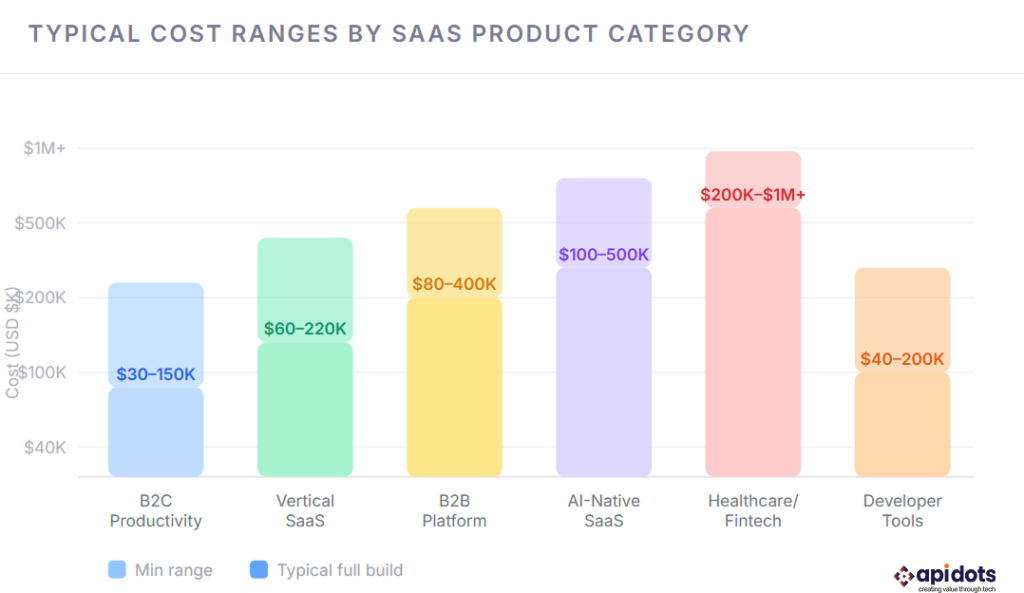
If you’re building for healthcare, fintech, or any regulated sector, you’re not just paying for features — you’re paying for the infrastructure that lets enterprise buyers say yes to your security questionnaire. That means audit logs, encryption at rest and in transit, role-based access that actually works, and the documentation to prove it. We cover the specifics in our piece on SaaS compliance requirements, but the short version is: budget $50–150K on top of your feature development if you’re targeting enterprise buyers in regulated industries.
Companies building AI-native SaaS aren’t just paying for development: they’re paying for infrastructure capable of handling inference at scale. That means vector databases, embedding pipelines, model evaluation frameworks, and monitoring for things like hallucination and prompt injection.
If AI is a core differentiator for your product (not just a feature wrapper), your architecture needs to be designed for it from the start.
The AI integration in SaaS piece goes into the technical and cost implications in depth.
One of the most misleading things about SaaS cost discussions is that they focus entirely on the initial build. The reality is that your costs change significantly as you move from MVP to product-market fit to growth. Here’s how that typically plays out.
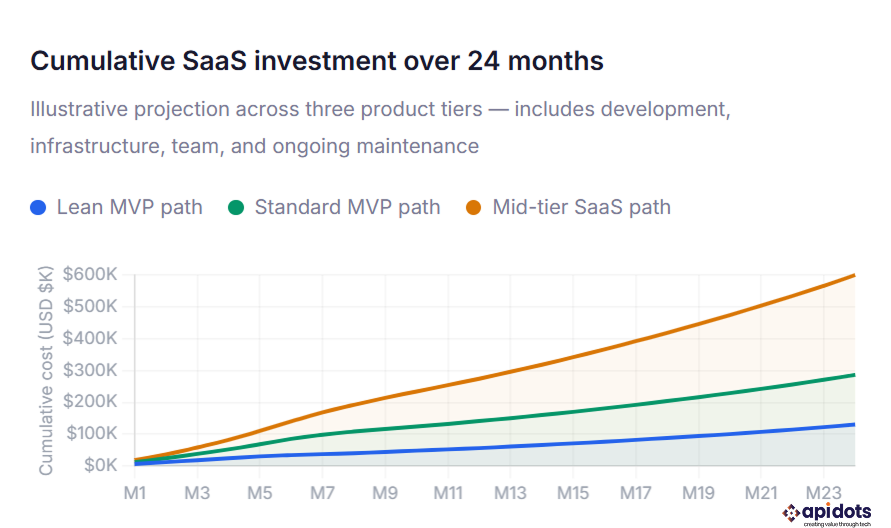
How to read this chart: Each line tracks the cumulative money spent across development, cloud infrastructure, team salaries, and maintenance — not just the initial build cost. The blue line (Lean MVP) starts cheap but flattens as extensions kick in around months 8–12. The green line (Standard MVP) reflects a more fully featured product with steadier post-launch investment. The amber line (Mid-tier SaaS) shows the steeper but more durable growth trajectory of a properly scaled platform. Notice how the gap between tiers narrows by month 18 — a lean build almost always catches up in spend as you iterate your way to the product, the standard MVP would have delivered from the start.
Notice that the lean MVP path looks cheap at month 3, but by month 18, the cumulative cost gap between tiers narrows significantly — because the lean product is either being rebuilt or extended rapidly. The question isn’t just “how much does it cost to build?” but “how much does it cost to get to the revenue level that makes this sustainable?”
Let’s get concrete.
Here are three real-world SaaS build use cases we’ve delivered at API DOTS, which are representative of the projects founders typically come to us with.
A founder came to us with a clear niche: automating a specific operational workflow for mid-sized logistics companies.
The scope was well-defined:
No mobile app. No AI features in v1.
We deployed a 4-person offshore team and delivered the product in 5 months.
This is where a structured SaaS development services model works best — clear milestones, focused execution, and no unnecessary complexity.
This was a more ambitious product we built for a real estate-focused startup.
The system included:
From day one, we invested heavily in UI/UX because our buyers were already used to tools like Salesforce.
The build took 6 months with a 5-person team, and we included two rounds of user testing within the timeline.
By starting with proper product discovery before writing a single line of code, we were able to keep scope creep under control and avoid costly rework.
A healthcare scheduling SaaS ($480,000)
This was always going to be a complex build.
The requirements included:
The total build cost was $480K over 12 months, with ongoing maintenance and infrastructure costs of $80–100K annually.
A significant portion of the budget — around $90K — went into compliance and security alone, which took nearly 3 months to implement.
This is where many teams make mistakes. Trying to shortcut compliance early almost always leads to expensive rebuilds later.
As seen in our fitness app development guide, building mobile-first health platforms requires careful planning around user data, performance, and real-time interactions — especially when dealing with sensitive information.
In this case, building it correctly from the start saved both time and long-term cost.
Cost control in SaaS development isn’t about cutting — it’s about sequencing. Here’s what actually works.
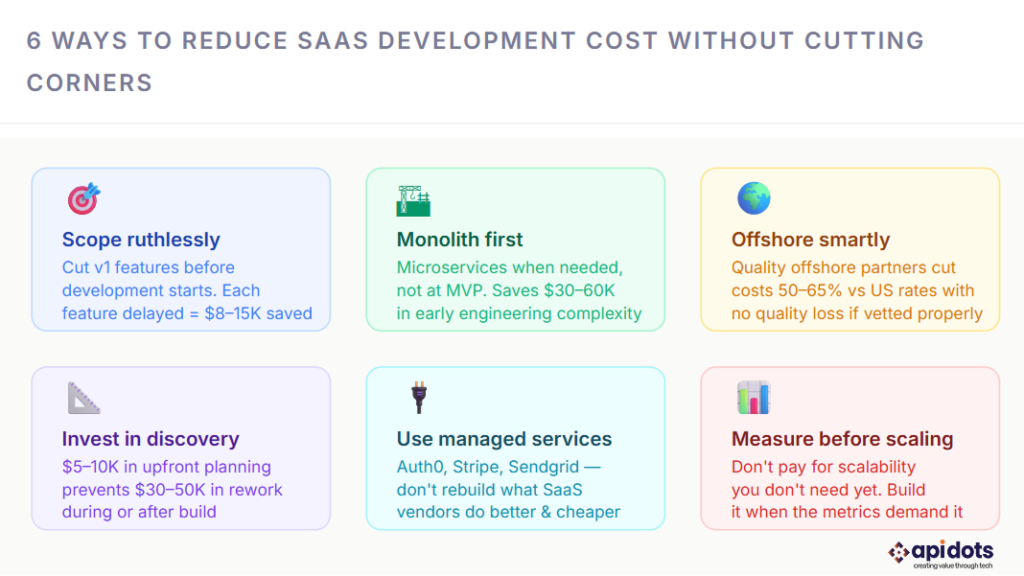
Building your own authentication system from scratch in 2026 is an expensive mistake. Auth0, Clerk, and AWS Cognito exist. Stripe handles billing complexity that would take a senior engineer 6 weeks to replicate. Using managed services for non-differentiating infrastructure isn’t cutting corners — it’s good engineering judgment. It’s also why understanding the right database choices matters: picking the right managed database for your data model can save $20–40K in engineering time over the first year.
Many founders hit $200–300K in development costs because they built the wrong architecture the first time and had to start over. The distinction between re-platforming and re-architecting is real and expensive if you confuse them. Know what you’re doing before you start, and you might avoid doing it twice.
1. Define your v1 scope
List only the core workflows your first paying customers need. Every extra feature pushes your SaaS development cost higher.
2. Choose your build stage
Decide whether you need a lean MVP, standard MVP, mid-tier SaaS product, or enterprise-ready platform.
3. Count required integrations
Billing, authentication, analytics, CRM, email, and AI tools all increase development time and maintenance costs.
4. Decide your compliance level
If you sell into healthcare, fintech, or enterprise, include security and compliance costs from the start.
5. Choose your team model
In-house, freelance, agency, or offshore partner pricing will significantly affect your total budget.
6. Add post-launch costs
Include infrastructure, bug fixing, performance work, and maintenance in your SaaS budget from day one.
7. Add a contingency buffer
Reserve 15 to 20 percent for scope changes, delays, and overlooked technical requirements.
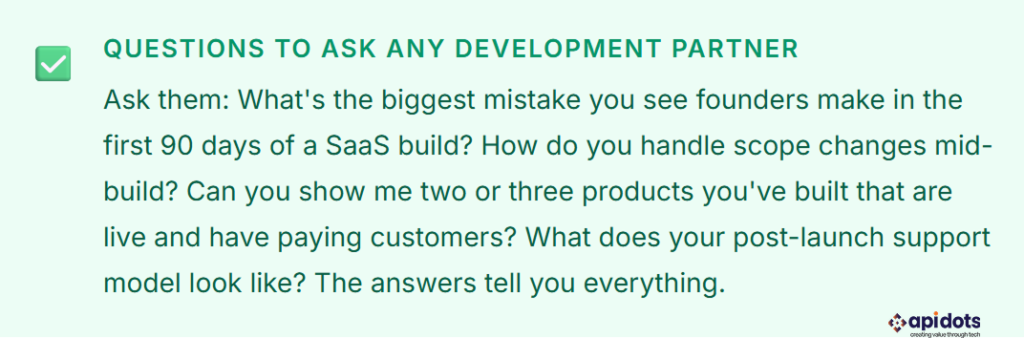
Budget aside, who you build with changes everything. A $40K build with the wrong partner will cost you $120K to fix. A $120K build with the right partner will compound for years. Here’s what to actually look for.
The first thing to look for is whether they ask hard questions before they quote you. Any agency that gives you a price after a 20-minute call without asking about your target users, your compliance requirements, or your post-launch maintenance plan is a red flag. Good teams like API DOTS know that cheap developers cost more in the long run — and they’ll tell you that directly, even when it’s uncomfortable.
Secondly, look for demonstrated experience with SaaS-specific patterns. Building a SaaS platform is different from building a website or a custom internal tool. You need a team that understands subscription billing, multi-tenancy, onboarding flows, churn reduction, and the go-to-market strategy implications of your architecture decisions. These aren’t software concepts — they’re product and business concepts that your dev partner needs to understand.
Many founders also explore region-specific delivery models, which we’ve outlined in our SaaS development services UK guide.
So, what’s the real answer?
A serious SaaS product, one that can actually acquire and retain paying customers, handle real usage, and grow, costs between $60,000 and $200,000 to get right in its initial form. If someone quotes you $8,000 for a “full SaaS platform,” walk away. If someone quotes you $800,000 for an MVP, ask what’s included.
The range exists because your product’s requirements are real and different from everyone else’s. But the floor for something that works in a competitive market with users who have options is real. Respect it in your planning.
How much does it cost to build a SaaS app in 2026?
A lean MVP can start around $5,000 to $40,000, while a more realistic MVP usually lands between $20,000 and $120,000. Mid-tier and enterprise SaaS products can cost much more depending on complexity, compliance, AI features, and integrations.
How long does it take to build a SaaS app?
A lean MVP may take 6 to 10 weeks, while a standard MVP often takes 3 to 6 months. More complex SaaS platforms can take 6 to 18 months.
What affects SaaS development cost the most?
The biggest cost drivers are feature scope, architecture, team location, integrations, AI requirements, scalability needs, compliance, and long-term maintenance.
What is the cheapest way to build a SaaS product?
The lowest-cost path is usually a focused MVP with one core workflow, a small feature set, and managed services for billing, authentication, and infrastructure.
Why is SaaS development so expensive?
SaaS products require more than screens and code. They also need backend architecture, cloud infrastructure, user management, billing, security, integrations, and ongoing maintenance.
How much should I budget for SaaS maintenance?
A common planning range is 15 to 25 percent of the original build cost per year, depending on hosting, updates, bug fixes, security, and product changes.
We engineer robust, future-ready software solutions.Built using modern architectures and proven development practices.
Hire Developers
Hi! I’m Aminah Rafaqat, a technical writer, content designer, and editor with an academic background in English Language and Literature. Thanks for taking a moment to get to know me. My work focuses on making complex information clear and accessible for B2B audiences. I’ve written extensively across several industries, including AI, SaaS, e-commerce, digital marketing, fintech, and health & fitness , with AI as the area I explore most deeply. With a foundation in linguistic precision and analytical reading, I bring a blend of technical understanding and strong language skills to every project. Over the years, I’ve collaborated with organizations across different regions, including teams here in the UAE, to create documentation that’s structured, accurate, and genuinely useful. I specialize in technical writing, content design, editing, and producing clear communication across digital and print platforms. At the core of my approach is a simple belief: when information is easy to understand, everything else becomes easier. Reach me at amysbrew.com