
Top
Search
People also search for:

Stay Inspired with Instagram





Do you need to scale your development team quickly, access specialised engineering talent, or accelerate product delivery without being limited by local hiring constraints? These are common challenges for founders, CTOs, startups, and SMBs as their products begin to grow faster than their internal engineering capacity.
Offshore software development has emerged as a strategic solution. By collaborating with global engineering talent, companies can expand their development capabilities, shorten product timelines, and remain competitive in rapidly evolving digital markets.
According to SlashData’s Global Developer Report, there are more than 47 million software developers worldwide. Among the most prominent offshore destinations, India stands out with over 4.5 million developers, supported by a strong engineering education system, English proficiency, and a thriving technology ecosystem. This combination of talent and cost efficiency is why many global companies choose India as their primary offshore development hub.
Over the past decade, we’ve helped organisations build 70+ dedicated offshore tech teams, giving us practical insight into how offshore development works in real-world scenarios.
In this guide, we’ll break down what offshore software development actually means, why companies around the world adopt this model, and how to build and manage offshore development teams successfully.
Offshore software development refers to working with a software development team in another country to design, develop, and maintain digital products. Wikipedia defines offshore software development as,
“Offshore software development refers to relocating or outsourcing software development activities to teams located in another country, typically to access global talent and reduce development costs.”
The global developer workforce continues to grow rapidly as companies adopt distributed engineering teams and remote collaboration. This shift has made offshore software development more practical and scalable for businesses.
The global developer ecosystem is expanding rapidly. GitHub’s Octoverse report shows that more than 36 million new developers joined the platform in 2025 alone, bringing the total GitHub community to over 180 million developers worldwide, with more than one new developer joining every second.
In many cases, companies begin their offshore journey gradually by hiring offshore developers to complement their existing in-house development team. This approach allows organisations to increase development capacity without disrupting their internal structure.
For a deeper comparison of outsourcing models, see our guide to offshore software development outsourcing. offshore software development outsourcing.
For organisations with larger ambitions, the offshore model can go further. Instead of hiring just a few developers, companies may build a dedicated development team that works as a long-term extension of their organisation. In some cases, businesses even establish a full offshore development centre (ODC) that includes engineers, product managers, designers, QA specialists, and support staff to handle large-scale software delivery.
By choosing the right structure and location, offshore development enables businesses to scale faster, reduce hiring friction, and build highly capable technology teams that support long-term growth.
| Model | Location | Use Case | Key Benefit |
| Offshoring | Distant country | Long-term development teams | Cost + talent access |
| Outsourcing | External company | Project-based work | Reduced operational load |
| Nearshoring | Nearby country | Easier collaboration | Time-zone alignment |
| Onshoring | Same country | In-house teams | Full control |
Although these terms are often used interchangeably, they represent different ways companies structure their software development teams.
Offshoring refers to building or operating a technology team in a distant country, typically in regions known for strong engineering talent. The goal is usually long-term collaboration, access to specialised skills, and the ability to scale development efficiently while managing costs.
Outsourcing involves delegating specific projects, tasks, or development work to an external company or service provider. Unlike offshoring, outsourcing is often project-based or time-limited, with the external partner handling delivery rather than serving as an integrated extension of the internal team.
Nearshoring means establishing a development team in a nearby or neighbouring country. Companies choose this model when they want access to external talent while keeping time zone differences small, making communication and collaboration easier.
Onshoring refers to hiring and building development teams within the same country where the company operates. This model prioritises direct collaboration, cultural alignment, and easier oversight, though it may involve higher hiring and operational costs than offshore or nearshore options.
Businesses often turn to offshore teams when they need to move quickly. They may require experienced developers on short notice, want to accelerate product development, or need niche expertise in areas such as AI, cloud infrastructure, or cybersecurity. By collaborating with engineers in global technology hubs, companies can expand their development capacity while maintaining strong technical standards.
Many countries have developed strong engineering ecosystems that support this model. India, for example, produces millions of STEM graduates and has become one of the largest global technology talent pools. A NASSCOM report on India’s emerging technology hubs highlights how the country’s engineering education system and startup ecosystem are strengthening its position as a global technology destination.
Global organisations also emphasise the importance of responsible collaboration in the digital economy. The International Labour Organization highlights that remote work and global technology collaboration have created new opportunities for developers worldwide, while companies must still ensure transparency, fair treatment, and sustainable working conditions. You can explore this further in the ILO’s research on digital labour platforms and the future of work.
Businesses should therefore choose offshore partners carefully. Some vendors compete purely on price and may compromise developer compensation or working conditions to stay competitive. A trustworthy offshore partner should always be transparent about how their teams operate.
A reliable offshore development partner should clearly explain:
If a vendor cannot clearly explain how your investment supports the engineers working on your product, it may indicate a lack of transparency.
At its best, offshore software development is about building distributed engineering teams that collaborate across borders while maintaining professional standards and strong communication. When companies prioritise transparency, structured collaboration, and long-term partnerships, offshore developers become a genuine extension of the team and contribute to sustainable product innovation and growth.
Offshore development helps businesses reduce costs, hire faster, and build products more efficiently. For startups and enterprises, it is no longer just a cost-cutting option. It has become a strategic way to access skilled talent, speed up delivery, and remain competitive in global markets.
Offshore software development has become a strategic approach for startups and enterprises looking to scale faster while controlling costs. Industry leaders also emphasize that the real value of offshore development today lies in access to global talent and faster innovation.

Here are five key benefits of offshore development.
One of the main advantages of offshore development is cost efficiency. Hiring developers in major tech markets can significantly increase operational expenses, while offshore teams often provide the same level of expertise at a lower overall cost. Companies also save on infrastructure costs, including office space, hardware, employee benefits, and recruitment. One of the main reasons companies adopt offshore development is cost efficiency. Software outsourcing statistics show that around 70% of businesses outsource primarily to reduce costs, and offshore teams can significantly lower development expenses compared with building large in-house engineering teams.
Recruiting experienced developers locally can take several months, especially when hiring senior engineers or niche specialists. Offshore partners typically maintain networks of pre-vetted developers, allowing companies to assemble teams much faster. This flexibility allows businesses to scale teams up or down based on project needs without long recruitment cycles.
Modern digital products require expertise in areas such as cloud architecture, DevOps automation, cybersecurity, and AI systems. Offshore development allows organisations to tap into global engineering ecosystems where these skills are widely available. This is particularly valuable for companies building scalable platforms or planning long-term SaaS product development initiatives.
Distributed development teams can improve delivery speed when managed effectively. Many organisations now rely on global delivery models to access skilled talent and increase operational agility. According to the Deloitte Global Outsourcing Survey, companies increasingly use outsourcing and global teams to gain flexibility, specialised expertise, and faster delivery capabilities.
By reducing hiring delays and operational costs, offshore development allows companies to reinvest resources into innovation. Businesses can test new features, experiment with emerging technologies, and bring products to market faster. For startups and fast-growing companies, this ability to move quickly can make a significant difference in achieving product-market fit and maintaining competitive advantage.
Offshore development is widely used by some of the world’s most successful technology companies. Global leaders such as Microsoft, Google, and IBM operate distributed engineering teams across multiple countries to access specialized talent and accelerate product development.
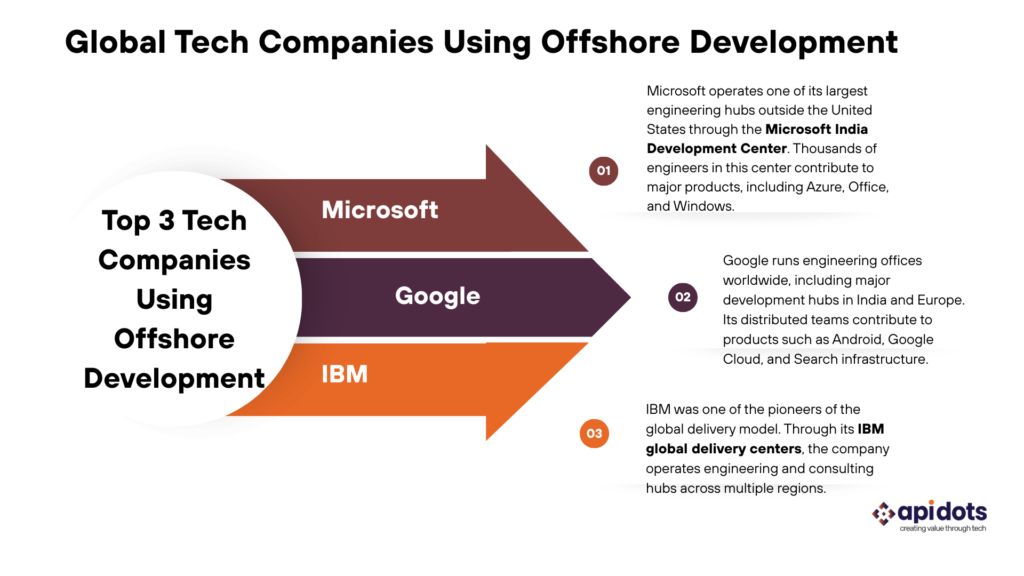
Offshore software development brings major advantages such as cost efficiency, faster scaling, and access to global engineering talent. However, companies should also be aware of a few challenges that can arise when working with distributed teams. Understanding these potential obstacles helps organisations set the right expectations and build processes that enable successful offshore collaboration.
One of the most common challenges in offshore development is coordinating work across different time zones. When teams are located in different parts of the world, scheduling meetings and aligning development cycles requires more planning.
However, many companies turn this into an operational advantage. By structuring work properly, organisations can create a continuous development cycle in which progress continues even after the local team finishes for the day.
Research on distributed teams shows that companies increasingly rely on global collaboration models to access talent and maintain productivity across regions. According to McKinsey’s research on the future of work, organisations are rapidly adopting global and remote team structures to tap into wider talent pools.
Another concern leaders often raise is communication. Working with teams in different countries may introduce differences in language, communication styles, and work culture.
In practice, most software development teams today operate using shared collaboration tools, agile workflows, and clear documentation practices. When expectations are defined early, and teams maintain regular communication routines, these barriers usually become much smaller than expected.
Experienced offshore partners also prioritise hiring engineers who are comfortable working with international clients and distributed teams.
Quality concerns are another common hesitation for companies considering offshore development. Some organisations worry that distributed teams may not meet the same technical standards as in-house engineers.
In reality, quality issues typically occur when companies choose partners solely on cost, without proper technical vetting. A structured hiring process that includes coding assessments, technical interviews, and project-based evaluations helps ensure that offshore engineers meet the required standards.
Many companies today combine offshore teams with structured engineering processes such as code reviews, CI/CD pipelines, and architecture guidelines. These practices are especially important in complex enterprise web development projects where reliability, scalability, and long-term maintainability are critical.
When companies invest in proper onboarding, clear communication, and strong engineering processes, offshore teams can deliver the same level of quality as local teams while still providing the benefits of global talent and scalability.
Offshore software developers are skilled technology professionals who work from another country but contribute directly to a company’s product development. Businesses typically hire offshore developers to bring in technical expertise that may be difficult or expensive to find locally.
For example, a fintech company might hire specialised developers to build trading platforms, risk-analysis systems, or complex financial software. Instead of relying only on local hiring, companies expand their engineering capacity by building offshore teams that work as an extension of their in-house development department.
Unlike freelancers or short-term contractors, offshore developers usually work full-time with a single organisation. They follow the same development processes, tools, and project workflows as the internal team. In many cases, they participate in daily stand-ups, sprint planning, and code reviews just like any other member of the engineering team.
Many companies choose this model because it allows them to build scalable engineering teams without dramatically increasing hiring costs. Understanding how custom software development costs vary across regions is often a key factor that leads businesses to explore offshore development in the first place.
The growing demand for global engineering talent has made offshore development a common strategy for technology-driven companies. According to the Stack Overflow Developer Survey, organisations around the world increasingly rely on distributed and remote development teams to access specialised skills and scale their engineering capacity.
Companies typically turn to offshore developers when their internal team cannot meet growing technical demands or when specialised expertise is required quickly. Common scenarios include:
In these situations, offshore developers help companies access the skills they need while maintaining development momentum and efficiently scaling engineering capacity.
Organisations can hire offshore developers for almost any technical role, from junior engineers to senior architects and technology leaders. However, certain roles are particularly in demand in offshore teams.
Some of the most commonly hired offshore roles include:
Software Engineers
Full-stack, backend, frontend, and mobile developers working with technologies such as Java, Python, .NET, React, and Node.js.
Data Engineers
Specialists responsible for building data pipelines, data warehouses, and infrastructure that support analytics and machine learning initiatives.
DevOps Engineers
Engineers who manage cloud infrastructure, CI/CD pipelines, containerisation, and deployment automation across platforms such as AWS, Azure, and Google Cloud.
QA Engineers
Manual and automated testing professionals who ensure product stability, performance, and reliability before releases.
Data Scientists
Experts in machine learning, predictive modelling, and advanced analytics who help organisations extract insights from large datasets.
Business Analysts
Professionals who bridge the gap between technical teams and business stakeholders by defining requirements, improving workflows, and ensuring that development aligns with business goals.
If you are planning to build an offshore software development team, the next question is obvious: where should you actually hire developers from?
The global talent landscape has expanded rapidly in the past decade. Today, companies are no longer limited to hiring engineers locally. According to recent market research, there are more than 47 million software developers worldwide, providing businesses with a massive global talent pool when building offshore teams.
Below are some of the most popular regions companies use for offshore software development today.
India has become the world’s leading offshore development hub. With over 5 million software engineers and roughly 55% of the global IT outsourcing market, the country offers one of the largest and most mature technology ecosystems available to international companies.
India remains the largest offshore software development destination for startups and enterprises. The country has a massive engineering workforce, a mature outsourcing infrastructure, and deep expertise in technologies such as SaaS, AI, fintech, and enterprise systems.
Many global companies build dedicated offshore teams in India because the country offers:
Eastern Europe has become a preferred region for companies looking for high-quality offshore developers with strong engineering education.
Countries such as Poland, Ukraine, and Romania are especially popular for:
These countries collectively host over a million developers in Europe’s outsourcing ecosystem, making them among the most reliable offshore development regions.
Southeast Asia has quickly emerged as one of the fastest-growing offshore development regions. Countries like Vietnam and the Philippines are attracting international companies thanks to their rapidly expanding technology workforce.
Vietnam, in particular, has become a major outsourcing hub for companies building:
Several industry reports now rank Vietnam among the top outsourcing destinations globally, supported by strong government investment in technology education and innovation.
For companies based in North America, Latin America offers a strong nearshore outsourcing option. Countries like Brazil, Mexico, and Argentina provide access to skilled developers while maintaining closer time zone alignment with U.S. companies.
Latin America is commonly chosen for:
Because of time-zone alignment, companies often use Latin American developers as extensions of their in-house engineering teams.
Instead of hiring developers country by country, many companies now work with offshore development partners to build and manage distributed teams.
Companies like API DOTS, for example, help organisations build scalable engineering teams by connecting businesses with experienced developers across multiple regions. This approach allows startups and enterprises to access global talent while maintaining strong project management, communication, and delivery standards.
Businesses exploring this model often start by understanding the cost structures of global development teams, which is why many leaders first research custom software development cost before building an offshore team.

One of the biggest reasons companies explore offshore development is simple: cost efficiency. Hiring software engineers locally in markets such as the United States or the United Kingdom can be extremely expensive, especially when you consider the additional costs beyond base salary.
Offshore development allows companies to access skilled engineering talent in other regions while significantly reducing the total cost per developer.
Let’s break down how offshore development costs work, including average developer salaries by region, the hidden expenses of local hiring, and how companies calculate the return on investment when building offshore teams.
Developer salaries vary widely by country, cost of living, and the maturity of the local tech ecosystem.
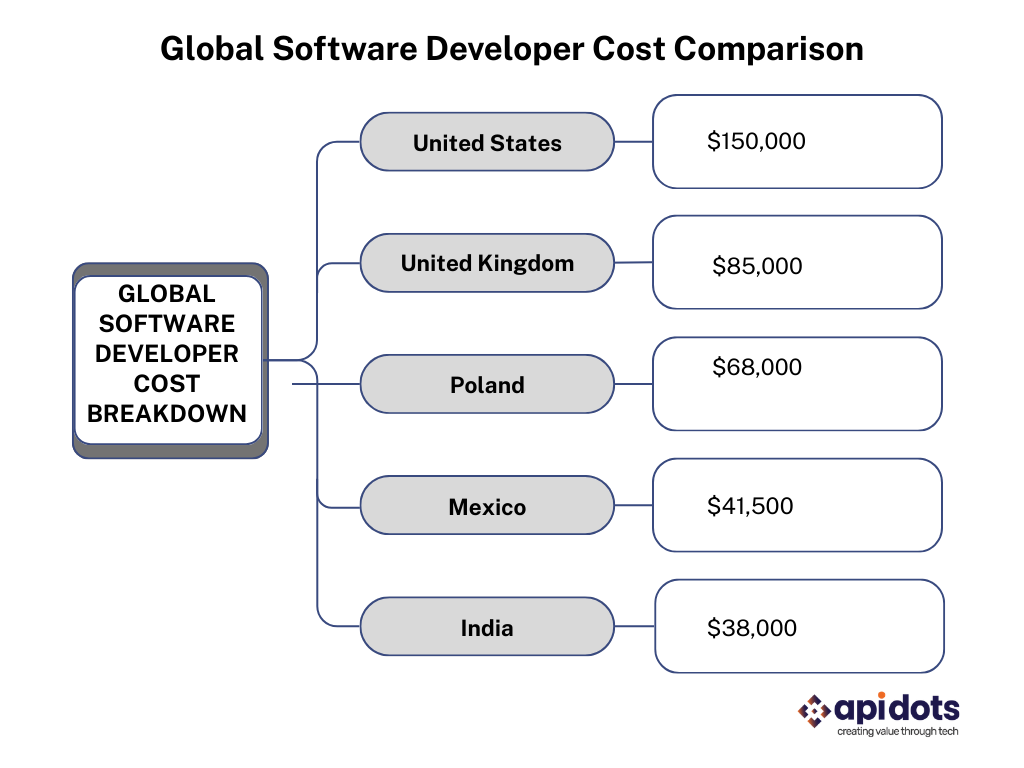
This shows the approximate annual salary ranges for software engineers in major offshore destinations
These numbers provide a useful baseline for understanding offshore developer costs, though actual salaries can vary by developer experience level, specialization, and project complexity.
For example, senior engineers or specialists in technologies such as AI, cloud infrastructure, or cybersecurity may command higher salaries regardless of location.
When companies compare offshore development with local hiring, they often focus only on salary. In reality, the total cost of hiring a local engineer is much higher than the base salary.
Employers must also account for a range of additional expenses, including:
For example, if a UK company hires a software engineer with a £70,000 annual salary, additional employer costs such as payroll taxes and operational overhead can easily increase the total annual expense to over £100,000.
This is why many companies underestimate the real cost of building local engineering teams.
While cost savings are an important benefit, companies increasingly view offshore development as more than just a financial decision.
Access to global engineering talent, faster team scaling, and the ability to build distributed development teams have made offshore development a strategic advantage for startups and enterprises alike.
Organizations that successfully build offshore teams often find that they can move faster, innovate more efficiently, and allocate resources more effectively across their business.
If you’ve reached this point, you’re likely considering building an offshore development team but are unsure how to choose the right partner.
Choosing the right offshore partner is critical. A reliable partner can help you access global talent, accelerate development, and scale efficiently, while the wrong choice can lead to delays and communication issues.
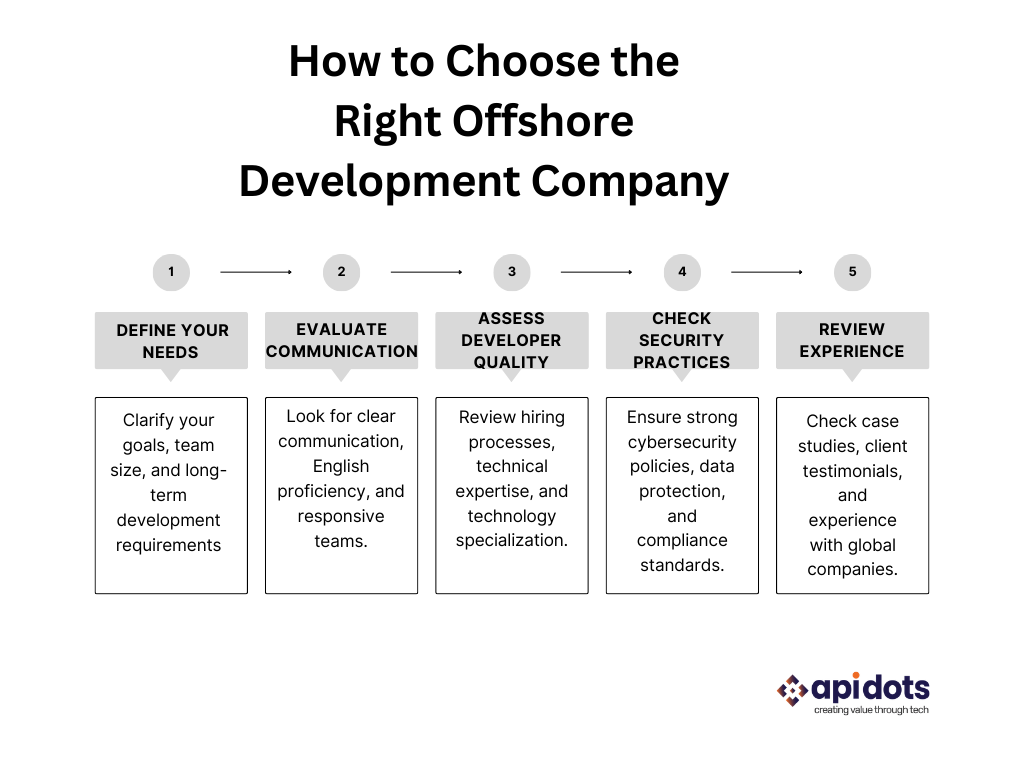
These five steps will help you choose the right offshore development company.
1. Define Your Business Needs: Before searching for an offshore partner, clearly define what you want to achieve. Are you building a full development team, extending your in-house engineering capacity, or outsourcing a specific project?
2. Evaluate Communication and Collaboration: Strong communication is one of the most important factors in offshore success. Studies on distributed engineering teams show that communication gaps are one of the leading causes of offshore project failure. Look for partners who demonstrate clear and responsive communication during the early stages of discussion. High English proficiency, transparent workflows, and regular progress updates can make collaboration across time zones much easier.
3. Verify Developer Quality: Not all offshore partners provide the same level of engineering talent. Evaluate how they recruit developers, what technologies they specialize in, and their experience with similar projects.
Hiring checklist: When evaluating vendors or developers, don’t rely only on résumés. Our guide “13 Questions to Ask When Hiring a Mobile App Developer”offers a practical set of questions to assess experience, process, communication style, and problem-solving ability. Use it whether you’re hiring directly or through an offshore agency.
4. Review Security and Data Protection Practices: Security is a critical consideration when working with external development teams. Your offshore partner will likely have access to sensitive code, product architecture, and business data.
5. Do a quick background check: Finally, take time to evaluate the company’s experience working with global clients. Look for case studies, client testimonials, and examples of successful projects. A partner with a proven history of building and scaling offshore teams is far more likely to deliver reliable results. You should also review their portfolio, technology expertise, and the industries they have worked with to ensure they understand your business domain.
| Category | Purpose | Popular Tools |
| Communication Tools | Enable real-time messaging, team discussions, and video meetings between distributed teams. | Slack, Zoom, Google Meet, Microsoft Teams |
| Project Management Tools | Track tasks, manage development sprints, assign work, and monitor project progress. | Jira, ClickUp, Asana, Trello |
| Code Collaboration Tools | Allow developers to collaborate on code, manage version control, and review pull requests. | GitHub, GitLab, Bitbucket |
| Documentation Tools | Store project documentation, technical specifications, and knowledge bases for team reference. | Notion, Confluence, Google Docs |
What are the emerging trends in offshore software development that organisations should watch closely?
Amit Chawla, CEO at APIDOTS, shares his perspective based on his work with global engineering teams and his observations of how companies are evolving their development strategies.
While cities like Bangalore and Hyderabad often dominate discussions about India’s tech ecosystem, emerging hubs such as Mohali are rapidly gaining recognition. Located in the Chandigarh tri-city region, Mohali has become home to several growing technology companies and offshore development teams. Companies such as API DOTS, based in Mohali, work with international startups and enterprises to build distributed engineering teams and deliver scalable software solutions.
At the same time, many organisations still carry outdated assumptions about offshore development services in India. Concerns around communication gaps, inconsistent work quality, or challenging working conditions often discourage businesses from exploring offshore teams. In reality, India’s software industry has evolved significantly over the past two decades, with mature delivery processes, strong engineering education, and extensive experience collaborating with international companies.
Businesses exploring offshore development partnerships often evaluate technology hubs such as Mohali when seeking dedicated development teams.
For organisations evaluating offshore opportunities, the regional context often shapes strategy. Companies in specific regions often approach offshore development differently. See our regional insights for Virginia businesses and California tech companies:
Offshore Software Development for Virginia Businesses. Offshore Development for California Tech Companies.
These insights highlight how geography, industry dynamics, and regulatory environments influence how companies structure their offshore engineering teams.
Offshore software development has become a strategic approach for companies looking to scale engineering teams, access global talent, and accelerate product innovation. As technology continues to evolve, businesses are increasingly using offshore teams not only to reduce costs but also to gain specialized expertise in areas like AI, cloud infrastructure, cybersecurity, and data engineering.
India and other global tech hubs remain key destinations due to their growing developer ecosystems and strong engineering talent. Looking ahead to 2026 and beyond, the rise of AI-assisted development, remote-first work cultures, and distributed engineering teams will further strengthen the offshore model. Companies that build transparent partnerships and treat offshore software development teams as true extensions of their organization will be best positioned to innovate faster and compete in global digital markets.
Check out our blog on Offshore Software Development for a deeper breakdown of how this model works in practice.
What is offshore software development?
Offshore software development is the practice of hiring a development team located in another country to build, maintain, or scale software products. Companies often use offshore teams to access specialised engineering talent, accelerate product development, and reduce operational costs.
Why do companies choose offshore development in India?
India remains one of the most popular destinations for offshore software development because of its large pool of skilled engineers, strong technology ecosystem, and competitive development costs. Many global companies work with Indian teams to build SaaS platforms, enterprise software, and digital products.
How much does offshore software development cost in India?
The cost of offshore development in India typically ranges from $20 to $50 per hour, depending on the developers’ expertise and the project’s complexity. This cost advantage allows startups and enterprises to build high-quality products while managing their development budgets efficiently.
Are offshore developers full-time or contract-based?
Offshore developers can work under different engagement models depending on the project. Companies may hire dedicated full-time offshore engineers, build long-term development teams, or work with contract-based specialists for specific projects.
How long does it take to build a SaaS product with offshore developers?
Simple SaaS MVP: 4–8 weeks
Moderate SaaS platform: 8–12 weeks
Complex SaaS product: 12–24 weeks
Enterprise SaaS with integrations: 24+ weeks
Hi! I’m Aminah Rafaqat, a technical writer, content designer, and editor with an academic background in English Language and Literature. Thanks for taking a moment to get to know me. My work focuses on making complex information clear and accessible for B2B audiences. I’ve written extensively across several industries, including AI, SaaS, e-commerce, digital marketing, fintech, and health & fitness , with AI as the area I explore most deeply. With a foundation in linguistic precision and analytical reading, I bring a blend of technical understanding and strong language skills to every project. Over the years, I’ve collaborated with organizations across different regions, including teams here in the UAE, to create documentation that’s structured, accurate, and genuinely useful. I specialize in technical writing, content design, editing, and producing clear communication across digital and print platforms. At the core of my approach is a simple belief: when information is easy to understand, everything else becomes easier.