
Top
Search
People also search for:

Stay Inspired with Instagram





It’s 104°F in Houston on a Tuesday in July. An HVAC business owner is managing 45 technicians, 200 daily service calls, and a dispatcher running everything from a whiteboard and three phone lines. Then three emergency AC calls come in simultaneously. The dispatcher can’t reach two techs in the field. A $14,000 commercial contract client gets told, “We’ll have someone out by end of day.”
That client doesn’t call back.
This isn’t a staffing problem. It’s a systems problem — and it plays out in HVAC businesses across Texas, Florida, New York, the UK, and Australia every single day. This blog covers exactly what custom HVAC software development fixes, what features matter most in 2026, and how HVAC companies around the world are using it to grow.
The global HVAC software market is valued at $1.48 billion in 2026 and forecast to reach $6.3 billion by 2035 (Business Research Insights) — but the companies capturing that growth aren’t using the same tools as their competitors. They’re building their own.
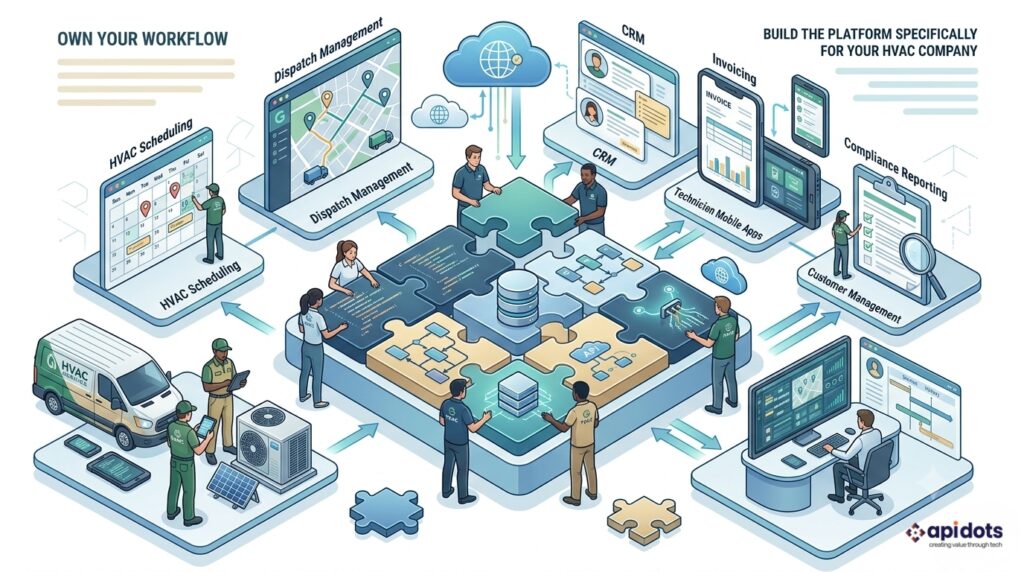
Custom HVAC software development is the process of building field service management software from scratch — specifically designed for one HVAC company’s exact workflows. Unlike off-the-shelf platforms, a custom system covers scheduling, HVAC dispatch software, CRM, invoicing, mobile technician apps, and compliance reporting in one integrated platform, built to connect with your existing systems and owned entirely by your business.
That definition matters because the word “custom” gets misused constantly in software sales. Custom does not mean a ServiceTitan account configured with your logo. “Custom” means your engineers build the database schema, your workflows define the navigation, and your compliance requirements shape the reporting—and you own 100% of the codebase when it’s done.
This is what API DOTS builds. Not tool configuration — actual software development, tailored from the ground up.
Off-the-shelf HVAC platforms work well for small operations getting started. After a certain scale, they become the ceiling rather than the foundation. Here’s where they consistently break down:
1. Rigid Workflows Built for the Average Company Service Titan is designed for the median HVAC business—which means it fits no specific HVAC business perfectly. A 3-technician plumbing-HVAC hybrid in Brisbane operates completely differently from a 120-technician commercial HVAC contractor in Dallas. Generic platforms force your operation into their workflow design, not the other way around.
2. Integration Walls Off-the-shelf platforms connect to a pre-approved list of software partners. They don’t connect to your specific QuickBooks configuration, your supplier’s proprietary inventory API, your building management client portal, or the legacy CRM your sales team refuses to abandon. Every integration gap becomes a manual data entry task — which is exactly the problem software is supposed to solve.
3. Licensing Cost That Scales Painfully, ServiceTitan’s pricing scales per technician. A 50-technician HVAC company in Toronto pays 50x what a solo operator pays. As companies grow from 20 to 80 technicians, annual SaaS costs routinely hit $40,000–$80,000 per year—with no equity, no ownership, and no customization. Custom software has a fixed development investment and zero recurring per-seat fees.
4. No Real AI Customization Pre-built AI features in commercial platforms are designed for average workflows and average data. Custom AI dispatch, built on your 18 months of historical job data and your specific technician skill matrix, performs at a fundamentally different level than a generic routing algorithm. The same applies to predictive maintenance, demand forecasting, and automated communications.
5. Zero Competitive Differentiation If you and your three closest competitors all run ServiceTitan, you operate identically from a technology standpoint. The dispatcher at your competitor makes the same decisions with the same information in the same interface. Custom software becomes a genuine operational moat — a capability your competitor can’t copy by signing up for a trial.
This is exactly the gap API DOTS’s custom HVAC software development services were built to fill.
Also Read: Custom Software Development for Business — What It Actually Costs
The following 12 features represent what separates a competitive HVAC operation from one that’s still managing dispatch on a whiteboard. Each one is more powerful in a custom-built system than in any off-the-shelf platform.
Custom AI dispatch matches each incoming job to the right technician based on skill certification, equipment specialization, current GPS location, active job queue, and prior service history with that specific customer — not just whoever is “available.” A Houston HVAC contractor managing 80 field technicians reduced average drive time per job by 31% after replacing manual dispatch with a custom AI routing system. Off-the-shelf dispatch is map-based. Custom dispatch is intelligence-based.
The difference in operational cost at 80 technicians—even a 20-minute drive reduction per job—adds up to $180,000+ in annual fuel and labor savings.
Also Read: Agentic AI vs AI Agents—What Actually Changes for Businesses
Live drag-and-drop scheduling with GPS-tracked technician locations, machine-learning-based job duration prediction, and automated conflict detection. When a job runs long, the system automatically flags downstream conflicts and suggests schedule adjustments — without the dispatcher manually rechecking every open slot.
A Phoenix HVAC company managing extreme summer demand spikes now pre-builds their technician schedule 72 hours in advance using AI-predicted call volume, based on weather forecast data and historical seasonal patterns. Emergency call capacity is reserved automatically.
Every customer record holds the complete service relationship: equipment make, model, and age; full service history; warranty and maintenance agreement status; access notes; communication log; and technician notes from every prior visit. When a technician arrives at a job, they know the property before they step out of the van.
A Melbourne residential HVAC company built customer retention of 73% year-over-year by using their custom CRM to trigger automated service reminders based on equipment age and the time since the last maintenance visit. The reminder campaign runs without any manual involvement.
Also Read: Custom CRM Software for Better Customer Relationships
Native iOS and Android apps — not mobile-browser wrappers that require a cell signal to function. Key features for field use: full offline mode with job sync on reconnect, digital job sheets with photo capture, parts lookup against live van inventory, customer e-signature collection, GPS time-in and time-out tracking, and next-job navigation.
London HVAC field engineers using a custom technician app reduced office admin hours by 60% — paperwork that previously got completed back at the depot at the end of the day now closes out in the field, the moment the job finishes.
Also Read: Mobile App Development for Businesses — A Complete Guide
Quote-to-invoice automation means: technician closes the job on their app → invoice generates automatically with parts and labor → payment link sends to the customer via SMS and email → payment processes → accounting sync completes. The dispatcher and office admin don’t touch it.
An Atlanta HVAC company reduced their invoice-to-payment cycle from 18 days to 3.2 days after deploying automated invoicing. At their revenue volume, that cycle compression freed up $340,000 in working capital that was previously sitting in outstanding invoices.
Automated scheduling, renewal reminder sequences, SLA tracking per contract, and profitability analysis per agreement type. When a maintenance agreement is within 90 days of expiry, the system automatically initiates a renewal outreach sequence — 90-day, 60-day, 30-day, and final-notice communications — with one-click renewal for the customer.
A Chicago commercial HVAC company managing 340 active maintenance agreements across multi-tenant high-rises was tracking every renewal in Google Sheets. They were missing 14% of renewal windows annually — revenue that was simply leaving through a process gap. Their custom maintenance management module closed that gap entirely in the first quarter of deployment.
Real-time van stock levels per technician, automatic reorder triggers when stock drops below threshold, supplier integration for live pricing, and parts cost tracking linked to each job for true job-level profitability analysis.
A Dallas HVAC contractor reduced parts-related job delays by 44% — situations where a technician arrived at a job without the required part — by building a custom inventory system that cross-references the scheduled job type against van stock levels the night before and flags gaps for next-morning parts collection.
Also Read: Smart AI Inventory Management — How It Works
IoT sensors on commercial HVAC equipment feed live operational data — temperature differentials, refrigerant pressure, compressor current draw, vibration signatures — into a machine learning model that identifies anomaly patterns before equipment fails. The service management system generates a preventive work order automatically.
A Singapore building manager received a 48-hour advance warning on an impending chiller unit failure through their custom predictive maintenance system. The controlled repair cost $12,000. The emergency replacement it avoided would have cost $85,000 — plus penalties under their building management SLA.
Customers book appointments; track job status in real time, access invoices and equipment records; and renew maintenance agreements—without calling your office. Built as a branded customer-facing web portal with login, not a generic third-party booking widget.
A Sydney HVAC company found that 38% of new residential bookings now come through their customer portal with zero office staff involvement. The portal handles the booking, confirms the slot, sends the technician ETA on the day, and collects payment after completion — a complete self-service transaction.
A single dashboard that shows performance across all locations: technician utilization per branch, revenue per location, cross-branch resource sharing when one area has overflow, and consolidated reporting for the owner or regional manager.
A Toronto HVAC franchise managing 6 Ontario locations was running separate ServiceTitan instances for each branch—meaning no visibility across locations and no ability to share technicians when demand was uneven. Their custom multi-location platform unified all six branches in one system.
EPA refrigerant tracking (Section 608), NYC Local Law 97 energy efficiency reporting, California Title 24 documentation, UK F-Gas Regulation logs — custom software generates these compliance reports automatically from job and equipment data, with no manual compilation.
A NYC commercial HVAC contractor was facing $45,000 in potential Local Law 97 penalties because their team was manually compiling energy efficiency data from job records — a process prone to gaps and errors. Automated compliance reporting eliminated the risk by generating audit-ready reports from operational data in real time.
Also Read: RPA vs Intelligent Automation Strategy 2026
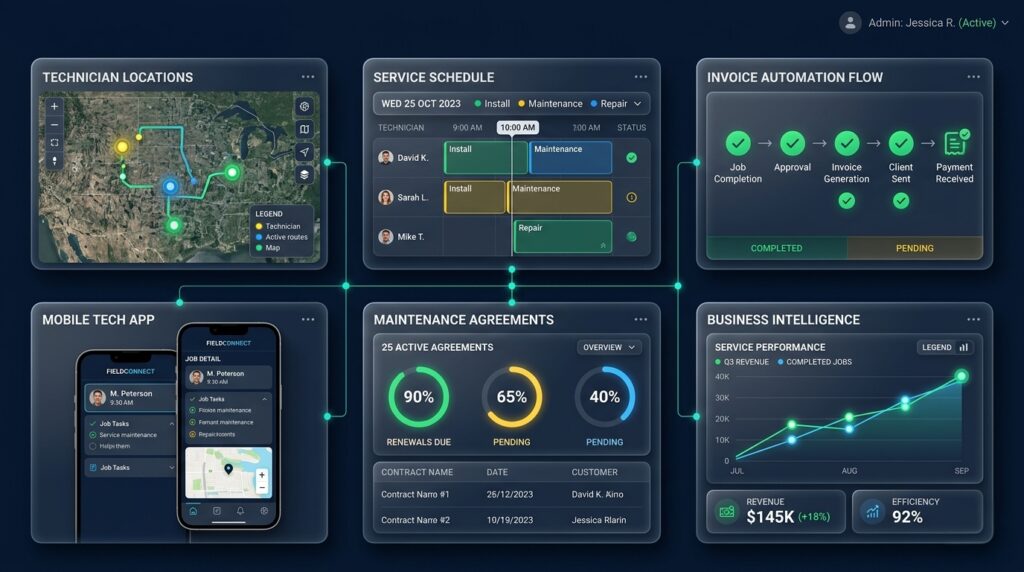
Real-time owner and manager dashboards showing the following: revenue per technician per week, job completion rate, first-time fix rate, customer acquisition cost by channel, maintenance agreement attach rate, seasonal demand trend lines, and branch-level P&L—all live, without a Monday morning report pull.
A Dubai property management company operating HVAC maintenance contracts across 12 commercial towers uses their custom BI dashboard to track SLA performance per building, flag contracts at risk of missing response time commitments, and report to property owners with a single export—work that previously required a 3-person reporting team.
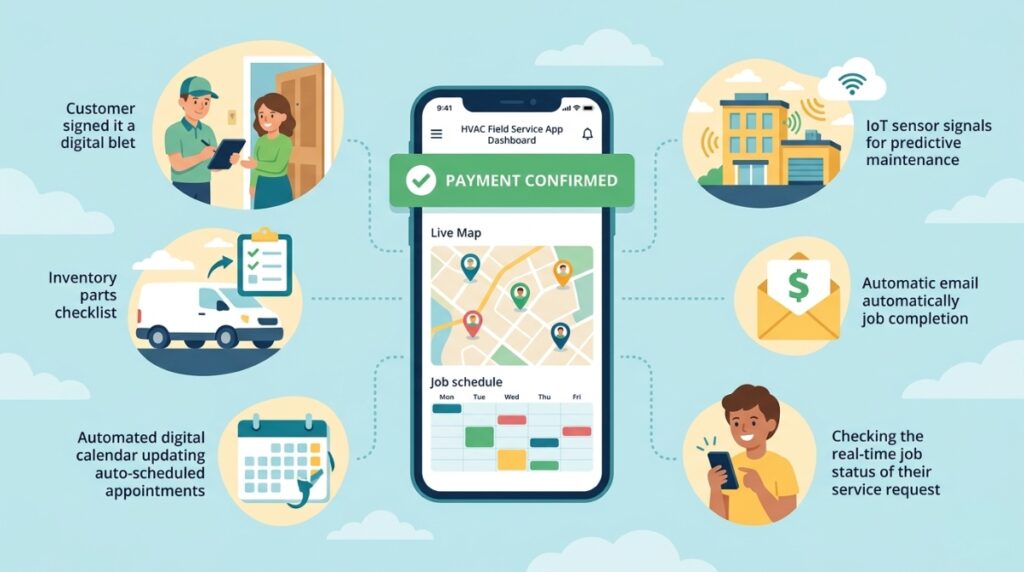
54% of HVAC software vendors introduced AI features between 2023 and 2025 — but most of those are bolt-on additions to existing platforms. The AI being built natively into custom HVAC software in 2026 is categorically more capable.
The next evolution of dispatch automation is AI agents that don’t wait for a dispatcher to review a suggestion — they act. An agentic dispatch system receives an inbound job request; assesses technician availability, skill match, and location, books the job, sends the technician notification, updates the customer with an ETA, and adjusts the day’s schedule for downstream jobs — all autonomously, in under 30 seconds.
This isn’t theoretical. The underlying technology (AI agents with tool-use capability) has matured to production-readiness in 2025. Custom HVAC software built now can include agentic dispatch from day one. Generic platforms are years away from offering this as a configurable feature.
Also Read: AI-Powered Software Solutions — What’s Actually Possible in 2026
There has been a 39% rise in predictive analytics integration in HVAC software, driven by commercial building owners who want to eliminate emergency equipment failures from their facilities management budget. IoT sensors on HVAC equipment have become inexpensive enough to deploy at scale — the value now comes from the software intelligence interpreting the data.
Custom HVAC software integrates IoT sensor feeds directly into the service management platform. When sensor data crosses a predictive failure threshold, a work order generates automatically, routes to the right technician, and schedules before the equipment fails. This capability requires custom development — it’s not available as a standard feature in any commercial platform.
AI-generated follow-up messages, seasonal outreach campaigns, post-service satisfaction requests, and maintenance renewal sequences are personalized per customer and sent automatically at the right time. The system knows that a customer with a 7-year-old Carrier unit in a high-humidity Florida ZIP code is a different message target than a commercial property manager in Calgary managing a building heating system.
Custom HVAC software integrates generative AI communication natively, trained on HVAC service context. This is not the same as connecting a generic AI tool to a CRM via API — those bolt-on integrations break constantly and require ongoing maintenance. Native integration delivers reliable personalization at zero marginal cost per message.
Technicians completing job notes, logging parts used, and updating job status by voice while their hands are inside an air handler unit. Custom mobile apps built with voice API integration allow field technicians to complete 80% of their administrative work without touching a screen.
This reduces documentation errors (notes completed in the moment rather than reconstructed from memory), speeds up job close-out, and removes the friction that causes technicians to skip detail fields in job records. Voice interfaces in HVAC apps require custom development — off-the-shelf platforms offer no customizable voice capabilities.
California AB 32, NYC Local Law 97, the UK’s Net Zero Buildings Standard, and Singapore’s BCA Green Mark certification all require HVAC operators to produce energy efficiency documentation. As these regulations tighten, the manual effort to compile compliance reports from job records is becoming untenable.
AI built into custom HVAC software auto-generates compliance documentation from operational data—refrigerant logs, equipment service records, and energy consumption data from IoT integration—and produces audit-ready reports on demand. This is not a feature available in standard HVAC platforms. It requires custom development by a team that understands both HVAC operations and compliance frameworks.
Demand for HVAC software in the USA was valued at $283.22 million in 2026, projected to reach $567.64 million by 2036 at a 7.2% CAGR, with California’s West region driving an 8.3% CAGR from data center cooling contracts and Title 24 compliance mandates (Future Market Insights). In New York City, Local Law 97 carbon emissions penalties—starting at $268 per metric ton of excess CO₂—are creating urgent demand for HVAC software with built-in compliance tracking that generic platforms can’t provide. Florida’s year-round residential and hospitality HVAC volume makes automated scheduling and seasonal surge management essential for any contractor managing more than 20 technicians across Miami, Orlando, or Tampa. In Nevada, Las Vegas casino and hospitality sector HVAC contracts require guaranteed uptime—24/7 monitoring and instant AI dispatch are non-negotiable requirements.
Also Read: Custom SaaS Development Florida—What Growing Companies Need to Know
Toronto-based commercial HVAC contractors managing maintenance agreements across 500+ commercial properties are hitting the limits of US-built platforms that don’t account for Canadian compliance reporting or multi-currency operation. In Calgary, Alberta, the extreme winter heating demand creates predictive maintenance requirements that off-the-shelf platforms can’t model for northern Canadian weather patterns. Vancouver’s green building standards under BC Energy Step Code are driving demand for HVAC software with native energy performance tracking.
London commercial building HVAC contractors are managing F-Gas regulation documentation requirements under UK law, engineering Gas Safe certification tracking, and building energy certificate compliance—none of which is handled adequately by US-built HVAC platforms. In Edinburgh, NHS hospital HVAC maintenance contracts require uptime SLA tracking and scheduled preventive maintenance documentation that a custom-built system handles with no manual intervention.
Also Read: SaaS Development Company London — What UK Businesses Should Expect
Sydney’s commercial and residential HVAC growth is driving adoption of customer self-service portals—contractors who offer online booking and job tracking are winning residential accounts at significantly higher rates than those running phone-only operations. Brisbane’s high-humidity climate creates year-round residential demand, and HVAC companies there are using automated seasonal outreach systems to pre-book maintenance before peak cooling season rather than managing the reactive surge.
Dubai’s property management companies are managing HVAC maintenance contracts across portfolios of high-rise residential and commercial towers — a scale that requires multi-building service management and SLA performance tracking that no US-built platform handles adequately. In Riyadh, Saudi Arabia’s Vision 2030 smart building programs are driving HVAC software adoption at the government-building level, with IoT monitoring integration becoming a standard contract requirement.
Singapore’s government-mandated BCA Green Mark certification program requires HVAC energy performance documentation that must be produced on a building-by-building basis — a custom software requirement that off-the-shelf platforms from the US and UK weren’t designed to address. In India, Bangalore and Mumbai’s commercial construction boom is creating demand for custom HVAC service management software that delivers the capabilities of ServiceTitan at a price point accessible to rapidly growing mid-market HVAC operators.
Also Read: Offshore Software Development Company — How to Choose the Right Partner
The decision between custom development and an off-the-shelf platform comes down to scale, operational complexity, and how long you plan to be in business. Here’s the honest comparison:
| Factor | Off-the-Shelf (ServiceTitan, Jobber) | Custom HVAC Software (API DOTS) |
|---|---|---|
| Built for your workflow | No—built for average HVAC company | Yes—designed around your exact operation |
| Integration flexibility | Limited to approved partner integrations | Integrates with any system, API, or database |
| Upfront cost | Low ($0–$500/mo per user) | Medium-high (one-time development investment) |
| Long-term cost | High—scales with headcount and per-seat fees | Low—no per-seat fees, you own the software |
| AI customization | Pre-built generic AI features | Custom AI trained on your data and workflows |
| Compliance reporting | Generic templates | Built for your specific regional regulations |
| Competitive advantage | Zero — competitors use same platform | High — software becomes your operational moat |
| Scalability | Limited by vendor roadmap | Unlimited — you control development priorities |
| Mobile app | Mobile-responsive web browser | Native iOS + Android with offline mode |
| Codebase ownership | Vendor-owned, you rent access | You own 100% of the codebase |
Who should start with off-the-shelf: Solo operators and small teams under 10 technicians who need to get operational quickly. ServiceTitan and Jobber are excellent tools at this scale.
Who should move to custom: Companies hitting 20–30 technicians where per-seat licensing starts exceeding a development investment, operations with complex multi-location needs, and any HVAC business in a compliance-heavy market — NYC, California, UAE, Singapore, UK — where generic reporting simply doesn’t meet the requirements.
For multi-location franchise operators, enterprise commercial HVAC contractors, or any business with unique workflow requirements: custom is the only answer that scales without becoming a liability.
A residential and light-commercial HVAC contractor operating across Florida, Georgia, and South Carolina. 68 technicians. 3 dispatch coordinators. Over 1,100 active maintenance agreement customers. Their tech stack: ServiceTitan for scheduling, QuickBooks for invoicing, a separate CRM for customer communication, and a Google Sheets tracker for maintenance agreement renewals. Four disconnected systems.
The data fragmentation was costing them in ways they hadn’t fully quantified until they mapped it out:
Six months of Zapier automations between ServiceTitan and the CRM — which worked partially until a ServiceTitan interface update broke three of the five zaps. They hired a part-time data coordinator to manage the sync. The coordinator helped with the daily transfer but couldn’t solve the maintenance agreement renewal problem. They were still losing $15,000+ per month in lapsed contracts.
A single custom platform developed to replace all four systems:
| Phase | Timeline | Activity |
|---|---|---|
| Discovery & Architecture | Weeks 1–4 | Workflow mapping, database design, integration planning |
| Core Platform Development | Weeks 5–14 | Scheduling, dispatch, CRM, invoicing modules |
| Mobile App Development | Weeks 10–18 | iOS + Android technician app with offline sync |
| Integration & Data Migration | Weeks 18–22 | QuickBooks sync, legacy data migration, full UAT |
| Go-Live & Optimization | Weeks 23–26 | Phased rollout, staff training, performance monitoring |
| Metric | Before | After | Change |
|---|---|---|---|
| Annual SaaS licensing cost | $47,000/year | $0/year recurring | Eliminated |
| Maintenance contract revenue recovered | — | $163,000 | Revenue recovered |
| Dispatch coordination hours/day | 3.5 hours | 0.8 hours | ↓ 77% |
| Monday report generation | 4 hours manual | Instant (live dashboard) | ↓ 100% |
| Invoice-to-payment cycle | 21 days average | 4.1 days average | ↓ 80% |
| First-time fix rate | 71% | 84% | ↑ 13 percentage points |
| Full ROI on development investment | — | Month 8 | — |
The 2.7 dispatch coordinator hours freed per day were redeployed to outbound customer success calls — re-engaging dormant customers and upselling maintenance agreements. Within the first quarter post-launch, that activity generated $47,000 in new maintenance contract revenue.
The lesson from this project: “The four-platform problem is not a technology problem — it’s a data problem. When your customer data, job data, and financial data live in four separate systems, your business makes decisions on incomplete information every single day.”
Every day your dispatch, CRM, and invoicing systems operate in silos, you’re losing revenue through missed renewals, manual errors, and reporting blind spots — exactly like the company in this case study.
API DOTS builds a single custom system around your exact operation. No per-seat fees. No integration workarounds. No generic workflows.
Book a Free HVAC Software Discovery Call → 60 minutes. We map your current workflow, identify every gap, and show you what a custom system would look like for your business.
Step 1: Discovery and Workflow Audit The HVAC business owner walks API DOTS through every operational process — from how inbound calls are handled to how invoices are reconciled at month end. Every system currently in use gets documented: what data it holds, what it connects to, and where the manual handoffs happen. This stage defines the integration requirements, compliance reporting needs, and the exact features the custom system must cover. Output: a complete process map and technical specification.
Step 2: Architecture and UX Design The development team designs the system architecture, database schema, and user interface before writing a line of code. Dispatchers, technicians, and the owner each get their own UX flow designed around how they actually work. The HVAC business owner reviews and approves wireframes and the technical architecture before development starts — no surprises mid-build.
Step 3: Core Platform Development Scheduling, dispatch, CRM, and invoicing modules are built in parallel development teams, with weekly client demo calls showing working software — not slide decks. The owner and dispatch team test each module as it’s built, catching workflow gaps before they become technical debt.
Step 4: Mobile App Development The iOS and Android technician apps are built alongside the web platform, sharing the same API layer. Offline functionality is tested in low-connectivity field conditions — not just in the office on WiFi. Technician UAT happens in real job scenarios before the app goes to production.
Step 5: Integration, Testing, and Data Migration Every historical customer record, job record, equipment record, and maintenance agreement gets migrated from the legacy systems before go-live. The full UAT phase involves real dispatchers running real scheduling scenarios and real technicians completing test jobs on the mobile app. Known-issue resolution happens before the live date, not after.
Step 6: Launch, Training, and Ongoing Support Phased rollout by team: dispatch first, then field technicians, then management reporting. Training is role-specific — dispatchers don’t sit through technician app training, and technicians don’t sit through reporting walkthroughs. Post-launch monitoring covers system performance, exception logs, and user adoption for the first 90 days.
Learn everything that goes into a complete custom build at our HVAC software development page.
Also Read: AI/ML Development Services — What Enterprise Builds Actually Involve
This is the question HVAC business owners Google at 11pm before deciding whether to call a developer. Here’s the honest answer:
Development Cost Ranges:
| Scope | Features Included | Cost Range | Timeline |
|---|---|---|---|
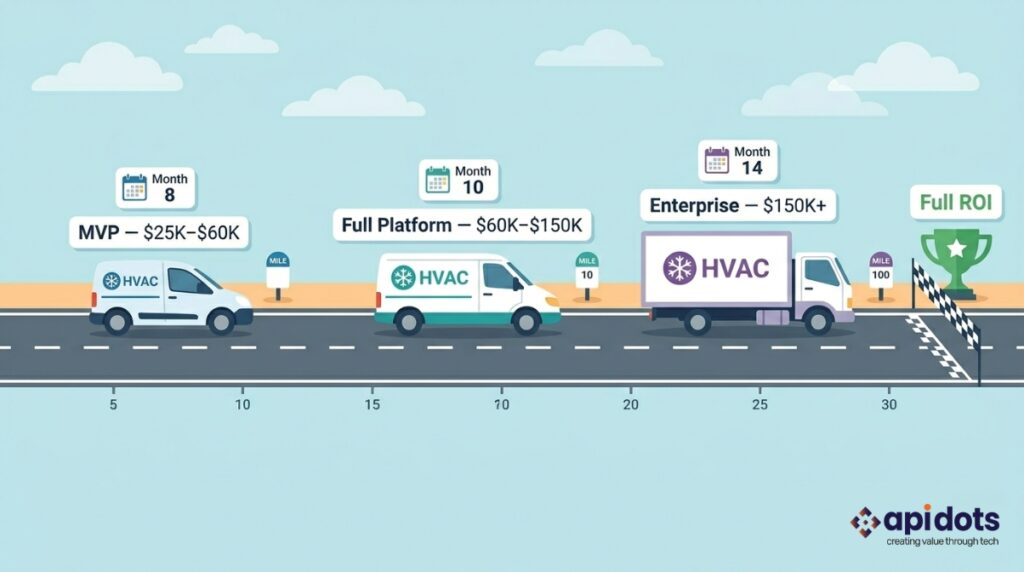
| MVP / Core System | Scheduling + dispatch + basic CRM | $25,000–$60,000 | 16–20 weeks |
| Full Platform | All 12 features including mobile app + AI | $60,000–$150,000 | 24–32 weeks |
| Enterprise Multi-Location | Multi-branch + compliance + BI dashboard + AI | $150,000–$350,000+ | 32–48 weeks |
ROI Drivers (what pays back the investment):
Typical ROI timeline: 8–14 months for a 30–80 technician HVAC operation. The case study above achieved full ROI at month 8 — driven primarily by $163,000 in recovered maintenance revenue and $47,000 in eliminated licensing costs in the first year.
Also Read: AI Software Development Cost 2026 — A Realistic Guide
Q1: What is custom HVAC software development?
Custom HVAC software development is the process of building field service management software specifically designed for one HVAC company’s exact workflows — scheduling, dispatch, CRM, invoicing, mobile technician apps, and compliance reporting — from scratch, not from an off-the-shelf platform. Unlike ServiceTitan or Jobber, custom software integrates with your existing systems, reflects your specific operations, and is owned entirely by your business with no recurring per-seat licensing fees.
Q2: How much does it cost to build custom HVAC software?
Custom HVAC software development costs between $25,000 and $150,000 depending on scope. A core MVP covering scheduling, dispatch, and basic CRM runs $25,000–$60,000 in 16–20 weeks. A full platform with AI dispatch, native mobile apps, maintenance agreement management, and compliance reporting runs $60,000–$150,000 over 24–32 weeks. Most HVAC companies with 30+ technicians recover this investment within 8–14 months through eliminated SaaS fees, recovered maintenance contract revenue, and dispatch efficiency.
Q3: How long does it take to build custom HVAC software?
A custom HVAC software build takes 16–32 weeks from discovery to go-live depending on scope. A basic scheduling and dispatch system goes live in 16–20 weeks. A full-featured platform with native mobile apps, AI features, and legacy system data migration takes 24–32 weeks. API DOTS builds the web platform and mobile apps in parallel teams to compress timelines, with weekly demo calls showing real working software throughout.
Q4: Is custom HVAC software better than ServiceTitan or Jobber?
Custom HVAC software outperforms ServiceTitan or Jobber for companies with more than 20 technicians, multi-location operations, compliance-heavy markets (NYC, California, UAE, Singapore), or workflows that generic platforms can’t accommodate. For solo operators, off-the-shelf is the faster start. The inflection point is typically 20–30 technicians, where per-seat licensing costs begin to exceed a custom development investment — at which point custom becomes both better and cheaper over a 3-year horizon.
Q5: Can custom HVAC software integrate with QuickBooks and existing tools?
Yes — custom HVAC software built by API DOTS integrates with QuickBooks, any accounting platform, existing CRM systems, supplier inventory portals, building management systems, and IoT sensor platforms. Unlike off-the-shelf tools that connect only to pre-approved partners, custom software integrates with any system that has an API or database access. This eliminates the manual data transfer between disconnected platforms that costs HVAC businesses thousands of staff hours annually.
Q6: What AI features can be built into custom HVAC software?
Custom HVAC software can include AI-powered dispatch (matching technicians to jobs based on skill, location, and customer history), predictive maintenance (IoT sensor integration with machine learning failure prediction), generative AI customer communications (automated follow-ups, renewal sequences, seasonal outreach), demand forecasting (predicting high-volume periods for proactive scheduling), and compliance AI (auto-generating NYC LL97, California Title 24, or Singapore BCA reports from operational data). None of these are available as genuinely custom features in standard off-the-shelf platforms.
The global HVAC service software market is set to reach $6.5 billion by 2035 at a 17.3% CAGR — and the companies capturing that growth are not running the same tools as their competitors. They’re building operational systems that their competitors can’t replicate by signing up for a trial. That’s the strategic value of custom development.
Custom HVAC software is not just a technology investment. It’s the infrastructure that makes AI dispatch possible, that closes maintenance agreement revenue gaps automatically, that meets compliance requirements in NYC, California, Dubai, and Singapore without a dedicated compliance team, and that gives your technicians a field experience that reflects how they actually work — not how a platform designer imagined they might. The digital transformation opportunity in HVAC operations is significant. The companies acting on it now are building moats.
API DOTS builds custom HVAC software for companies across the US, Canada, UK, Australia, UAE, and Asia-Pacific. Not tool configuration — actual software development, built around your workflows, owned by you, with no ongoing per-seat fees. Whether you’re at 20 technicians outgrowing Jobber, or 150 technicians running a fragmented stack of three platforms, the starting point is a single conversation. Explore API DOTS HVAC solutions and see what a system built specifically for your operation looks like.
Whether you’re managing 15 technicians in Atlanta, 80 technicians across Dallas and Houston, 6 franchise locations in Ontario, or a commercial HVAC portfolio in Dubai — if your current software is slowing you down, the answer isn’t a different off-the-shelf platform.
The answer is software built for your operation.
Book a Free HVAC Software Strategy Call with API DOTS →
No commitment. No sales pitch. Just a clear picture of what custom software could do for your HVAC business — and exactly how we’d build it.
We leverage AI, cloud, and next-gen technologies strategically.Helping businesses stay competitive in evolving markets.
Consult Technology Experts
I’m a digital marketer with experience in SEO, content strategy, and online brand growth. I specialize in creating optimized content, improving website rankings, building high-quality backlinks, and driving traffic through effective digital marketing strategies. I enjoy helping businesses strengthen their online presence and turn visitors into customers.