
Top
Search
People also search for:

Stay Inspired with Instagram




There has been a surge of interest in Vibe Coding, a technique that lets you use plain language to describe your project to an AI, which then automatically generates the code. Andrej Karpathy coined the term “vibe coding” in 2025 and stated that it allows developers to fully embrace their “vibe” and relax because AI can be expected to convert their requests into working applications.
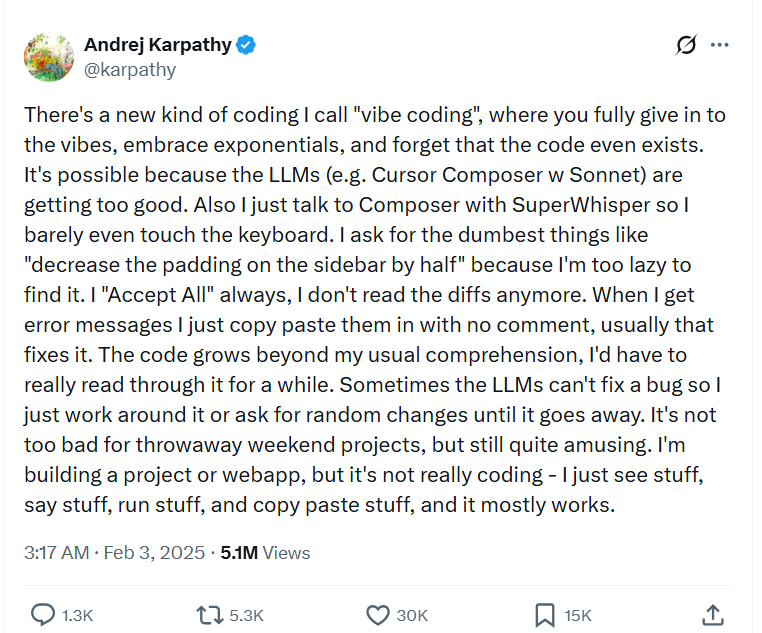
With Vibe Coding, product managers and experts can speak to AI in everyday language and have the AI create software in real-time instead of writing the code line by line (like a traditional programmer).
While Vibe Coding certainly provides an easier method to create software, it has also created potential problems associated with inconsistent quality of code created using Vibe Coding, security issues, and a lack of governance surrounding the use of Vibe Coding. Many organizations began to implement Vibe Coding as a form of entry-level programming at the end of 2025. By late 2025, many teams began to view vibe coding as an entry point rather than a full development practice
Traditional AI coding tools, such as GitHub Copilot, suggest code snippets while you type. Vibe coding flips that relationship: you start with natural-language goals, and the AI generates entire modules, from UI to backend.
The human’s role shifts from controlling syntax to steering the AI through feedback, corrections and high-level direction. Karpathy’s phrase captures the intuitive, flow-state experience of co-creating with AI rather than meticulously specifying each detail.
| Criteria | Vibe Coding | Traditional Coding |
| Starting point | Conversation describing goals & “vibes”; AI generates full application | Developers write code; AI tools suggest completions or boilerplate |
| Human role | Guides AI with iterative feedback; focuses on outcomes | Writes and edits code directly; uses AI to accelerate manual work |
| Suitable for | Rapid prototyping and exploratory apps | Production code when combined with disciplined engineering practices |
| Risks | Hallucinations, hidden vulnerabilities, unpredictable outputs | Traditional risks (bugs, mis-specifications) but easier to debug due to explicit logic |
Enterprise teams can experiment with vibe coding, but experts warn that governance is essential. In Anaconda’s survey of more than 300 AI practitioners, only 34% of organizations had formal policies and tools for AI-assisted coding.
Teams that embedded security checks and red-team agents into their AI workflows reported a 40% drop in monthly bug tickets and avoided critical exploits. Developers at Chronosphere and other companies still treat AI outputs as suggestions requiring thorough code review.
The general advice: use vibe coding as a creative accelerator, but pair it with standard reviews, test coverage, and compliance checks.
Vibe coding is a method of rapidly coding any idea through rapid iterations.
According to Pramata’s Vice President, Achint Agarwal,
“Vibe Coding creates a compressed feedback loop. In the past, prototyping would involve weeks of working between the code and designers & engineers to get to the finished product. Now, once a product manager describes what they want the experience to be, they can get back to working on code in minutes. “Iterate in a fluid manner. You can simply describe the changes, and the AI will generate the updated code for you. Using Vibe Coding makes it easier for the product manager to take risks with their roadmaps and quickly validate their ideas prior to going to full-blown builds.”
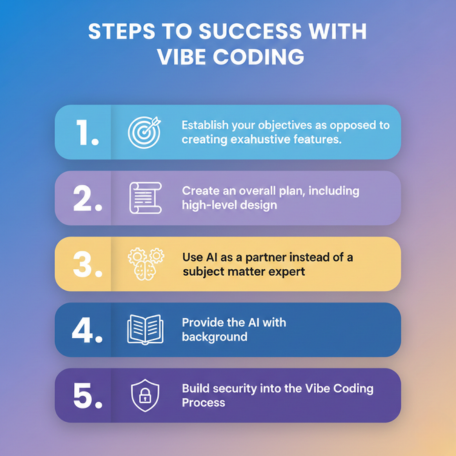
1. Establish your objectives as opposed to creating exhaustive features; explain the type of user experience you’re seeking to create and what business issue you’re trying to solve
2. Create an overall plan, including high-level design: Just because vibe coding is a fast method of coding doesn’t mean you shouldn’t be developing architecture; therefore, develop your specifications and framework prior to using it.
3. Use AI as a partner instead of a subject matter expert; be sure to review your outputs, question the rationale and avoid relying on the AI-generated code.
4. Provide the AI with background and examples: If you use a proven framework to test your AI code, you can use the AI to test your solution.
5. Build security into the Vibe Coding Process; be sure to implement code reviews and testing before you deploy your AI-generated code.
Case studies show that vibe coding can introduce vulnerabilities. A marketing team at Cycode built an AI ROI calculator with Vibe coding. Their own security platform found SQL injection and cross-site scripting issues in the generated code.
Another company discovered that 55 % of function blocks generated by large models had security holes. Experts emphasize tracking lineage, running automated quality checks, and auditing prompt histories to maintain control.
Tools range from simple builders to fully integrated development environments. Cursor and Replit blend AI assistance with multi-file editing. Bolt and Lovable help beginners go from idea to prototype without code. Developers comfortable with IDEs can explore Windsurf or Zed. Regardless of the tool, security reviews and compliance layers remain critical.
Recent surveys paint a nuanced picture of vibe coding’s adoption:
Bubble’s 2025 study of 793 builders found that 71.5 % feel confident using visual development (drag-and-drop plus AI) for mission-critical apps, while only 32.5 % feel confident with vibe coding. Just 9 % deploy vibe coding in production, versus 65.2 % relying on visual development. More than 72 % worry about security vulnerabilities in Vibe-coding platforms.
The same survey shows 86.7 % would recommend visual development to new entrepreneurs, compared with 51.4 % for vibe coding. Builders saved between $10K and $250K annually by using visual development tools and reduced their need to hire engineers.
Fastly’s July 2025 survey of 791 developers found that about 32 % of senior developers (10+ years of experience) said over half their shipped code was AI-generated, compared with 13 % of juniors. While 59 % of seniors feel AI helps them ship faster, only 49 % of juniors agree. Notably, 28 % of developers frequently fix AI code enough to negate time savings.
A randomized controlled trial by METR reported that developers took 19 % longer to complete complex tasks when using AI coding tools, despite expecting a 24 % speed-up.
The statistics indicate that vibe coding appears to have a lot of future potential, but it frequently clashes with the reality of inexperienced developers and production-quality code.
The newly formed discipline of context engineering arose as a response to the limitations of vibe coding. Context engineers are no longer creating clever prompts; they are now curating relevant data, memory, and tools and providing the AI model with the context to produce consistent results.
According to Gartner, context engineering refers to “designing and managing the right Data, workflows, and environment so that an AI system can produce accurate, enterprise-aligned results.” Industry data indicates that over 40% of AI project failures stem from poor or irrelevant context inputs.
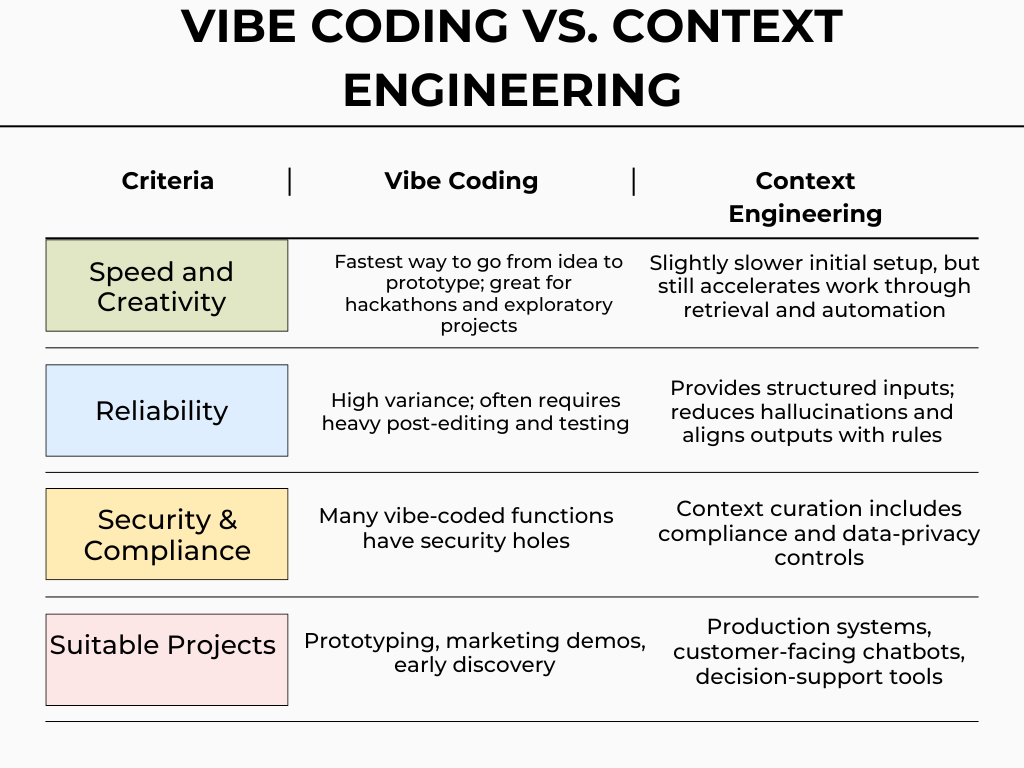
Context engineering involves:
Real-world case studies illustrate its impact. A telecommunication chatbot that integrated conversation history, customer databases, and dynamic instructions achieved higher customer satisfaction and fewer escalations than models lacking such context. According to Typedef’s report, Sprinklr observed 50 % accuracy improvements and 60 % lower compute costs through targeted context optimization.
With context engineering, the AI becomes a reliable collaborator, not just a speculative code generator. It reduces hallucinations, improves reasoning, and ensures outputs align with business requirements. Organizations are beginning to assign dedicated context engineers to manage AI data pipelines and memory systems.
Verdict: If your goal is to quickly validate an idea or produce a demo, vibe coding offers unmatched speed. For critical systems that require security, reliability, and maintainability, context engineering is emerging as the better choice. Many teams will combine both: vibe coding for early exploration and context-engineered workflows for production.
The journey from vibe coding to context engineering marks a broader maturation of AI-assisted software development. Early hype around natural-language coding showcased the power of large language models but also exposed real risks. Updated surveys reveal that while developers enjoy using AI tools, productivity gains are not guaranteed, and security remains a top concern.Context engineering addresses these challenges by providing AI systems with the structured, relevant information they need to act reliably. As vector databases, retrieval pipelines, and memory frameworks evolve, AI coding will become less about “vibes” and more about designing the right context. Teams that invest in these practices now will be positioned to build smarter, safer, and more maintainable software as we move into 2026 and beyond.
We leverage AI, cloud, and next-gen technologies strategically.Helping businesses stay competitive in evolving markets.
Consult Technology Experts
Hi! I’m Aminah Rafaqat, a technical writer, content designer, and editor with an academic background in English Language and Literature. Thanks for taking a moment to get to know me. My work focuses on making complex information clear and accessible for B2B audiences. I’ve written extensively across several industries, including AI, SaaS, e-commerce, digital marketing, fintech, and health & fitness , with AI as the area I explore most deeply. With a foundation in linguistic precision and analytical reading, I bring a blend of technical understanding and strong language skills to every project. Over the years, I’ve collaborated with organizations across different regions, including teams here in the UAE, to create documentation that’s structured, accurate, and genuinely useful. I specialize in technical writing, content design, editing, and producing clear communication across digital and print platforms. At the core of my approach is a simple belief: when information is easy to understand, everything else becomes easier.