SQL databases remain highly relevant — distributed SQL and AI-powered query optimisation are actively extending their capabilities.
NoSQL platforms now natively support vector search and direct ML pipeline integrations at production scale.
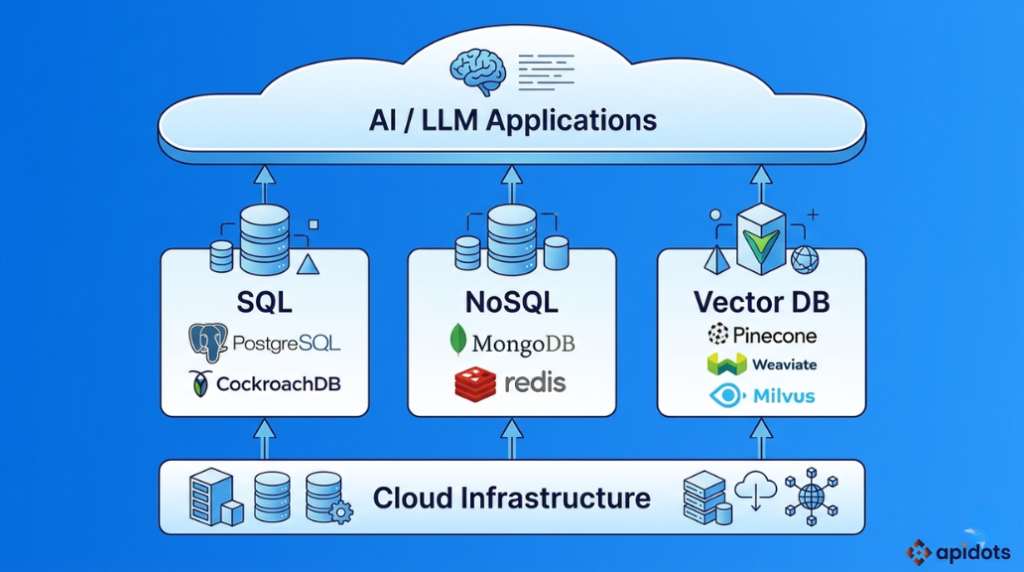
Vector databases (Pinecone, Weaviate, Milvus) are emerging as essential infrastructure for LLM and semantic AI applications.
Most modern AI products will adopt a polyglot approach — combining SQL, NoSQL, and vector databases.
Gartner (2024) projects over 40% of AI-driven apps will rely on vector search by 2026, up from less than 5% today.
The real question is no longer SQL vs NoSQL — it is which combination best serves your specific AI workflow.
Introduction
The debate between SQL (relational) and NoSQL (non-relational) databases is not new—but AI and machine learning are rewriting the rules. The next generation of applications must handle the following:
Structured + unstructured data at massive scale
Real-time analytics and low-latency inference
Semantic search powered by embeddings and vector data
Automated optimization via AI-driven systems
Choosing the right database is no longer just about scalability vs consistency—it’s about building an AI-ready architecture that can evolve for years to come.
This blog takes an in-depth look at how SQL and NoSQL are adapting, the emergence of hybrid and vector databases, and which technologies are likely to dominate the data layer of future applications.
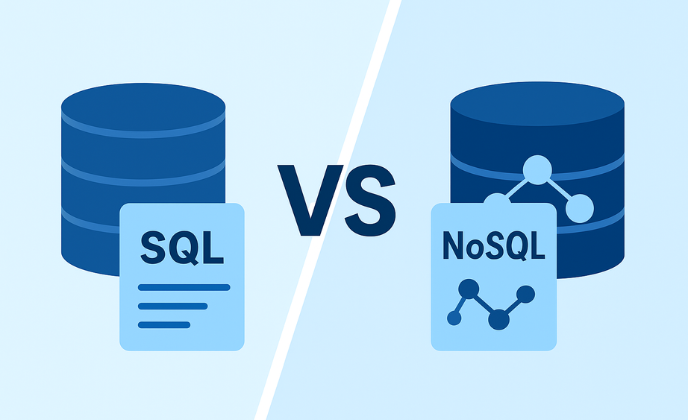
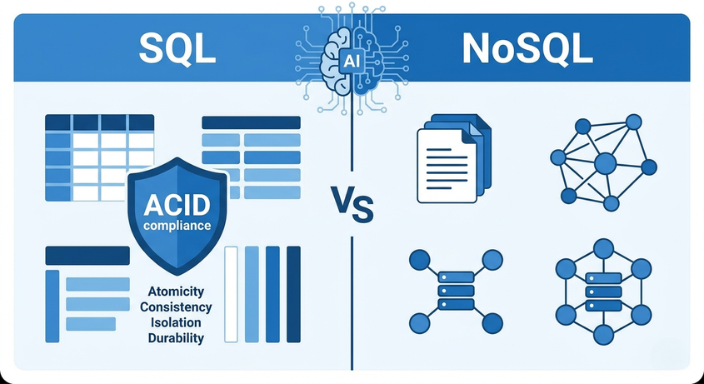
SQL vs NoSQL: The Traditional Divide
1. SQL Databases (Relational)
Examples: MySQL, PostgreSQL, Oracle, Microsoft SQL Server
Key Strengths:
Strict schema and consistency (ACID compliance)
Mature tooling and query languages (SQL)
Ideal for financial, transactional, and structured workloads
Weaknesses:
Scaling horizontally is challenging
Less suited for rapidly changing data models or unstructured data
2. NoSQL Databases (Non-Relational)
Examples: MongoDB, Cassandra, Redis, DynamoDB
Key Strengths:
Flexible schema and rapid development
Easy horizontal scaling (distributed by design)
Optimized for unstructured or semi-structured data
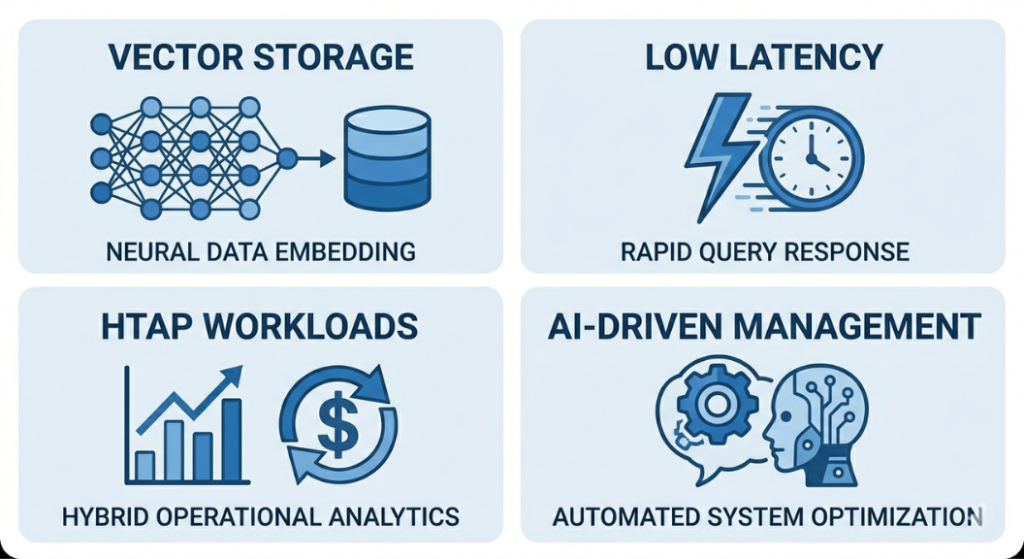
Artificial intelligence is data-hungry. Training large language models (LLMs), running real-time inference, and powering AI-driven products demand a different type of database performance profile:
Unstructured + vectorized data storage
Text, images, audio, and embeddings cannot be efficiently stored in traditional rows and columns.
Vector databases (e.g., Pinecone, Weaviate, Milvus) are purpose-built for semantic search and similarity queries.
Low-latency reads and writes
AI applications need millisecond responses to support real-time recommendations, personalization, and chatbots.
Systems like Redis or DynamoDB are favored for caching and high-throughput workloads.
Hybrid workloads (OLTP + OLAP)
AI systems mix transactional data (user interactions) with analytical workloads (feature generation, model retraining).
According to Gartner’s data and analytics research, by 2025, 70% of new applications will use Hybrid Transactional/Analytical Processing (HTAP) — a direct response to the demands of AI workloads.
Self-optimizing and AI-driven databases
AI is now being used to automate index tuning, query optimization, and anomaly detection.
Vendors like Oracle and Microsoft are already marketing “autonomous databases” that reduce manual intervention.
Building an AI-Native Application? APIDOTS helps product teams architect scalable, AI-ready data layers — from selecting the right database stack to full-scale implementation. Explore our AI & ML Development Services →
Key Industry Statistics and Trends
Vector databases are surging. According to Gartner (2024), over 40% of AI-driven apps will rely on vector search by 2026, up from less than 5% today.
Multi-model databases are gaining traction. DB-Engines rankings show MongoDB and PostgreSQL are among the fastest-growing platforms because they combine structured + semi-structured support.
Distributed SQL is growing. Platforms like CockroachDB and YugabyteDB are addressing SQL scalability, competing directly with NoSQL’s historical advantage.
AI-assisted query generation is becoming mainstream. Tools like OpenAI Codex and Google Cloud’s AI tools are allowing developers to write database queries in natural language.
Native JSON support in databases like PostgreSQL and MySQL allows them to store semi-structured data.
AI-powered query optimization is reducing human effort in tuning databases.
HTAP capabilities—PostgreSQL extensions and cloud-native offerings like Google Spanner—combine transactional consistency with real-time analytics.
In short, SQL databases are becoming more flexible without abandoning their consistency guarantees. For teams already running SQL infrastructure, a full migration may be unnecessary — the platform is rapidly catching up to AI demands. If you are evaluating how to integrate intelligence into your stack, explore APIDOTS AI & ML development services for architecture guidance.
NoSQL in the Age of AI: Rising but Evolving
NoSQL platforms have always been AI-friendly because they handle massive, schema-less datasets. But now they’re going beyond just documents and key-values.
Native vector support: MongoDB Atlas Search, Redis with RedisVector modules
Automatic sharding + replication: Scaling to billions of operations with minimal config
Integration with ML pipelines: Direct connectors to TensorFlow, PyTorch, LangChain, etc.
Notably, NoSQL systems are also adding SQL-like features—multi-document transactions, advanced indexing, and more standardized query languages. This points to convergence rather than a permanent divide between the two paradigms. For a practical look at how this plays out in product development, see how AI integration is reshaping SaaS companies.
The Rise of Vector and Hybrid Databases
The new frontier is databases built specifically for AI/LLM workloads:
Vector Databases: Pinecone, Weaviate, Milvus—store embeddings to power semantic search, recommendation engines, and contextual LLM applications.
Hybrid Databases: ArangoDB, FaunaDB, and Couchbase combine relational, document, and graph models in one engine.
Distributed + Multi-model SQL: CockroachDB and YugabyteDB are bridging SQL performance with NoSQL scalability.
This evolution suggests the SQL vs NoSQL debate is becoming less binary—developers are increasingly using polyglot persistence, choosing the right database for each component of the system.
What the Future Looks Like
1. Convergence Is Inevitable
SQL databases will get better at unstructured data.
NoSQL databases will improve transactional consistency.
2. AI-Driven Database Management
Expect self-healing and self-optimizing databases, using AI to handle indexing, partitioning, and anomaly detection automatically.
3. The Shift to Polyglot Persistence
Most AI applications will use multiple databases:
SQL for structured transactional data
NoSQL or vector DB for unstructured embeddings and semantic search
In-memory caches like Redis for real-time responses
4. LLMs as Database Interfaces
Natural language to SQL/NoSQL queries will become standard.
ChatGPT-style assistants will act as data engineers, automatically writing queries and integrating with pipelines.
Practical Advice: Which Database Should You Choose?
There is no single right answer — it depends on your use case, data model, and AI roadmap. Use this quick-reference guide to orient your decision:
Use Case
Recommended Stack
Examples
Finance / ERP / Healthcare
SQL or Distributed SQL
PostgreSQL, CockroachDB
AI products (chatbots, search, RAG)
NoSQL or Vector DB
MongoDB, Pinecone, Weaviate
Real-time caching / sessions
In-memory DB
Redis, DynamoDB
Complex AI with mixed workloads
Polyglot: SQL + NoSQL + Vector
PostgreSQL + MongoDB + Pinecone
If you need all of the above — and most AI-native products eventually will — a polyglot approach is the answer. Orchestrate SQL, NoSQL, and vector databases in the cloud, connecting them through a well-designed data layer and API abstraction. As your platform scales, data security and compliance in SaaS become equally critical to get right from the start.
Conclusion
The question “SQL vs NoSQL” is evolving into “How can SQL and NoSQL coexist in an AI-powered architecture?”
SQL isn’t going anywhere—it’s becoming more scalable and AI-assisted.
NoSQL is growing rapidly—especially with vector support and cloud-native scale.
Hybrid and AI-driven databases will power the next generation of intelligent applications.
By 2026 and beyond, developers won’t just ask “Which database should I pick?”—they’ll ask “Which combination of databases best supports my AI workflow?”
Ready to Architect Your AI Data Layer?ApiDots builds production-ready AI and data infrastructure for startups and enterprises — from database architecture design to full-stack implementation. Get in touch with our team →
We Build With Emerging Technologies to Keep You Ahead
We leverage AI, cloud, and next-gen technologies strategically.Helping businesses stay competitive in evolving markets.
Hi! I’m Aminah Rafaqat, a technical writer, content designer, and editor with an academic background in English Language and Literature. Thanks for taking a moment to get to know me.
My work focuses on making complex information clear and accessible for B2B audiences. I’ve written extensively across several industries, including AI, SaaS, e-commerce, digital marketing, fintech, and health & fitness , with AI as the area I explore most deeply. With a foundation in linguistic precision and analytical reading, I bring a blend of technical understanding and strong language skills to every project.
Over the years, I’ve collaborated with organizations across different regions, including teams here in the UAE, to create documentation that’s structured, accurate, and genuinely useful. I specialize in technical writing, content design, editing, and producing clear communication across digital and print platforms.
At the core of my approach is a simple belief: when information is easy to understand, everything else becomes easier.





Hi! I’m Aminah Rafaqat, a technical writer, content designer, and editor with an academic background in English Language and Literature. Thanks for taking a moment to get to know me. My work focuses on making complex information clear and accessible for B2B audiences. I’ve written extensively across several industries, including AI, SaaS, e-commerce, digital marketing, fintech, and health & fitness , with AI as the area I explore most deeply. With a foundation in linguistic precision and analytical reading, I bring a blend of technical understanding and strong language skills to every project. Over the years, I’ve collaborated with organizations across different regions, including teams here in the UAE, to create documentation that’s structured, accurate, and genuinely useful. I specialize in technical writing, content design, editing, and producing clear communication across digital and print platforms. At the core of my approach is a simple belief: when information is easy to understand, everything else becomes easier.